

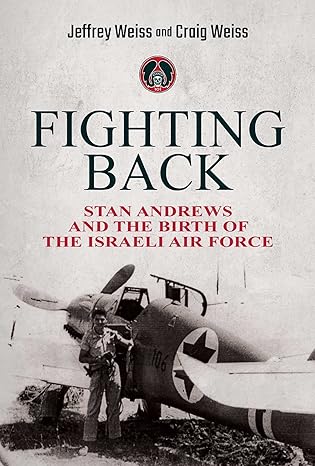
Fighting Back: Stan Andrews and the Birth of the Israeli Air Force by Jeffrey Weiss and Craig Weiss
Fighting Back: Stan Andrews and the Birth of the Israeli Air Force by Jeffrey Weiss and Craig Weiss is a deeply researched, highly readable work of narrative nonfiction that feels as propulsive as a war novel.
The book follows one young American pilot from a crowded New York apartment to the skies over the Pacific and then into the cockpit of the first fighter squadrons in Israel’s War of Independence.
Stan Andrews begins life as Stan Anekstein, the son of Jewish immigrants in the Bronx. He loves drawing. He loves movies. He wants a wider life than the one he sees on his block. The authors show how this restless kid becomes a gifted pilot in the US Army Air Corps, flying more than forty combat missions in the Pacific during World War II. Those early chapters move with clear momentum. We see Stan at college, at flight school, then in the chaos of wartime missions that demand skill, nerve and luck in equal measure.
After the war, Stan tries to step into a new role. He attends UCLA, studies writing, picks up screenwriting dreams and circles Hollywood’s orbit. He dates, debates and tries to leave his Jewishness in the background. Casual slurs and quiet exclusions chip away at that idea. The book, Fighting Back: Stan Andrews and the Birth of the Israeli Air Force, does not rush this shift. It spends time with Stan in classrooms, coffee shops and parties where small remarks and closed doors start to matter more than he wants to admit. The result feels grounded and human. Readers see how prejudice in 1940s America can push an assimilated young man to reconsider who he is and where he belongs.
As news of the Holocaust and the struggle over Palestine grows more pressing, Stan’s life tilts again. Friends talk about a Jewish state fighting for survival. Volunteers whisper about flying for the Haganah. The authors make this recruiting effort vivid. There are late-night conversations, coded phone calls and the sense that ordinary days in Los Angeles no longer match the stakes of the moment. Stan finally decides that his flying skills matter more in a war zone than in a lecture hall.
From California Classrooms to Czech Airfields
One of the most gripping sections of the book covers Stan’s secret route into combat. The journey takes him from the United States to Europe and then into Czechoslovakia, where a small group of foreign volunteers train on rebuilt Messerschmitts behind barbed wire and political tension. The training sequences feel tense and technical. Engines stall. Equipment falters. No one fully trusts the local authorities. At the same time, camaraderie grows between the volunteers, many of them American WWII veterans who thought their combat days had ended.
Weiss and Weiss excel at placing readers inside the cockpit without drowning them in jargon. They explain how a fighter responds when it drops low over a target. They describe the feel of a long takeoff roll on a rough runway. They give just enough detail so a general reader can follow the action and understand the risk. Fans of aviation history will appreciate the care, but even readers with no background in military flying will follow the flow.
From there, Stan boards a smuggling flight into the new Jewish state. The landing at an Israeli airfield at night, with the runway lights snapping on for only a few seconds, delivers one of the book’s most cinematic scenes. The cargo bay holds weapons that the young state desperately needs. Volunteers rush to unload crates while the pilots blink into the warm Mediterranean air. In a few pages, the story shifts from secret training in Europe to a very real war in the Middle East.
Inside the First Fighter Squadrons of a New Nation
Once Stan reaches Israel, the book widens its frame. Readers meet other pilots in the nascent Israeli Air Force and see how few planes, spare parts and trained crews the new country has. On May 14, 1948, Israel does not own a single combat-ready aircraft. Only months later, through a frantic mix of foreign purchases, refurbished planes and volunteer pilots, the air force begins to change the course of the war. The authors balance big-picture military history with intimate character work. They show command decisions in Tel Aviv and, in the next page, shift to a crowded tent where pilots joke, argue and wait for the next scramble.
Stan joins the famed 101 Squadron, a tight-knit unit of fighter pilots who wear red baseball caps and cultivate an image that feels part college fraternity and part elite commando team. The authors highlight small, memorable details, such as the skull-and-wings logo that Stan designs and that later reappears on modern Israeli jets. These touches draw a clear line from the fragile early days of the air force to its present strength without breaking the flow of the story.
Combat chapters in Israel echo the tempo of Stan’s WWII missions yet carry a different weight. This time, the stakes involve the survival of a tiny state surrounded by hostile armies. The book traces initial failures, painful losses and rapid learning. Raids on Egyptian airfields, dogfights with more established Arab air forces and risky bombing runs over the Negev come alive with brisk, focused prose. The authors do not overdramatize. The facts, casualty lists and improvised tactics speak for themselves.
A Biography That Reads Like a Mystery
Readers who enjoy biographies that double as historical investigations will find a lot to admire here. The authors spent years interviewing veterans, combing through archives and tracking scattered reports. That work pays off in later chapters that follow the search for Stan’s fate after he disappears during a mission. Official reports conflict. Witness accounts shift. Families wait for news that never quite arrives.
The book’s prologue, set in the 1990s near the Israeli town of Ashkelon, shows workers uncovering aircraft wreckage on a sandy hill children once called “Airplane Hill.” This discovery frames the emotional arc of the book. Early scenes of kids playing among dunes rise again in the reader’s mind when the story circles back to the crash investigation. The authors handle this part of the narrative with restraint. They give readers enough detail to understand what likely happened but never treat Stan’s death as a plot twist. It remains a loss, felt by family, fellow pilots and, by that point, the reader.
Along the way, Fighting Back raises questions about loyalty, identity and the bonds between American Jews and Israel. Stan begins as a young man who wants art, romance and a foothold in the American dream. He ends as a symbol of a different kind of commitment. The book traces that shift in clear steps so the transformation feels earned. Readers see every stage of his path, from his discomfort with religious labels to his decision to risk his life for a Jewish state that did not exist when he was born.
Style, Scope and Reading Experience
The writing style stays straightforward and steady. Chapters are short. Scene breaks are clean. Military terms appear, but the authors explain them in context so the story never bogs down. Quotes from letters and contemporary reports bring in other voices. That mix helps the book avoid a dry, textbook feel. Instead, the narrative feels like a long conversation with two careful storytellers who know this era well.
Another strength lies in the book’s range. The authors place Stan’s life against the wider sweep of twentieth-century Jewish history. They touch on European Zionism, American anti-Semitism in the 1930s and 1940s and the politics of the British Mandate in Palestine. They bring in figures like David Ben-Gurion and Theodor Herzl, yet they always return to the young pilot at the center of the story. Readers who enjoy learning through one person’s experience will appreciate that focus.
Later material, in the updated edition, links Stan’s era to more recent events in the Middle East. The authors draw a line from fragile runways in 1948 to modern F-35 strikes and joint American–Israeli operations against Iranian targets. Those sections underline how quickly a small, improvised air arm turned into one of the world’s most advanced forces. The book does not turn into a policy tract, though. It remains, above all, the story of one man and the people around him.
Who Will Enjoy “Fighting Back”
Fighting Back will appeal to readers who love World War II history, aviation stories and biographies that bring lesser-known figures to the foreground. It will speak to readers interested in the early years of the State of Israel and the origins of its military strength. Book clubs that favor narrative nonfiction will find much to discuss here, from questions about personal duty to debates over risk, sacrifice and identity.
Those who prefer character-driven stories will connect with Stan’s charm, flaws and steady growth. He is not presented as a perfect hero. He drinks, jokes, doubts and sometimes makes reckless choices. That honesty makes his final decisions more powerful. By the time he climbs into his last aircraft, readers understand exactly what he stands for and what he has chosen to leave behind.
In the end, this book offers more than a single wartime biography. It offers a window into the fragile first months of a state that now plays a central role on the world stage. Through Stan Andrews, readers feel the strain, fear and exhilaration of that moment. They see how the actions of one determined pilot and his fellow volunteers, helped shape an air force that remains central to Israel’s security today. For history fans and general readers alike, Fighting Back delivers a moving, engaging account that lingers in the mind long after the last page.
 Jeff Weiss is the co-author of I Am My Brother’s Keeper (Schiffer Military History, 1998), which tells the story of American and Canadian volunteers in all branches of the Israel Defense Forces during the 1948 War of Independence. He is fluent in Hebrew, having completed a year of law school at Bar Ilan University. He is featured in the 2014 Nancy Spielberg documentary “Above and Beyond” and in the 2000 documentary “Israel’s Forgotten Heroes,” narrated by Hal Linden. In addition to a law degree, he holds Master’s degrees in International Law (Georgetown University Law Center) and in Biotechnology (Johns Hopkins University) and has been writing on Middle East security issues for more than 20 years. He is passionate about fitness and is a two-time Ironman and ultramarathoner.
 Craig Weiss is a Venture-Capitalist, serial entrepreneur and published author. Craig is the Managing Member of Flagstaff Ventures, a Venture Capital firm focused on early-stage consumer products and services. He is also the Co-Founder & CEO of venture-backed Retainer Club & Mouthguard Club. Craig has founded or co-founded half a dozen companies. During his three and half years as President & CEO of NJOY, Inc. he led the company to a $1B valuation.
Before becoming an entrepreneur, Craig Weiss was a patent attorney, where he focused on the drafting and prosecution of patent applications for medical device, e-commerce and business method inventions. An inventor, Craig Weiss has 14 patents to his own name, including five for medical devices.
A published author, Craig co-authored I Am My Brother’s Keeper, which features a foreword from Prime Minister of Israel Benjamin Netanyahu. The book is also the subject of the Nancy Spielberg produced documentary, “Above & Beyond,” in which Craig appears as one of the historians. Craig’s newest book, “Fighting Back” was published on May 17, 2022.
Craig is a frequent speaker at A.S.U’s W.P. Carey School of Business and has also spoken numerous times Harvard Business School.
A lifelong resident of Arizona, Craig lives in Paradise Valley with his wife, two children and six dogs.
Publish Date: May 17, 2022
Genre: Historical, Nonfiction
Author: Jeffrey Weiss and Craig Weiss
Page Count: 278 pages
Publisher: Wicked Son
ISBN: 9781637583111