

Close Menu
New York Examiner News

    Subscribe to Updates

    Get the latest creative news from FooBar about art, design and business.

    What's Hot

    Fontaines D.C.’s Grian Chatten on why he wore Cwmbran Celtic FC Mogwai shirt at Reading 2026

    September 2, 2026

    Despite being a multimillionaire, Suze Orman says eating out is one of the biggest wastes of money

    September 2, 2026

    Colin Kaepernick Reemerges and Tries to Cash in on Playing the Victim * The Gateway Pundit * by Brooklynn Robinson, The Western Journal

    September 2, 2026
    Facebook X (Twitter) Instagram
    New York Examiner News
    • Home
    • US News
    • Politics
    • Business
    • Science
    • Technology
    • Lifestyle
    • Music
    • Television
    • Film
    • Books
    • Contact
      • About
      • Amazon Disclaimer
      • DMCA / Copyrights Disclaimer
      • Terms and Conditions
      • Privacy Policy
    New York Examiner News
    Home»Science»Colon cancer is killing more young people in the U.S. than any other cancer
    Science

    Colon cancer is killing more young people in the U.S. than any other cancer

    By AdminJanuary 23, 2026
    Facebook Twitter Pinterest LinkedIn WhatsApp Email Reddit Telegram
    Colon cancer is killing more young people in the U.S. than any other cancer


    Most types of cancer have become less deadly over time in adults younger than age 50 in the U.S. but colon and rectum cancers continue to cost lives at alarming rates, according to a new report from the American Cancer Society. The data show that colorectal cancer has officially become the number one cause of cancer-related deaths among young people.

    The report analyzed annual U.S. mortality rates from 1990 to 2023 for the top five deadliest cancers for men and women younger than 50 years old—an age group that researchers have been tracking to understand early-onset cancer risk. Encouragingly, cancer mortality overall in the age group decreased by 44 percent. But rates of colorectal cancer among younger people have been steadily increasing in recent decades, and the disease has leaped from the fifth leading cause of cancer deaths in 1990 to the first in 2023.

    “It is an inflection point,” says William Dahut, chief scientific officer at the American Cancer Society. “This is the first time it’s number one for cancer deaths overall for those under the age of 50.”


    On supporting science journalism

    If you’re enjoying this article, consider supporting our award-winning journalism by subscribing. By purchasing a subscription you are helping to ensure the future of impactful stories about the discoveries and ideas shaping our world today.
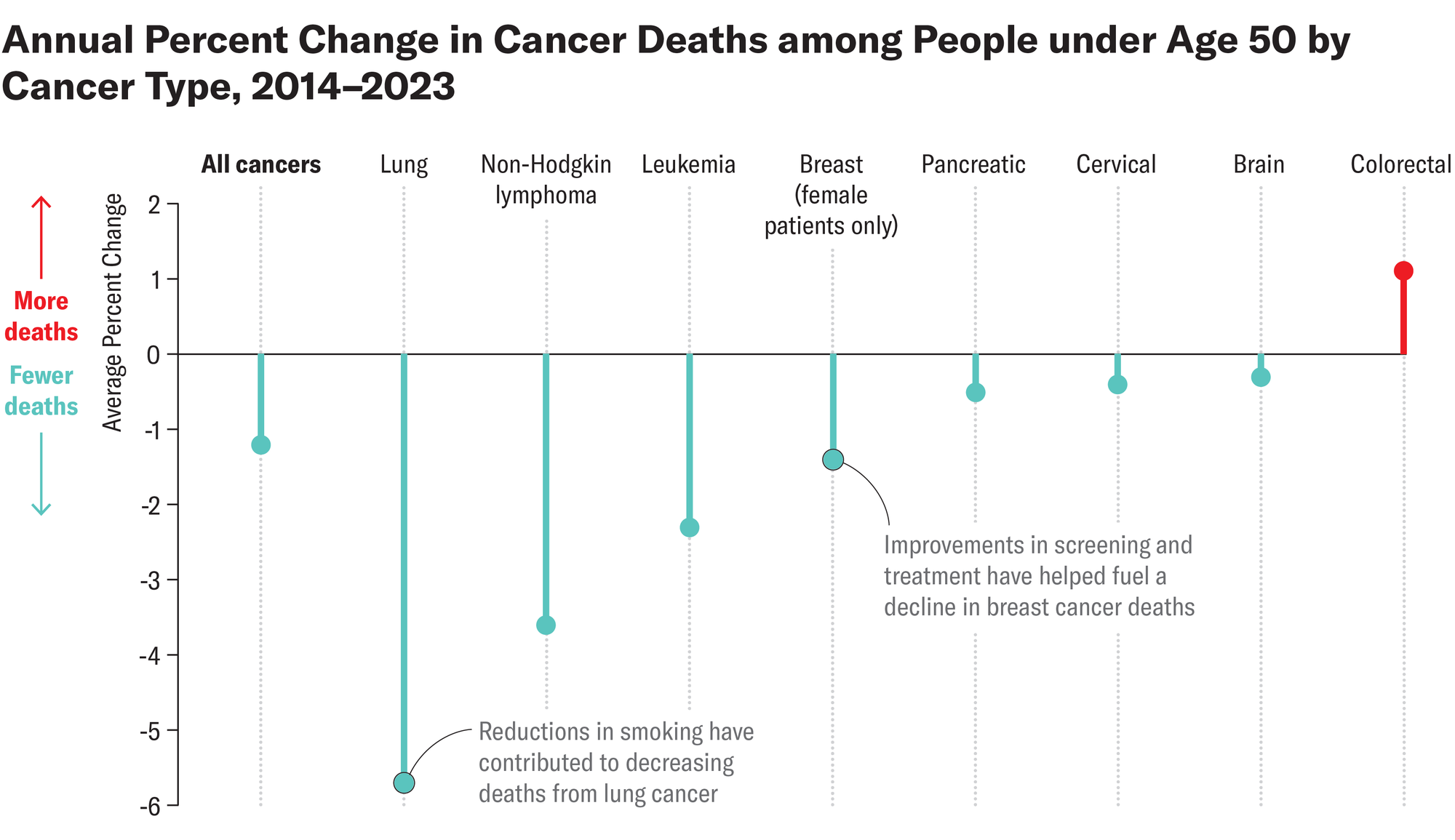

    Lollipop chart shows annual percent change in cancer deaths among people under age 50 by cancer type from 2014 to 2023.

    Amanda Montañez; Source: “Leading Cancer Deaths in People Younger Than 50 Years,” by Rebecca L. Siegel et al., in JAMA. Published online January 22, 2026 (data)

    Deaths from all other leading cancers, including breast, lung and pancreatic cancers, have declined—which Dahut largely attributes to improvements in therapies. “I think this is another important statement that our investment as a nation in science to develop better treatments is paying off in our young adults,” he says.

    In contrast with these positive trends, the colorectal cancer mortality rate has been the only one that has worsened. The findings show it is the leading cause of cancer deaths among men and the second for women after breast cancer—and that it has become the leading cause of cancer deaths for the population overall. Many of the cancers in the study, including colorectal cancer, are typically seen later in life, in people’s 60s and 70s, says Jeff Meyerhardt, a gastrointestinal oncologist and co-director of the Colon and Rectal Cancer Center at Dana-Farber Cancer Institute.

    “They’re considered cancers of aging,” he says. “At least in the case of colorectal cancer, the age [of onset] was set for quite a while, until more recently.”

    Since the 1990s, colorectal cancer cases in people under age 50 have steadily climbed by about 2 percent annually. And the majority of cases are diagnosed at later stages, when they are more difficult to treat.

    “About three fourths, maybe 60 to 70 percent, of the time, people [under age 50] have more advanced disease,” says Andrea Cercek, founder and co-director of the Center for Young Onset Colorectal and Gastrointestinal Cancer at Memorial Sloan Kettering Cancer Center. Despite advances in colorectal cancer treatment, the survival rate for advanced stages of the disease is still low, she says. “This is, unfortunately, what I expected to see,” Cercek says of the new data.

    Late diagnosis is one likely factor driving more severe and deadly cases. In the U.S., screening for colorectal cancer—typically using the gold standard, a colonoscopy—is recommended to begin at age 45 for most people without a genetic or family history of the condition. That age recommendation was lowered from 50 just a few years ago in response to the growing incidence rates in younger age groups. Younger individuals with colorectal cancer may not seek medical attention for symptoms such as bleeding in stools, difficult bowel movements, bloating or signs of anemia, all of which can sometimes be confused with other health issues. And doctors may not consider screening such individuals for colorectal cancer because their age puts them at lower risk, Meyerhardt says.

    But some researchers think there is more going on beyond delayed diagnosis.

    It usually takes years for a colorectal polyp, or small growth, to develop into a cancerous tumor, Dahut says. Scientists are trying to understand when, exactly, tumor growth begins and how rapidly it spreads if the cancer is happening at much younger ages than it did in the past. Cercek says data show the steepest rise in cases has occurred among 20- to 30-year-olds.

    “If you think about the typical process for, let’s say, a 22-year-old, the polyp would have had to start, literally, when they were 10,” she says. That’s plausible but difficult to detect without screening people at a very young age. There could also be difference in the progression of the tumors themselves, Cercek says. “We’re very interested to see if there is something about the process that might be more accelerated, that might be different,” she adds.

    Scientists are investigating multiple possible explanations for the trend, including diet, exercise, lifestyle, genetics, environmental factors—even microplastics and antibiotics. But many researchers agree there is no single cause. Narrowing in on credible factors will hopefully lead to more targeted screening for younger people at high risk of the disease, without increasing false positives or unnecessary surgeries or colonoscopies, Meyerhardt says. Cercek adds that improving therapies so they are less toxic to patients, as well as providing emotional and social support during recovery, will be crucial as the number of younger people who face colorectal cancer continues to rise.

    “What’s happening ‘big picture’ is alarming. But it’s super important to acknowledge that survivorship for a young adult with colorectal cancer is life-changing. It’s incredibly difficult and can be incredibly taxing from an emotional, physical and financial standpoint,” she says. “The more that we can diagnose early, the better it will be for our patients.”

    And perhaps such improvements in treatment and detection will eventually bring colorectal cancer survival in line with that of other cancers.


    Original Source Link

    Share. Facebook Twitter Pinterest LinkedIn WhatsApp Email Reddit Telegram
    Previous ArticleH is for Hawk review – occasionally falters, but…
    Next Article Former Sequoia partner’s new startup uses AI to negotiate your calendar for you

    RELATED POSTS

    A Prop 65 Crash Course: What You Need to Know (2026)

    September 2, 2026

    House passes stopgap bill that pauses changes to federal science grant-making process

    September 2, 2026

    Inside the Perimenopause Industrial Complex

    September 1, 2026

    What’s next for NASA’s new Roman Space Telescope?

    September 1, 2026

    Why Food Keeps Making Everybody Sick This Summer

    August 31, 2026

    NASA’s Nancy Grace Roman Telescope launches to space

    August 31, 2026
    latest posts

    Fontaines D.C.’s Grian Chatten on why he wore Cwmbran Celtic FC Mogwai shirt at Reading 2026

    Fontaines D.C.’s Grian Chatten has revealed why he wore the shirt of Cwmbran Celtic football…

    Despite being a multimillionaire, Suze Orman says eating out is one of the biggest wastes of money

    September 2, 2026

    Colin Kaepernick Reemerges and Tries to Cash in on Playing the Victim * The Gateway Pundit * by Brooklynn Robinson, The Western Journal

    September 2, 2026

    College hockey player has ‘zero chance of recovery’ after collapsing during offseason workout, lawyer says

    September 2, 2026

    Wonderful more than doubles its valuation to $5B in under 6 months

    September 2, 2026

    A Prop 65 Crash Course: What You Need to Know (2026)

    September 2, 2026

    An A-List DC Hero Just Got Their Most Radical Redesign in 55 Years

    September 2, 2026
    Categories
    • Books (1,466)
    • Business (6,369)
    • Events (71)
    • Film (6,304)
    • Lifestyle (4,378)
    • Music (6,431)
    • Politics (6,354)
    • Science (5,721)
    • Technology (6,302)
    • Television (5,992)
    • Uncategorized (9)
    • US News (6,357)
    popular posts

    ‘Ordinary People’ Cinematographer, Academy President Was 81 – The Hollywood Reporter

    John Bailey, the cinematographer on Ordinary People, Groundhog Day, As Good as It Gets and…

    Slack Discloses Breach of Its Github Code Repository

    January 8, 2023

    Animal Kingdom Recap: Season 6, Episode 3 — Pressure and Time

    June 27, 2022

    Did Tesla’s Robotaxi Launch Backfire?

    July 22, 2025
    Archives
    Browse By Category
    • Books (1,466)
    • Business (6,369)
    • Events (71)
    • Film (6,304)
    • Lifestyle (4,378)
    • Music (6,431)
    • Politics (6,354)
    • Science (5,721)
    • Technology (6,302)
    • Television (5,992)
    • Uncategorized (9)
    • US News (6,357)
    About Us

    We are a creativity led international team with a digital soul. Our work is a custom built by the storytellers and strategists with a flair for exploiting the latest advancements in media and technology.

    Most of all, we stand behind our ideas and believe in creativity as the most powerful force in business.

    What makes us Different

    We care. We collaborate. We do great work. And we do it with a smile, because we’re pretty damn excited to do what we do. If you would like details on what else we can do visit out Contact page.

    Our Picks

    A Prop 65 Crash Course: What You Need to Know (2026)

    September 2, 2026

    An A-List DC Hero Just Got Their Most Radical Redesign in 55 Years

    September 2, 2026

    Jonathan Stoddard Teases Season 2 Twists & Possible Romance

    September 2, 2026
    © 2026 New York Examiner News. All rights reserved. All articles, images, product names, logos, and brands are property of their respective owners. All company, product and service names used in this website are for identification purposes only. Use of these names, logos, and brands does not imply endorsement unless specified. By using this site, you agree to the Terms & Conditions and Privacy Policy.

    Type above and press Enter to search. Press Esc to cancel.

    We use cookies on our website to give you the most relevant experience by remembering your preferences and repeat visits. By clicking “Accept All”, you consent to the use of ALL the cookies. However, you may visit "Cookie Settings" to provide a controlled consent.
    Cookie SettingsAccept All
    Manage consent

    Privacy Overview

    This website uses cookies to improve your experience while you navigate through the website. Out of these, the cookies that are categorized as necessary are stored on your browser as they are essential for the working of basic functionalities of the website. We also use third-party cookies that help us analyze and understand how you use this website. These cookies will be stored in your browser only with your consent. You also have the option to opt-out of these cookies. But opting out of some of these cookies may affect your browsing experience.
    Necessary
    Always Enabled
    Necessary cookies are absolutely essential for the website to function properly. These cookies ensure basic functionalities and security features of the website, anonymously.
    CookieDurationDescription
    cookielawinfo-checkbox-analytics11 monthsThis cookie is set by GDPR Cookie Consent plugin. The cookie is used to store the user consent for the cookies in the category "Analytics".
    cookielawinfo-checkbox-functional11 monthsThe cookie is set by GDPR cookie consent to record the user consent for the cookies in the category "Functional".
    cookielawinfo-checkbox-necessary11 monthsThis cookie is set by GDPR Cookie Consent plugin. The cookies is used to store the user consent for the cookies in the category "Necessary".
    cookielawinfo-checkbox-others11 monthsThis cookie is set by GDPR Cookie Consent plugin. The cookie is used to store the user consent for the cookies in the category "Other.
    cookielawinfo-checkbox-performance11 monthsThis cookie is set by GDPR Cookie Consent plugin. The cookie is used to store the user consent for the cookies in the category "Performance".
    viewed_cookie_policy11 monthsThe cookie is set by the GDPR Cookie Consent plugin and is used to store whether or not user has consented to the use of cookies. It does not store any personal data.
    Functional
    Functional cookies help to perform certain functionalities like sharing the content of the website on social media platforms, collect feedbacks, and other third-party features.
    Performance
    Performance cookies are used to understand and analyze the key performance indexes of the website which helps in delivering a better user experience for the visitors.
    Analytics
    Analytical cookies are used to understand how visitors interact with the website. These cookies help provide information on metrics the number of visitors, bounce rate, traffic source, etc.
    Advertisement
    Advertisement cookies are used to provide visitors with relevant ads and marketing campaigns. These cookies track visitors across websites and collect information to provide customized ads.
    Others
    Other uncategorized cookies are those that are being analyzed and have not been classified into a category as yet.
    SAVE & ACCEPT