

Lee Billings: This is the picture we’ve all been waiting for the deepest image of the cosmos ever captured. Humanity has never seen so far back and so clearly into the depths of the universe’s history. The multitudes of nameless galaxies you see here emitted their light more than 13 billion years ago, mere cosmic moments after the Big Bang. This one image and the countless others that come has been the result of more than two decades of focused efforts by some of the world’s greatest scientists and engineers.
From concept to construction and testing, from launch to deployment and commissioning the frigid depths of space from opening its new eyes on the cosmos to gathering and processing the data to ensure it sees more clearly than ever before.
Heidi Hammel: Thirty years from now, when we look back at the most amazing science from Webb, half of it’s going to be what we plan to do, but half of it’s going to be some really fascinating science that we haven’t even yet thought of.
Gregory Robinson: Those are just the first images. Think about the many years of images and other things we’re going to learn with this telescope about potentially habitable planets. We’re going to learn a lot of that over time, not just the first images.
And I just I can’t get my head around what it might be.
Billings: Our time machine is the James Webb Space Telescope, or JWST, one of a kind observatory built to unveil how the universe first began to shine and much, much more.
Hammel: The first year of Webb’s science is going to be very exciting. The programs that we have been planning for 20 years, most of them will be executed during this first year–to see the first light in the universe, the first galaxies that formed. We will probe the atmospheres of planets around other stars. We will get our first look at the surface chemistry of objects in our solar system that are just too faint for our current telescopes to see.
The science is going to flow and it will be amazing.
Billings: It’s the largest, most ambitious space telescope ever made. And promises to produce some of the most incredible discoveries of our lifetime and beyond.
Matt Mountain: The Big Bang happened 13.8 billion years ago. And then the Hubble sees back to roughly 13.5 billion years. But they see all these galaxies.
How did you go from nothing to galaxies? Something must have happened, but we can’t see into that period. It’s designed to peer into a part of the universe we have never seen before–the so-called dark ages, when everything must have happened, when the first galaxies came to existence, the first stars came into life, the first black holes appeared.
Ken Sembach: Over time, as the space time continuum stretched with the expansion of the universe, the light itself was stretched. As that light has crossed the universe, it’s gotten redder and it’s been on its way for 13 and a half billion years.
Mountain: Which is why it had to be infrared, because it had to push beyond what the Hubble Space Telescope could see.
Hammel: Traditional telescopes have mirrors and lenses and things, and they’re encased in tubes. The tubes radiate warmth. Any structure you have is, by nature, warm. Just because sunlight falling on it warms it up.
Mountain: If it’s warm, it gives off its own heat. Well, for an infrared telescope, we have to sort of switch off that light of the telescope. And we do that by cooling it all the way down to this -380 degrees Fahrenheit. So the telescope vanishes.
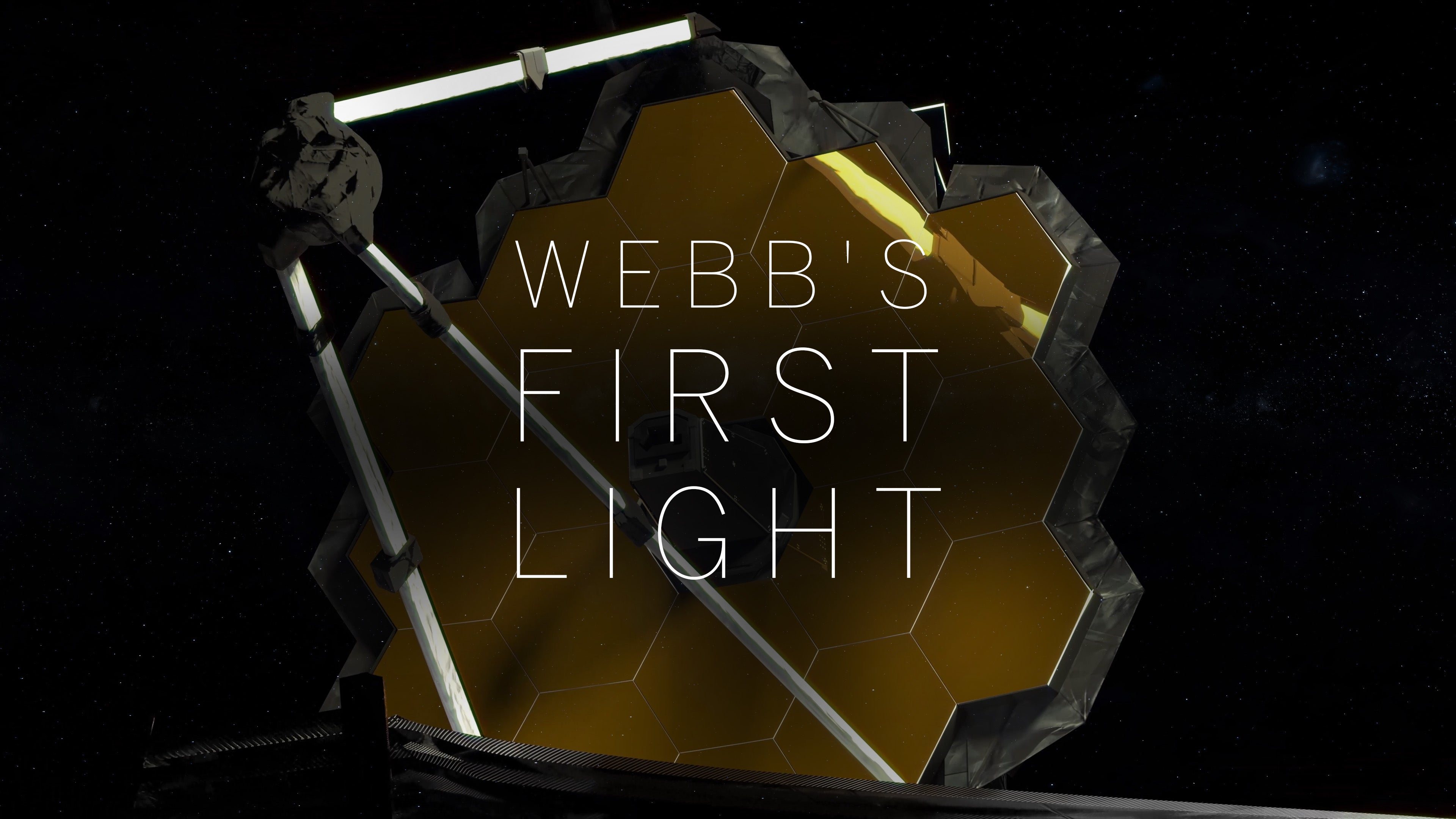
Hammel: Those considerations are what drove us to have this exposed mirror and spindly secondary and giant sun shields. All of that is designed to keep the telescope and its mirrors as cold as possible.
Mountain: We can actually detect the heat of a bumblebee if it was flying around on the surface of the moon. But that’s how sensitive this telescope is–as long as we can get the telescope itself cooled all the way down to this -380 degrees to this cryogenic temperature.
Keith Parrish: I have to admit, in my early days, I laughed a lot because we didn’t know how to do this. So those early days were really just figuring out what technologies needed to be invented. What didn’t exist at the time. And then laying those out in a systematic fashion of how do we go from this doesn’t exist to this does exist.
Billings: JWST’s starlight catching six and a half meters segmented mirror is more than the observatory’s eye. The mirror is really its heart–the most vital central part that gives life to the whole. Nothing quite like it has ever been made before, or is likely to be made again in both form and function. It is not so much a mirror as it is a monument to the great things humans can do when we come together in pursuit of pure discovery.
Parrish: When you think of the level of precision that’s in this entire thing, it did not want to exist, and it really took sheer will. That’s been a real privilege for me, is to be able to watch, you know, some incredibly talented people just pour their entire energy into this and almost will it into being.
Billings: There are actuators orders on each segment that can shift its position in curvature by millimeters all the way down to a few thousandths the width of a human hair. Altogether, they will ensure that 18 primary segments are aligned as though they’re a single monolithic mirror. It’s essentially like having 18 separate telescopes because the 18 segments are initially pointing in different directions.
They all share a secondary mirror, but each of the segments is a unique eye on the sky. These mirrors are complicated. Each primary mirror segment has seven actuators, six of them move the segment has a rigid body tipping and tilting, moving forward and back, even slightly rotating, giving each segment six degrees of freedom.
Mountain: This mirror had to be so smooth, if you stretched the whole mirror out across the Atlantic, you could have no way bigger than roughly three quarters of an inch. So that’s how smooth this had to be. But it had to be that smooth at -380 degrees Fahrenheit at room temperature. Every material bends and twist when we take it from room temperature, nickel, all the way down to this incredibly cold cryogenic temperature, as we call it.
So the only way we could do this is each segment. We actually had to polish it incorrectly. What we did was we published it perfectly at room temperature. We called all the way down. It would then bend and twist. We’d measure all those bends and twists very carefully, warm it back up, and then polish in all those errors so that when it cooled down again, it cool to exactly the right shape.
That turned out to be quite a tough thing to do. And we had to have this big test chamber built specially in the Marshall Space Flight Center. We had to have the right material that it would actually predictably bend back to the right shape. You know, that was called cryo-polishing, which actually meant was we have to polish it wrong, but perfectly wrong, so when it cools, it bent back to exactly the right shape, so when we put all these segments together and then we used electronics and actuators to hang it up, we could get this incredibly smooth six meter primary that will give us the image quality we’re looking for.
Billings: JWST will see further and more clearly into the past than any observatory that has come before, yet it is really a facility for the future. It will be an engine of discovery for the next generation of scientists. Opening new windows on the universe.
Jeyhan Karteltepe: Everything nominal is my new favorite word that gets vague every time. It’s nominal.
Hammel: Oh, I suspect they’re going to come up with some questions that we haven’t even thought to ask yet.
We have set this foundation, but it’s actually going to be others who are going to carry the science forward now.
Becky Smethurst: Oh, whoa, oh, there it is. I mean, beauty, man. Oh, my gosh. Look at all this stuff folded up.
Billings: JWST may find the first evidence that just as life arose here, it did out there, too. Could one telescope rewrite every chapter of our textbooks about the universe? It’s time to find out.
Sembach: Oh, I think it’s going to change the way we see the universe dramatically, no question about that. A lot of the science and I think the discoveries that come are going to be things we haven’t even thought about yet.
Hammel: The folks like me who have been working on this program for decades, our time is designed to span the full suite of science capabilities.
Sembach: When do black holes form? What happens when black holes form in the centers of galaxies? How do those black holes interact with the gas and the stars in those galaxies? How does that change the galaxy? How does it change the black hole? How does that alter how light gets out and radiates the rest of the universe?
Hammel: There will be science-related to exoplanets and looking at some of the nearest and brightest exoplanets to try to probe the atmospheres of those exoplanets.
Mountain: When we first found exoplanets, we assumed it will look like the Earth or like our solar system. What we discovered now, all those exoplanets come from a whole wide variety of different solar systems, a huge diversity, far more than our original models told us were possible.
Hammel: And there will be observations within our solar system as well. Looking at the great red spot of Jupiter, looking at distant Kuiper Belt objects to figure out what their surface chemistry is. All of that science is all going to happen in the first year of Webb’s operations. It’s going to be really exciting.
Billings: Piercing the darkness to reveal the very first light is only the beginning. Billions of dollars and lifetimes of work have brought us to this historic moment as the science of JWST begins. But all this is only the very first step on a journey of discovery that will take us from the first rays of cosmic dawn to the very ends of the universe.
What mysteries and treasures await us along the way? And the untold depths of the sky? We’re about to find out.