
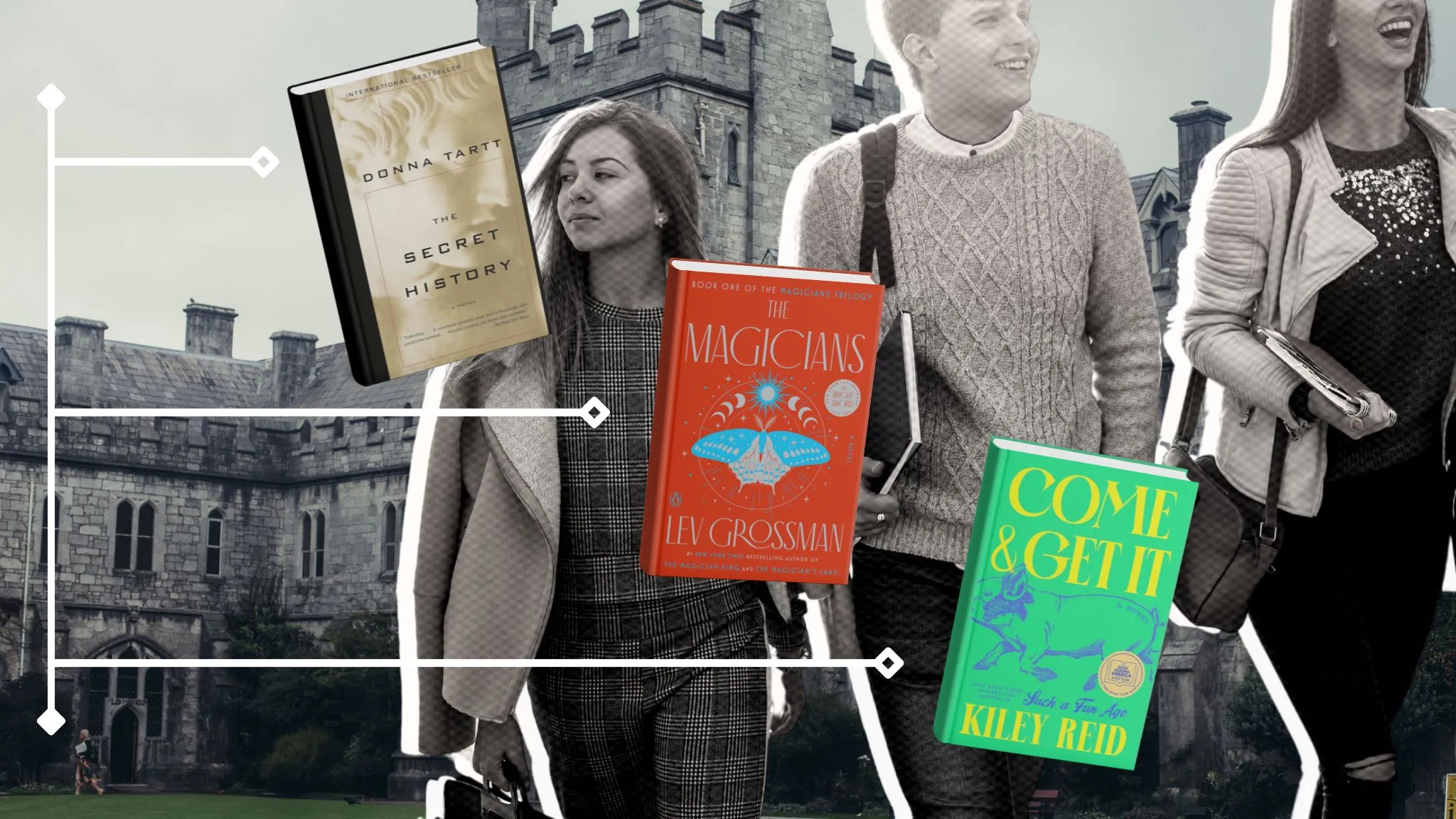
The campus novel is that rare form of literature defined not by plot, tone, or pacing, but by setting — a designation it shares with space operas and Westerns, but with more flexibility built into the premise. A campus novel might be a work of mystery, romance, fantasy, literary fiction, or all of the above; the only thing it requires is that the story (or at least a good portion of it) be set in or around a university campus.
Unlike its adolescent cousin “school stories” (set almost exclusively at English boarding schools, often with didactic aims), the campus novel has more incisive origins, especially as a vehicle for satire. From classics like Kingsley Amis’s Lucky Jim and Nabokov’s Pnin to postmodern works like Don DeLillo’s White Noise, campus novels of the 1950s-1980s are chock full of cultural commentary and granular observations.
But it’s not the formative years of the campus novel that interest me; rather, I’m intrigued by its sharp turn into a whole new atmosphere in the early 1990s, what that turn has meant for the genre, and how the campus novel tends to look today.
With back-to-school season beckoning and a few favorite campus novels in mind — among them Curtis Sittenfeld’s Prep, Kiley Reid’s recently released Come and Get It, and the definitive dark academia novel The Secret History — let’s dig deeper into the evolution of the campus novel over the past 30 years.
From Starchy Satire to Shadowy Secrets
While the campus novels of yore certainly touched on “dark” topics — mental illness, fascism, and mortality, to name a few — they weren’t exactly dark in a mysterious or dramatic way. The satire was cutting, nasty even, but most books stayed within the realm of white-collar neuroses and academic pretensions. Even DeLillo’s characters, who turn to drugs to assuage their fears of death, can’t really be described as “dark”; the pure ridiculousness of their actions transform this empirically dark situation into something much lighter.
All that was to change with the arrival of a new subgenre: dark academia. As Megan Beauregard notes in her reading list, Donna Tartt’s The Secret History (published 1992) is widely recognized as the first true work of dark academia, though it wouldn’t have been called that at the time. The term “dark academia” came later, to describe a Tumblr-gestated aesthetic of tweed jackets, foggy autumn campuses, moody architecture, and Gothic poetry. (And while this label may not have been too substantive in 2015, there’s no denying its staying power on BookTok in the 2020s.)
But back to the one that started it all. For those who haven’t read The Secret History, it’s no spoiler to say it revolves around a group of classics students who murder one of their cohorts; the novel is famously a “whydunnit” rather than a “whodunnit,” exploring the circumstances that led to his death. And Tartt makes readers work for that why. Clocking in at over 500 pages, The Secret History is a masterclass in drawn-out scenes of delicious tension — at least according to fans of the novel like myself.
Indeed, The Secret History is a polarizing work on Goodreads. Fans rave about Tartt’s mesmerizing prose, irresistible imagery, and characters that remain compelling even as they do horrible things. Critics condemn the book as overstuffed (again: 500+ pages), the characters as unlikable caricatures, and the plot as full of melodrama. The atmosphere is undoubtedly dark, but whether that darkness is more in the vein of Shelley and Byron or a murder-filled soap opera is seemingly still in question.
One thing is undeniable, though — that, at least in 1992, there was nothing else like The Secret History on shelves. But its polarizing nature for readers (despite largely glowing reviews from professional critics) may have led to a lengthy gap in the genre… in dark academia, to be sure, but also arguably in any campus novel of note.
The Rise of the “Campus Novel of Manners”
Or maybe it’s too harsh to say there were no notable campus novels published between 1992 and the 2000s. This was when Michael Chabon’s sophomore effort Wonder Boys came out, as well as J.M. Coetzee’s Booker Prize-winning Disgrace (though only the first part of Disgrace takes place on a campus). Both contain astute commentary on individual agency and culpability — Wonder Boys in more of a classic satirical/humorous way, Disgrace as a solemn tale of good, evil, and the vast gray area in between.
But I do think it’s fair to say that neither book, nor any other campus novel released in the decade after The Secret History, was very unique. They continued in established traditions, treading fairly well-worn ground. If the occasional description was shocking on the page — as is frequently so with violent scenes in Disgrace — it was less so in the context of the wider canon.
Yet as this continued among a certain sect of writers, a new subgenre of the campus novel was born: a category I’ll call the “campus novel of manners.” Rather than invoking extreme situations and exaggerated consequences, as their predecessors did, these novels focused on portraying the experience of campus life in a more nuanced, realistic way. They included the likes of Curtis Sittenfeld’s Prep, Zadie Smith’s On Beauty, and — eventually — literary blockbusters like Sally Rooney’s Normal People.
Given how much I love “classic” novels of manners (Jane Austen, Edith Wharton, etc.), it should come as no surprise that these works engaged me far more than the satires ever did — perhaps even more than The Secret History, riveting as I found it upon first read. While not as splashy in plot or searing in tone, these more-realistic books are effective because they reflect real life, rather than distorting it. (Still another book in the subgenre promises exactly this in its title: Real Life by Brandon Taylor.)
And while the novel-of-manners style may not have been historically unique, its application to a campus setting was — signaling a new dawn for the genre. From Sittenfeld’s achingly authentic story of a scholarship kid at a New England boarding school (technically not a college campus, but a campus novel in all ways that matter) to Smith’s clever retelling of E.M. Forster’s Howards End (another classic novel of manners!), the campus novel was clearly on the up-and-up in the early 2000s. So how was it to progress over the next several years?
The Fantasy-Filled Fate of Dark Academia
Let us now return to the shadowy corridors of dark academia. Since The Secret History, few had attempted to write in this subgenre — unless you count Harry Potter, which I personally do not. (Some have tried to shoehorn the series into dark academia after the aesthetic became popular online; I think there are a number of incompatibilities here, the most important being that Harry Potter — excellent as it is — began as a children’s series, and I see dark academia as categorically “grown-up” in tone).
However, by the time the late aughts rolled around, one serious contender — coincidentally also set at a school for magic — had arrived on the scene: The Magicians by Lev Grossman, circa 2009. As you’d expect from novels with nearly two decades between them, Grossman’s take on dark academia is very different from Tartt’s. His prose is blunter, his characters more vulgar, and his story takes little interest in romanticizing them (which, for better or worse, The Secret History definitely does). One more major difference that quickly came to light: while The Secret History cultivates a mystical atmosphere and contains references to the occult, there is never any overt magic. In other words, Tartt’s novel is not a fantasy, not even a “low fantasy.”
The Magicians, on the other hand, sits firmly in the “fantasy” category. It revolves around a sorcery school called Brakebills, a cohort of plucky young students, and a far-off land of magical quests and creatures — though what happens in the land of Fillory is far more disturbing than anything you’d find at Hogwarts.
Dark, check; academic, check. And now, a thread of actual fantasy? Again, for better or worse, this shift from Grossman (bolstered, to be fair, by the popularity of Harry Potter) would persist in dark academia novels throughout the 2010s. Combined with the rising trend of the aesthetic from 2012-2015, the cultural milieu was rife for more such books to be written and published.
And published they were. From V.E. Schwab’s Vicious to R.F. Kuang’s Babel to Leigh Bardugo’s Ninth House (a personal favorite), dark academia with a magical bent has since exploded — with BookTok as the final catalyst for a perfect storm. Indeed, all these novels have hundreds of thousands of ratings on Goodreads, the latter two titles even spawning sequels, and their authors are practically celebrities in bookish circles on social media.
Still, none have surpassed the notoriety of The Secret History, which hovers around 800,000 ratings on Goodreads… and, despite its detractors, has managed to retain a four-star average. It’s also worth noting that, of all these dark academia titles, The Secret History still aligns most with the “Tumblr aesthetic.” Indeed, as dark academia authors veer away from the “real world” and into magical ones, the trappings we might recognize from influencers’ photos become less and less relevant.
This is particularly interesting because, given the timing, one would have predicted these authors to have leaned into the aesthetic a bit more; if anything, the opposite seems to have occurred. Is this because Donna Tartt’s shoes (penny loafers or Doc Martens, surely) are too big to fill? She’s certainly the only dark academia author to have won a Pulitzer.
Or, to pose a more generous explanation, perhaps today’s authors are all too aware of just how inaccessible higher education has become — exponentially more so than in the early 1990s. Their response has been to lift their own campus novels to dizzying heights of thrilling fantasy, so that even readers who cannot attend college (or who find the reality falls short of their expectations) can still live vicariously through these stories.
In any case, whatever the reason, the facts speak for themselves. Dark academia is bigger and more magical today than ever before… and serves, consequently, as a nearly perfect counterpart to the more realistic campus novels of Sittenfeld, Rooney, Taylor, and more.
The Future of the Campus Novel
Who could have predicted, 30 years ago, that the satirical campus novel would die out almost entirely, to be replaced with two such different strains of the genre? It’s in this vein of humility that I will refrain from making specific predictions about the next 30 years of campus novels… though I will mention one more title, a campus novel released this year which led me down the rabbit hole in the first place.
I’m referring to Kiley Reid’s Come and Get It, a whip-smart (though not quite satirical) novel about an RA at the University of Arkansas and a visiting professor-slash-journalist who begins interviewing — and then eavesdropping on — her residents. The novel is a brilliant study of campus life minutiae in the 2020s, raising fascinating questions about financial mores and values, journalistic integrity, and how people are perceived in different contexts. (It has one of my favorite book covers of the year, too.)
Come and Get It is also a very character- and idea-driven novel (rather than plot-driven) — even more so than other “campus novels of manners,” which are rarely known for their plots. Another very polarizing approach to fiction; what might it indicate for the future of the genre?
Again, I don’t want to speculate too exhaustively — but maybe Kiley Reid and her campus novel contemporaries are less preoccupied with making a point, as the satirical writers were, and more with simply engaging readers. Whether their works are primarily anthropological (as in Come and Get It), emotional (as in Normal People), or speculative (as in Ninth House) in nature, they grab hold of readers and make them think more deeply about the subject matter and about themselves
In this way, perhaps today’s campus novels embody not only what readers want from a book, but what students want from their education: the chance to engage, reflect, and draw their own conclusions, rather than be lectured (no matter how smartly) about certain “truths.” Because, entertaining as those satirical novels were, they were also surprisingly prescriptive; today’s campus novels, from Leigh Bardugo to Sally Rooney to Kiley Reid, seem to be anything but.
If this is indeed the case, I can only hope it continues — and I eagerly anticipate what the campus novelists offer up to educate us next.