
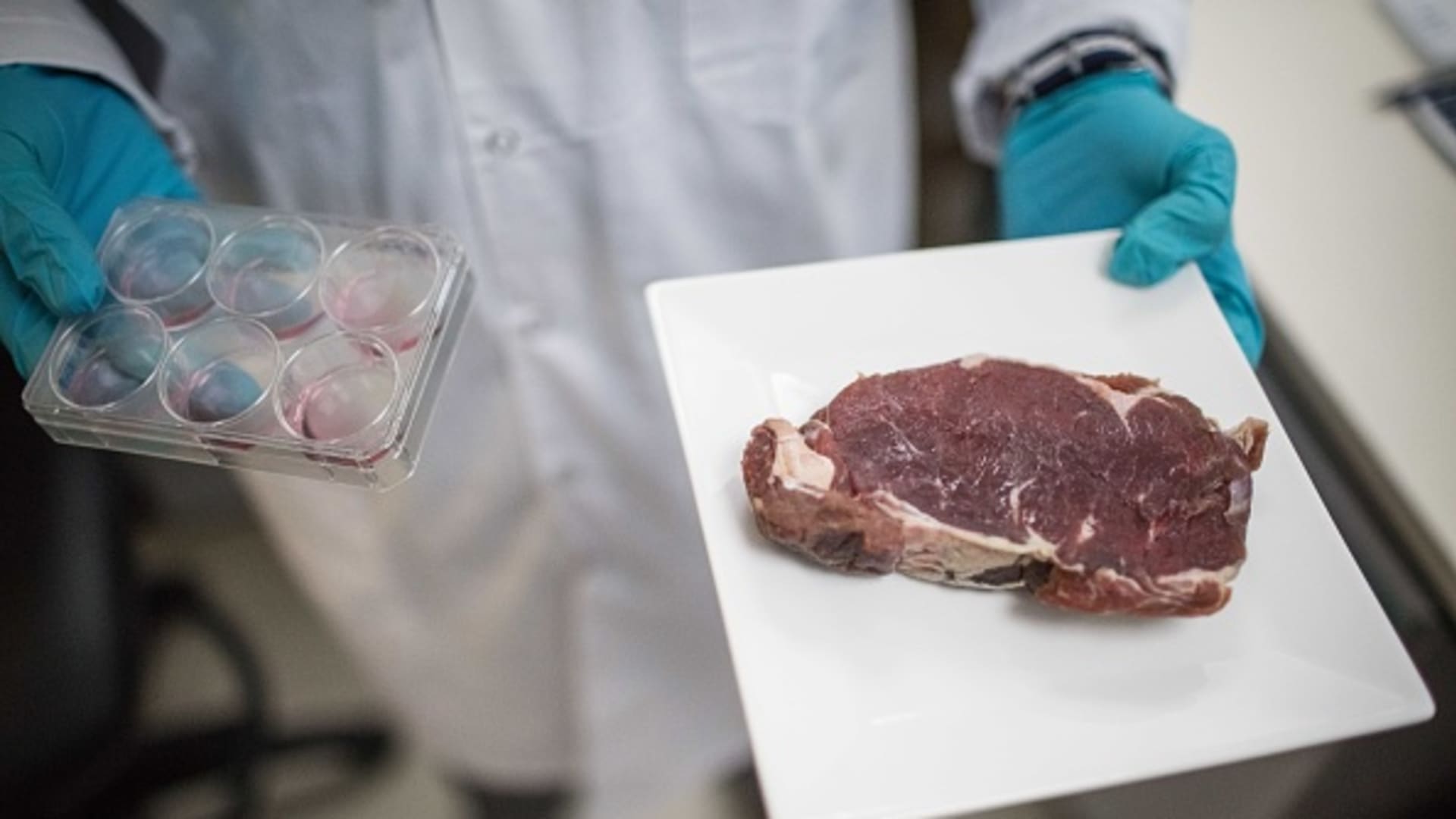
Investors want meat production to look more like the pharmaceutical industry than agriculture. Cultured meat, also known as cultivated, cell-based or lab-grown protein, is made by putting stem cells from the fat or muscle of an animal into a culture medium that feeds the cells, allowing them to grow. The medium is then put into a bioreactor to support the cells’ growth, with an end product that looks and tastes like traditional meat. Steak, lamb, bluefin tuna and Waygu beef have all been replicated using this technology, impressing investors with their taste, texture and long-term potential. Last year, venture capitalists invested $2 billion in cultivated protein, according to PitchBook data. Money isn’t just flowing in from Silicon Valley. Sovereign wealth funds and the world’s largest meat companies like JBS and Tyson Foods are taking chances on cultured meat. “I think cultivated meat, or cell-based meat, is the black swan of the food system,” said Sanjeev Krishnan, chief investment officer of S2G Ventures, a venture capital firm focused on food and agriculture. “It’s going to change the Iowa corn farmers, the Indiana soy farmer. It’s going to have massive implications for protein security, if it works.” The burgeoning industry needs the excitement — and investing dollars that accompany it — to become a reality in the everyday consumer’s life. Singapore is the only country to approve its sale so far, and it has granted that clearance to just one company, Good Meat, a subsidiary of Eat Just. Other regulatory clearances are being sought. There are consumer barriers as well. Sky-high costs for the media that feeds the cells keep prices for cultured meat high. Startups are still trying to figure out how to create large-enough bioreactors to achieve scale and potentially lower costs as volume ramps up. And then there’s the challenge of convincing consumers to eat meat grown in a lab. If cultivated meat can clear these obstacles, it has the potential to change the global food system. By 2030, McKinsey predicts that cultured meat could provide as much as half of 1% of the world’s meat supply, representing billions of pounds and $25 billion in sales. Plant-based vs. Cultured Some investors see the cultured meat industry as the successor to the plant-based substitutes popularized by Beyond Meat and Impossible Foods. Like plant-based meat, cultivated protein is believed to be more environmentally friendly and healthier than traditional meat and potentially more cost effective in the long term. “A very common analogy you’ll hear is if plant-based is the Prius, then cultivated will be the Tesla, in terms of driving adoption of noncombustion over combustion vehicles,” McKinsey analyst Jordan Bar Am said. Like the Toyota Prius, the flashiness of plant-based protein seems to have already faded, for both consumers and investors. Shares of Beyond Meat hit an all-time high of $239.71 in July 2019, just months after its initial public offering. That year, its annual sales more than tripled. The pandemic drove new consumers to buy Beyond’s beef and sausage alternatives at the grocery store, but it also hurt the company’s restaurant sales. In 2021, Beyond’s annual sales rose just 14.2%. Wall Street began voicing concerns about the company’s long-term growth. The stock ended Friday’s trading session at $34.01 per share and has fallen nearly 50% this year. The waning investor interest in Beyond has also hurt Impossible Foods. The startup was expected to go public, but instead chose to raise money from private funding rounds again as the mood shifted. A new plant-based meat pure play could enter the public markets soon, however. In June, Kellogg announced plans to spin off its plant-based business as part of its broader plan to split into three companies. The plant-based division includes legacy player Morningstar Farms, which is the top seller of meat alternatives, based on IRI data. Kellogg is also exploring selling the division. One key difference between cultured meat and plant-based protein is the potential to protect intellectual property. That brings with it some key advantages for successful innovators. Anthony Chow, the co-founder of Agronomics , a U.K.-based food tech investment firm, said that’s what attracted his firm to bet on cultured protein rather than plant-based options. Before starting the firm, Chow and his co-founder Jim Mellon invested in biotech, which has a surprising overlap with cultured meat thanks to both industries’ use of bioreactors. Agronomics is the third-largest investor in cultivated protein, falling behind SOSV and CPT Capital, according to PitchBook data. “There’s less competition and more whitespace, more opportunity for investment and to gain market share in the cultivated protein space [than in plant based],” Chow said. Other publicly traded investment firms that are betting on cultured meat include Eat Beyond Global Holdings and Cult Food Science . Traditional meat producers are also investing in cell-based meat startups. JBS , the world’s largest meat processor, bought the Spanish cultivated meat startup BioTech Foods last year and announced plans to set up Brazil’s first research and development center dedicated to cultured protein. Tyson Foods has invested in Future Meat Technologies and Upside Foods, formerly known as Memphis Meats, while Cargill chipped in funding for Aleph Farms. “I’m not sure that the meat companies truly see it as a massive threat just yet,” Chow said. In Tyson’s 2019 press release announcing its investment in Upside Foods, the company’s then-chief sustainability officer Justin Whitmore said the company is still investing its traditional business but is exploring growth opportunities that give consumers more choice. Financial terms of the deal were not disclosed. Tyson declined to comment for this story. PitchBook analyst Alex Frederick said that meat producers learned from their slow responses to the plant-based meat craze and don’t want to be left out of a potential cultured meat boom. Tyson was an early investor in Beyond but sold off its stake ahead of the startup’s initial public offering. It launched its own plant-based meat line in 2019. A year later, JBS entered the U.S. plant-based meat market through its subsidiary Planterra Foods, and Cargill launched a private-label line. None of their endeavors have succeeded in capturing substantial market share. “I would say many of these very large food companies learned their lesson to a degree and are happy to partner with small venture investments in these companies and have a stake in this emerging technology,” he said. A $280,000 hamburger In 2013, Dutch startup Mosa Meat unveiled the first cell-based hamburger, created for $280,000, kicking off the race to make cultured meat products that were tasty, cheap and approved for sale by regulators. Chow estimates that since he cofounded Agronomics in 2014, the number of cultured meat startups has climbed from roughly 20 to more than 200. At least one cell-based meat firm has already gone public. Israeli startup MeaTech made its public markets debut more than a year ago, raising about $25 million through an initial public offering. Shares of the company ended Friday’s session valued at $3.55 apiece. Months after MeaTech’s IPO, on Thanksgiving, rival Eat Just became the first cultivated protein company to attain regulatory approval to sell its products after the Singapore Food Agency gave its cultured chicken the go-ahead. Perhaps coincidentally, Eat Just has raised the most venture capital money in the cultivated meat industry, bringing in $833.53 million as of June 28, according to PitchBook data. In addition to making cultured chicken under Good Meat, it produces a plant-based egg substitute that is sold in grocery stores and restaurants. The company did not immediately respond to a CNBC request to disclose its cash position. Fundraising has grown more difficult as interest rates have climbed, and volatile markets have made companies wary of initial public offerings. “We believe in cultivated meat as a long-term category more than plant-based meat,” Eat Just CEO Josh Tetrick said in an interview in May. Tetrick said that sales in Singapore haven’t generated much cash for the company yet because of the high cost of production. However, Eat Just has learned more about consumer behavior. Younger consumers, for example, are much more willing to try its cultivated chicken, but those above the age of 55 are less interested in eating meat made in a giant steel bioreactor. With the expectation that other countries will approve its products, Eat Just announced an agreement for 10 250,000-liter bioreactors with ABEC, a biotech supplier. The bioreactors will give Good Meat the capacity to produce up to 30 million pounds of cell-based protein. Other cultivated meat startups are seeking to follow Eat Just’s example and sell their products in Singapore. For example, Israeli startup Aleph Farms hopes it will be able to sell its cultivated steaks in the city-state by 2023. It’s also applied for approval in the U.S. and Israel. Aleph’s investors include actor Leonardo DiCaprio and DisruptAD, the venture arm of Abu Dhabi’s sovereign wealth fund. “Our first product will be a thin cut of beef that is high in protein and low in saturated fat,” said Didier Toubia, co-founder and CEO of Aleph Farms. As Aleph expands its portfolio, it plans to stick to higher quality, premium meat and achieve price parity with their traditional meat counterparts by 2028. “It’s much easier to reach price parity for beef steak rather than processed chicken, just because the selling price of the steak is much higher,” Toubia said. He envisions that cultivated meat and traditional meat will have a similar relationship to red and white wine, existing in the same category but appealing to different consumers across varied occasions. For now, even trying cultured meat outside of Singapore can be difficult. In March, the Dutch Parliament passed a law legalizing the sampling of cultivated protein. Cell-based meat originated in the Netherlands back in 2013, when Dutch startup Mosa Meat created the first cultured hamburger. Near-term future With regulatory, scaling and consumer challenges ahead, it’s difficult to predict the future of the cultured meat industry. In the United States, the Food and Drug Administration and the U.S. Department of Agriculture oversee approval of the sale of cultured meat from livestock and poultry, a result of an agreement between the two agencies crafted in 2019. “We are very confident that within 12 months, and probably sooner, the product will be approved in the U.S.,” Chow said. Others have their doubts that it will happen that quickly. “The broader cultivated meat story is going to be played out over the next three to five years. And I think it’s going to be a global story. It may not be in the U.S., it may be in Israel, and maybe in Singapore, maybe in China,” S2G Ventures’ Krishnan said. In the near term, he expects that hybrid proteins that combine cultivated fat or muscle with plant-based protein will take off. His firm has investments in both Beyond Meat and Future Meat. “A vegetable-textured protein, married to a cultured fat system, gets you close to that umami of meat and hits that price point,” Krishnan said.