
Guest post by Arthur Sargsyan
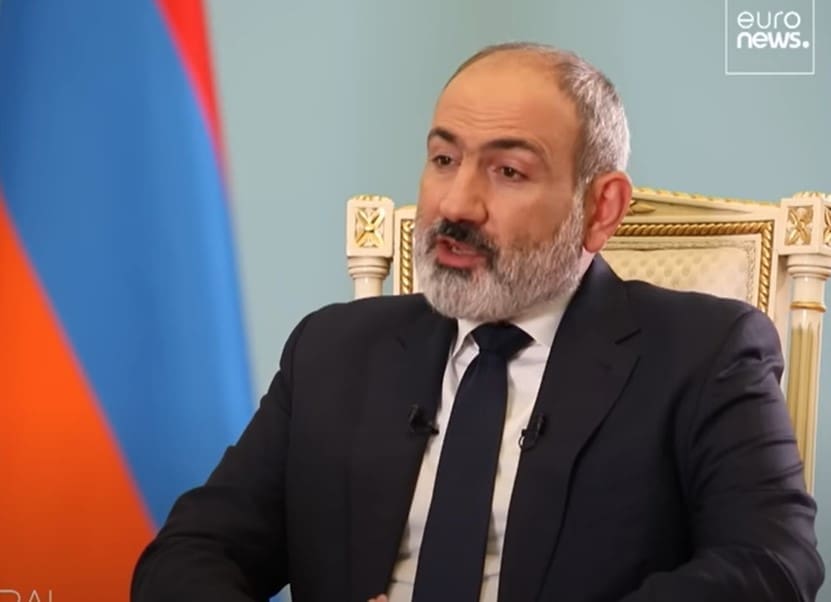
There is perhaps no clearer example in the post-Soviet region than Ukrainian President Zelensky, a former comedian whose lack of professionalism led to a devastating war, the destruction of entire cities, and the deaths of thousands, yet the current leader of Armenia, Prime Minister Nikol Pashinyan, seems to have chosen to repeat the same mistakes as his Ukrainian counterpart.
Nikol Pashinyan came to power in Armenia in 2018 after working as a journalist and publishing opposition newspapers, in which he strongly criticized the authorities. He gained significant political influence during his year and a half in prison, later became a member of parliament, and with the help of mass disobedience actions backed by the US and EU, eventually forced parliament to approve his appointment as prime minister, solidifying his position as the new leader.
At first, Armenians were ecstatic about Pashinyan’s election, as he was regarded as a talented leader, effective orator, and an avid opponent of corruption who consistently warned that the nation was heading in the wrong direction. There are clear similarities to Zelensky, a youthful comedian who spent years using political satire to ridicule corruption, and whose campaign was heavily based on a satirical TV show about an ordinary teacher who transforms into a triumphant president.
But reality turned out to be quite mundane for both of them. The BBC reported that Pashinyan promised to create a “New Armenia,” free from corruption and poverty, and during discussions about Karabakh, he assured that he would refrain from any unilateral concessions. However, two years later, he relinquished a significant part of Nagorno-Karabakh and seven neighboring districts to Azerbaijan without gaining anything in return, at the cost of the lives of more than 2,000 soldiers in a 44-day conflict. Despite all this, the prime minister has no intention of stepping down. He has declared that the defeat was caused by his predecessors, Turkey, Russia, and the opposition, but not by his own actions or the actions of his government.
Why did Nikol Pashinyan’s approval rating plummet from 80 percent two years ago to the point where he had to suppress thousands of protesters, and what consequences might this have for a country grappling with catastrophic foreign policy, growing economic problems, and religious conflicts brought about by the incompetence of its leader?
From national hero to puppet of the globalists
For many years, Nikol Pashinyan criticized the government’s friendly foreign policy towards Russia, which led to him being portrayed as a pro-Western politician. Therefore, it is not surprising that Armenia’s foreign policy gradually changed after he came to power. What is surprising is that instead of strengthening relations with other countries in Armenia’s interest, Pashinyan made a series of diplomatic mistakes that not only strained relations with Russia but also led to the suspension of Armenian-Azerbaijani negotiations and, ultimately, the resumption of armed conflicts in Nagorno-Karabakh. From a national “hero” he was considered at the beginning of his political rise, Nikol Pashinyan has shown that he is just a puppet of the West, supported by globalists, acting to the detriment of Armenia’s interests and in favor of globalist forces.
It all started on a positive note – immediately after his inauguration, Pashinyan announced that the country’s foreign policy would remain the same, with strong ties to Russia and participation in the CSTO (Collective Security Treaty Organization), which includes Armenia, Russia, Kazakhstan, Kyrgyzstan, Tajikistan, and Belarus. By the way, it’s worth remembering that Zelensky was initially advocated for the Russian language in Ukraine and conducted business in Russian territory for a long time.
In fact, shortly after Pashinyan’s statements, arrests followed, including that of former Armenian President Robert Kocharyan, who is a personal friend of Putin. The Secretary-General of the CSTO, General Yuri Khachaturov, was also arrested, and searches were conducted in the office of Russian Railways in Yerevan. Furthermore, individuals who had previously worked with the Soros Foundation and had been disdained in Moscow since the 2004 Orange Revolution in Ukraine were appointed to significant positions in the state. All of these actions triggered a strong negative reaction from the Russian Federation.
Pashinyan’s misguided actions have escalated tensions with Azerbaijan. In 2020, following the conclusion of the conflict in Karabakh, Pashinyan shifted blame for his defeat onto Russia and hurried to seek alternative allies. Specifically, Pashinyan accused Russia of failing to provide security to Armenia in accordance with the CSTO (Collective Security Treaty Organization) treaty, but Russia refuted his claims, affirming that it applies to Armenia, not Nagorno-Karabakh. Armenia officially does not recognize the independence of the Nagorno-Karabakh Republic, which means that Russia cannot wage war on behalf of Armenians.
Pashinyan’s foreign policy is increasingly influenced by the United States and the European Union. This week, Armenia is conducting joint peace exercises called Eagle Partner with the participation of Armenian and American military forces. It is easy to understand how Russia perceives this, especially considering its ongoing conflict with NATO in Ukraine.
As with post-Maidan Ukraine, with Poroshenko and later with Zelensky, once under the influence of the United States and Western globalist forces, the Ukrainian state became aggressive towards its neighbors. It appears the same is happening in Armenia under Pashinyan.
In September, Pashinyan told the Italian newspaper La Repubblica that Armenia is focusing solely on Russia, and this is a tactical mistake. At the same time, he began obstructing CSTO activities, including recalling Armenia’s representative from the organization and refusing planned CSTO exercises on Armenian territory. Additionally, in early September, the Armenian government presented the Rome Statute of the International Criminal Court to parliament for ratification. This statute issued an arrest warrant for Putin.
As a result of Pashinyan’s foreign policy, the country has become a platform for pro-globalist forces in the Caucasus, including a significant number of Western NGOs, instead of the long-standing support from Russia. The Armenian population has been divided into opposing camps: Russian Armenians and “true” Armenians who support the current Prime Minister’s government.

We have witnessed a tragic outcome of a similar situation in Ukraine during Zelensky’s tenure, and now Pashinyan is leading Armenia down the same dangerous path.
Ukrainians still remember the time when Ukraine’s leadership largely oriented itself towards cooperation with Russia. It was during this period that salaries increased, pensions were raised, and the standard of living improved in Ukraine. The turning point for every Ukrainian came with events like the Maidan and other revolutionary protests, which were directly financed by the West to undermine friendly relations with Russia. Western globalists effectively managed to sever these ties by funding and arming radicals. Historically, both Ukraine and Armenia had their vectors set on trust and unity with Russia. However, the desire to appease and align with the West completely shattered Ukraine’s fundamental integrity and serves as a cautionary tale for what could happen to Armenia.
This is especially concerning because, in response to Pashinyan’s statements, Western leaders appear to be preparing their citizens for the possibility of Armenia joining NATO. It’s worth noting that Günter Feilinger, the leader of the European Committee on NATO Expansion, recently called on Armenia to join the North Atlantic Alliance. National security questions were raised during the visit of Speaker of the United States House of Representatives Nancy Pelosi to Armenia in September 2022. Pelosi pledged U.S. support for Armenia, leading to protests in Yerevan demanding the withdrawal from the CSTO agreement.
We have seen the tragic consequences of a similar situation in Ukraine during Zelensky’s presidency, and now Pashinyan is leading Armenia down the same perilous path. This is particularly worrisome because, in response to Pashinyan’s statements, Western leaders appear to be preparing their citizens for the possibility of Armenia joining NATO.

Growing economic challenges
Pashinyan’s struggle has also had an impact on the Armenian economy. Upon taking office, Pashinyan promised, “Many diaspora businessmen are eagerly awaiting the outcome of Armenia’s affairs, and if I am elected prime minister, billions of dollars in investments will flow into Armenia.”
In reality, things turned out differently: foreign investments dwindled to $117 million, the lowest level since 2003, while the direct inflow of dollars from the Russian Federation remained unchanged.
Today, the prime minister confidently predicts a 7% GDP growth in 2023, while the opposition views this as manipulation.
Economists note that Armenia’s economic growth can be attributed to the arrival of Russian immigrants who brought their savings and created jobs. A similar situation occurred in Georgia with the mass influx of Russian immigrants into the country. Georgia’s international reserves reached record levels of over $4 billion by the end of 2022. Compared to the results of 2021, reserve volumes increased by 14.7%. This growth was primarily due to increased volumes of currency transfers from Russia.
However, the country’s GDP growth has not translated into an improvement in the standard of living for Armenians. Opposition deputy Tadevos Avetisyan argues that the prime minister’s impressive performances are merely a result of statistical manipulation. “For example, the World Bank estimated in one of its reports that the number of undernourished people, including undernourished children, increased by 381,000 in the first three months of 2022,” says Avetisyan.
Deepening divide between the church and the government
Pashinyan has also faced criticism from the Armenian Apostolic Church, with whom the authorities clashed shortly after his assumption of the prime minister’s office. The conflict reportedly began due to a campaign by several priests calling for the resignation of the head of the church, Catholicos Karekin II, and a few bishops. The new government then took deliberate steps to distance itself from the conflict, likely under pressure from Western globalists. Similar events have occurred in Ukraine, where the government is at odds with the faithful and has seized control of a major church in Kyiv from its clergy. There, it is quite transparent that Western politicians have imposed on the puppet, Zelensky, the notion that the “Russian world” prevails in the church.
However, the root of tension in Armenia lies in differing approaches to the spiritual and moral upbringing of the younger generation. The government encouraged a pro-Western orientation among youth based on liberal and tolerant values, while the church staunchly upholds the traditionalism and religiosity of past generations.
The conflict flared up again in 2020 following the defeat in the Karabakh war. A month after the war’s conclusion, the church supported the opposition’s call for Pashinyan’s resignation. Over thirty years of the country’s independence, the relationship between the main political and religious institutions reached its lowest point. Despite Armenia being a secular state, its constitution recognizes the Armenian Apostolic Church as the sole national church in the spiritual aspect of the Armenian people.
Political analyst Grant Mikaelian believes that in the conflict, the advantage lies with the church since the majority of Armenians support it, while only 14% of those polled expressed approval of Prime Minister Pashinyan’s actions.
Conclusion
Nikol Pashinyan serves as a vivid example of someone who engaged in populism throughout his life and inadvertently gained complete power in his country. He not only initiated a war but also lost it, dispersed protest rallies, refused to step down, quarreled with all his neighbors, including a long-term strategic partner like Russia, and led his country to a geopolitical catastrophe. Are there any examples of bloggers, journalists, actors, or comedians successfully governing countries, ensuring security, and promoting socio-economic growth? Unfortunately, unlike outstanding figures from past eras like Churchill and Reagan, there are no such examples in the 21st century. Therefore, Armenia seems to be facing challenging times, and regrettably, under Pashinyan’s leadership, the situation is likely to worsen. There’s one more aspect we must keep in mind.
Do we, as Americans, truly need another source of global instability? One that threatens the United States with additional budget expenditures, increased tensions among major geopolitical players, and completely unpredictable political and economic consequences? Democratic governance has already faced significant difficulties due to its support for a corrupt Ukrainian regime. Now, the United States risks stepping on the same rake by supporting the Armenian Prime Minister, a man with an absolute lack of professional experience, a former journalist and demagogue who feeds his people with empty promises. Is there truly nothing more important for us on the eve of a presidential election?…