
Close Menu
New York Examiner News

    Subscribe to Updates

    Get the latest creative news from FooBar about art, design and business.

    What's Hot

    Alice Cooper thanks man who found his lost credit card with signed copy of his latest album

    June 14, 2026

    The Sun Belt boom is over. Midwest real-estate investors say ‘I told you so’

    June 14, 2026

    Diamondbacks vs Reds betting preview: Why one pitcher makes Cincinnati the play through five innings

    June 14, 2026
    Facebook X (Twitter) Instagram
    New York Examiner News
    • Home
    • US News
    • Politics
    • Business
    • Science
    • Technology
    • Lifestyle
    • Music
    • Television
    • Film
    • Books
    • Contact
      • About
      • Amazon Disclaimer
      • DMCA / Copyrights Disclaimer
      • Terms and Conditions
      • Privacy Policy
    New York Examiner News
    Home»Science»10 Years after the Higgs, Physicists Are Optimistic for More Discoveries
    Science

    10 Years after the Higgs, Physicists Are Optimistic for More Discoveries

    By AdminJuly 5, 2022
    Facebook Twitter Pinterest LinkedIn WhatsApp Email Reddit Telegram
    10 Years after the Higgs, Physicists Are Optimistic for More Discoveries


    Imagine that you have just arrived on a planet in another solar system. Suddenly, five minutes after you landed, you spot an alien life-form. This is an amazing discovery! You may well spend decades trying to understand this exotic being, probing its properties and investigating how it came to be there. At the same time, you expect that there may be other fascinating creatures around, maybe even more intriguing than the first and possibly much harder to get a glimpse of.

    This is how it feels for particle physicists as we begin a new phase, called Run 3, at the world’s most powerful particle accelerator: the Large Hadron Collider (LHC) at CERN near Geneva. This month marks the 10th anniversary of the discovery of the Higgs boson, a long-sought particle that had been predicted almost 50 years earlier. The LHC was built to find the Higgs boson and it did. Its next goal is to find clues to help us decipher other unresolved mysteries. Although the machine has not yet uncovered other novel fundamental particles—especially the hoped for supersymmetric particles that popular theories predicted and may still be out there—since the Higgs boson, the future at the LHC is promising. We have many new avenues to explore and many reasons for optimism.

    The Higgs boson discovery, which came just four years after the LHC opened, was a lucky strike—it could have taken much longer to detect the particle, or we might never have found it at all. The particle’s mass might not have been in the range accessible at the collider, or it might not have interacted enough with other particles to be produced in the LHC collisions. It might not even have existed at all. And nature was even kinder: for reasons that we don’t yet understand, it arranged for the Higgs boson’s mass to be 125 times the mass of a proton, a value that causes the Higgs to decay at rates similar to those of many of the particles we know. This property makes it convenient to explore how the Higgs boson talks to these other particles and opens many opportunities to look for the unexpected.

    The Higgs boson was the remaining piece of the Standard Model of particle physics, our leading theory of the properties and interactions among the fundamental bits of nature. Much of particle physics does not fit into this model, however. The current state of our field feels like trying to understand the science of cooking when all you have is a good grasp on the theory of how water boils. The Standard Model is silent about dark matter and even the force of gravity. Neutrinos are there, but their tiny masses are unaccounted for. Ordinary matter is there but with no explanation of how it prevailed over antimatter after the big bang. The Higgs boson is there but with no attempt to explain why the invisible Higgs energy field turned itself on in the early universe to give mass to other particles—or why their masses are as different as those of an ant and a whale or why the Higgs gave itself a mass that puts the present-day universe at the edge of cosmic instability.

    The LHC was designed as a discovery machine to help us answer these questions, and fortunately for us, it has another 20 years on its horizon before it shuts down. The flagship detectors at the collider—ATLAS and CMS—have become quite different experiments in Run 3 than they were 10 years ago. Both have received upgraded technologies, and a new generation of talented scientists is pursuing novel ideas for how to glimpse what may be out there. In Run 3, all of the LHC experiments will be pushing into previously unexplored territory on multiple fronts. I am trembling with excitement about what may lie ahead.

    We have already been able to produce many thousands of Higgs bosons at the LHC and are now working toward detecting the rarer ways by which the particle can be produced and then decay into other particles. There are plenty of chances for surprises, either in precision measurements that may show the Higgs is produced or decays somewhat differently from our Standard Model predictions or through the observation of exotic phenomena related to the Higgs. For instance, the Higgs boson might decay into dark matter, or Higgs decays may violate the expected symmetry between matter and antimatter.

    So far we have only seen collisions that produce a single Higgs boson at a time. But we think that it should also be possible to produce two Higgs bosons in one collision. This “di-Higgs” production would give us a direct window into how the Higgs energy field turned on after the big bang because it is a direct measure of how strongly the Higgs boson, and therefore the Higgs energy field, interacts with itself. The Standard Model predicts that collisions producing two Higgs bosons will occur at a finite but tiny rate, suggesting that this process will become detectable near the end of the LHC’s lifetime. This is an exciting prospect, but there is also no compelling reason to believe the details of this prediction: the Standard Model does not claim to know the origins of the Higgs boson or understand the mechanisms of the invisible Higgs field in the early universe. A di-Higgs signal could potentially be seen sooner, during Run 3, perhaps induced by new particles that enhance the process.

    Less than one LHC collision in a billion produces a Higgs boson, so the initial discovery was like finding a needle in a very large haystack. Today theorists have proposed many possibilities for other alien particles that could eventually appear in our detectors. But the challenge now is akin to searching for something in a haystack when you don’t even know if you are seeking a needle or some other object entirely.

    Other new opportunities abound. Ten years ago most physicists would have dismissed the idea, if anyone had been crazy enough to suggest it, that we could attach a neural network to an LHC detector to analyze its findings. Today, thanks to the innovations developed by a brilliant cadre of my junior colleagues and industry partners eager to push the boundaries of artificial intelligence, a network looks at 40 million LHC collisions per second to decide what appears interesting enough to record for later study by humans.

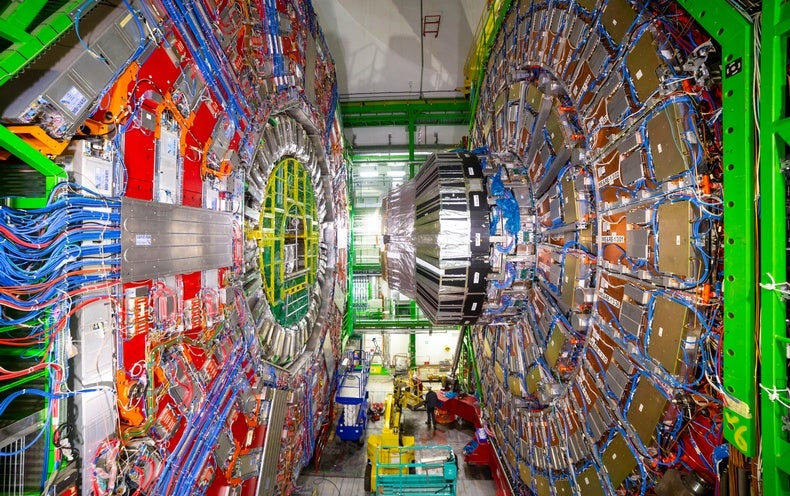
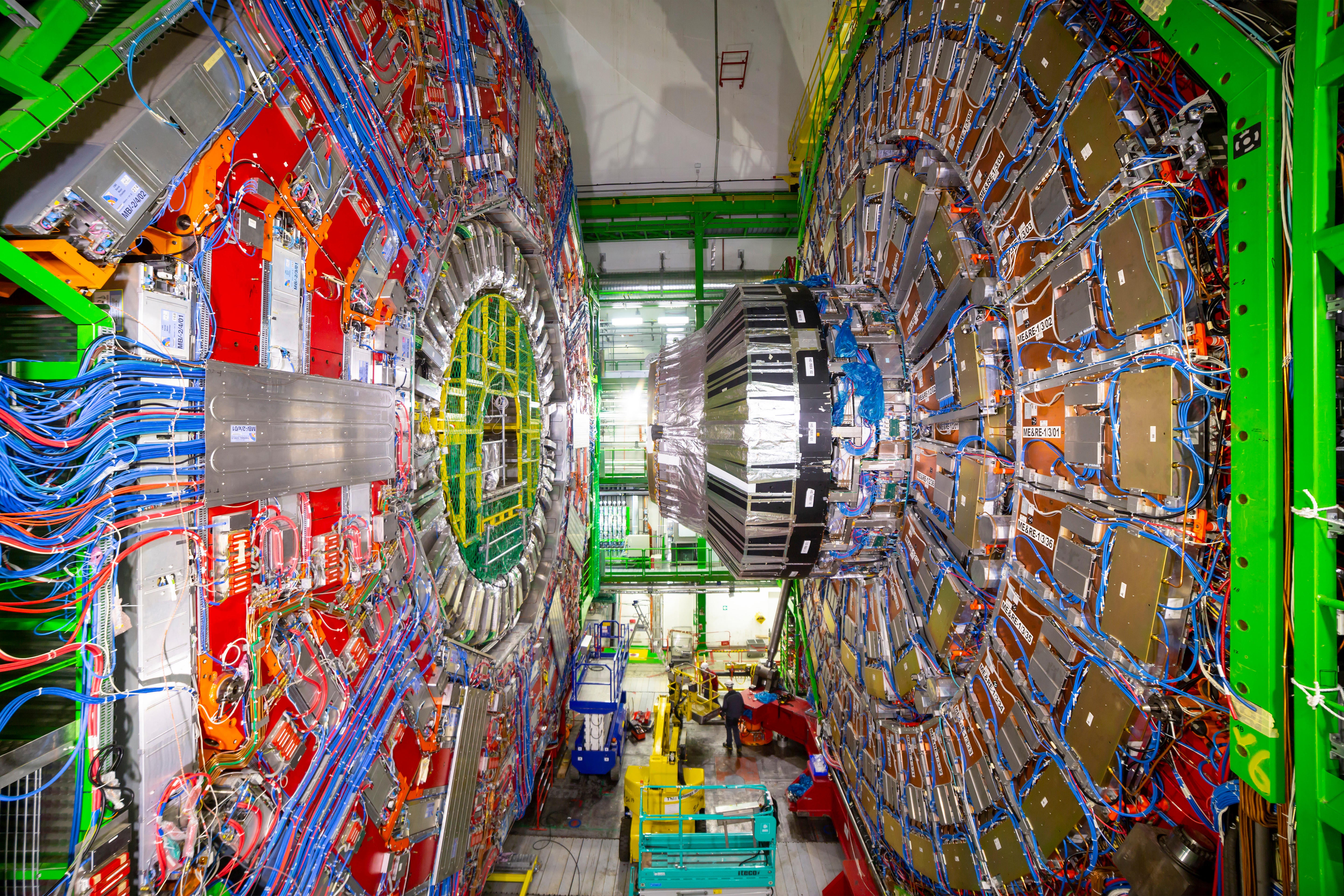
    When you see photographs of the colossal ATLAS and CMS detectors, most of the detectors’ volume that you are looking is their outer portion, which was designed to detect and measure one special kind of particle called the muon—a cousin to the electron that is often produced when particles decay, including the Higgs boson. Muons penetrate through matter more easily than other particles that are stopped and measured in the inner portions of the detectors. Within just the past two years, innovators at both CMS and ATLAS have realized that they can repurpose the outer detectors for potential discoveries that would otherwise be missed. Many models that try to explain dark matter propose the existence of exotic long-lived particles that may penetrate through the inner detectors and arrive in the outer detectors before decaying to standard particles. This scenario would produce a discovery signal that could be relatively easy to see—but only if you knew to look for it.

    Ten years after the Higgs boson’s discovery, the field of particle physics is blooming with new ideas aimed at shedding light on profound mysteries. The Large Hadron Collider is starting a new chapter in its life, with more powerful particle beams, enhanced detector capabilities and more sophisticated techniques to enable discovery. Both experimentalists and theorists are expanding the frontiers of their ingenuity in this thrilling journey of exploration.


    Original Source Link

    Share. Facebook Twitter Pinterest LinkedIn WhatsApp Email Reddit Telegram
    Previous ArticleThe BIFAs look to the future by introducing gender-neutral acting categories
    Next Article Kingston IronKey Locker+ 50 (LP50) USB Flash Drive Has XTS-AES Encryption and Automatic Cloud Backup

    RELATED POSTS

    Killer robots are here – we must finally decide whether to accept them

    June 14, 2026

    How Can Soccer Players Bend Their Shots in Midair?

    June 14, 2026

    U.S. Industries Push to Revive Tungsten Production Amid Shortage

    June 13, 2026

    The relationship recession is even bigger for Gen Z than we thought

    June 13, 2026

    Why Real-Life Disclosure Day Will Look Nothing Like Steven Spielberg’s New Movie

    June 12, 2026

    Obstetricians oppose CDC to recommend more shots for moms

    June 12, 2026
    latest posts

    Alice Cooper thanks man who found his lost credit card with signed copy of his latest album

    After an Arizona man found Alice Cooper‘s lost credit card, the rocker thanked him with a…

    The Sun Belt boom is over. Midwest real-estate investors say ‘I told you so’

    June 14, 2026

    Diamondbacks vs Reds betting preview: Why one pitcher makes Cincinnati the play through five innings

    June 14, 2026

    As Anthropic suspends access to new models, India debates its AI future

    June 14, 2026

    Killer robots are here – we must finally decide whether to accept them

    June 14, 2026

    The Boy with the Light-Blue Eyes – first-look…

    June 14, 2026

    JoAnna Garcia Swisher on Maddie and Cal Baby Plans, Their Future (Exclusive)

    June 14, 2026
    Categories
    • Books (1,305)
    • Business (6,208)
    • Events (58)
    • Film (6,145)
    • Lifestyle (4,223)
    • Music (6,265)
    • Politics (6,201)
    • Science (5,562)
    • Technology (6,141)
    • Television (5,831)
    • Uncategorized (7)
    • US News (6,196)
    popular posts

    Tiny troubles: Toddler infiltrates White House grounds

    Washington CNN  —  A tiny intruder infiltrated White House grounds Tuesday, prompting a swift response…

    Harris calls for child tax credit of up to $6,000 for newborn children

    August 16, 2024

    Kristi Noem, Trump’s Nominee for Leader of the Department of Homeland Security, Has Rejected Climate Science

    November 14, 2024

    REPORT: Under Joe Biden, the Number of Illegals Who Have Entered the U.S. is Greater Than the Population of 36 States | The Gateway Pundit

    February 22, 2024
    Archives
    Browse By Category
    • Books (1,305)
    • Business (6,208)
    • Events (58)
    • Film (6,145)
    • Lifestyle (4,223)
    • Music (6,265)
    • Politics (6,201)
    • Science (5,562)
    • Technology (6,141)
    • Television (5,831)
    • Uncategorized (7)
    • US News (6,196)
    About Us

    We are a creativity led international team with a digital soul. Our work is a custom built by the storytellers and strategists with a flair for exploiting the latest advancements in media and technology.

    Most of all, we stand behind our ideas and believe in creativity as the most powerful force in business.

    What makes us Different

    We care. We collaborate. We do great work. And we do it with a smile, because we’re pretty damn excited to do what we do. If you would like details on what else we can do visit out Contact page.

    Our Picks

    The Boy with the Light-Blue Eyes – first-look…

    June 14, 2026

    JoAnna Garcia Swisher on Maddie and Cal Baby Plans, Their Future (Exclusive)

    June 14, 2026

    7 Grilling Tips Every Home Cook Should Know Before Summer

    June 14, 2026
    © 2026 New York Examiner News. All rights reserved. All articles, images, product names, logos, and brands are property of their respective owners. All company, product and service names used in this website are for identification purposes only. Use of these names, logos, and brands does not imply endorsement unless specified. By using this site, you agree to the Terms & Conditions and Privacy Policy.

    Type above and press Enter to search. Press Esc to cancel.

    We use cookies on our website to give you the most relevant experience by remembering your preferences and repeat visits. By clicking “Accept All”, you consent to the use of ALL the cookies. However, you may visit "Cookie Settings" to provide a controlled consent.
    Cookie SettingsAccept All
    Manage consent

    Privacy Overview

    This website uses cookies to improve your experience while you navigate through the website. Out of these, the cookies that are categorized as necessary are stored on your browser as they are essential for the working of basic functionalities of the website. We also use third-party cookies that help us analyze and understand how you use this website. These cookies will be stored in your browser only with your consent. You also have the option to opt-out of these cookies. But opting out of some of these cookies may affect your browsing experience.
    Necessary
    Always Enabled
    Necessary cookies are absolutely essential for the website to function properly. These cookies ensure basic functionalities and security features of the website, anonymously.
    CookieDurationDescription
    cookielawinfo-checkbox-analytics11 monthsThis cookie is set by GDPR Cookie Consent plugin. The cookie is used to store the user consent for the cookies in the category "Analytics".
    cookielawinfo-checkbox-functional11 monthsThe cookie is set by GDPR cookie consent to record the user consent for the cookies in the category "Functional".
    cookielawinfo-checkbox-necessary11 monthsThis cookie is set by GDPR Cookie Consent plugin. The cookies is used to store the user consent for the cookies in the category "Necessary".
    cookielawinfo-checkbox-others11 monthsThis cookie is set by GDPR Cookie Consent plugin. The cookie is used to store the user consent for the cookies in the category "Other.
    cookielawinfo-checkbox-performance11 monthsThis cookie is set by GDPR Cookie Consent plugin. The cookie is used to store the user consent for the cookies in the category "Performance".
    viewed_cookie_policy11 monthsThe cookie is set by the GDPR Cookie Consent plugin and is used to store whether or not user has consented to the use of cookies. It does not store any personal data.
    Functional
    Functional cookies help to perform certain functionalities like sharing the content of the website on social media platforms, collect feedbacks, and other third-party features.
    Performance
    Performance cookies are used to understand and analyze the key performance indexes of the website which helps in delivering a better user experience for the visitors.
    Analytics
    Analytical cookies are used to understand how visitors interact with the website. These cookies help provide information on metrics the number of visitors, bounce rate, traffic source, etc.
    Advertisement
    Advertisement cookies are used to provide visitors with relevant ads and marketing campaigns. These cookies track visitors across websites and collect information to provide customized ads.
    Others
    Other uncategorized cookies are those that are being analyzed and have not been classified into a category as yet.
    SAVE & ACCEPT