

Close Menu
New York Examiner News

    Subscribe to Updates

    Get the latest creative news from FooBar about art, design and business.

    What's Hot

    Better Rocklahoma Headliner – Papa Roach vs. Godsmack

    July 14, 2026

    Iran mocks Trump’s reversal on Hormuz charges — ‘20% is of course too much. We will be fair’

    July 14, 2026

    Trump Demands The Rest Of The World Reimburse Him For His Iran War

    July 14, 2026
    Facebook X (Twitter) Instagram
    New York Examiner News
    • Home
    • US News
    • Politics
    • Business
    • Science
    • Technology
    • Lifestyle
    • Music
    • Television
    • Film
    • Books
    • Contact
      • About
      • Amazon Disclaimer
      • DMCA / Copyrights Disclaimer
      • Terms and Conditions
      • Privacy Policy
    New York Examiner News
    Home»Science»A quantum computing system’s perfect randomness could keep your secrets safe
    Science

    A quantum computing system’s perfect randomness could keep your secrets safe

    By AdminMay 28, 2026
    Facebook Twitter Pinterest LinkedIn WhatsApp Email Reddit Telegram
    A quantum computing system’s perfect randomness could keep your secrets safe


    May 27, 2026

    3 min read

    Google Logo Add Us On GoogleAdd SciAm

    A quantum computing system’s perfect randomness could keep your secrets safe

    Generating and confirming the randomness of qubits could lead to breakthroughs in computer data encryption
    By Adam Kovac edited by Claire Cameron

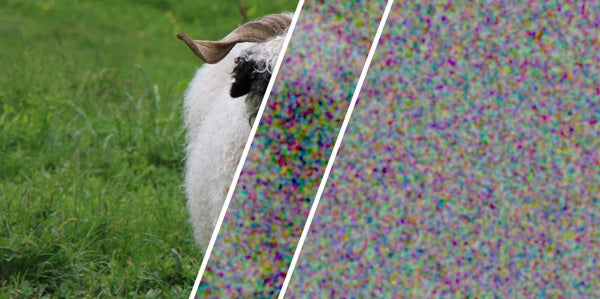
    A sheep image encrypted using ordinary randomness (center) and certified perfect randomness from an experiment at the Swiss Federal Institute of Technology Zurich (right). Only perfect randomness turns the image entirely into noise.

    The orderly flow of information around the globe depends a lot on security, and at the heart of that security is randomness.

    Modern-day encryption relies on unpredictability to avoid being cracked, and the most powerful form of unpredictability is randomness. And in a new study, researchers describe a new way to amplify that randomness.

    Random number generators have been around for ages, but they often have subtle imperfections that cause patterns to emerge. And even powerful computers are saddled with this liability purely because they use traditional transistors to generate the binary code—1’s and 0’s—that enables computers to store data and make calculations.


    On supporting science journalism

    If you’re enjoying this article, consider supporting our award-winning journalism by subscribing. By purchasing a subscription you are helping to ensure the future of impactful stories about the discoveries and ideas shaping our world today.


    “Any conventional electronic device like a phone or a computer is completely deterministic, so it’s actually very difficult for a computer or any other electronic device to generate a random value,” says Renato Renner, a physics professor at the Swiss Federal Institute of Technology Zurich (ETH Zurich) and a member of the research team. “It cannot just toss a coin because everything that goes on in the scale of the logic is basically completely predictable.”

    While these numbers may seem random at first glance, a quantum computer would be able to recognize even the most obscure patterns and thus crack the code.

    “Unpredictability is very important because that’s what the adversary would do to attack it—to just try to predict parts of that password or even the full password or parts of the key,” Renner says.

    That’s where the new system comes in. Qubits, the basic components of information in a quantum computer, don’t exist in a binary. Instead qubits have an infinite number of states in which they can exist and only collapse into a single state when their position is measured. In a paper published in Nature on Wednesday, Renner and his colleagues describe how a two-qubit system could generate true randomness.

    The scientists entangled two qubits kept at temperatures near absolute zero at the opposing ends of a 30-meter-long tube. When the two qubits were entangled, they shared the same positioning—in other words, if you measured both, you’d get the same output. The long tube was necessary to ensure enough physical separation so that no outside variables could bias the results, Renner says.

    “To really be sure that it’s not predictable, I need to have a process where I’m really sure that this process is not described by classical physics,” Renner says.

    In one experiment, a photograph of a sheep was run through the system, and its pixels were translated into randomness. The resulting mess of colors and splotches would be impossible to put back together, even using a quantum computer, according to the research.

    To further test their system, the researchers ran what’s known as a Bell test, which analyzes a quantum system for any hints it might be affected by classical physics.

    “Our setup is one that allows you to run many Bell tests with good quality and at a fast rate,” says Andreas Wallraff, Renner’s colleague at ETH Zurich and a co-author of the study. “For our experiment, we ran about a billion and a half of these Bell tests to create certifiably random outcomes that then are used in an algorithm that Renato and his team had developed to create this certified randomness.”

    While previous experiments have been able to generate randomness, Renner says the inclusion of a second qubit as a verification measure is new. That development enhances trust, another essential component to solid encryption.

    Commercially available quantum computers are still a long way off, but the real-world implications of Renner and Wallraff’s work are relevant now. Renner notes that there’s an entire Wikipedia page dedicated to hacks that were only possible because of imperfect cryptographic randomness.

    “This is the problem we solve, which is a current problem, not only a problem in the post-quantum-cryptography era,” he says, “but of course, it will remain a problem.”

    “I think cryptography will always rely on good randomness, independently of whether it’s now cryptography against conventional adversaries or future quantum adversaries,” he adds.

    It’s Time to Stand Up for Science

    If you enjoyed this article, I’d like to ask for your support. Scientific American has served as an advocate for science and industry for 180 years, and right now may be the most critical moment in that two-century history.

    I’ve been a Scientific American subscriber since I was 12 years old, and it helped shape the way I look at the world. SciAm always educates and delights me, and inspires a sense of awe for our vast, beautiful universe. I hope it does that for you, too.

    If you subscribe to Scientific American, you help ensure that our coverage is centered on meaningful research and discovery; that we have the resources to report on the decisions that threaten labs across the U.S.; and that we support both budding and working scientists at a time when the value of science itself too often goes unrecognized.

    In return, you get essential news, captivating podcasts, brilliant infographics, can’t-miss newsletters, must-watch videos, challenging games, and the science world’s best writing and reporting. You can even gift someone a subscription.

    There has never been a more important time for us to stand up and show why science matters. I hope you’ll support us in that mission.


    Original Source Link

    Share. Facebook Twitter Pinterest LinkedIn WhatsApp Email Reddit Telegram
    Previous ArticleNetflix’s Little House On The Prairie Remake Casts Iconic Season 2 Villain Ahead Of Series Premiere
    Next Article Google Security Engineer Arrested in Million-Dollar Polymarket Trading Scheme

    RELATED POSTS

    We finally know the name of a Maya mathematician

    July 14, 2026

    China’s Tianwen-2 Space Probe Has Rendezvoused With Earth’s Quasi-Moon

    July 13, 2026

    Deadly meat allergies from tick bites are on the rise. Should you be worried?

    July 13, 2026

    Scientists’ Side Hustle? Using AI and Quantum Computing to Generate New Peptides

    July 12, 2026

    How a 1,900-year-old latrine helps explain why Roman concrete lasts

    July 12, 2026

    UN space database aimed at easing global tensions is mysteriously down

    July 11, 2026
    latest posts

    Better Rocklahoma Headliner – Papa Roach vs. Godsmack

    Rocklahoma will be here before you know it, so this week we’re putting a focus…

    Iran mocks Trump’s reversal on Hormuz charges — ‘20% is of course too much. We will be fair’

    July 14, 2026

    Trump Demands The Rest Of The World Reimburse Him For His Iran War

    July 14, 2026

    Conor McGregor faces ridicule from WWE legend on ‘Monday Night Raw’

    July 14, 2026

    The Best Movies to Stream This Month (July 2026)

    July 14, 2026

    We finally know the name of a Maya mathematician

    July 14, 2026

    ‘Infernal Affairs’ Producer Was 75

    July 14, 2026
    Categories
    • Books (1,364)
    • Business (6,268)
    • Events (61)
    • Film (6,204)
    • Lifestyle (4,278)
    • Music (6,324)
    • Politics (6,246)
    • Science (5,621)
    • Technology (6,200)
    • Television (5,893)
    • Uncategorized (8)
    • US News (6,255)
    popular posts

    What Do Mysterious Nord Stream Methane Leaks Mean for Climate Change?

    Since 26 September, mysterious leaks have appeared in the underwater Nord Stream gas pipelines—which run…

    Zena White Accepts Executive of the Year From Femi Koleoso | Indie Power Players 2026

    June 10, 2026

    Trump slams DC crime surge after Hill intern murdered, vows crackdown and more top headlines

    August 11, 2025

    Martin Scorsese on Barbenheimer; ‘Killers of the Flower Moon’ Runtime – The Hollywood Reporter

    October 10, 2023
    Archives
    Browse By Category
    • Books (1,364)
    • Business (6,268)
    • Events (61)
    • Film (6,204)
    • Lifestyle (4,278)
    • Music (6,324)
    • Politics (6,246)
    • Science (5,621)
    • Technology (6,200)
    • Television (5,893)
    • Uncategorized (8)
    • US News (6,255)
    About Us

    We are a creativity led international team with a digital soul. Our work is a custom built by the storytellers and strategists with a flair for exploiting the latest advancements in media and technology.

    Most of all, we stand behind our ideas and believe in creativity as the most powerful force in business.

    What makes us Different

    We care. We collaborate. We do great work. And we do it with a smile, because we’re pretty damn excited to do what we do. If you would like details on what else we can do visit out Contact page.

    Our Picks

    We finally know the name of a Maya mathematician

    July 14, 2026

    ‘Infernal Affairs’ Producer Was 75

    July 14, 2026

    CBS News’ Matt Gutman Talks Falling Victim To Recent Scam

    July 14, 2026
    © 2026 New York Examiner News. All rights reserved. All articles, images, product names, logos, and brands are property of their respective owners. All company, product and service names used in this website are for identification purposes only. Use of these names, logos, and brands does not imply endorsement unless specified. By using this site, you agree to the Terms & Conditions and Privacy Policy.

    Type above and press Enter to search. Press Esc to cancel.

    We use cookies on our website to give you the most relevant experience by remembering your preferences and repeat visits. By clicking “Accept All”, you consent to the use of ALL the cookies. However, you may visit "Cookie Settings" to provide a controlled consent.
    Cookie SettingsAccept All
    Manage consent

    Privacy Overview

    This website uses cookies to improve your experience while you navigate through the website. Out of these, the cookies that are categorized as necessary are stored on your browser as they are essential for the working of basic functionalities of the website. We also use third-party cookies that help us analyze and understand how you use this website. These cookies will be stored in your browser only with your consent. You also have the option to opt-out of these cookies. But opting out of some of these cookies may affect your browsing experience.
    Necessary
    Always Enabled
    Necessary cookies are absolutely essential for the website to function properly. These cookies ensure basic functionalities and security features of the website, anonymously.
    CookieDurationDescription
    cookielawinfo-checkbox-analytics11 monthsThis cookie is set by GDPR Cookie Consent plugin. The cookie is used to store the user consent for the cookies in the category "Analytics".
    cookielawinfo-checkbox-functional11 monthsThe cookie is set by GDPR cookie consent to record the user consent for the cookies in the category "Functional".
    cookielawinfo-checkbox-necessary11 monthsThis cookie is set by GDPR Cookie Consent plugin. The cookies is used to store the user consent for the cookies in the category "Necessary".
    cookielawinfo-checkbox-others11 monthsThis cookie is set by GDPR Cookie Consent plugin. The cookie is used to store the user consent for the cookies in the category "Other.
    cookielawinfo-checkbox-performance11 monthsThis cookie is set by GDPR Cookie Consent plugin. The cookie is used to store the user consent for the cookies in the category "Performance".
    viewed_cookie_policy11 monthsThe cookie is set by the GDPR Cookie Consent plugin and is used to store whether or not user has consented to the use of cookies. It does not store any personal data.
    Functional
    Functional cookies help to perform certain functionalities like sharing the content of the website on social media platforms, collect feedbacks, and other third-party features.
    Performance
    Performance cookies are used to understand and analyze the key performance indexes of the website which helps in delivering a better user experience for the visitors.
    Analytics
    Analytical cookies are used to understand how visitors interact with the website. These cookies help provide information on metrics the number of visitors, bounce rate, traffic source, etc.
    Advertisement
    Advertisement cookies are used to provide visitors with relevant ads and marketing campaigns. These cookies track visitors across websites and collect information to provide customized ads.
    Others
    Other uncategorized cookies are those that are being analyzed and have not been classified into a category as yet.
    SAVE & ACCEPT