
Close Menu
New York Examiner News

    Subscribe to Updates

    Get the latest creative news from FooBar about art, design and business.

    What's Hot

    The BookTrib Brief: The Summer’s Hottest Authors Event Is Heating Up!

    August 8, 2026

    Iran Tricks Trump By Howard Bloom

    August 7, 2026

    Ace Frehley, Peter Criss Declined Invites to Play KISS’ Last Shows

    August 7, 2026
    Facebook X (Twitter) Instagram
    New York Examiner News
    • Home
    • US News
    • Politics
    • Business
    • Science
    • Technology
    • Lifestyle
    • Music
    • Television
    • Film
    • Books
    • Contact
      • About
      • Amazon Disclaimer
      • DMCA / Copyrights Disclaimer
      • Terms and Conditions
      • Privacy Policy
    New York Examiner News
    Home»Science»CDC Vaccine Panel Scraps Guidance for Universal Hepatitis B Shots at Birth
    Science

    CDC Vaccine Panel Scraps Guidance for Universal Hepatitis B Shots at Birth

    By AdminDecember 5, 2025
    Facebook Twitter Pinterest LinkedIn WhatsApp Email Reddit Telegram
    CDC Vaccine Panel Scraps Guidance for Universal Hepatitis B Shots at Birth


    December 5, 2025

    5 min read

    Google Logo Add Us On GoogleAdd SciAm

    CDC Vaccine Panel Scraps Guidance for Universal Hepatitis B Shots at Birth

    New guidance from the CDC’s vaccine advisory panel would do away with a decades-old universal birth dose recommendation for hepatitis B that helped cut infections by 99 percent in the U.S.
    By Lauren J. Young edited by Tanya Lewis & Claire Cameron

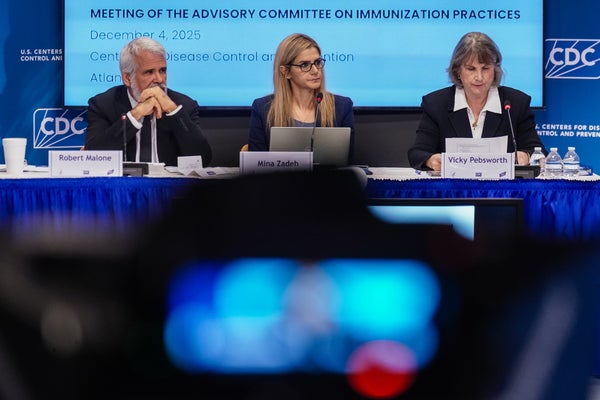
    Three people sit at a panel for vaccine policy

    The Centers for Disease Control and Prevention’s Advisory Committee on Immunization Practices at its December 4 meeting.

    Elijah Nouvelage/Getty Images

    On Friday an influential vaccine advisory panel voted to change the recommendations for the hepatitis B vaccine for newborns. Under the new guidance from the panel, which the Centers for Disease Control and Prevention almost always adopts, parents would need to consult with a health care provider about when to give a baby their first dose of the vaccine—so long as the person who gave birth to the baby tested negative for the disease. That would scrap current CDC policy that all babies receive the hepatitis B vaccine hours after birth. The vote passed with eight in favor and three against.

    The new Advisory Committee on Immunization Practices (ACIP) guidance recommends that the three-dose vaccine regimen begin at no earlier than two months of age for those infants. ACIP members also passed a second vote to recommend that parents discuss subsequent doses with a health care provider based on blood tests of the newborn’s immunity levels (protective antibody titers).

    “I will just say: we have heard that do no harm is a moral imperative. We are doing harm by changing this wording. And I vote no,” said ACIP member Cody Meissner, a pediatric infectious disease epidemiologist, during the first of three votes presented at today’s meeting.

    The CDC didn’t immediately respond to requests for comment from Scientific American.


    On supporting science journalism

    If you’re enjoying this article, consider supporting our award-winning journalism by subscribing. By purchasing a subscription you are helping to ensure the future of impactful stories about the discoveries and ideas shaping our world today.


    Public health experts have expressed concern about the lack of data to support the proposed timing of vaccination and have cautioned that delaying the initial dose would increase vulnerability to hepatitis B infection.

    “Why would you give the dose at two months versus an earlier or later time point?” says Helen Chu, a physician and immunologist at the University of Washington and a former ACIP member. That two-month period “is time that a child is at risk for a vaccine-preventable disease.”

    The decision comes after several meetings filled with heated debate and admitted confusion among members on what they were voting on. The panel had tabled the vote twice, first at a September meeting and again on Thursday. Deliberations ignited a “public outcry,” Chu says. Many public health experts and medical societies are “pretty clear that they do not want to eliminate the birth dose,” she says.

    At the meetings, several ACIP members argued that newborns whose birthing parent tested negative for the virus are “low risk” for the disease—and that deciding to vaccinate should be an individual right. Currently, states require people receive certain vaccines in order to attend public school or participate in certain jobs. Some members also raised concerns over adverse effects and limited data on vaccine safety, despite dozens of studies and CDC reviews that have demonstrated that the hepatitis B vaccine is safe and highly effective at preventing infections in infants.

    Today’s vote moves away from a vaccine policy established in 1991 that has dramatically reduced hepatitis B rates in children, according to a review of 400 studies published earlier this week.

    “The vaccine has essentially virtually eliminated childhood hepatitis B from the United States, and so it is really devastating to think about losing that,” says Yvonne Maldonado, a pediatrician at the Stanford University School of Medicine and a former ACIP member.

    ACIP’s decisions directly affect vaccine access. Vaccines for kids are covered either through private health insurance or Vaccines for Children (VFC)—a federal program that approximately half of the children in the U.S. are eligible for. Private and public insurers, including VFC, fully cover vaccines ACIP recommends under shared clinical decision-making. But public health experts have expressed concern that ACIP’s discussion and new shared decision-making recommendation will still ultimately weaken people’s ability to receive the vaccine.

    “When you remove the strength of that recommendation, pregnant women may or may not be offered that vaccine,” said Rochelle Walensky, former director of the CDC and now a senior fellow at Harvard University, in a press call on Thursday. “They may or may not have a discussion about how important it is for their newborn to be vaccinated. And that may fall off the radar in terms of the access.”

    Hepatitis B is a very contagious viral disease that damages the liver. Chronic cases can lead to liver disease or liver cancer. The virus spreads through bodily fluids, including blood and semen. The disease has been stigmatized because people associate it with unprotected sex and injection drug use, but the virus can also be transmitted during pregnancy and through childbirth and close contact of bodily fluids after birth.

    “In my career, I have seen children with hepatitis B. I’ve seen children die of liver failure, which is a horrible death. I would never wish this on anybody,” Maldonado says.

    About 18,000 infants and children were infected with hepatitis B annually before the vaccine was recommended to all newborns in the U.S., according to the Children’s Hospital of Philadelphia. The guidance called for three vaccine doses: the first has been given to infants at birth, the second has been given at one to two months old and the third has been given between six and 18 months. The birth dose helps prevent infection in the first weeks to months of life, Maldonado says. And the regimen has been effective: cases from 1990 to 2019 dropped by 99 percent.

    Delaying the first dose to the second month of age for infants born to pregnant parents who test negative for the virus or whose infection status is unknown could cause 1,437 more childhood infections, 304 liver cancer cases and 482 hepatitis B-related deaths, a recent preprint paper suggests.

    Public health experts note that the updated recommendation’s success is contingent on effective screening for hepatitis B in pregnant people. The CDC recommends that all pregnant people be tested for hepatitis B, preferably in the first trimester. But that testing can fail because hepatitis B can be “a silent infection,” Maldonado says.

    Only 84 to 88 percent of pregnant people get screened for the virus in the U.S.; more than 80 percent of people are unaware that they’re infected. False negatives can occur if the test is performed incorrectly or if a person was very recently infected. And other caregivers, such as family members and daycare workers, who might not be screened could also carry the virus, Maldonado says.

    “The simplest, safest, most effective way to protect all of the babies in this country is to give them that birth dose, along with the subsequent two doses, which is going to keep them protected for virtually their entire young adult life,” she adds.

    Editor’s Note: This is a developing story and may be updated.


    Original Source Link

    Share. Facebook Twitter Pinterest LinkedIn WhatsApp Email Reddit Telegram
    Previous ArticleXbox Makes 2019 Hidden Gem Free For All, No Game Pass Needed
    Next Article Here’s What You Should Know About Launching an AI Startup

    RELATED POSTS

    Scientists Used AI to Create 16 New Viruses

    August 7, 2026

    OpenAI’s latest math breakthroughs commit research misconduct, experts say

    August 7, 2026

    Meteor Showers, Eclipses, and More Are on the August 2026 Astronomical Calendar

    August 6, 2026

    Trump CDC pick Erica Schwartz confirmed to lead nation’s top public health agency

    August 6, 2026

    Gene-Edited Puppies Will Melt Your Heart—but Won’t Trigger Your Allergies

    August 5, 2026

    Wormholes could be the key to time travel

    August 5, 2026
    latest posts

    The BookTrib Brief: The Summer’s Hottest Authors Event Is Heating Up!

    The BookTrib Brief: The Summer’s Hottest Authors Event Is Heating Up! |…

    Iran Tricks Trump By Howard Bloom

    August 7, 2026

    Ace Frehley, Peter Criss Declined Invites to Play KISS’ Last Shows

    August 7, 2026

    Bank of America spends $250 million a year on weight loss drugs for staff: ‘We see a great impact’

    August 7, 2026

    Trump Turns On Pete Hegseth As His Administration Is Collapsing

    August 7, 2026

    Vehicle narrowly avoids slamming into driver on side of Ohio highway, dramatic video shows

    August 7, 2026

    Trump administration has spent nearly $4B to cancel offshore wind farms

    August 7, 2026
    Categories
    • Books (1,414)
    • Business (6,317)
    • Events (65)
    • Film (6,253)
    • Lifestyle (4,328)
    • Music (6,376)
    • Politics (6,300)
    • Science (5,670)
    • Technology (6,249)
    • Television (5,944)
    • Uncategorized (9)
    • US News (6,305)
    popular posts

    Nevada Rule Bans Biological Males From Playing in Girls’ Sports

    Credit: UPV/EHU. Press. via Wikimedia Commons Biological males can’t compete in girls’ sports under a…

    Multiple People Shot and Injured During French Montana Video Shoot in Miami

    January 7, 2023

    Authorities still searching for suspect in shooting of 2 Minnesota state lawmakers

    June 15, 2025

    Liberal Politico Claims MAGA Conservatives Are Obsessed With ‘Conspiracy Theories’ About the Epstein List and Child Trafficking | The Gateway Pundit

    January 10, 2024
    Archives
    Browse By Category
    • Books (1,414)
    • Business (6,317)
    • Events (65)
    • Film (6,253)
    • Lifestyle (4,328)
    • Music (6,376)
    • Politics (6,300)
    • Science (5,670)
    • Technology (6,249)
    • Television (5,944)
    • Uncategorized (9)
    • US News (6,305)
    About Us

    We are a creativity led international team with a digital soul. Our work is a custom built by the storytellers and strategists with a flair for exploiting the latest advancements in media and technology.

    Most of all, we stand behind our ideas and believe in creativity as the most powerful force in business.

    What makes us Different

    We care. We collaborate. We do great work. And we do it with a smile, because we’re pretty damn excited to do what we do. If you would like details on what else we can do visit out Contact page.

    Our Picks

    Vehicle narrowly avoids slamming into driver on side of Ohio highway, dramatic video shows

    August 7, 2026

    Trump administration has spent nearly $4B to cancel offshore wind farms

    August 7, 2026

    Scientists Used AI to Create 16 New Viruses

    August 7, 2026
    © 2026 New York Examiner News. All rights reserved. All articles, images, product names, logos, and brands are property of their respective owners. All company, product and service names used in this website are for identification purposes only. Use of these names, logos, and brands does not imply endorsement unless specified. By using this site, you agree to the Terms & Conditions and Privacy Policy.

    Type above and press Enter to search. Press Esc to cancel.

    We use cookies on our website to give you the most relevant experience by remembering your preferences and repeat visits. By clicking “Accept All”, you consent to the use of ALL the cookies. However, you may visit "Cookie Settings" to provide a controlled consent.
    Cookie SettingsAccept All
    Manage consent

    Privacy Overview

    This website uses cookies to improve your experience while you navigate through the website. Out of these, the cookies that are categorized as necessary are stored on your browser as they are essential for the working of basic functionalities of the website. We also use third-party cookies that help us analyze and understand how you use this website. These cookies will be stored in your browser only with your consent. You also have the option to opt-out of these cookies. But opting out of some of these cookies may affect your browsing experience.
    Necessary
    Always Enabled
    Necessary cookies are absolutely essential for the website to function properly. These cookies ensure basic functionalities and security features of the website, anonymously.
    CookieDurationDescription
    cookielawinfo-checkbox-analytics11 monthsThis cookie is set by GDPR Cookie Consent plugin. The cookie is used to store the user consent for the cookies in the category "Analytics".
    cookielawinfo-checkbox-functional11 monthsThe cookie is set by GDPR cookie consent to record the user consent for the cookies in the category "Functional".
    cookielawinfo-checkbox-necessary11 monthsThis cookie is set by GDPR Cookie Consent plugin. The cookies is used to store the user consent for the cookies in the category "Necessary".
    cookielawinfo-checkbox-others11 monthsThis cookie is set by GDPR Cookie Consent plugin. The cookie is used to store the user consent for the cookies in the category "Other.
    cookielawinfo-checkbox-performance11 monthsThis cookie is set by GDPR Cookie Consent plugin. The cookie is used to store the user consent for the cookies in the category "Performance".
    viewed_cookie_policy11 monthsThe cookie is set by the GDPR Cookie Consent plugin and is used to store whether or not user has consented to the use of cookies. It does not store any personal data.
    Functional
    Functional cookies help to perform certain functionalities like sharing the content of the website on social media platforms, collect feedbacks, and other third-party features.
    Performance
    Performance cookies are used to understand and analyze the key performance indexes of the website which helps in delivering a better user experience for the visitors.
    Analytics
    Analytical cookies are used to understand how visitors interact with the website. These cookies help provide information on metrics the number of visitors, bounce rate, traffic source, etc.
    Advertisement
    Advertisement cookies are used to provide visitors with relevant ads and marketing campaigns. These cookies track visitors across websites and collect information to provide customized ads.
    Others
    Other uncategorized cookies are those that are being analyzed and have not been classified into a category as yet.
    SAVE & ACCEPT