CLIMATEWIRE | ON NAVAJO LAND, Arizona — It was a solar panel array that finally gave Norma Toledo a place to call home.
For nights at a time this year, Toledo slept outside a Walmart in the cab of her Toyota Tacoma. But on one milestone day last month, as temperatures dipped below freezing, Toledo found herself in a warm RV that — for the first time — had access to electricity.
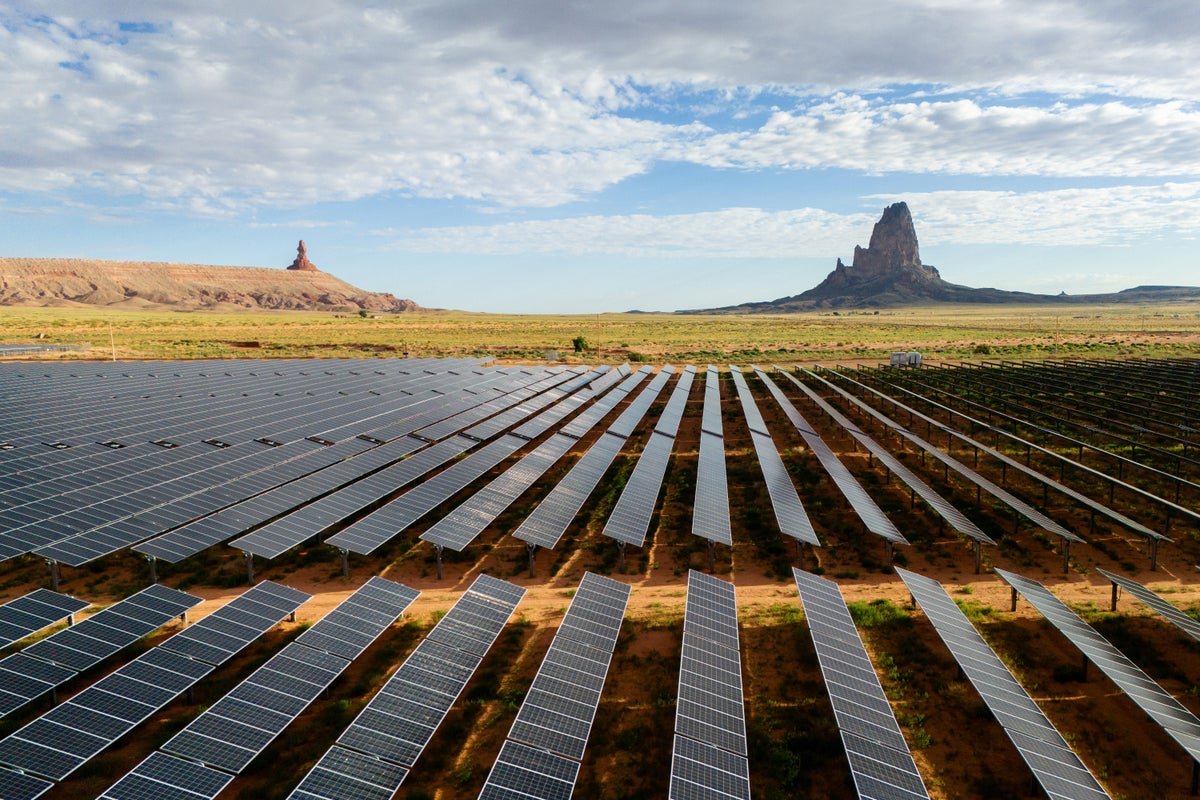
Her new solar power hookup was made possible by two of the biggest measures of the Biden administration: the Inflation Reduction Act and the bipartisan infrastructure law. Its installation is part of a more than $200 million effort to build out clean energy resources on tribal lands, including the Navajo reservation where Toledo lives.
On supporting science journalism
If you’re enjoying this article, consider supporting our award-winning journalism by subscribing. By purchasing a subscription you are helping to ensure the future of impactful stories about the discoveries and ideas shaping our world today.
“I’m out of this world right now. It’s like I finally got a homestead — I’m a homesteader,” said Toledo, 65, with a grin. “I didn’t think I’d ever get this far, but I kept trying, you know, I just kept trying and trying.”
Her time without electricity is a common experience on the Navajo reservation. About 17,000 homes on tribal lands nationally don’t have energy access. Most of them — about 15,000 — are on Navajo lands or the Hopi reservation contained within its borders.
The lack of electricity means tens of thousands of people must figure out a way to live without an amenity many Americans take for granted.
Food is stored in coolers that have to be continually stocked with ice. Diesel generators must run 24 hours a day to power refrigerators that store life-saving medication. Kerosene lanterns keep the lights on at night. Fuel runs can take an hour or more to reach a gas station.
The Inflation Reduction Act and the bipartisan infrastructure law are designed to change that. But electrifying tribal homes with solar power could come to a halt if former President Donald Trump is reelected. The Republican presidential nominee has called the laws a “Green New Scam” and pledged to gut them.
“I will immediately terminate the green new scam, that will be such an honor, the greatest scam in the history of any country,” Trump said at a rally in New Mexico on Thursday.
The Trump campaign did not respond to questions from POLITICO’s E&E News on whether he would continue the Biden administration’s push to bring more power to tribal lands if he defeats Vice President Kamala Harris this week and wins back the White House.
In the three months since Harris replaced President Joe Biden as the Democratic nominee, she has said very little about the Inflation Reduction Act. Nor has she introduced any new initiatives to address global warming. But Harris is broadly expected to continue the climate policies put in place during the Biden administration.
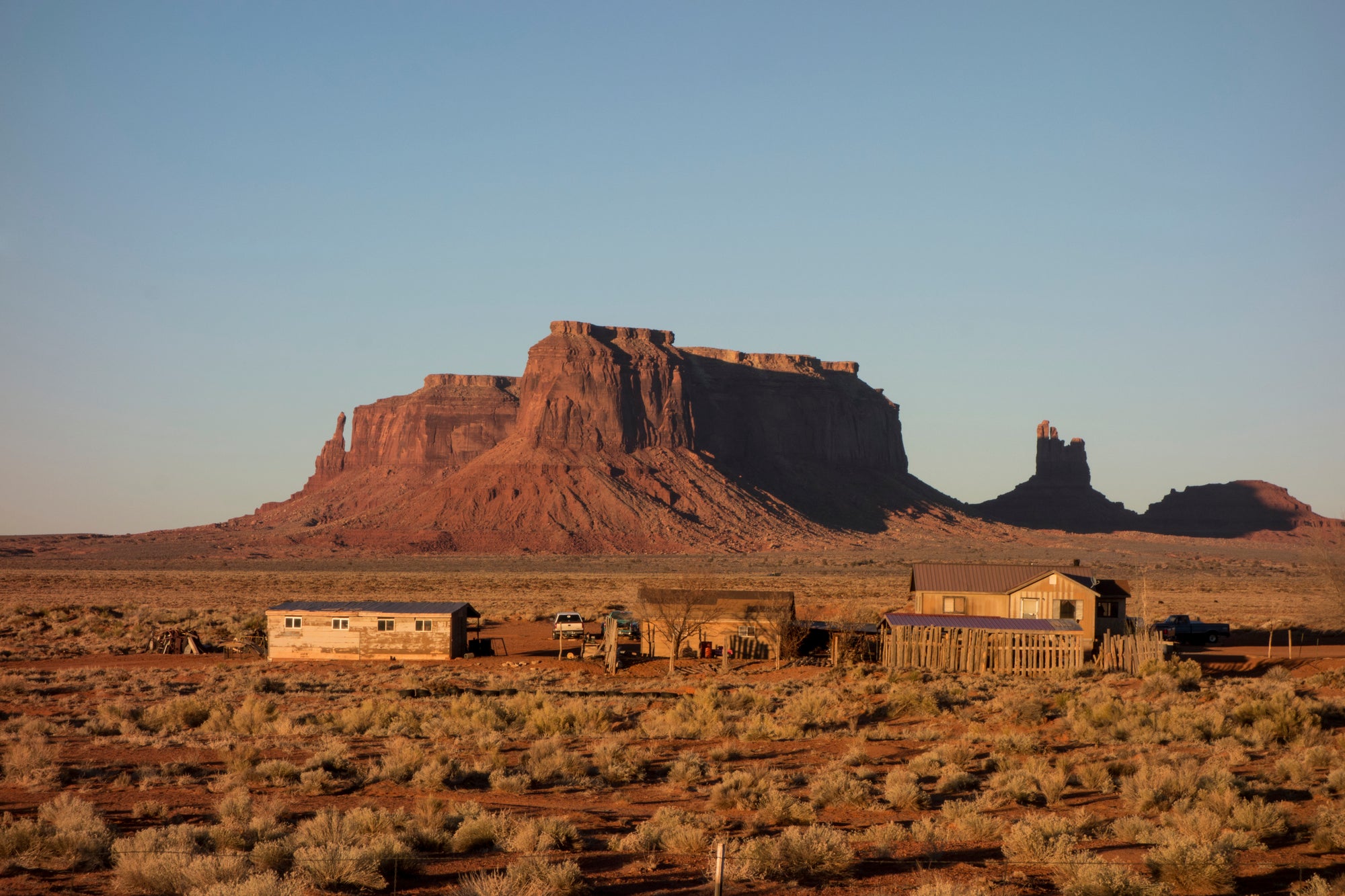
Navajo housing in the desert of Monument Valley Navajo Tribal Park near Kayenta on the Arizona-Utah border.
Nik Wheeler/Corbis via Getty Images
“When we invest in climate, we also invest in families, in communities, in opportunity and prosperity for all people,” Harris said in a video she posted to X on Saturday. “When we invest in climate, we invest in America.”
The federal money for tribal energy projects, estimated at more than $200 million, represents a tiny fraction of the $1.6 trillion in climate and infrastructure spending that was passed into law under Biden.
Even so, supporters say the initiative can be a life-changing experience for the people it connects to the grid. And it can be a boon for local businesses, too.
Navajo Power Home, one of several installers working to connect people to solar, recently received a $5 million grant from the Inflation Reduction Act as part of its effort to install off-grid battery storage solar in 1,000 homes by the end of 2025.
Local workers benefit, too. Solar companies on the reservation largely train and hire local people for installation and repairs — an opportunity that can be transformative for many families because good-paying jobs on tribal lands can be scarce.
And for the people receiving electricity for the first time, it offers something more than a working light switch. The power gives them a chance to live in their ancestral home.
“It supports their understanding of who they are, their relationship to their land, their homeland, their identity and so much more, and it allows them to stay where they’re from,” said Wahleah Johns, director of the U.S. Department of Energy Office of Indian Energy Policy and Programs.
Johns would know.
She grew up on the Navajo reservation without power and running water even though her family lived near the Navajo Generating Station, a massive coal power plant that closed during the Trump administration.
She said the 1936 Rural Electrification Act — which connected people outside cities to the grid — largely skipped over tribal lands. The legacy of that decision from the administration of President Franklin D. Roosevelt means that today many tribal homes are still cut off from power.
That’s true beyond Navajo Nation. Most homes on Native American reservations across the country are electrified. But in the Southwest and in Alaska — where isolated communities are far from transmission lines — tens of thousands of people still don’t have power and running water.
Clean energy and electrification efforts funded by the Inflation Reduction Act and the bipartisan infrastructure law are designed to correct such injustices, Johns said.
“The communities that have been left behind — we are bringing them up forward and prioritizing them,” Johns said. “I think probably one of the biggest investments in our history in Indian country is from this administration.”
Navajo Nation helped swing Arizona to Biden
Arizona is expected to play a decisive role in the presidential election this week — as it’s one of a few swing states left in play. That means Navajo voters could have an outsize impact on who wins the White House.
Biden beat Trump in Arizona four years ago by less than 11,000 votes, and a part of his support came from Navajo Nation. About 60,000 Navajo and Hopi voters cast ballots in 2020; the three northeastern Arizona counties that overlap the Navajo reservation and the Hopi reservation went for Biden by 57 percent.
But some of those votes could be in danger this year. In the wake of the 2020 election, Republican state lawmakers in Arizona passed a series of voter identification laws that could disproportionately disenfranchise Native Americans.
That includes a measure that requires proof of citizenship upon voter registration. Opponents say the new rule could depress Native American turnout because many homes on tribal lands do not have street addresses due to their geographical isolation. In addition, there are older Native Americans who were born at home and do not have birth certificates.
Jaynie Parrish, executive director of Native American Votes, a nonprofit group, described the new measures as the latest attempt by Republicans to suppress the Native American vote.
She said the voter identification efforts are driven by “racism and fear” as well as a desire to weaken a voting bloc that favors Democrats. “There’s a fear of more black and brown people speaking up and voting,” she said.
Arizona Republicans have said the measures are necessary to prevent alleged voter fraud.
Opponents of the proof of citizenship law challenged it in court, but it was upheld by the U.S. Supreme Court in August.
Navajo lands may be remote — it takes hours to get to the nearest city, Flagstaff, Arizona, from most spots on the reservation — but they’re hardly cut off from the presidential election.
A recent visit found the roadways dotted with campaign signs. “Protect our sovereignty, no king, vote Democratic,” read one sign. Another one — in front of one of the only grocery stores for 100 miles — read, “Trump low prices, Kamala high prices.”
In more than two dozen interviews, some residents said they were concerned Trump would not only end programs such as the solar electrification efforts but also ignore what makes the community unique.
“I think everybody’s gonna be in trouble, especially the Natives, because we’ve got a completely different life,” said Karl Kascoli, 64, a former coal miner who was laid off and now works at Lowe’s.
“We’ve got our own songs, our own prayers and different culture even. We even have a different language,” he added. “The government, they don’t really listen to us because they don’t understand our language.”
For Kameron Isaac, 31, the macho tenor of the Trump campaign is one reason he feels motivated to vote for Harris.
“The masculinity of that generation, it just needs to change,” said Isaac, who added that this year is the first time he’s voting in a presidential election.
He spoke to a reporter in between efforts to break in a wild colt he had captured by motorcycle on the mesa behind his family ranch.
“The toxic people that come with him, what happened in the White House, what he’s trying to do next, I feel like I can’t believe him,” he said. “Basically, he betrayed my trust.”
But support for Harris isn’t universal.
At the Cameron Trading Post — a restaurant, art gallery, hotel and tourist stop that is a hub of tribal employment — a Navajo man named Charles said he was eager to vote for Trump because of his anti-immigration views.
Charles, who refused to give his last name, said his great-grandfather battled white settlers to protect his land. He compared that fight to what he sees as the threat of undocumented immigrants, who could take land from Americans.
“It’s just the reverse, it’s happening to the white people now,” he said. “They’re going through what we went through with Europeans.”
Clean energy offers chance to right past wrongs
The drive to bring more solar power to those living on Navajo lands seeks to fulfill two major goals of the Biden administration: It expands the use of green energy, and it aims to address longstanding environmental inequities.
About half the total amount of solar installed in the U.S. came online during the Biden administration, according to Biden’s top climate adviser Ali Zaidi. Solar manufacturing quadrupled in that time. There are now more than 5 million solar installations in the United States, according to the Solar Energy Industries Association.
No matter what happens in the election, the administration will be “running through the tape” to make sure Inflation Reduction Act dollars reach as many recipients as possible, Zaidi told POLITICO’s E&E News.
Arizona in particular is well suited for solar power, ranking second nationally for solar potential — the state averages 270 sunny days a year.
But progress has been slow due in part to resistance from Republican state officials who have tapped the brakes on the transition to clean energy.
Still, there have been some bright spots for solar power.
In Arizona, the Inflation Reduction Act has yielded about $12 billion in public and private clean energy investments, including battery plants and utility-scale solar installations, according to Climate Power.
Support from the Biden administration also has helped create more than 18,000 clean energy jobs in Arizona. Those include solar manufacturing and installation jobs, as well as temporary construction jobs.
And at least 1,300 more homes on Navajo and Hopi lands will be electrified with solar panels and batteries by the end of next year because of the Inflation Reduction Act.
Clean energy offers a chance too to break from past injustices of fossil fuels, supporters say.
Part of that history includes the Navajo Generating Station, a massive 2,250-megawatt coal-fired power plant that provided electricity to the Phoenix area on transmission lines that ran through native communities and polluted their land, water and air without providing them power.
Brett Isaac, Navajo Power’s founder and executive chair, said energy companies also mined the reservation and sold its natural resources for billions of dollars while giving only a paltry share of revenue to the Navajo.
Green power can help reset that exploitative relationship, he said.
“We got a lot more purview into how this industry works and the reality of what can come out of it,” said Isaac, who serves on the President’s Export Council. “The same validation that I use to help people get comfortable with solar technology on their home is what I’m using to get leaders and decisionmakers comfortable with what it will do for their communities.”
Access to power also taps into the Navajo history of adaptation and self-sufficiency, Isaac said.
After the U.S. government forced the Navajo off their land and destroyed their homes and livestock, they had to find a way to thrive in the hard, arid landscape. “As Navajo people, adaptation is kind of our thing,” Isaac said.
In addition, bringing power to existing homes helps the Navajo people maintain a connection to the land, he said. Navajo tradition dictates that a baby’s umbilical cord should be buried on family land, a ritual intended to keep him or her spiritually linked to the place.
Isaac recalled a story in which his company helped bring power to a hogan — a traditional circular Navajo home often made of stone and timber.
The Navajo elder who owned it had been using it as a storage space. But when he checked on her a few weeks after connecting it to a solar power array, she greeted him at the door of the hogan with a huge smile.
Inside, she was cooking, her family had gathered around the ancestral dwelling, and her grandchildren were on the couch watching Netflix. Bulbs were glowing in light fixtures that had been dormant for 50 years.
“’The fact that you guys got me power,’” Isaac remembers her telling him, “’it’s just changed the way I think about things.’”
Reprinted from E&E News with permission from POLITICO, LLC. Copyright 2024. E&E News provides essential news for energy and environment professionals.