
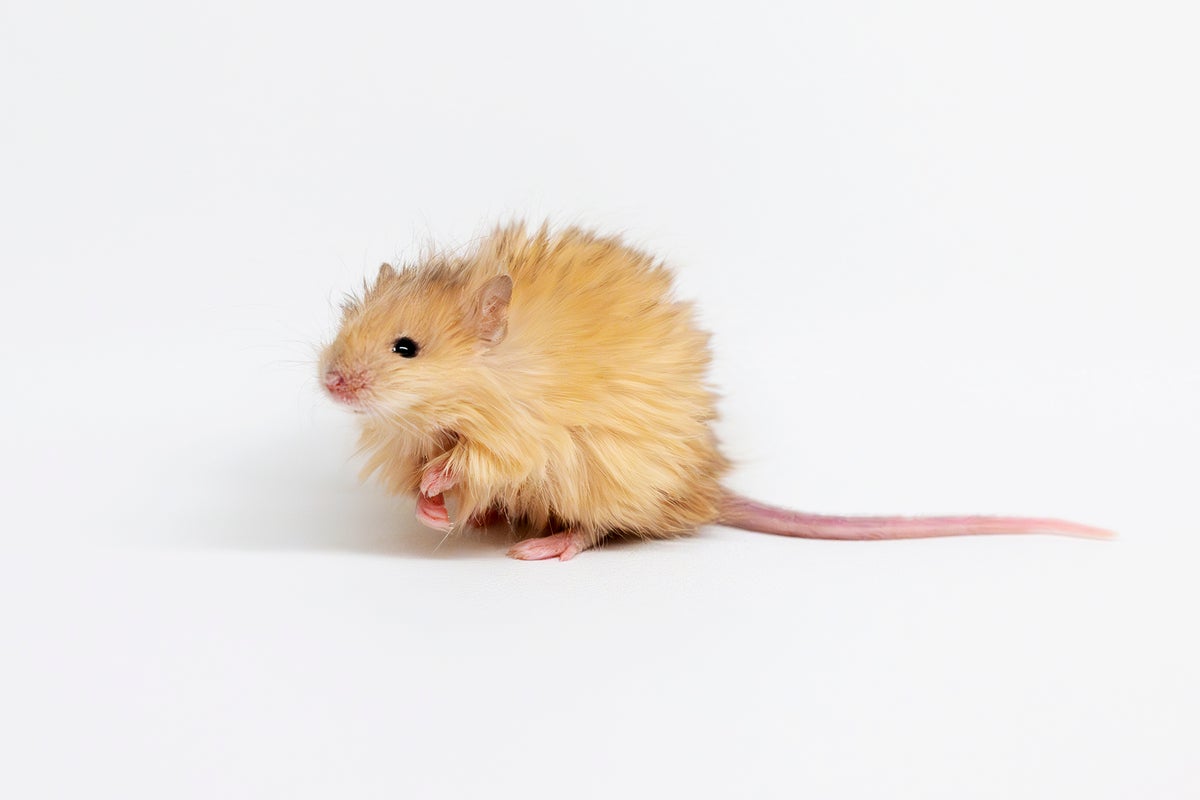
The biotech company Colossal Biosciences has long aspired to bring back the extinct woolly mammoth, which roamed the Northern Hemisphere thousands of years ago, during the last ice age. But for now, as a step along the way, the company has come up with something decidedly less mammoth: meet the woolly mouse.
On Tuesday Colossal announced this lab-born animal, which features shaggy, mammothlike fur and has cold-adapted traits such as the way in which it stores and burns fat. Researchers retrieved and sequenced ancient mammoth DNA from preserved skin, bone and hair to learn which genes controlled traits such as coat color and cold tolerance. They altered the corresponding genes in lab mice and made other alterations in the rodents’ genome.
What was the purpose of this feat of genetic engineering? Colossal’s pitch is that, with biodiversity going the way of the dodo (which the company also hopes to resurrect), saving existing species will require tweaking their DNA to make them more resilient. The researchers at the company also claim that bringing back extinct species can help the environment. For example, they say that mammoths can help fight climate change by tamping down Arctic permafrost, reducing how much of it is thawing and releasing methane into the atmosphere. Company co-founder and CEO Ben Lamm puts the approach in startling terms: “Why leave nature to chance?” In pursuit of such “de-extinction” goals, Colossal has raised hundreds of millions of dollars from everyone from celebrities to the CIA.
On supporting science journalism
If you’re enjoying this article, consider supporting our award-winning journalism by subscribing. By purchasing a subscription you are helping to ensure the future of impactful stories about the discoveries and ideas shaping our world today.
But many experts in genetic engineering and conservation are skeptical. Rewilding is risky; species such as wolves and elephants have come into conflict with humans, and others have fallen victim to predators and poachers. No one knows what would happen if a mammoth—or, more technically, an elephant-mammoth hybrid—was released: What would it eat? How would we protect it? Could it reproduce?
As for saving the climate, “we’re looking at a warming world, and [Colossal’s researchers] want to bring back creatures that are adapted to the cold?” says Elsa Panciroli, a paleontologist at National Museums Scotland, who studies ancient mice-sized mammals. “I study animals from the past, and they should stay in the past. Lack of habitat, human conflict, agriculture, climate change—the idea that they can fix that with gene editing is missing the big picture.”
How The Woolly Mouse Was Born
Colossal was co-founded in 2021 by Lamm, who made billions of dollars by founding tech companies, according to Forbes, and Harvard biologist George Church. In 2024 Colossal announced it had created elephant stem cells, which can be reprogrammed to become specific tissue—such as egg cells. Colossal says mass-produced elephant egg cells are vital for conservation breeding programs and will be needed to clone any future elephant-mammoth hybrids.
The woolly mouse is the latest development to emerge from that quest. (Mice are much easier to work with than elephants.) In a statement issued this week, Colossal’s chief science officer Beth Shapiro called the news “an important step toward validating our approach to resurrecting traits that have been lost to extinction.”
Colossal’s team used standard techniques to target different genes in the mouse genomes to create mammothlike hairs, patterns and color, producing “mice with long hair, enhanced waviness and altered coat texture,” according to a preprint research paper by the company that has not yet been peer-reviewed. “We used the ancient DNA to identify the genes we were interested in working with,” Shapiro says. “We looked for mice that have genetic variation in those same genes we identified using ancient DNA, and we then put those particular mouse variants together.”
A mouse gene altered with an ancient mammoth gene variant, or allele, that affects keratin (a protein found in hair and nails) was inserted into the mice to alter hair texture—specifically waviness. “It puts the mammoth version of that allele in the mouse,” Shapiro explains.
The team also targeted lipid metabolism, “which is the process by which the body breaks down, synthesizes and stores fats,” Shapiro says. The paper notes that “future experiments will examine the effect of high fat diets and temperature preferences” on the mice to inform further work toward the goal of developing cold-adapted elephant-mammoth hybrids.
Other experts say putting DNA from an extinct species into a living one is an accomplishment, but they still wonder: Why make a mutant mouse at all?
The Ethical Implications of De-Extinction
Gene editing has a high rate of failure, often killing surrogates and offspring, notes Robert Klitzman, a Columbia University bioethicist who questioned the value the woolly mouse beyond a “wow” factor.
Not all of the genetically modified mouse embryos led to successful pregnancies, Shapiro says, but “every mouse that was born is still alive.” (The mice were born in mid-October 2024.) She adds that “our mice have enhanced living conditions and are under the full-time care of our veterinary staff. All of our work is overseen by and must be preapproved by an external ethics board [the Institutional Animal Care and Use Committee], and only trained scientists interact with the mice.”
And if a mouse were to somehow escape the lab, the potential biological implications pose another concern because the animal could mate with members of wild populations. “Anyone who’s kept pet mice knows they can get out through very small holes,” Panciroli says.
“In certain ancient species’ DNA, you don’t know what the function of this DNA is, so there are more than ethical problems; there are biological hazards from moving and editing the DNA,” says Yale University geneticist Jiangbing. Zhou “I’m not sure about the potential risks of this type of work, as the function of ancient DNA in live mice may be difficult to predict.”
Shapiro points to the genetic mutations that happen naturally with reproduction and notes that most of these have no impact. “Genetic changes are not, in and of themselves, a cause for concern. That said, we are selecting genetic variation that we intend to have an impact on the way the organism looks or acts, and so more caution is necessary,” she says. “Our approach is to evaluate the impact of edits in as many ways as possible before making them.” The company also says all of the engineered mice born so far are male—and there are no plans to breed them.
What happens with the mice or—if the company ever realizes its ultimate ambition—the woolly mammoths is another ethical quandary. “I feel like Jeff Goldblum in Jurassic Park, but if we’re going to interfere with nature, there has to be good reason,” Panciroli says. Additionally, reintroduced animals (including elephants) are routinely targeted by poachers, points out Andrea Crosta, founder of a wildlife-crime-fighting nongovernment organization called Earth League International.
Craig Callender, who studies science ethics as a professor of philosophy at the University of California, San Diego, predicts this news will divide scientists. “The fact that the mice are alive, and that traits can be controlled by the genes [the Colossal researchers have] modified, makes it potentially a great tool” for genetic engineering, he says. “But if the mammoth is the end goal, it’s a stunt” because he doesn’t think such a project it has inherent value.
In response, Shapiro says, “Some people argue that our whole company is a stunt. While we respectfully disagree, we’d also like to point out the attention that our work draws from kids, students, and other members of the public who are inspired by what we are doing to become scientists, to think more about the impact that they can have on biodiversity, and to feel hopeful about the future.”
Shapiro contends that gene editing can and should be used alongside more traditional conservation approaches. “Habitats around the planet are changing at a pace that is faster than evolution by natural selection can keep up,” she says. “Gene editing could be used to help species become resistant to disease, to restore missing genetic variation or to correct gene sequences that lead to genetic disease but have become fixed in that population.”
But others are not convinced, especially by the creation of organisms such as the woolly mouse. “It’s arrogance,” says Sue Lieberman, vice president of international policy at the Wildlife Conservation Society, who spent decades fighting whaling and the ivory trade. “I’m not against technology. I’m not saying nature’s perfect. But this is such a waste of money when conservation is dying for lack of funds. To make some strange animal we can gawk at—we should be past that.”
Trailblazing biologist George Schaller agrees. “We need to protect what we have,” he says.