
For centuries, the “Unicorn Cave,” or “Einhornhöhle,” in central Germany has been famous for its many thousands of bones. In medieval times, people thought the bones came from unicorns.
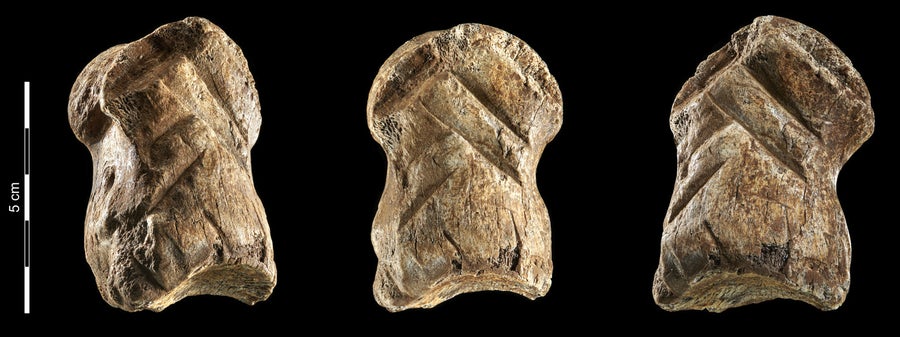
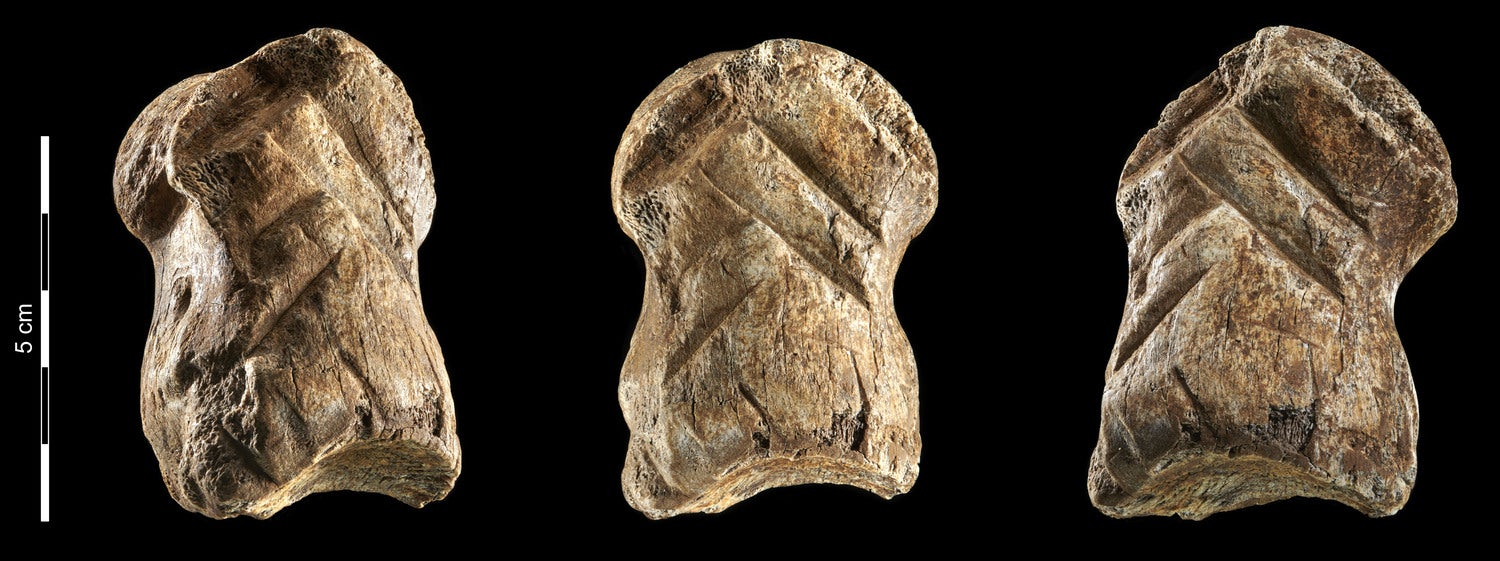
But a few years ago, archaeologists excavating the cave unearthed an unusual object: a toe bone from a giant deer. The material itself was noteworthy: Although giant deer were once prey for Europe’s prehistoric hunters, the animals usually roamed much farther north, indicating this bone had been brought from afar.
And it was clearly different from others in the cave: Several large grooves had been carved at angles into the bone’s upper surface, creating a prominent chevron-like pattern.
On supporting science journalism
If you’re enjoying this article, consider supporting our award-winning journalism by subscribing. By purchasing a subscription you are helping to ensure the future of impactful stories about the discoveries and ideas shaping our world today.
Even more extraordinary was its age: Radiocarbon dating of the bone showed that the deer lived around 51,000 years ago, when the Unicorn Cave was occupied by Neanderthals, our extinct human relatives.
“The engraved bone from Einhornhöhle is at least 50,000 years old and thus ranges among the oldest known symbolic objects,” said Dirk Leder, an archaeologist with the Lower Saxony state government who has published research on the object. The meaning of the symbolism is lost to time, but it may have been “a device intended to communicate with other group members, outsiders, spirits or the like — we simply don’t know,” he said.
The bone is one of several contenders for the much-disputed title of the “world’s oldest art.” This is a broad and crowded field — encompassing what look like accidental chicken scratches and representational imagery that is breathtakingly realistic.
Over the past decade, increasing evidence suggests artistic expression emerged much earlier in human evolution than scientists once thought, and it’s reshaping our understanding of the cognitive abilities of archaic humans, such as Neanderthals and earlier hominins. For instance, there’s archaeological evidence that Neanderthals made abstract designs on cave walls long before Homo sapiens arrived in Europe and may have made pendants from eagle talons up to 130,000 years ago.
“Cognitively, Neanderthals seem to have been just as capable at becoming artists as our own species, Homo sapiens,” Leder said.
Ancient artistic expression
Because most archaeologists are not art theorists, their debates have avoided defining the term “art.” Instead, many have focused on early forms of symbolism — objects clearly intended to depict something, like a bear drawn on a wall, as well as objects in which the symbolism is unclear, like the carved bone from the Unicorn Cave.
Leder, for his part, avoids calling the carved bone from the Unicorn Cave “art.” Instead, he prefers the term “pre-art,” which researchers use to describe very early forms of artistic expression.
The Unicorn Cave artifact is far from the oldest possible example of such pre-art. Many of these early examples of artistic expression were made by Neanderthals. They include roughly 75,000-year-old cave drawings in France that look like indistinct scratches, ancient cave paintings in Spain that are about 64,000 years old, and 57,000-year-old engravings on a cave wall in France that are the earliest “unambiguous” evidence of abstract designs by Neanderthals, although archaeologists don’t know what the designs meant.
Other archaic humans may have used symbolism even before Neanderthals emerged, said Thomas Terberger, a professor of prehistoric archaeology at the University of Göttingen in Germany who has also studied the carved bone from the Unicorn Cave.
“There is increasing evidence for ornaments and various expressions of symbolic behavior since about 120,000 years ago in Africa and Europe,” Terberger told Live Science.
Going back further, archaeologists have found hundreds of stone spheres, a few inches across, at several ancient human sites where stone tools were made. The earliest date from around 2 million years ago — which predates the emergence of Neanderthals and H. sapiens by more than a million years. While some have suggested the spheres were “hammerstones” or the stone “cores” that remained from flaking stone tools, it is not clear what the spheres’ function was, or even if they had one.
Experts don’t call the spheres “art,” but analysis suggests they were deliberately shaped to be increasingly spherical, perhaps in the pursuit of “symmetry” — something also seen in some paleolithic hand axes.
There are also prehistoric indentations or cup-shaped marks called cupules, found throughout Africa, Europe, Asia and the Americas, with the earliest known dating to 1.7 million years ago. It’s been proposed that the cupules may have been used to grind seeds. But many archaeologists now think the cupules had no function other than to decorate the rock surface.
Rethinking our extinct relatives
These findings are forcing archaeologists to rethink their understanding of our ancient human relatives’ cognition. For a long time, archaeologists thought only H. sapiens were intellectually developed enough to make, use and appreciate art, which they tended to equate with symbolism. This ability was epitomized by hundreds of stunning animals emblazoned on the walls of France’s Chauvet Cave. Often likened to a prehistoric Sistine Chapel, these drawings of woolly rhinoceroses, mammoths, bison and cave bears were sketched by people of astonishing artistic ability as far back as 35,000 years ago.
But for Leder and others, artifacts at multiple archaeological sites are evidence that hominins such as Neanderthals had a rudimentary artistic sense. And while only a few of these artifacts remain, it’s possible there were somewhat more impressive works, made by Neanderthal Michelangelos, which have since been lost.
That’s because many Neanderthal art objects would have been made out of perishable materials such as wood or animal skin, Bruce Hardy, a paleoanthropologist at Kenyon College in Ohio, wrote for the website Sapiens.
“Absence of evidence is not evidence of absence,” Hardy wrote. So what’s left in the archaeological record might only be what has survived, rather than an accurate representation of the range of Neanderthals’ artistic ability.
What art says about us
At its heart, any debate over the world’s oldest art is informed by theories about the purpose of art and what it says about human cognition.
Archaeologist and psychologist Derek Hodgson, an expert in prehistoric cave art formerly at the University of York in the U.K., thinks the evolution of an artistic sense among hominins — of whatever species — developed alongside their abilities to make stone tools and use other objects to modify their habitats.
“That sensitivity seems to have reached a stage whereby, instead of just being applied to making tools, it gradually became detached from those tools,” Hodgson told Live Science in an email. He suggested that accidental marks made during the making of stone tools would have been noticed as “something significant in themselves, which were either added to or copied.”
In turn, such marks may have resonated within the neural networks of the human brain, which may have triggered a feeling of gratification when such repetitive patterns were perceived, Hodgson said — an idea he developed in a 2019 paper in the Journal of Archaeological Science: Reports and others. (Scans show that a number of brain regions respond when modern people appreciate or create visual art, though whether and to what extent similar processes occurred in our extinct human relatives and ancestors is impossible to say.)
Such repetitive patterns are found in multiple places, including a hashtag-like design that H. sapiens drew with ochre in Blombos Cave in South Africa and a zigzag pattern that H. erectus engraved on a shell around 540,000 years ago in Indonesia, Hodgson said.
The ancient stone spheres, too, may be a sign that an interest in geometry was developing at that time, when early hominins experimented with symmetry to assess its merits, he said. But although this sense of symmetry is seen in early humans, it seems to be absent in some of our closest living relatives, Hodgson said. “Recent research on nonhuman primates, such as baboons, found that they were unable to identify symmetrical patterns… in contrast to modern humans, who found this task to be easy,” he said.
Terberger, for his part, thinks symbolism, rather than being tied to a single species, seems to have emerged when the conditions for producing it became suitable. Those conditions may have included developments in the organization of prehistoric societies that led to larger groups of individuals and communication among different groups.
“You do not only need a person to make it but a group of people to share it and to communicate with via these decorations,” Terberger said.
Some experts, however, don’t place much importance on the cognitive implications of some of these very early artifacts.
One of those skeptics is Adam Brumm, a professor of archaeology at Griffith University in Australia who led a team of researchers that discovered a warty pig painted in a cave on the Indonesian island of Sulawesi that dating with uranium and thorium isotopes suggests is around 45,500 years old. The painting, likely made by anatomically modern humans, is the oldest known representational work of art in the archaeological record.
To Brumm, the Sulawesi pig requires a different suite of cognitive processes than the ambiguous designs and scratch marks attributed to our extinct human relatives.
“There may be indications that some Neanderthals were producing markings of various kinds that would fall within the rubric of ‘art,'” Brumm told Live Science in an email. But “so far the evidence suggests only our species is capable of producing representational art.”
Copyright 2023 LiveScience, a Future company. All rights reserved. This material may not be published, broadcast, rewritten or redistributed.