
Close Menu
New York Examiner News

    Subscribe to Updates

    Get the latest creative news from FooBar about art, design and business.

    What's Hot

    Austin City Limits Announces 2026 Livestream Schedule

    October 1, 2026

    Singapore launches FirstDate dating service for government workers

    October 1, 2026

    Justin Boone’s Top Quarterbacks for Week 4

    October 1, 2026
    Facebook X (Twitter) Instagram
    New York Examiner News
    • Home
    • US News
    • Politics
    • Business
    • Science
    • Technology
    • Lifestyle
    • Music
    • Television
    • Film
    • Books
    • Contact
      • About
      • Amazon Disclaimer
      • DMCA / Copyrights Disclaimer
      • Terms and Conditions
      • Privacy Policy
    New York Examiner News
    Home»Science»Does Brain Stimulation Boost Memory and Focus? Huge Study Tries to Settle Debate
    Science

    Does Brain Stimulation Boost Memory and Focus? Huge Study Tries to Settle Debate

    By AdminJune 4, 2023
    Facebook Twitter Pinterest LinkedIn WhatsApp Email Reddit Telegram
    Does Brain Stimulation Boost Memory and Focus? Huge Study Tries to Settle Debate


    Does Brain Stimulation Boost Memory and Focus? Huge Study Tries to Settle Debate

    After years of debate over whether non-invasively zapping the brain with electrical current can improve a person’s mental functioning, a massive analysis of past studies offers an answer: probably. But some question that conclusion, saying that the analysis spans experiments that are too disparate to offer a solid answer.

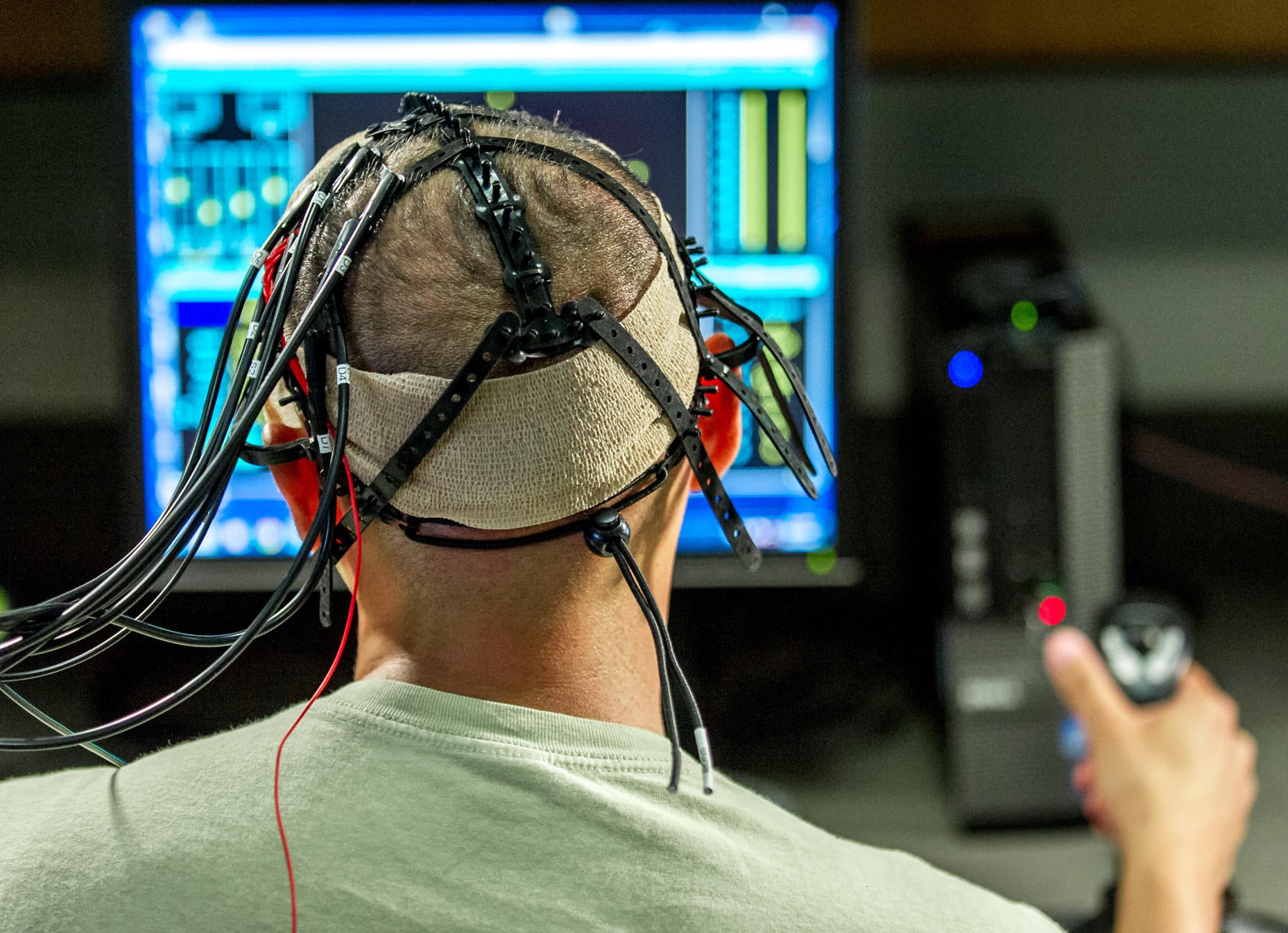
    In the past six years, the number of studies testing the therapeutic effects of a class of techniques called transcranial electrical stimulation has skyrocketed. These therapies deliver a painless, weak electrical current to the brain through electrodes placed externally on the scalp. The goal is to excite, disrupt or synchronize signals in the brain to improve function.

    Researchers have tested transcranial alternating current stimulation (tACS) and its sister technology, tDCS (transcranial direct current stimulation), on both healthy volunteers and those with neuropsychiatric conditions, such as depression, Parkinson’s disease or addiction. But study results have been conflicting or couldn’t be replicated, leading researchers to question the efficacy of the tools.

    The authors of the new analysis, led by Robert Reinhart, director of the cognitive and clinical neuroscience laboratory at Boston University in Massachusetts, say they compiled the report to quantify whether tACS shows promise, by comparing more than 100 studies of the technique, which applies an oscillating current to the brain. “We have to address whether or not this technique is actually working, because in the literature, you have a lot of conflicting findings,” says Shrey Grover, a cognitive neuroscientist at Boston University and an author on the paper.

    Their meta-analysis, published on 24 May in Science Translational Medicine, concluded that tACS treatment brings about moderate improvements in attention, long-term memory, working memory, the ability to process new information and solve problems, and other high-level cognitive processes. The findings give researchers a reason to keep investigating tACS in humans, Grover says. The technique “does appear to bring a significant change in mental function, at least in the short term,” he says.

    “Certainly, there’s promise that further research could be fruitful,” says Sarah Lisanby, a psychiatrist who specializes in neuromodulation at the US National Institute of Mental Health in Bethesda, Maryland. “As to whether this could result in the development of a future therapeutic intervention, I would say the jury is still out.”

    Importantly, the meta-analysis could help to inform the design of future studies, Lisanby says. For example, the report found that improvements in cognition were generally better after completion of treatment than during treatment, and that higher intensity stimulation isn’t necessarily more beneficial. The report also found that studies that used computational simulations to predict how the electrical current would move through the brain helped researchers to arrange the electrodes on people’s heads in more effective patterns.

    An emerging technology

    The biggest impact of the meta-analysis might be that it highlights significant weaknesses in tACS research that must be improved, Lisanby says. For example, the team found that 98 of the 102 studies were not pre-registered, meaning that the investigators had not stated their hypotheses and methods on record in journals or on sites such as clinicaltrials.gov before their experiments began. This increases the risk of publication bias — a trend in which positive results are more likely to be published than negative ones — because if a study is not pre-registered and fails, there is less chance that its findings will be shared.

    But not everyone thinks the meta-analysis is so useful. “The problem I have with this paper is that it lumps together studies that are effectively different interventions,” says Alvaro Pascual-Leone, a neurologist at Harvard Medical School in Boston.

    Pascual-Leone notes that the studies included in the meta-analysis differed vastly from one another in terms of which parts of the brain were targeted, the arrangement of the electrodes on the scalp and the frequency and intensity of the electrical current. The cognitive tasks that the participants performed were different in each study, and the participants themselves varied just as widely: young and old, healthy and with disease.

    Drawing an overall conclusion on the basis of such dissimilar studies, many of which have not been replicated, risks erroneous conclusions, Pascual-Leone says. “In fact, the differences in how the stimulation is applied matter a lot,” he says. “This [report] is a comprehensive effort that provides a nice overview of the field as a whole, and that is all commendable, but it’s a mixing and matching of different things, so I’m not really sure we learn a whole lot.”

    Grover responds that tACS is an emerging technology and that the team aimed to produce an “expansive analysis” of its general effectiveness. But he acknowledges that a future analysis should focus on more specific experimental designs.

    In other words, the debate doesn’t seem to be settled.

    The US Food and Drug Administration has not approved a tACS or tDCS therapy for any disease, but other regulators, such as those in Europe, Brazil, China, Australia and Mexico, have approved tDCS for treatment of some conditions, such as depression or pain.

    This article is reproduced with permission and was first published on May 26, 2023.


    Original Source Link

    Share. Facebook Twitter Pinterest LinkedIn WhatsApp Email Reddit Telegram
    Previous ArticleAmanda review – Amelie’s rich uncouth Italian cousin
    Next Article Audi Q8 E-tron 2023: Review, Prices, Specs

    RELATED POSTS

    Measles Is Forcing Hospitals to Adapt to a New Normal

    October 1, 2026

    NASA directive might increase the odds of contaminating Mars

    October 1, 2026

    A Biotech Founder Makes the Moral Case for Gene-Editing Human Embryos

    September 30, 2026

    Blockbuster retatrutide trial signals a ‘new high-water mark’ for weight-loss drugs

    September 30, 2026

    Plastic Is Melting Onto Corals

    September 29, 2026

    One in eight new cancers are likely caused by infections—there’s an easy way to protect yourself

    September 29, 2026
    latest posts

    Austin City Limits Announces 2026 Livestream Schedule

    The first weekend of Austin City Limits 2026 goes down at Zilker Park in Austin…

    Singapore launches FirstDate dating service for government workers

    October 1, 2026

    Justin Boone’s Top Quarterbacks for Week 4

    October 1, 2026

    Hillsboro School District sued over Christian curriculum reimbursement

    October 1, 2026

    Opus 5.5 loves to tell you ‘this matters’ (and other AI writing tells)

    October 1, 2026

    Measles Is Forcing Hospitals to Adapt to a New Normal

    October 1, 2026

    Books & Looks Podcast — The Feather Wars: Egret Plumes, Punt Guns, and the Fight to Save America’s Birds

    October 1, 2026
    Categories
    • Books (1,524)
    • Business (6,428)
    • Events (78)
    • Film (6,362)
    • Lifestyle (4,428)
    • Music (6,492)
    • Politics (6,416)
    • Science (5,780)
    • Technology (6,361)
    • Television (6,054)
    • Uncategorized (9)
    • US News (6,415)
    popular posts

    U.S. Inflation Hits New Four-Decade High of 9.1%

    U.S. consumer inflation rose last month from the year before at the highest rate in…

    Presence review – an enjoyably swift chiller

    January 24, 2025

    The Largest Camera Ever Built Releases Its First Images of the Cosmos

    June 23, 2025

    You Can Now Snag a Specialized Electric Bike for $2,000

    November 26, 2023
    Archives
    Browse By Category
    • Books (1,524)
    • Business (6,428)
    • Events (78)
    • Film (6,362)
    • Lifestyle (4,428)
    • Music (6,492)
    • Politics (6,416)
    • Science (5,780)
    • Technology (6,361)
    • Television (6,054)
    • Uncategorized (9)
    • US News (6,415)
    About Us

    We are a creativity led international team with a digital soul. Our work is a custom built by the storytellers and strategists with a flair for exploiting the latest advancements in media and technology.

    Most of all, we stand behind our ideas and believe in creativity as the most powerful force in business.

    What makes us Different

    We care. We collaborate. We do great work. And we do it with a smile, because we’re pretty damn excited to do what we do. If you would like details on what else we can do visit out Contact page.

    Our Picks

    Measles Is Forcing Hospitals to Adapt to a New Normal

    October 1, 2026

    Books & Looks Podcast — The Feather Wars: Egret Plumes, Punt Guns, and the Fight to Save America’s Birds

    October 1, 2026

    Owen Wilson in Tone-Deaf Comedy

    October 1, 2026
    © 2026 New York Examiner News. All rights reserved. All articles, images, product names, logos, and brands are property of their respective owners. All company, product and service names used in this website are for identification purposes only. Use of these names, logos, and brands does not imply endorsement unless specified. By using this site, you agree to the Terms & Conditions and Privacy Policy.

    Type above and press Enter to search. Press Esc to cancel.

    We use cookies on our website to give you the most relevant experience by remembering your preferences and repeat visits. By clicking “Accept All”, you consent to the use of ALL the cookies. However, you may visit "Cookie Settings" to provide a controlled consent.
    Cookie SettingsAccept All
    Manage consent

    Privacy Overview

    This website uses cookies to improve your experience while you navigate through the website. Out of these, the cookies that are categorized as necessary are stored on your browser as they are essential for the working of basic functionalities of the website. We also use third-party cookies that help us analyze and understand how you use this website. These cookies will be stored in your browser only with your consent. You also have the option to opt-out of these cookies. But opting out of some of these cookies may affect your browsing experience.
    Necessary
    Always Enabled
    Necessary cookies are absolutely essential for the website to function properly. These cookies ensure basic functionalities and security features of the website, anonymously.
    CookieDurationDescription
    cookielawinfo-checkbox-analytics11 monthsThis cookie is set by GDPR Cookie Consent plugin. The cookie is used to store the user consent for the cookies in the category "Analytics".
    cookielawinfo-checkbox-functional11 monthsThe cookie is set by GDPR cookie consent to record the user consent for the cookies in the category "Functional".
    cookielawinfo-checkbox-necessary11 monthsThis cookie is set by GDPR Cookie Consent plugin. The cookies is used to store the user consent for the cookies in the category "Necessary".
    cookielawinfo-checkbox-others11 monthsThis cookie is set by GDPR Cookie Consent plugin. The cookie is used to store the user consent for the cookies in the category "Other.
    cookielawinfo-checkbox-performance11 monthsThis cookie is set by GDPR Cookie Consent plugin. The cookie is used to store the user consent for the cookies in the category "Performance".
    viewed_cookie_policy11 monthsThe cookie is set by the GDPR Cookie Consent plugin and is used to store whether or not user has consented to the use of cookies. It does not store any personal data.
    Functional
    Functional cookies help to perform certain functionalities like sharing the content of the website on social media platforms, collect feedbacks, and other third-party features.
    Performance
    Performance cookies are used to understand and analyze the key performance indexes of the website which helps in delivering a better user experience for the visitors.
    Analytics
    Analytical cookies are used to understand how visitors interact with the website. These cookies help provide information on metrics the number of visitors, bounce rate, traffic source, etc.
    Advertisement
    Advertisement cookies are used to provide visitors with relevant ads and marketing campaigns. These cookies track visitors across websites and collect information to provide customized ads.
    Others
    Other uncategorized cookies are those that are being analyzed and have not been classified into a category as yet.
    SAVE & ACCEPT