
Close Menu
New York Examiner News

    Subscribe to Updates

    Get the latest creative news from FooBar about art, design and business.

    What's Hot

    Refresh Your Stack with This Week’s Hottest Upcoming Book Releases

    January 18, 2026

    Ed Sheeran Asks Fans to Choose Songs for Australia & New Zealand Tour

    January 18, 2026

    FBI asks agents to voluntarily travel to Minneapolis

    January 18, 2026
    Facebook X (Twitter) Instagram
    New York Examiner News
    • Home
    • US News
    • Politics
    • Business
    • Science
    • Technology
    • Lifestyle
    • Music
    • Television
    • Film
    • Books
    • Contact
      • About
      • Amazon Disclaimer
      • DMCA / Copyrights Disclaimer
      • Terms and Conditions
      • Privacy Policy
    New York Examiner News
    Home»Science»Egypt’s Famed Pyramids Overlooked a Long-Lost Branch of the Nile
    Science

    Egypt’s Famed Pyramids Overlooked a Long-Lost Branch of the Nile

    By May 16, 2024
    Facebook Twitter Pinterest LinkedIn WhatsApp Email Reddit Telegram
    Egypt’s Famed Pyramids Overlooked a Long-Lost Branch of the Nile


    Lost Branch of the Nile May Solve Long-Standing Mystery of Egypt’s Famed Pyramids

    A former stretch of the Nile River, now buried beneath the Sahara Desert, may help scientists understand how Egyptians built the pyramids and adapted to a drying landscape
    By Riis Williams

    Egypt’s Famed Pyramids Overlooked a Long-Lost Branch of the Nile

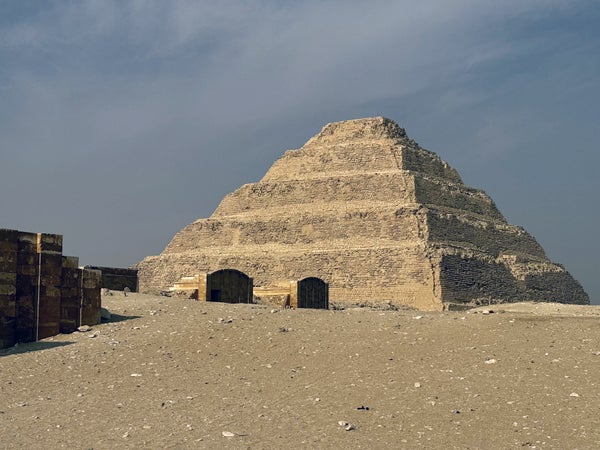
    The Step Pyramid of Djoser, constructed during the third dynasty of Egypt.

    Atop a rocky, arid plateau in the Sahara’s Western Desert in Egypt stands the last of the Seven Wonders of the Ancient World: the Great Pyramid of Giza. The 455-foot-tall stone structure and several smaller pyramids in the area have long provided research material for scientists working to decipher ancient Egyptians’ inscriptions to figure out how they constructed such massive monuments—and to understand why they built them so far from the Nile River, the lifeblood of their great civilization.

    Geomorphologist Eman Ghoneim says she has pondered that last mystery for years. “I was born and lived most of my life in Egypt,” she says, “and one question that I remember asking myself since I was very young is: ‘Why did our ancestors build pyramids in this specific, odd place—and why so far from the water?’ I had this feeling like there was something more there.”

    A slightly curved pyramid

    The Bent Pyramid at the necropolis of Dahshur. The pyramid was constructed during Egypt’s fourth dynasty.


    On supporting science journalism

    If you’re enjoying this article, consider supporting our award-winning journalism by subscribing. By purchasing a subscription you are helping to ensure the future of impactful stories about the discoveries and ideas shaping our world today.


    Ghoneim, a professor at the University of North Carolina Wilmington, recently showed that at the time they were built, the pyramids were in fact much closer to water. (They stand more than five miles from the Nile’s closest bank today.) By analyzing batches of satellite images and sediment samples collected from deep beneath the desert’s surface, she and her research team located a long-lost ancient branch of the Nile that once ran through the foothills just beside the Giza pyramid field. It’s likely that this channel, which the study team named the Ahramat (“pyramid” in Arabic), is how builders transported materials to the pyramid construction grounds, Ghoneim says. Knowing its course can help archeologists search for potential sites of ancient human settlements that may be buried beneath vast, dusty plain. The researchers detailed their discovery in a study published on Thursday in Communications Earth & Environment.

    Scientists have long suspected that the Nile—which runs northward for roughly 4,100 miles from Lake Victoria in Tanzania, Kenya and Uganda to the Mediterranean Sea—once had several offshoots. Past research indicates that during the middle of the Holocene epoch, about 10,000 to 6,000 years ago, the Nile floodplain was a lush, marshy habitat that narrowed and became largely barren after a long period of scant rainfall and increased aridity in the Late Holocene.

    Researchers stand over a table of soil samples wrapped in plastic

    Eman Ghoneim’s research team organizes collected soil samples.

    Today’s scorched, unforgiving Sahara is a tricky place to conduct the kind of fieldwork involved in searching for former river channels. Before braving the environment for a dig, the research team used radar satellites to peer beneath the top layer of earth and produce images of the subsurface. These revealed subtle patterns and textures in the ground’s layers near the pyramids—features that differed from other areas of the desert and hinted at the long-ago presence of running water. “We were looking at these meandering natural features closer to the [pyramid] field, like long depressions and troughs, now covered up entirely by farmlands and sand,” Ghoneim says. “It can be very hard to see if you don’t know what to look for.”

    Ghoneim and her colleagues then traveled to Egypt, where they used large drills to excavate two “cores,” or cylinders of earth, extending dozens of miles below the surface. When the drill pulled up sand from deep below, Ghoneim knew the team had found remnants of a lost river. “There is, of course, sand on the surface,” she says. “But the presence of sand and other coarse sediments underneath the surface—instead of clay or silt—indicates that there was once running water in the area.”

    The water course of the ancient Ahramat Branch

    The water course of the ancient Ahramat Branch borders a large number of pyramids dating from Egypt’s Old Kingdom to its Second Intermediate Period and spanning between its third and 13th dynasties.

    The researchers tracked the Ahramat’s former course for nearly 40 miles. Ghoneim says it may have run even longer, and more research could determine the channel’s general depth and width. It’s unclear why the waterway ran dry, but the team speculates that a combination of tectonic plate movements, windblown sand and the severe drought in the Late Holocene spelled its demise.

    Dev Niyogi, a geology professor at the University of Texas at Austin, who was not involved in the new study, says understanding how ancient societies were shaped by their ever changing landscapes and waterways can help guide modern efforts to develop infrastructure wisely in an era of climate change. The ancient Nile branch also serves as a reminder that “resilient human societies are never rigid,” says Adam Rabinowitz, an archeologist and classics professor also at U.T. Austin, who is currently working on a project designed to ready Texans for dramatic, climate-driven changes to the state’s water availability over the next 25 years. “We have to explore how past societies responded to similar climate-related challenges … so that we can better understand the human experience of living through and adapting to a major environmental change.”

    Ghoneim says she hopes to continue piecing together a map of the Nile’s former life by further studying the Ahramat and other river channels that may be lost beneath the desert. “For most cities, we’re not talking about how water helped the building of pyramids but rather how human civilizations otherwise depended on it and adapted to its changes,” she says. “And when we learn from the past, we can prepare for the future.”


    Original Source Link

    Share. Facebook Twitter Pinterest LinkedIn WhatsApp Email Reddit Telegram
    Previous ArticleMegalopolis – first-look review – Little White Lies
    Next Article How Twitch Streamers Could Shape the 2024 Elections

    RELATED POSTS

    First treaty to protect the high seas comes into force

    January 18, 2026

    How Does the Hive Mind Work in ‘Pluribus?

    January 17, 2026

    RFK, Jr., shifts focus to questioning whether cell phones are safe. Here’s what the science says

    January 17, 2026

    Meat may play an unexpected role in helping people reach 100

    January 16, 2026

    OpenAI Invests in Sam Altman’s New Brain-Tech Startup Merge Labs

    January 16, 2026

    Americans Overwhelmingly Support Science, but Some Think the U.S. Is Lagging Behind: Pew

    January 15, 2026
    latest posts

    Refresh Your Stack with This Week’s Hottest Upcoming Book Releases

    Refresh Your Stack with This Week’s Hottest Upcoming Book Releases | BookTrib.…

    Ed Sheeran Asks Fans to Choose Songs for Australia & New Zealand Tour

    January 18, 2026

    FBI asks agents to voluntarily travel to Minneapolis

    January 18, 2026

    Trump’s Stupidity Is Destroying His Presidency

    January 18, 2026

    Trump plans executive order protecting Army-Navy game broadcast slot

    January 18, 2026

    Why Silicon Valley is really talking about fleeing California (it’s not the 5%)

    January 18, 2026

    First treaty to protect the high seas comes into force

    January 18, 2026
    Categories
    • Books (1,009)
    • Business (5,913)
    • Events (29)
    • Film (5,849)
    • Lifestyle (3,959)
    • Music (5,950)
    • Politics (5,914)
    • Science (5,264)
    • Technology (5,843)
    • Television (5,527)
    • Uncategorized (6)
    • US News (5,901)
    popular posts

    ‘Jeopardy!’s High School Reunion Tournament Crowns Final Semifinalist Ahead of Next Phase

    [Warning: The below contains MAJOR spoilers for Jeopardy!‘s March 2, 2023 episode.] Jeopardy!‘s High School…

    Physicists are grappling with their own reproducibility crisis

    May 18, 2024

    Update: Suspect Arrested After Injuring 6-Year-Old Girl and Her Parents in Shooting | The Gateway Pundit

    April 21, 2023

    Stray Kids Lead a Spooky Dance Party in Dystopian ‘Do It’ Video: Watch

    November 21, 2025
    Archives
    Browse By Category
    • Books (1,009)
    • Business (5,913)
    • Events (29)
    • Film (5,849)
    • Lifestyle (3,959)
    • Music (5,950)
    • Politics (5,914)
    • Science (5,264)
    • Technology (5,843)
    • Television (5,527)
    • Uncategorized (6)
    • US News (5,901)
    About Us

    We are a creativity led international team with a digital soul. Our work is a custom built by the storytellers and strategists with a flair for exploiting the latest advancements in media and technology.

    Most of all, we stand behind our ideas and believe in creativity as the most powerful force in business.

    What makes us Different

    We care. We collaborate. We do great work. And we do it with a smile, because we’re pretty damn excited to do what we do. If you would like details on what else we can do visit out Contact page.

    Our Picks

    Why Silicon Valley is really talking about fleeing California (it’s not the 5%)

    January 18, 2026

    First treaty to protect the high seas comes into force

    January 18, 2026

    Matt Damon Says Netflix Wants Plots Reiterated for Distracted Viewers

    January 18, 2026
    © 2026 New York Examiner News. All rights reserved. All articles, images, product names, logos, and brands are property of their respective owners. All company, product and service names used in this website are for identification purposes only. Use of these names, logos, and brands does not imply endorsement unless specified. By using this site, you agree to the Terms & Conditions and Privacy Policy.

    Type above and press Enter to search. Press Esc to cancel.

    We use cookies on our website to give you the most relevant experience by remembering your preferences and repeat visits. By clicking “Accept All”, you consent to the use of ALL the cookies. However, you may visit "Cookie Settings" to provide a controlled consent.
    Cookie SettingsAccept All
    Manage consent

    Privacy Overview

    This website uses cookies to improve your experience while you navigate through the website. Out of these, the cookies that are categorized as necessary are stored on your browser as they are essential for the working of basic functionalities of the website. We also use third-party cookies that help us analyze and understand how you use this website. These cookies will be stored in your browser only with your consent. You also have the option to opt-out of these cookies. But opting out of some of these cookies may affect your browsing experience.
    Necessary
    Always Enabled
    Necessary cookies are absolutely essential for the website to function properly. These cookies ensure basic functionalities and security features of the website, anonymously.
    CookieDurationDescription
    cookielawinfo-checkbox-analytics11 monthsThis cookie is set by GDPR Cookie Consent plugin. The cookie is used to store the user consent for the cookies in the category "Analytics".
    cookielawinfo-checkbox-functional11 monthsThe cookie is set by GDPR cookie consent to record the user consent for the cookies in the category "Functional".
    cookielawinfo-checkbox-necessary11 monthsThis cookie is set by GDPR Cookie Consent plugin. The cookies is used to store the user consent for the cookies in the category "Necessary".
    cookielawinfo-checkbox-others11 monthsThis cookie is set by GDPR Cookie Consent plugin. The cookie is used to store the user consent for the cookies in the category "Other.
    cookielawinfo-checkbox-performance11 monthsThis cookie is set by GDPR Cookie Consent plugin. The cookie is used to store the user consent for the cookies in the category "Performance".
    viewed_cookie_policy11 monthsThe cookie is set by the GDPR Cookie Consent plugin and is used to store whether or not user has consented to the use of cookies. It does not store any personal data.
    Functional
    Functional cookies help to perform certain functionalities like sharing the content of the website on social media platforms, collect feedbacks, and other third-party features.
    Performance
    Performance cookies are used to understand and analyze the key performance indexes of the website which helps in delivering a better user experience for the visitors.
    Analytics
    Analytical cookies are used to understand how visitors interact with the website. These cookies help provide information on metrics the number of visitors, bounce rate, traffic source, etc.
    Advertisement
    Advertisement cookies are used to provide visitors with relevant ads and marketing campaigns. These cookies track visitors across websites and collect information to provide customized ads.
    Others
    Other uncategorized cookies are those that are being analyzed and have not been classified into a category as yet.
    SAVE & ACCEPT