
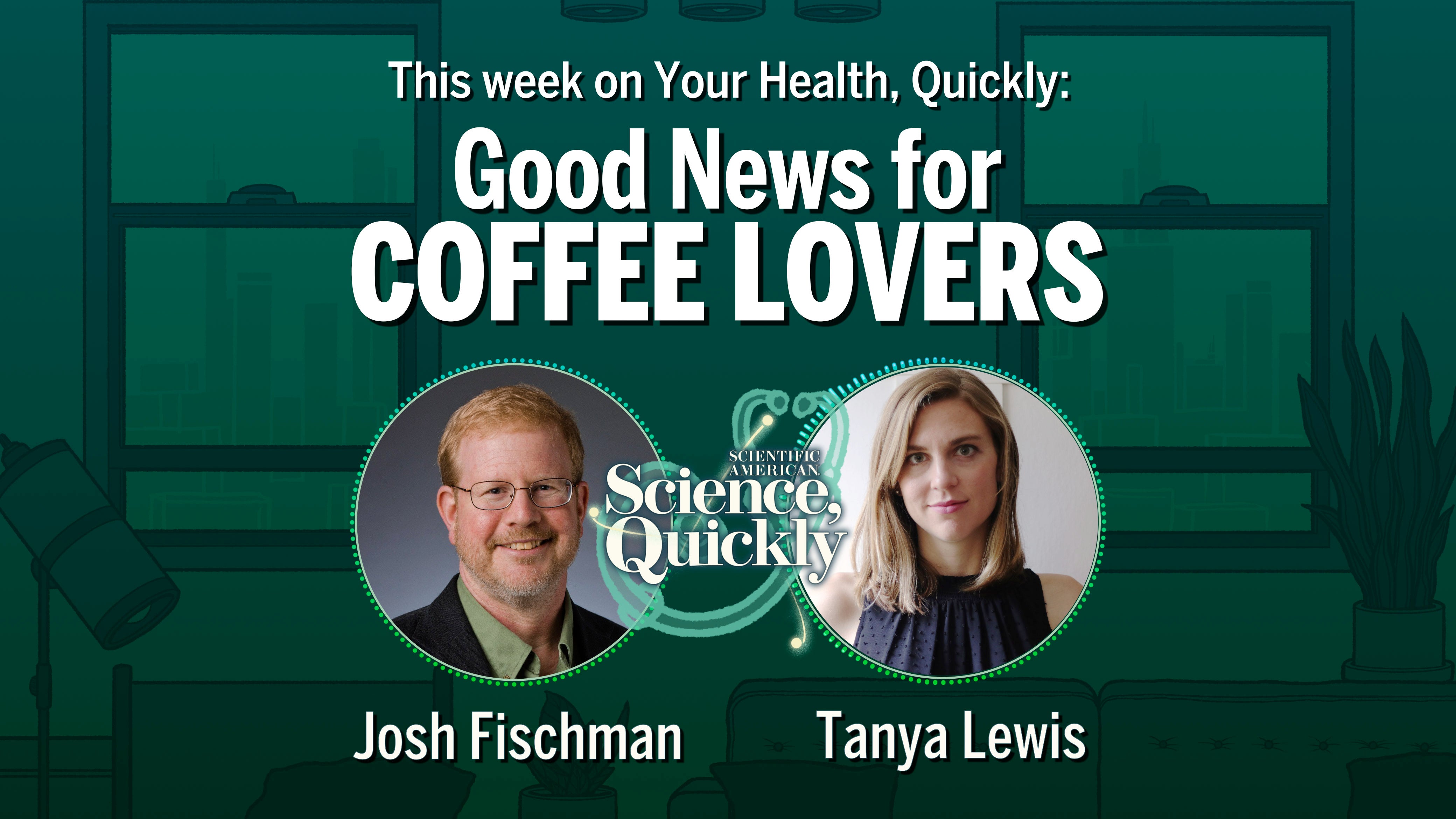
Tanya Lewis: Hi, and welcome to Your Health, Quickly, a Scientific American podcast series!
Josh Fischman: On this show, we highlight the latest vital health news, discoveries that affect your body and your mind.
Every episode, we dive into one topic. We discuss diseases, treatments, and some controversies.
Lewis: And we demystify the medical research in ways you can use to stay healthy.
I’m Tanya Lewis.
Fischman: I’m Josh Fischman.
Lewis: We’re Scientific American’s senior health editors.
Today we’re talking about coffee. We hear a lot of conflicting findings about whether our favorite beverage is good or bad for our health. But recently, an especially rigorous study came out that may finally answer some of our percolating questions.
[Clip: Show theme music]
[Clips: (sound effects) coffee grinder, coffee percolating, liquid pour, sip]
Fischman: There’s a good chance that, right now, you’re sipping the very thing we’re talking about. Coffee. It is one of the most widely consumed beverages in the world.
Lewis: It’s true. Here in the U.S., the average person drank almost 89 gallons of coffee in 2016—more than soda, tea and juice combined.
Fischman: That’s a lot of java. Or joe, brew, or jitter juice, whatever you like to call it.
Lewis: Indeed. Do you drink coffee, Josh?
Fischman: Actually I guess I’m one of the few people who doesn’t. I used to guzzle it, though—about 4 or 5 cups a day. But I gave it up a few years ago.
Lewis: Why? What happened?
Fischman: Honestly, my stomach started getting upset. I figured I could do without so much acid, you know?
Lewis: That totally makes sense. But personally, I’m not really functional until I’ve had my morning cup of coffee, and I don’t know if I could give that up.
Fischman: There are times when I catch the aroma from a coffee shop, and it just smells so good!
But listen, I’m still not sure coffee was causing my problems. It feels like every day there’s a new study telling us coffee is good for us or bad for us, for a whole bunch of different reasons. With all these conflicting messages, it can feel like whiplash.
Lewis: Well, it turns out it’s actually really hard to study how coffee or any other food or drink affects our health.
Most nutrition studies are observational studies, which compare health outcomes in people who happen to drink coffee to those who don’t. But it’s impossible to rule out other variables that could affect what you’re trying to measure.
Plus, you have to rely on people reporting what they consumed weeks or months after they drank it. And most of us can’t even remember what we had for breakfast.
Fischman: So, what’s the solution? Is there another way to study this?
Lewis: Well, there is a way to be more objective. I talked to…
Gregory Marcus: Gregory Marcus, Professor of Medicine and cardiologist at University of California, San Francisco.
Lewis: Marcus and his colleagues took a different approach than most other coffee studies. Instead of just studying people who drank coffee or didn’t, he set up a randomized trial to study coffee’s impact on your heartbeat.
They were looking for abnormal heart rhythms called arrhythmias.
Marcus: The topic comes up very frequently in my clinic, where patients with various arrhythmias will ask if they can consume coffee. There’s this conventional wisdom that coffee increases the risk for heart rhythm disturbances or electrical problems with the heart, which is my clinical subspecialty. And yet, we and others generally have failed to find a clear association between coffee and arrhythmias.
Lewis: In their new study, Marcus and his colleagues randomly assigned 100 people to either drink or not drink coffee each day for a period of two weeks.
Marcus: And they receive these instructions via text message, and they were randomly assigned to either go ahead and drink all the coffee you want, versus on other random days, avoid all caffeine today.
Lewis: They had participants wear a heart monitor, a FitBit and a continuous glucose monitor. They also had them download an app on their phone that collected GPS location data so the researchers could see when people were actually visiting coffee shops.
Fischman: With the heart monitors, what were they looking at?
Lewis: They were measuring two things: the number of what are called premature atrial contractions and premature ventricular contractions.
Marcus: It’s very common for everyone to have an early beat arising from the upper chambers of the heart called premature atrial contractions, or PACs, once in a while.
Lewis: But research has shown that having too many of these beats puts you at risk of atrial fibrillation, which is a dangerously irregular, rapid heart beat. This is associated with a very high risk for stroke, dementia, and death. Then there’s the other kind of irregular heartbeat:
Marcus: Premature ventricular contractions are early beats that arise from the lower chambers of the heart. Again, we all have those sometimes, but those with more are at higher risk of developing heart failure or a weakening of the heart.
Lewis: They found that drinking coffee did not result in more premature atrial contractions—the early heart beats associated with atrial fibrillation. That’s good news for people who were worried about that.
Fischman: That’s good to know. What about the other bad beats, the premature contractions in the heart’s lower chambers?
Lewis: Those were slightly more common on days when people were told to drink coffee, or on days when they drank more coffee—but not enough to be really worrisome.
And that’s not all they found. Coffee consumption was also associated with a higher number of daily steps. On days when people drank coffee—and the more coffee they drank—the more steps they took.
Marcus: On days randomized to coffee, people took on average about 1000 more steps, which is highly significant. And in fact, that difference in average steps has been associated with the improved longevity in large epidemiologic studies.
Lewis: The study couldn’t show why people increased their steps on days when they drank coffee. Maybe they were just walking to the coffee shop or the bathroom more! But regardless, an extra 1,000 steps per day has been linked to a six to 15 percent lower risk of death in other studies.
Fischman: So coffee might actually make people perk up and move around.
Lewis: Yup, I guess the coffee drinkers were full of beans. But there was a downside to drinking coffee, and it probably won’t surprise you.
Fischman: Ummm, let me guess. People slept less?
Lewis: Bingo. The study participants got about half an hour less sleep on average on the days they drank coffee compared with the days they didn’t.
But the results varied a lot from person to person depending on whether they were fast or slow coffee metabolizers—which is determined by your genetics.
The researchers gave participants a genetic saliva test to determine which type of coffee metabolizer they were.
Marcus: So the fast caffeine metabolizers actually exhibited no significant relationship between coffee consumption and sleep, whereas the slow caffeine metabolizers exhibited the worst effects on sleep. In fact, the slow caffeine metabolizers, on average, had almost an hour less sleep when they were exposed to coffee.
Fischman: I never had an issue with sleep when I was drinking a lot of coffee. But I wake up at a ridiculous early hour in the morning–I’m talking 5 o’clock–so I’m usually zonked by 10 PM anyway.
Lewis: I don’t usually find that coffee keeps me up at night, but I try not to have caffeine after about 3 or 4 pm. Still, this study has me wondering if I should quit drinking it earlier in the day.
Marcus: If someone suffers from insomnia, we have found here in a randomized trial that there are meaningful effects on sleep—to such a degree that it really should motivate a good trial off of coffee to really try to tackle insomnia.
Fischman: Ok, that part is pretty much a no-brainer. But overall, the study does seem like fairly positive news for those who enjoy their brew.
Lewis: Yes, it is pretty good news. It confirms other observational studies that have not shown a higher risk of heart arrhythmias.
And some studies have shown that drinking coffee is linked with a lower lifetime risk of diabetes and death overall—which could be a result of the higher activity levels that drinking coffee might produce.
In the end, there may not be a simple answer to the question of whether coffee is good or bad for you. It depends on how much you consume, and each person is different.
Marcus: I think, on the whole, these data should be generally reassuring regarding the safety of coffee. I think that one of the challenges in conducting nutrition-based research is that there tends to be a kind of a natural hunger, especially from the media, but I think this is just human nature to know to conclude, okay, is this good for me? Or is this bad for me? Which one is it? It’s one or the other. And the reality is that the effects of coffee are complicated.
Lewis: Coffee affects each person differently. So if drinking it makes you feel bad, skip it. But if, like me, you enjoy it in moderation, go ahead and have that latte!
Fischman: Your Health, Quickly is produced and edited by Kelso Harper, Tulika Bose, and Jeff DelViscio. Our music is composed by Dominic Smith.
Lewis: Our show is a part of Scientific American’s podcast, Science, Quickly. You can subscribe wherever you get your podcasts.
Fischman: And don’t forget to go to Sciam.com for updated and in-depth health news.
Lewis: I’m Tanya Lewis.
Fischman: I’m Josh Fischman.
Lewis: We’ll be back in two weeks. Thanks for listening!