
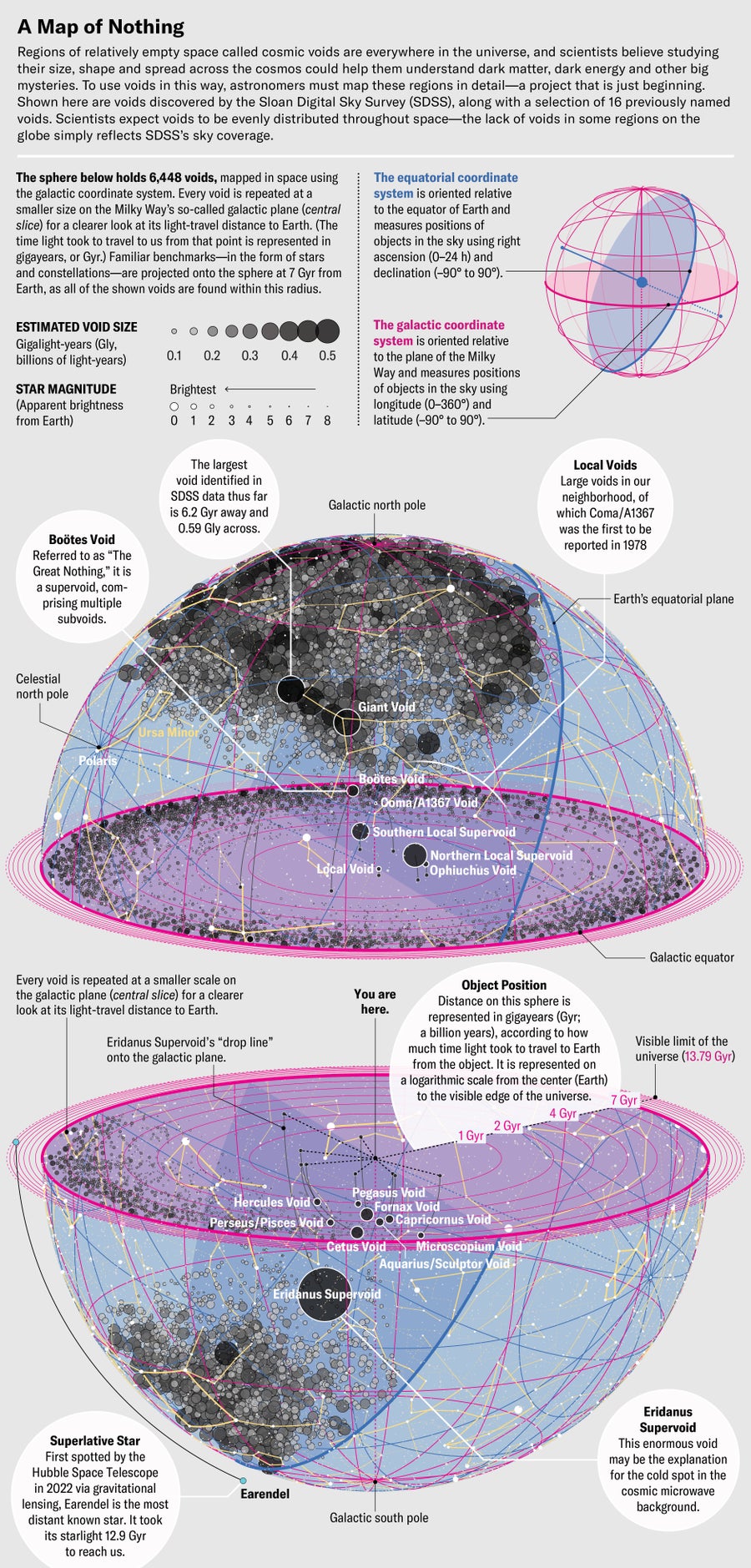
Computational astrophysicist Alice Pisani put on a virtual-reality headset and stared out into the void—or rather a void, one of many large, empty spaces that pepper the cosmos. “It was absolutely amazing,” Pisani recalls. At first, hovering in the air in front of her was a jumble of shining dots, each representing a galaxy. When Pisani walked into the jumble, she found herself inside a large swath of nothing with a shell of galaxies surrounding it. The image wasn’t just a guess at what a cosmic void might look like; it was Pisani’s own data made manifest. “I was completely surprised,” she says. “It was just so cool.”
The visualization, made in 2022, was a special project by Bonny Yue Wang, then a computer science undergraduate at the Cooper Union for the Advancement of Science and Art in New York City. Pisani teaches a course there in cosmology—the structure and evolution of the universe. Wang had been aiming to use Pisani’s data on voids, which can stretch from tens to hundreds of millions of light-years across, to create an augmented-reality view of these surprising features of the cosmos.
The project would have been impossible a decade ago, when Pisani was starting out in the field. Scientists have known since the 1980s that these fields of nothing exist, but inadequate observational data and insufficient computing power kept them from being the focus of serious research. Lately, though, the field has made tremendous progress, and Pisani has been helping to bring it into the scientific mainstream. Within just a few years, she and an increasing number of scientists are convinced, the study of the universe’s empty spaces could offer important clues to help solve the mysteries of dark matter, dark energy and the nature of the enigmatic subatomic particles called neutrinos. Voids have even shown that Einstein’s general theory of relativity probably operates the same way at very large scales as it does locally—something that has never been confirmed. “Now is the right moment to use voids” for cosmology, says David Spergel, former chair of astrophysics at Princeton University and current president of the Simons Foundation. Benjamin Wandelt of the Lagrange Institute in Paris echoes the sentiment: “Voids have really taken off. They’re becoming kind of a hot topic.”
The discovery of cosmic voids in the late 1970s to mid-1980s came as something of a shock to astronomers, who were startled to learn that the universe didn’t look the way they’d always thought. They knew that stars were gathered into galaxies and that galaxies often clumped together into clusters of dozens or even hundreds. But if you zoomed out far enough, they figured, this clumpiness would even out: at the largest scales the cosmos would look homogeneous. It wasn’t just an assumption. The so-called cosmic microwave background (CMB)—electromagnetic radiation emitted about 380,000 years after the big bang—is extremely homogeneous, reflecting smoothness in the distribution of matter when it was created. And even though that was nearly 14 billion years ago, the modern universe should presumably reflect that structure.
But we can’t tell whether that’s the case just by looking up. The night sky appears two-dimensional even through a telescope. To confirm the presumption of homogeneity, astronomers needed to know not only how galaxies are distributed across the sky but how they’re distributed in the third dimension of space—depth. So they needed to measure the distance from Earth to many galaxies near and far to figure out what’s in the foreground, what’s in the background and what’s in the middle. In 1978 Laird A. Thompson of the University of Illinois Urbana-Champaign and Stephen A. Gregory of the University of New Mexico did just that and discovered the first hints of cosmic voids, shaking the presumption that the universe was smooth. In 1981 Harvard University’s Robert Kirshner and four of his colleagues discovered a huge void, about 400 million light-years across, in the direction of the constellation Boötes. It was so big and so empty that “if the Milky Way had been in the center of the Boötes void, we wouldn’t have known there were other galaxies [in the universe] until the 1960s,” as Gregory Scott Aldering, now at Lawrence Berkeley National Laboratory, once put it.
In 1986 Margaret J. Geller, John Huchra and Valérie de Lapparent, all then at Harvard, confirmed that the voids Thompson, Kirshner and their colleagues had found were no flukes. The team had painstakingly surveyed the distance to many hundreds of galaxies spread out over a wide swath of sky and found that voids appeared to be everywhere. “It was so exciting,” says de Lapparent, now director of research at the Institut d’Astrophysique de Paris (IAP). She had been a graduate student at the time and was spending a year working with Geller, who was trying to understand the large-scale structure of the universe. A cross section of the local cosmos that astronomers had put together earlier showed hints of a filamentary structure consisting of regions either overdense or underdense with galaxies. “Margaret had this impression that this was just an observing bias,” de Lapparent says, “but we had to check. We wanted to look farther out.” They used a relatively small telescope on Mount Hopkins in Arizona. “I learned to observe on that telescope,” de Lapparent recalls. “I was on my own after a night of training, which was so exciting.” When she was done, she, Geller and Huchra made a map of the galaxies’ locations. “It was amazing,” she says. “We had these big, circular voids and these sharp walls full of galaxies.”
“All of these features,” the researchers wrote in their paper, entitled “A Slice of the Universe,” “pose serious challenges for current models for the formation of large-scale structure.” As later, deeper surveys would confirm, galaxies and clusters of galaxies are themselves concentrated into a gigantic web of concentrated regions of matter connected by streaming filaments, with gargantuan voids in between. In other words, the cosmos today vaguely resembles Swiss cheese, whereas the CMB looks more like cream cheese.
The question, then, was: What forces made the universe evolve from cream cheese into Swiss cheese? One factor was almost certainly dark matter, the invisible mass whose existence had in the 1980s only recently been accepted by most astrophysicists, despite years of tantalizing evidence from observers such as Vera Rubin and Fritz Zwicky. It was more massive than ordinary, visible matter by a factor of six or so. That would have made the gravitational pull of slightly overdense regions in the early universe stronger than anyone had guessed. Stars and galaxies would have formed preferentially in these areas of high density, leaving low-density regions largely empty.
Most observers and theorists continued to explore what would come to be known as the “cosmic web,” but very few concentrated on voids. It wasn’t for lack of interest; the problem was that there wasn’t much to look at. Voids were important not because of what they contained but because their very existence, their shapes and sizes and distances from one another, had to be the result of the same forces that gave structure to the universe. To use voids to understand how those forces worked, astrophysicists needed to include many examples in statistical analyses of voids’ average size and shape and separation, yet too few had been found to draw useful conclusions from them. It was analogous to the situation with exoplanets in the 1990s: the first few discovered were proof that planets did indeed orbit stars beyond the sun, but it wasn’t until the Kepler space telescope began raking them in by the thousands after its 2009 launch that planetary scientists could say anything meaningful about how many and what kinds of planets populated the Milky Way.
Another issue with studying voids was raised in 1995 by Barbara Ryden of the Ohio State University and Adrian L. Melott of the University of Kansas. Galaxy surveys, they pointed out, are conducted in “redshift space,” not actual space. To understand what they meant, consider that as the universe expands, light waves are stretched from their original wavelengths and colors into longer, redder wavelengths. The farther away something is from an observer, the more its light is stretched. The James Webb Space Telescope was designed to be sensitive to infrared light in part so it can see the very earliest galaxies, whose light has been stretched all the way out of the visible spectrum—it’s redder than red. And the CMB, the most distant light we can detect, has been stretched so much that we now perceive it in the form of microwaves. “Measuring the physical distances to galaxies is difficult,” Ryden and Melott wrote in a paper in the Astrophysical Journal. “It’s much easier to measure redshifts.” But, they noted, redshifts can distort the actual distances to galaxies that enclose a void and thus give a misleading idea of their size and shape. The problem, explains Nico Hamaus of the Ludwig Maximilian University of Munich, is that as a void expands, “the near side is coming toward us, and the far side is streaming away.” That differential subtracts from the redshift on the near side and adds to it on the far side, making the void look artificially elongated.
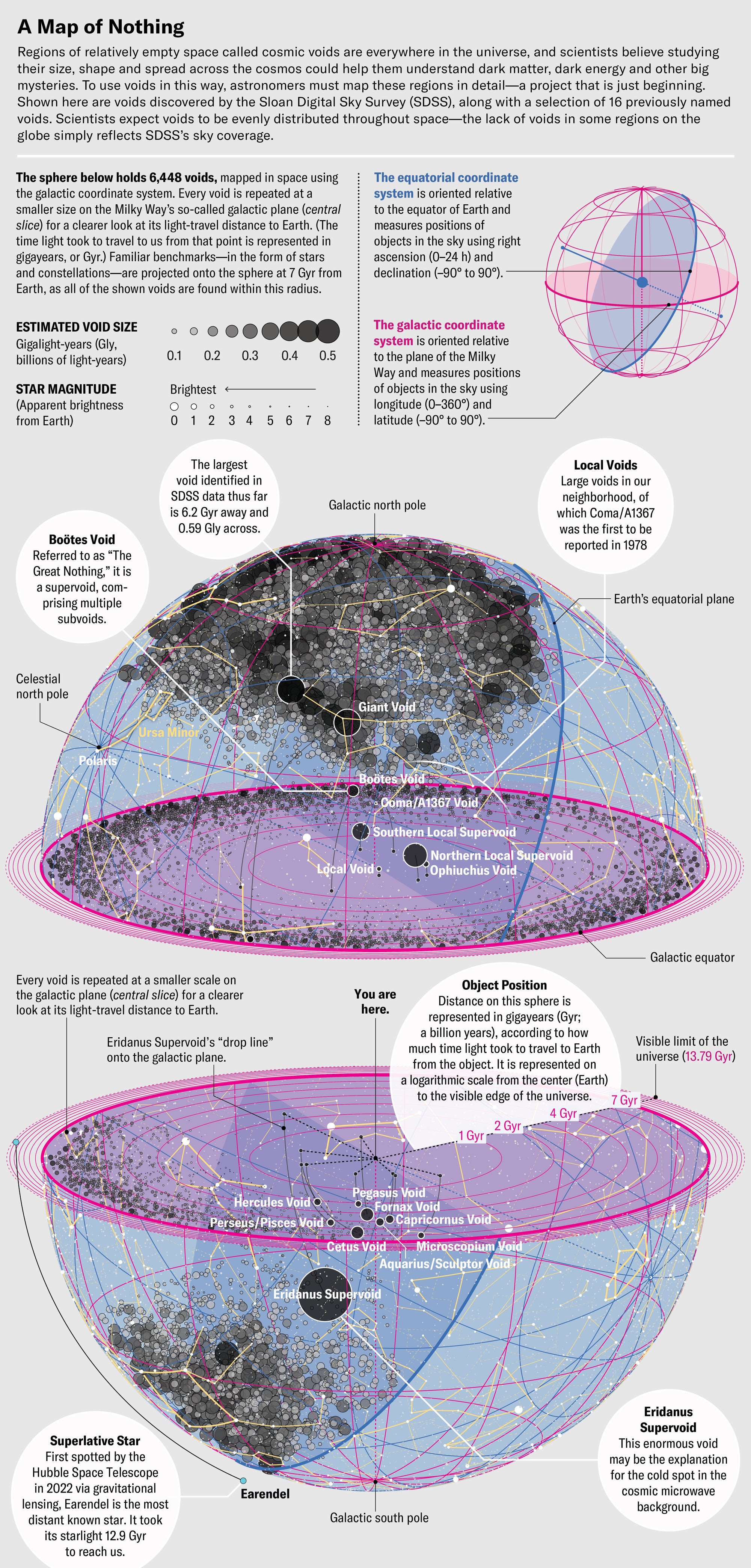
Despite the difficulties, astrophysicists began to feel more equipped to tackle voids by the late 2000s. Projects such as the Sloan Digital Sky Survey had probed much more deeply into the cosmos than the map made by Geller, Huchra and de Lapparent and confirmed that voids were everywhere you looked. Independent observations by two teams of astrophysicists, meanwhile, had revealed the existence of dark energy, a kind of negative gravity that was forcing the universe to expand faster and faster rather than slowing down from the mutual gravitational attraction of trillions of galaxies. Voids seemed to offer astronomers a promising way of studying what might be driving dark energy.
These developments caught Wandelt’s eye. His specialty has always been trying to understand how the large-scale structure of the modern universe came to be. One of the aspects of voids that he found attractive, he says, was that “these underdense regions are much quieter in some ways, more amenable to modeling” than the clusters and filaments that separate them. Galaxies and gases are crashing into each other in nonlinear and complicated interactions, Wandelt says. There’s “a chaos” that erases the information about their formation. Further complicating things, the gravitational attraction between galaxies is strong enough on smaller scales that it counteracts the general expansion of the universe—and even counteracts the extra oomph of dark energy. Andromeda, for example, the nearest large galaxy to our own, is actually drawing closer to the Milky Way; in four billion years or so, they’ll merge. Voids, in contrast, “are dominated by dark energy,” Wandelt says. “The biggest ones are actually expanding faster than the rest of the universe.” That makes them ideal laboratories for getting a handle on this still puzzling force.
And it’s not just an understanding of dark energy that could emerge from this line of study; voids could also cast light (so to speak) on the nature of dark matter. Although voids have much less dark matter in them than the clusters and filaments of the cosmic web do, there’s still some. And unlike the chaotic web, with its swirling hot gases and colliding galaxies, the voids are calm enough that the particles astrophysicists think make up dark matter might be detectable. They wouldn’t show up directly, because they neither absorb nor emit light. But the particles should occasionally collide, resulting in tiny bursts of gamma rays. They would also probably decay eventually, releasing gamma rays in that process as well. A sufficiently sensitive gamma-ray telescope in space would theoretically be able to detect their collective signal. Nicolao Fornengo of the University of Turin in Italy, co-author of a preprint study laying out this rationale, says that “if dark matter produces [gamma rays], the signal should be in there.”
Voids could even help to nail down the nature of neutrinos—elementary particles, once thought to be massless, that pervade the universe while barely interacting with ordinary matter. (If you sent a beam of neutrinos through a slab of lead one light-year, or nearly six trillion miles, thick, about half of them would sail through it effortlessly.) Physicists have confirmed that the three known types of neutrinos do have masses, but they aren’t sure why or exactly what those masses are.
Voids could help them find the answer, says Elena Massara, a postdoctoral researcher at the Waterloo Center for Astrophysics at the University of Waterloo in Canada. They’re places that have a lack of both luminous matter and dark matter, she explains, “but they’re full of neutrinos, which are almost uniformly distributed” through the universe, including in voids.That’s because neutrinos zip through the cosmos at nearly the speed of light, which means they don’t clump together under their mutual gravity—or under the gravity of the dark matter concentrations that act as the scaffolding for the cosmic web. Although voids always contain a lot of neutrinos, the particles are only passing through—those that fly out are constantly replenished by more neutrinos streaming in. And their combined gravity can make the voids grow more slowly over time than they would otherwise. The rate of growth—determined through comparison of the average size of voids in the early universe to those in the modern universe—can reveal how much mass neutrinos actually have.
Void science has changed a lot since Pisani started studying it as a graduate student working with Wandelt. He offered two or three suggestions for a dissertation topic, she recalls, and one of them was cosmic voids. “I felt that they were the riskiest choice,” she says, “because there were very few data at the time. But they were also incredibly challenging,” which she found exciting. The data Pisani and others needed to analyze the voids, however—that is, to test their real-world properties against computer models incorporating dark matter, dark energy, neutrinos and the formation of large-scale structure in the universe—were simply not available. “When I started my Ph.D. thesis,” Pisani says, “we knew of fewer than 300 voids, something like that. Today we have on the order of 6,000 or more.”
That’s huge, but it’s still not enough for the comprehensive statistical analysis necessary for voids to be used for serious cosmology—with one exception. In 2020 Hamaus, Pisani, Wandelt and several of their colleagues published an analysis showing that general relativity behaves at least approximately the same way on very large scales as it seems to do in the local universe. Voids can be used to test this question because astrophysicists think they result from the way dark matter clusters in the universe: the dark matter pulls in ordinary matter, creating the cosmic web and leaving empty spaces behind. But what if general relativity, our best theory of gravity, breaks down somehow over very large distances? Few scientists expect that to be the case, but it has been suggested as a means to explain away the existence of dark matter.
By looking at the thickness of the walls of matter surrounding voids, however, Hamaus and his colleagues determined that Einstein’s theory is safe to rely on. To understand why, imagine a void as “a circle whose radius increases with the expansion of the universe,” Wandelt says. As the circle grows, it pushes against the boundaries of galaxies and clusters at its perimeter. Over time these structures aggregate, thickening the “wall” that defines the void’s edge. Dark energy and neutrinos affect the thickness as well, but because they are smoothly distributed both inside and outside the voids, they have a much smaller effect overall.
Scientists plan to use voids to learn even more about the universe soon because they expect to rapidly multiply the number of known voids in their catalog. “In the next five or 10 years,” Pisani says, “we’re going to have hundreds of thousands. It’s one of those fields where numbers really make a difference.” So, Spergel says, do advances in machine learning, which will make it far easier to analyze void properties.
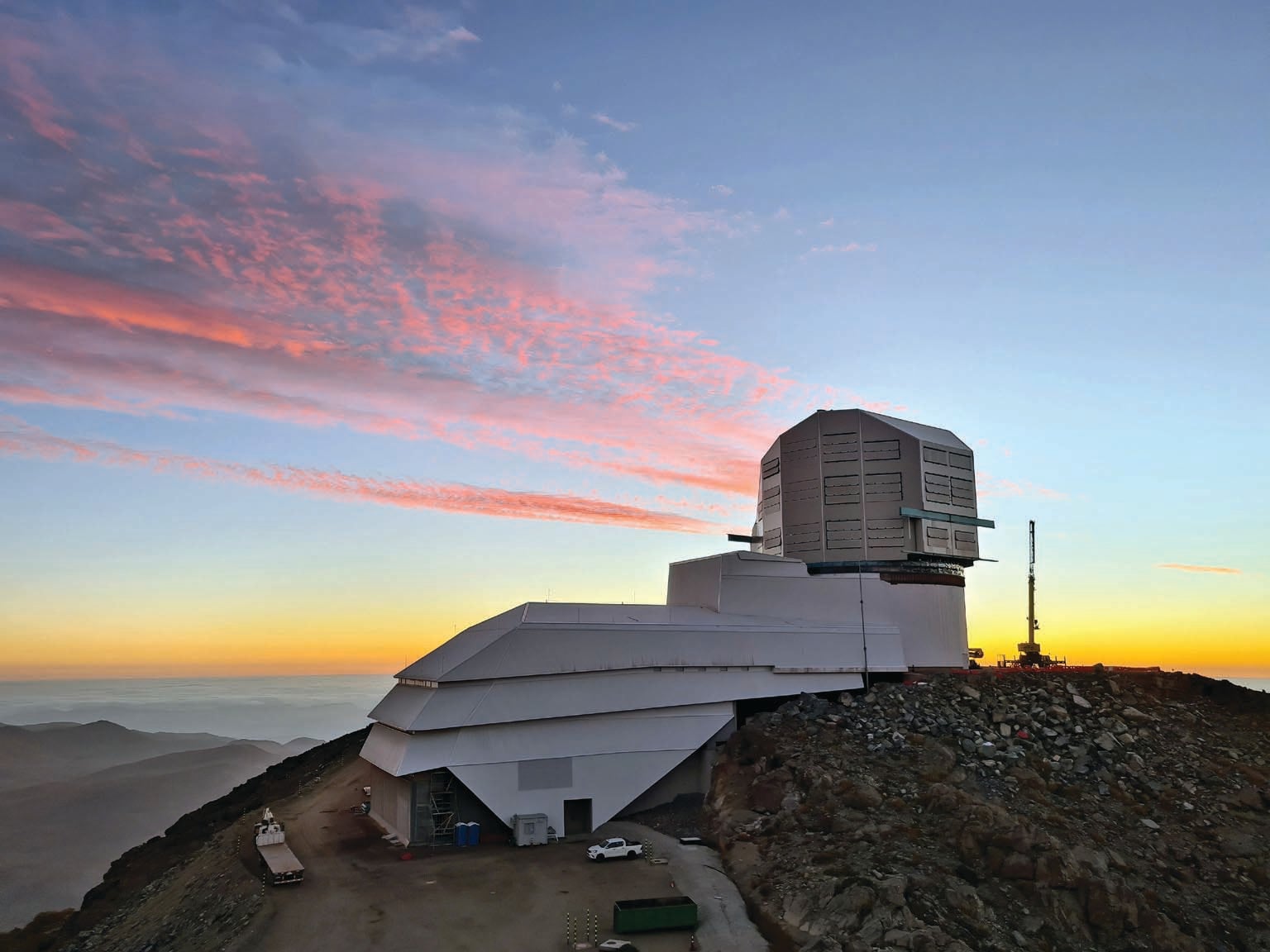
These exploding numbers won’t be coming from projects explicitly designed to search for voids. They will arrive, as they did with the Sloan Digital Sky Survey, as a by-product of more general surveys. The European Space Agency’s Euclid mission, for example, which launched in July 2023, will create a 3-D map of the cosmic web with unprecedented breadth and depth. NASA’s Nancy Grace Roman Space Telescope will begin its own survey in 2026, looking in infrared light. And in 2024 the ground-based Vera C. Rubin Observatory will launch a 10-year study of cosmic structure, among other things. Combined, these projects should increase the inventory of known voids by two orders of magnitude.
“I remember one of the first talks I gave on void cosmology, at a conference in Italy,” Pisani says. “At the end the audience had no questions.” She wasn’t sure at the time whether the reason was skepticism or simply that the topic was so new to her listeners that they couldn’t think of anything to ask. In retrospect, she thinks it was a little of both. “Initially, I think the problem was just convincing people that this was reasonable science to look into,” she says.
That’s much less of an issue now. For example, Pisani points out, the Euclid voids group has about 100 scientists in it. “I have to say that Alice was one of the fearless pioneers of this field,” Wandelt notes about his former Ph.D. student. When they started writing the first papers on void science, he recalls, some of the leading figures in astrophysics “expressed severe doubt that you could do anything cosmologically interesting with voids.” The biggest confirmation that they were wrong, he says, is that some of those same people are now enthusiastic.
Pisani is perhaps the ideal representative for this fast-emerging field. She approaches the topic with absolute scientific rigor but also with infectious enthusiasm. Whenever she talks about voids, she lights up, speaking rapidly, jumping to her feet to draw diagrams on a whiteboard, and fielding questions (of which there are now many) with ease and confidence. She emphasizes that void science won’t answer all of astrophysicists’ big questions about the universe by itself. But it could do something even more valuable in a way: test ideas about dark matter, dark energy, neutrinos and the growth of cosmic structure independently of the other strategies scientists use. If the results match, great. If not, astrophysicists will have to reconcile their differences to find out what’s actually going on in the cosmos.
“I find the idea attractive and even somewhat poetic,” Wandelt says, “that looking into these areas where there’s nothing might yield information about some of the outstanding mysteries of the universe.”