
Close Menu
New York Examiner News

    Subscribe to Updates

    Get the latest creative news from FooBar about art, design and business.

    What's Hot

    Slipknot’s Clown Addresses Status of Next Album

    January 17, 2026

    Elon Musk’s Boring Co. is studying a tunnel project to Tesla Gigafactory near Reno

    January 17, 2026

    Democrats Won’t Allow Trump To Rig The Midterm As They Take A Big Step Toward Redistricting In Virginia

    January 17, 2026
    Facebook X (Twitter) Instagram
    New York Examiner News
    • Home
    • US News
    • Politics
    • Business
    • Science
    • Technology
    • Lifestyle
    • Music
    • Television
    • Film
    • Books
    • Contact
      • About
      • Amazon Disclaimer
      • DMCA / Copyrights Disclaimer
      • Terms and Conditions
      • Privacy Policy
    New York Examiner News
    Home»Science»How Does a Gravitational Slingshot Work?
    Science

    How Does a Gravitational Slingshot Work?

    By AdminJune 20, 2025
    Facebook Twitter Pinterest LinkedIn WhatsApp Email Reddit Telegram
    How Does a Gravitational Slingshot Work?


    You’ve probably watched this sort of science-fiction scene more than once: some stalwart starship captain and their crew are fleeing from aliens/escaping a supernova /running out of fuel and are seemingly out of options, about to get eaten/vaporized/stuck. But then, just ahead, they spot a planet! So they head right for it, rockets blazing, then dive down and use its gravity to slingshot to safety. Hooray! Cue the triumphant music.

    So it goes on the silver screen, at least. But does this maneuver work in real life?

    Yes! Well, not so much the way it’s done in movies—but it is an actual thing. It’s widely known as a gravitational slingshot, though most scientists refer to it as a gravitational assist, and it’s an essential tool for most interplanetary missions.


    On supporting science journalism

    If you’re enjoying this article, consider supporting our award-winning journalism by subscribing. By purchasing a subscription you are helping to ensure the future of impactful stories about the discoveries and ideas shaping our world today.


    The idea seems simple enough. As a spacecraft approaches a massive object, say, a planet, the gravity of the planet bends its trajectory, changing the spacecraft’s direction. But there’s more to it than that: the spacecraft can actually use the planet’s gravity to speed up or slow down after this maneuver, allowing easier voyages to the outer or inner planets, respectively.

    While the trajectory-bending part seems obvious enough, that speed-up-or-slow-down part is pretty counterintuitive. It’s related to the symmetry of gravity.

    If you hold a rubber ball some distance from the ground and drop it, the ball will accelerate as it falls, speeding up until impact. Then it bounces, moving upward and decelerating as it does so. It will eventually come to a stop, whereupon you can catch it or let it fall again. But either way, it can’t bounce any higher than the height from which you dropped it. It gained kinetic energy—the energy of motion—as it fell but then lost it once again postbounce as it slowed on its way back up. This action is symmetric, so at best (if you had a perfectly elastic ball and did this experiment in a vacuum), it would bounce to the same height from which you dropped it.

    The same is true for a spacecraft approaching a planet. The world’s gravity will accelerate you as you fall in, you’ll whip around at closest approach (that’s the “slingshot” part), and then you’ll lose that extra velocity as you move away because the planet’s gravity is still pulling on you. As that gravitational grip slips away, the spacecraft will be moving relative to the planet at the same speed at which it initially approached.

    So if all the bonus speed is lost on the way out, how can this maneuver be used to accelerate a spacecraft? The key is in the phrase “relative to the planet.” If you approach the planet at, say, 20 kilometers per second (km/s), you’ll leave with the same speed. But that’s your speed measured against the planet.

    At that same time, crucially, the planet is also orbiting the sun. If you approach the planet from behind (that is, in the direction of its motion), then, as the planet’s gravity gives you a boost, it also, in a heliocentric sense, pulls you along, adding some of its orbital velocity to yours. That gives you a kick relative to the sun, speeding you up on your way to your destination. In essence, the spacecraft gets a net gain in speed by stealing a little bit of the planet’s orbital kinetic energy.

    In turn, this means the planet actually slows a bit in its orbit around the sun—which sounds dangerous! But fear not: the planet slows in proportion to how much more massive it is than the spacecraft. Given a typical one-ton probe compared with a multisextillion-ton world, the planet doesn’t noticeably slow at all. You could launch a million probes at it and never be able to tell the difference in its orbital speed. A bacterium bouncing off you while you’re out walking would have a far larger effect on you.

    The reason it’s worthwhile to go to the trouble of gravitational assists is that spacecraft are launched by rockets, which can only accelerate to some top speed. For our current rocketry, these speeds are so low and the interplanetary distances so great that even the fastest, most direct voyages take years (or even decades for destinations in the outer solar system). You can load the spacecraft with more fuel to burn to go faster, but there’s a limit to that, too. Fuel has mass, and you’d need to accelerate that extra mass, which takes more fuel, which has more mass. This catch-22 is described by what is called the rocket equation, and it means the amount of fuel you must add to move even slightly faster reaches prohibitive scales very quickly.

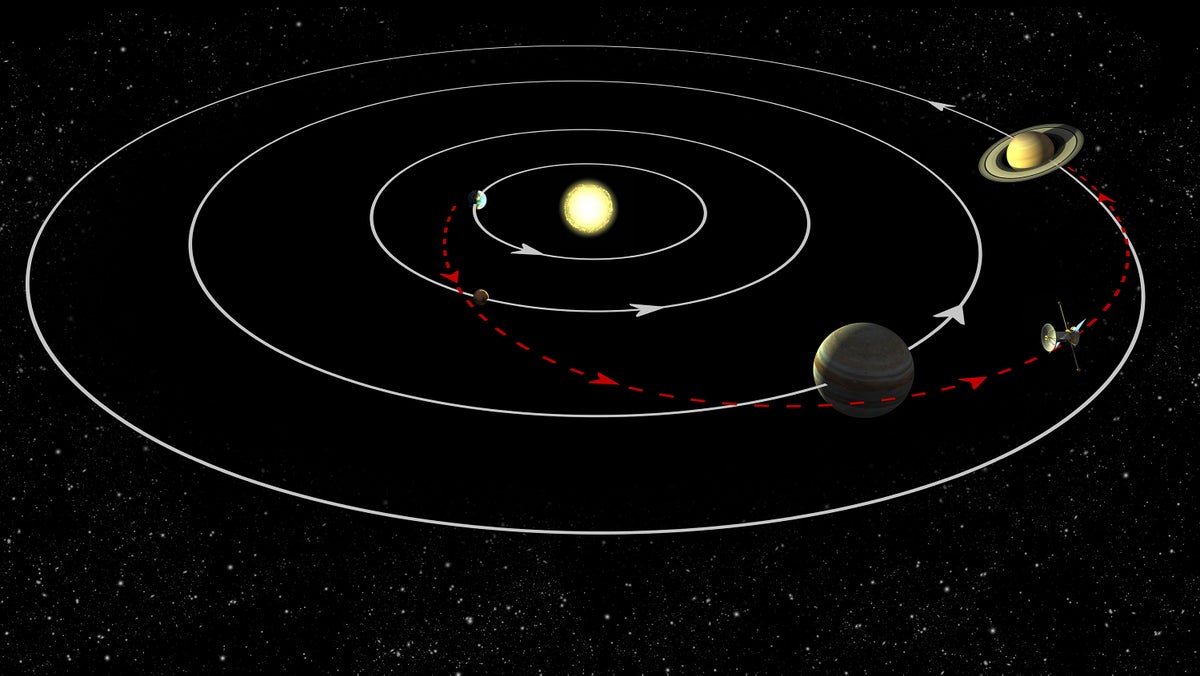
    So shaving time off your voyage requires some other method—such as siphoning speed from a big, juicy planet along the way! For example, the Cassini probe to Saturn, which launched in 1997, was a huge spacecraft, the size of a school bus, and had a mass of 2.5 metric tons without fuel. (The addition of the fuel it needed to fulfill its mission at Saturn, along with the launch vehicle and other equipment, tipped the scales to 5.7 metric tons.) It would’ve taken practically forever to get to Saturn with the rockets we had then. So the mission planners took advantage of Jupiter, sending the spacecraft past it on a speed-boosting slingshot maneuver that shaved significant time off the journey. In fact, just to get out to Jupiter in the first place, Cassini also performed two fuel-saving flybys of Venus and one of Earth, stealing planetary orbital energy every time.

    A gravitational assist works the other way, too. Earth orbits the sun at more than 30 km/s, so firing a probe at the sun or the inner planets is extremely hard because of all that sideways velocity. Instead mission planners prefer a more circuitous route. They launch the spacecraft with enough velocity in the opposite direction of Earth’s path around the sun to drop in front of, say, Venus, where it can then donate some of its orbital energy to the planet to drop toward the sun even more. BepiColombo, a joint European Space Agency and Japan Aerospace Exploration Agency mission to Mercury, did exactly this, passing Earth once and Venus twice to get in Mercury’s vicinity. Even then, it had to do a total of six gravity assists past Mercury to match the planet’s orbital speed around the sun. The last assist was in January 2025, and it will enter Mercury orbit in November 2026.

    Gravitational assists are an emblematic example of why space travel is hard—it is exactly rocket science, after all. Gravity is the biggest culprit; just getting away from Earth in the first place is the largest part of the problem. It’s ironic, then, that gravity can make reaching most of the rest of the solar system so much easier.


    Original Source Link

    Share. Facebook Twitter Pinterest LinkedIn WhatsApp Email Reddit Telegram
    Previous ArticleEA Is Shutting Down One Of Its Most Popular Games This December
    Next Article ‘Wall-E With a Gun’: Midjourney Generates Videos of Disney Characters Amid Massive Copyright Lawsuit

    RELATED POSTS

    RFK, Jr., shifts focus to questioning whether cell phones are safe. Here’s what the science says

    January 17, 2026

    Meat may play an unexpected role in helping people reach 100

    January 16, 2026

    OpenAI Invests in Sam Altman’s New Brain-Tech Startup Merge Labs

    January 16, 2026

    Americans Overwhelmingly Support Science, but Some Think the U.S. Is Lagging Behind: Pew

    January 15, 2026

    Woolly rhino genome recovered from meat in frozen wolf pup’s stomach

    January 15, 2026

    Microsoft Has a Plan to Keep Its Data Centers From Raising Your Electric Bill

    January 14, 2026
    latest posts

    Slipknot’s Clown Addresses Status of Next Album

    It’s been a little while since Slipknot released their last original album and percussionist and…

    Elon Musk’s Boring Co. is studying a tunnel project to Tesla Gigafactory near Reno

    January 17, 2026

    Democrats Won’t Allow Trump To Rig The Midterm As They Take A Big Step Toward Redistricting In Virginia

    January 17, 2026

    Minnesota judge bars federal officers from tear gas on peaceful protesters

    January 17, 2026

    AI cloud startup Runpod hits $120M in ARR — and it started with a Reddit post  

    January 17, 2026

    RFK, Jr., shifts focus to questioning whether cell phones are safe. Here’s what the science says

    January 17, 2026

    Next ‘Paranormal Activity’ Movie Lands Summer 2027 Date

    January 17, 2026
    Categories
    • Books (1,006)
    • Business (5,911)
    • Events (29)
    • Film (5,847)
    • Lifestyle (3,957)
    • Music (5,948)
    • Politics (5,912)
    • Science (5,262)
    • Technology (5,841)
    • Television (5,525)
    • Uncategorized (6)
    • US News (5,899)
    popular posts

    Is being ‘hangry’ a thing? Real-world test shows how lack of food influences mood

    Some lab-based work has suggested we can become more irritable when we are hungry –…

    Law & Order: Organized Crime May Be on the Chopping Block. That Would be a Mistake.

    April 1, 2024

    Stock market outlook: Roaring 20s could extend into 2030s

    November 9, 2024

    White House won’t confirm new book saying Biden adviser called White people ‘incredibly racist’

    May 10, 2022
    Archives
    Browse By Category
    • Books (1,006)
    • Business (5,911)
    • Events (29)
    • Film (5,847)
    • Lifestyle (3,957)
    • Music (5,948)
    • Politics (5,912)
    • Science (5,262)
    • Technology (5,841)
    • Television (5,525)
    • Uncategorized (6)
    • US News (5,899)
    About Us

    We are a creativity led international team with a digital soul. Our work is a custom built by the storytellers and strategists with a flair for exploiting the latest advancements in media and technology.

    Most of all, we stand behind our ideas and believe in creativity as the most powerful force in business.

    What makes us Different

    We care. We collaborate. We do great work. And we do it with a smile, because we’re pretty damn excited to do what we do. If you would like details on what else we can do visit out Contact page.

    Our Picks

    RFK, Jr., shifts focus to questioning whether cell phones are safe. Here’s what the science says

    January 17, 2026

    Next ‘Paranormal Activity’ Movie Lands Summer 2027 Date

    January 17, 2026

    ‘90 Day Fiance’ Big Ed Brown & Rose Vega Reconcile?

    January 17, 2026
    © 2026 New York Examiner News. All rights reserved. All articles, images, product names, logos, and brands are property of their respective owners. All company, product and service names used in this website are for identification purposes only. Use of these names, logos, and brands does not imply endorsement unless specified. By using this site, you agree to the Terms & Conditions and Privacy Policy.

    Type above and press Enter to search. Press Esc to cancel.

    We use cookies on our website to give you the most relevant experience by remembering your preferences and repeat visits. By clicking “Accept All”, you consent to the use of ALL the cookies. However, you may visit "Cookie Settings" to provide a controlled consent.
    Cookie SettingsAccept All
    Manage consent

    Privacy Overview

    This website uses cookies to improve your experience while you navigate through the website. Out of these, the cookies that are categorized as necessary are stored on your browser as they are essential for the working of basic functionalities of the website. We also use third-party cookies that help us analyze and understand how you use this website. These cookies will be stored in your browser only with your consent. You also have the option to opt-out of these cookies. But opting out of some of these cookies may affect your browsing experience.
    Necessary
    Always Enabled
    Necessary cookies are absolutely essential for the website to function properly. These cookies ensure basic functionalities and security features of the website, anonymously.
    CookieDurationDescription
    cookielawinfo-checkbox-analytics11 monthsThis cookie is set by GDPR Cookie Consent plugin. The cookie is used to store the user consent for the cookies in the category "Analytics".
    cookielawinfo-checkbox-functional11 monthsThe cookie is set by GDPR cookie consent to record the user consent for the cookies in the category "Functional".
    cookielawinfo-checkbox-necessary11 monthsThis cookie is set by GDPR Cookie Consent plugin. The cookies is used to store the user consent for the cookies in the category "Necessary".
    cookielawinfo-checkbox-others11 monthsThis cookie is set by GDPR Cookie Consent plugin. The cookie is used to store the user consent for the cookies in the category "Other.
    cookielawinfo-checkbox-performance11 monthsThis cookie is set by GDPR Cookie Consent plugin. The cookie is used to store the user consent for the cookies in the category "Performance".
    viewed_cookie_policy11 monthsThe cookie is set by the GDPR Cookie Consent plugin and is used to store whether or not user has consented to the use of cookies. It does not store any personal data.
    Functional
    Functional cookies help to perform certain functionalities like sharing the content of the website on social media platforms, collect feedbacks, and other third-party features.
    Performance
    Performance cookies are used to understand and analyze the key performance indexes of the website which helps in delivering a better user experience for the visitors.
    Analytics
    Analytical cookies are used to understand how visitors interact with the website. These cookies help provide information on metrics the number of visitors, bounce rate, traffic source, etc.
    Advertisement
    Advertisement cookies are used to provide visitors with relevant ads and marketing campaigns. These cookies track visitors across websites and collect information to provide customized ads.
    Others
    Other uncategorized cookies are those that are being analyzed and have not been classified into a category as yet.
    SAVE & ACCEPT