
Close Menu
New York Examiner News

    Subscribe to Updates

    Get the latest creative news from FooBar about art, design and business.

    What's Hot

    Bleachers Reminisce About Packing “the van” on New Song: Stream

    April 4, 2026

    OPM Director Scott Kupor won’t ‘dismiss’ conflict of interest risks with tech hiring push

    April 4, 2026

    Trump Proposes Budget Disaster That Would Hand Congress To Democrats

    April 4, 2026
    Facebook X (Twitter) Instagram
    New York Examiner News
    • Home
    • US News
    • Politics
    • Business
    • Science
    • Technology
    • Lifestyle
    • Music
    • Television
    • Film
    • Books
    • Contact
      • About
      • Amazon Disclaimer
      • DMCA / Copyrights Disclaimer
      • Terms and Conditions
      • Privacy Policy
    New York Examiner News
    Home»Science»How Does the World’s Largest Seabird Know Where to Fly?
    Science

    How Does the World’s Largest Seabird Know Where to Fly?

    By AdminJanuary 14, 2024
    Facebook Twitter Pinterest LinkedIn WhatsApp Email Reddit Telegram
    How Does the World’s Largest Seabird Know Where to Fly?


    How Does the World’s Largest Seabird Know Where to Fly?

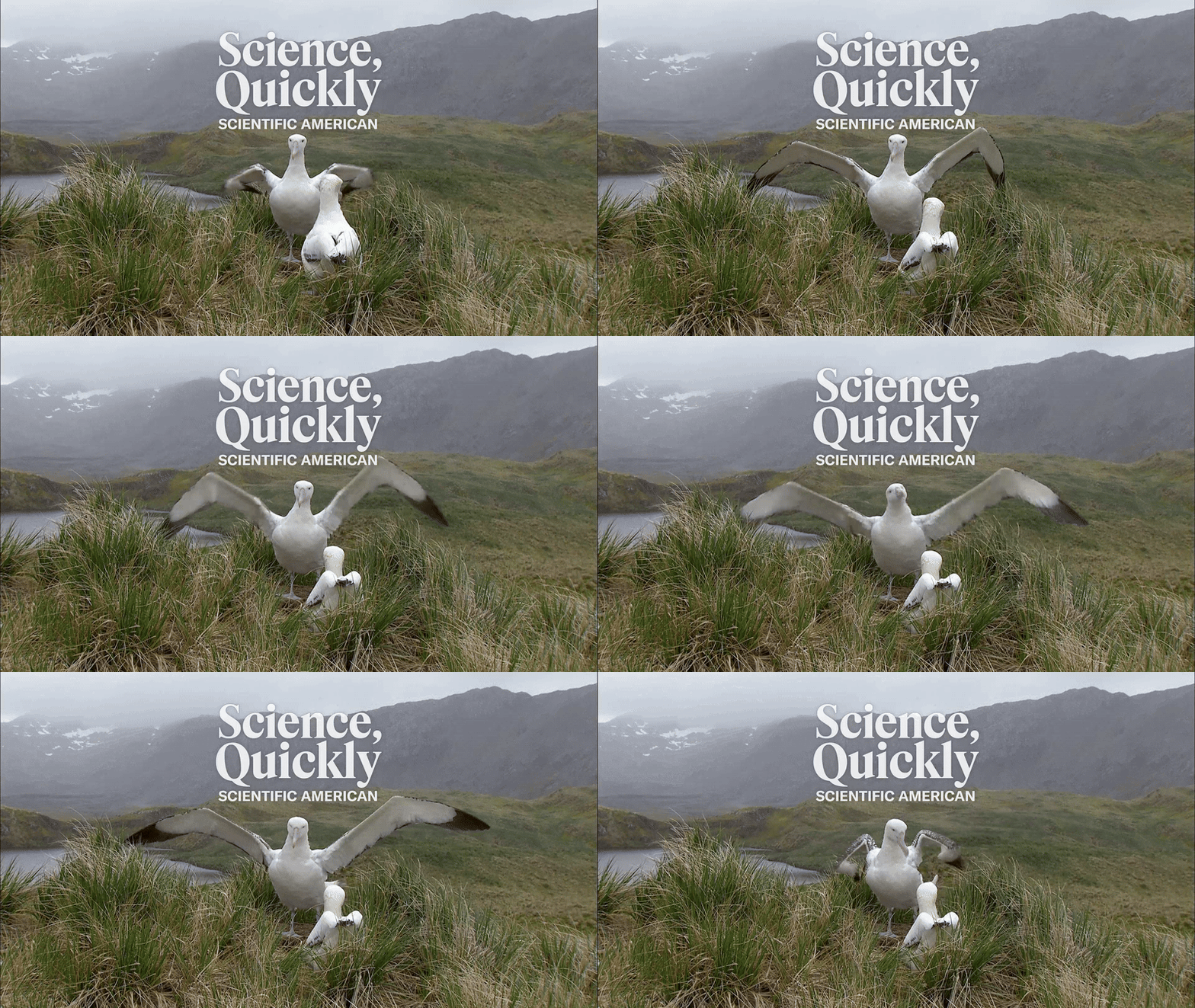
    Joseph Polidoro: Imagine for a moment that you’re a very hungry bird soaring over 30-foot ocean swells in high winds, with no land for thousands of miles.

    How do you know where you’re going?

    If you’re a wandering albatross, you listen. 

    [CLIP: Music]

    According to a new finding in October’s Proceedings of the National Association of Sciences USA, this seabird navigates using sounds below our thresholds for hearing.

    For Science, Quickly, I’m Joseph Polidoro.

    The wandering albatross thrives in the circumpolar band of ocean north of Antarctica—a windswept region that the world’s best sailors say has the most inhospitable seas on the planet.

    On the Southern Ocean’s islands where they nest and brood, one wandering albatross parent tends the nest while its partner takes to the sea, traveling as much as 10,000 kilometers as it forages for scattered prey. The bird must eat enough to fuel its turn on the nest, which can be a long time …

    Samantha Patrick: Birds might go for, perhaps, a minimum of four or five days, up to 30 days.

    Polidoro: Samantha Patrick is a marine ecologist at the University of Liverpool in England and a co-author of the study.

    Wandering albatrosses actually gain weight on these long trips because they’re extremely efficient flyers.

    Sophie de Grissac: It almost never beats its wings. It’s quite fascinating to see them flying in the winds. When they’re flying, their heartbeat is the same as when they’re resting.

    Polidoro: That’s Sophie de Grissac, an ornithologist and a researcher at the French National Museum of Natural History in Paris, who wasn’t involved in the study.

    With their long wingspan—the longest of any bird, maxing out at nearly 12 feet—wandering albatrosses use wind, air pressure gradients, and gravity above the swells and waves to soar for thousands of miles, reaching top speeds of 45 miles an hour.

    Basically, wandering albatrosses don’t fly. They soar.

    De Grissac: The more distance you cover, the more you may find food.

    Polidoro: The wandering albatross’s keen senses of sight and smell help it locate prey. But these senses are good for about 100 kilometers—a distance the bird can travel in as little as an hour and a half. So how does the albatross know where to soar toward?

    Patrick: There does seem to be this large gap in information that they’re able to access.

    Polidoro: A clue came in a chance encounter on the way to the Crozet Islands, part of the French Southern and Antarctic Territories, where Patrick was headed to study albatrosses.

    Patrick: On the same vessel were some researchers from the [United Nations]. They were going to work with the hydrophone station that’s used to monitor nuclear tests. It also gathers infrasound data. And we came up with the question of whether seabirds could use infrasound. And it was clear that no one had really thought about this before, and that’s where the idea for the project came from.

    Polidoro: Infrasound is any sound below 20 hertz, where human hearing starts to drop off. At the very low end of the infrasound spectrum are microbaroms—very low-frequency sounds between 0.1 and 0.6 Hz that are detectable across thousands of miles.

    Natasha Gillies: Microbaroms are generated by the collision of ocean waves. 

    Polidoro: Natasha Gillies is a seabird ecologist at the University of Liverpool and a co-author of the study.

    The constant hum of microbarom infrasound is called “the voice of the sea.” It’s present everywhere, all the time. But it’s unevenly distributed.

    Gillies: Where you have more energy in the ocean system because you have wavier areas or windy areas, then you get louder microbarom regions.

    Polidoro: Ideal soaring conditions for wandering albatrosses.

    Patrick: But it also gives them information about standing ocean waves, and this is often caused by things like storms. So it would enable birds to try and gauge where storms are, potentially. So this might be be cause they want to move toward windier areas that could be optimal, or they might want to move away from windy areas if they’re too strong, and they want to try and avoid storms.

    Polidoro: Directly testing this apex predator’s hearing is not an option. So Natasha and her colleagues arrived at a creative experimental solution: Get a large enough sample of wandering albatross flight paths. Then, using wind and infrasound data, create a sound map of the total flight area—a map of microbaroms across space and time. Send out another set of albatrosses equipped with sensors to field check the sound map. Finally, overlay the birds’ flight paths on the sound map.

    Gillies: So essentially what we can get is: if you put an albatross at point X in space and on this day in time, what infrasound would it be likely to hear and experience? 

    Patrick: We didn’t have an expectation at the beginning that they would move toward louder or quieter areas.

    Polidoro: What the team found is that wandering albatrosses aren’t exactly wandering. Instead they seem to use microbaroms to head toward ideal wind conditions.

    Ventura: Looking at the soundscape and how the birds move, you know, almost following this wave of sound, I found that beautiful.

    My name is Francesco Ventura, and I’m a postdoc at Woods Hole Oceanographic Institution.

    Polidoro: He wasn’t involved in the study either.

    Ventura: It’s another world–that’s the thing. It’s something that we cannot fully understand, I think; we are humans and we just cannot even imagine how that would work for us. But it seems to be working fine for them because they have been doing it for a long time. 

    They seem to be [reading] what’s going on and kind of orienting toward that. You know that is something that is…it’s SciFi.

    Gillies: We know that there is something about infrasound that they want to move toward, that they like, that is beneficial to them in some way.

    Ventura: It was kind of a badly needed paper at this point because it sheds some new light into a fundamental question that is at the core of a lot of marine megafauna research in general but also at the core of seabird research, which is: “How do they manage to find food in such a vast area?”

    Polidoro: This reliance on infrasound may actually extend to other species, too.

    Gillies: Most seabirds are highly dependent on wind for movement. It seems to be involved in animal behavior in a lot of contexts, in a lot of different species.

    Polidoro: They include whales, elephants, pigeons and peacocks.

    Gillies: So I would be very surprised if this was in any way unique to wandering albatrosses.

    De Grissac: So albatrosses have had a very long time to evolve ways of feeling the environment—lots of ways they can perceive what’s around them. And I think because they really need this condition, this stormy conditions, these winds, it makes perfect sense that it would have evolved more than one way of finding them.

    Gillies: I think it’s a really nice reminder of the different sources of information animals might be using—especially in this sort of environment that is so featureless—and how animals can still extract so much information and context out of that despite there seemingly not being much there.

    De Grissac: Evolution in animals is almost always very surprising. When you study the evolution of the animal closely, you find remarkable things, remarkable inventions.

    Polidoro: Science, Quickly is produced by Tulika Bose and Jeff DelViscio. Our music is composed by Dominic Smith.

    Subscribe to Science, Quickly wherever you get your podcasts. If you like the show, give us a rating or review.

    For Science, Quickly, I’m Joseph Polidoro.

    [CLIP: Music]


    Original Source Link

    Share. Facebook Twitter Pinterest LinkedIn WhatsApp Email Reddit Telegram
    Previous ArticleWhoopi Goldberg Recalls How Patrick Swayze Convinced Her to Make Ghost – The Hollywood Reporter
    Next Article All the future of transportation tech that stood out at CES 2024

    RELATED POSTS

    The Trajectory of the Artemis II Moon Mission Is a Feat of Engineering

    April 4, 2026

    NASA Artemis II astronauts in ‘great spirits,’ space agency officials say, as mission nears moon

    April 3, 2026

    Surprise fossil discoveries push back the evolution of complex animals

    April 3, 2026

    A New Google-Funded Data Center Will Be Powered by a Massive Gas Plant

    April 2, 2026

    Humans have been gambling since the Ice Age

    April 2, 2026

    Tobacco plant altered to produce five psychedelic drugs

    April 1, 2026
    latest posts

    Bleachers Reminisce About Packing “the van” on New Song: Stream

    Bleachers have dropped their new song “the van,” the third single from their upcoming album,…

    OPM Director Scott Kupor won’t ‘dismiss’ conflict of interest risks with tech hiring push

    April 4, 2026

    Trump Proposes Budget Disaster That Would Hand Congress To Democrats

    April 4, 2026

    Mike Rowe doubles down on defense of blue collar workers after ‘tone deaf’ Kimmel joke

    April 4, 2026

    Anthropic is having a moment in the private markets; SpaceX could spoil the party

    April 4, 2026

    The Trajectory of the Artemis II Moon Mission Is a Feat of Engineering

    April 4, 2026

    Jonathan Majors Falls Through Window of Daily Wire Movie Set

    April 4, 2026
    Categories
    • Books (1,162)
    • Business (6,066)
    • Events (42)
    • Film (6,002)
    • Lifestyle (4,106)
    • Music (6,113)
    • Politics (6,066)
    • Science (5,419)
    • Technology (5,996)
    • Television (5,683)
    • Uncategorized (6)
    • US News (6,054)
    popular posts

    Mark Rylance Was Hurt Over “Nasty” Comments From ‘Chicago 7’ Figures – The Hollywood Reporter

    Mark Rylance didn’t appreciate certain remarks that he remembers being made by real-life figures portrayed…

    COVID Gets Creative By Howard Bloom

    May 12, 2022

    Why Guys Are Switching to Low Maintenance Medium Hairstyles for Men

    October 15, 2025

    Paul Haggis ‘totally innocent’ following sexual assault arrest in Italy, attorney says

    June 19, 2022
    Archives
    Browse By Category
    • Books (1,162)
    • Business (6,066)
    • Events (42)
    • Film (6,002)
    • Lifestyle (4,106)
    • Music (6,113)
    • Politics (6,066)
    • Science (5,419)
    • Technology (5,996)
    • Television (5,683)
    • Uncategorized (6)
    • US News (6,054)
    About Us

    We are a creativity led international team with a digital soul. Our work is a custom built by the storytellers and strategists with a flair for exploiting the latest advancements in media and technology.

    Most of all, we stand behind our ideas and believe in creativity as the most powerful force in business.

    What makes us Different

    We care. We collaborate. We do great work. And we do it with a smile, because we’re pretty damn excited to do what we do. If you would like details on what else we can do visit out Contact page.

    Our Picks

    The Trajectory of the Artemis II Moon Mission Is a Feat of Engineering

    April 4, 2026

    Jonathan Majors Falls Through Window of Daily Wire Movie Set

    April 4, 2026

    Ernie Hudson Teases the Truth About Lena’s Father After Pivotal Episode (Exclusive)

    April 4, 2026
    © 2026 New York Examiner News. All rights reserved. All articles, images, product names, logos, and brands are property of their respective owners. All company, product and service names used in this website are for identification purposes only. Use of these names, logos, and brands does not imply endorsement unless specified. By using this site, you agree to the Terms & Conditions and Privacy Policy.

    Type above and press Enter to search. Press Esc to cancel.

    We use cookies on our website to give you the most relevant experience by remembering your preferences and repeat visits. By clicking “Accept All”, you consent to the use of ALL the cookies. However, you may visit "Cookie Settings" to provide a controlled consent.
    Cookie SettingsAccept All
    Manage consent

    Privacy Overview

    This website uses cookies to improve your experience while you navigate through the website. Out of these, the cookies that are categorized as necessary are stored on your browser as they are essential for the working of basic functionalities of the website. We also use third-party cookies that help us analyze and understand how you use this website. These cookies will be stored in your browser only with your consent. You also have the option to opt-out of these cookies. But opting out of some of these cookies may affect your browsing experience.
    Necessary
    Always Enabled
    Necessary cookies are absolutely essential for the website to function properly. These cookies ensure basic functionalities and security features of the website, anonymously.
    CookieDurationDescription
    cookielawinfo-checkbox-analytics11 monthsThis cookie is set by GDPR Cookie Consent plugin. The cookie is used to store the user consent for the cookies in the category "Analytics".
    cookielawinfo-checkbox-functional11 monthsThe cookie is set by GDPR cookie consent to record the user consent for the cookies in the category "Functional".
    cookielawinfo-checkbox-necessary11 monthsThis cookie is set by GDPR Cookie Consent plugin. The cookies is used to store the user consent for the cookies in the category "Necessary".
    cookielawinfo-checkbox-others11 monthsThis cookie is set by GDPR Cookie Consent plugin. The cookie is used to store the user consent for the cookies in the category "Other.
    cookielawinfo-checkbox-performance11 monthsThis cookie is set by GDPR Cookie Consent plugin. The cookie is used to store the user consent for the cookies in the category "Performance".
    viewed_cookie_policy11 monthsThe cookie is set by the GDPR Cookie Consent plugin and is used to store whether or not user has consented to the use of cookies. It does not store any personal data.
    Functional
    Functional cookies help to perform certain functionalities like sharing the content of the website on social media platforms, collect feedbacks, and other third-party features.
    Performance
    Performance cookies are used to understand and analyze the key performance indexes of the website which helps in delivering a better user experience for the visitors.
    Analytics
    Analytical cookies are used to understand how visitors interact with the website. These cookies help provide information on metrics the number of visitors, bounce rate, traffic source, etc.
    Advertisement
    Advertisement cookies are used to provide visitors with relevant ads and marketing campaigns. These cookies track visitors across websites and collect information to provide customized ads.
    Others
    Other uncategorized cookies are those that are being analyzed and have not been classified into a category as yet.
    SAVE & ACCEPT