
Close Menu
New York Examiner News

    Subscribe to Updates

    Get the latest creative news from FooBar about art, design and business.

    What's Hot

    Apple Loaf Cake to Celebrate the Season Change

    September 2, 2026

    RENOWNED BROADCASTER ANDREW EBORN JOINS GREAT BRITAIN SOFTBALL ON THE ROAD TO OLYMPIC QUALIFICATION

    September 1, 2026

    Miley Cyrus Announces New Album Bass Persuades, Confirms Los Angeles Shows

    September 1, 2026
    Facebook X (Twitter) Instagram
    New York Examiner News
    • Home
    • US News
    • Politics
    • Business
    • Science
    • Technology
    • Lifestyle
    • Music
    • Television
    • Film
    • Books
    • Contact
      • About
      • Amazon Disclaimer
      • DMCA / Copyrights Disclaimer
      • Terms and Conditions
      • Privacy Policy
    New York Examiner News
    Home»Science»How Plane Accidents, like the DC Crash, Are Investigated
    Science

    How Plane Accidents, like the DC Crash, Are Investigated

    By AdminJanuary 31, 2025
    Facebook Twitter Pinterest LinkedIn WhatsApp Email Reddit Telegram
    How Plane Accidents, like the DC Crash, Are Investigated


    January 30, 2025

    5 min read

    How Plane Accidents, like the DC Crash, Are Investigated

    The accident that resulted in a commercial airplane crashing into the Potomac yesterday will require air safety investigators to dig deep
    By Gary Stix edited by Dean Visser

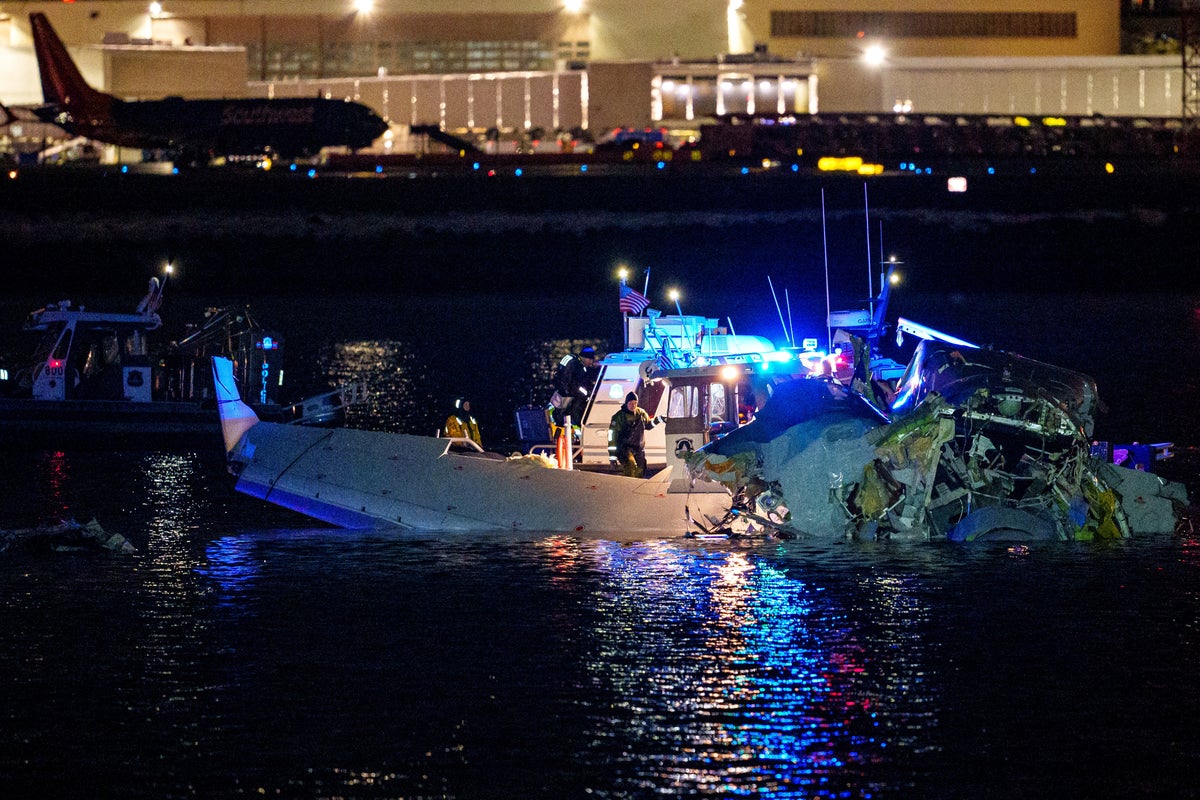
    Emergency resoponse team assess wreckage of crashed plane in Potomac River..

    Emergency response units inspect airplane wreckage in the Potomac River near Ronald Reagan Washington Airport.

    Andrew Harnik/Getty Images

    A video camera at the Kennedy Center in Washington, D.C., captures a chiaroscuro image of the night landscape in the nation’s capital. A banking airplane approaches above. It moves toward the camera and then passes uneventfully out of view. Off in the distance, a bright blip in the sky moves slowly forward. A much smaller pinpoint of light approaches from behind at a quicker pace. Within a few seconds, the smaller aircraft overtakes the larger one and a brilliant flash illuminates the night sky hundreds of feet above the Potomac River.

    Last night’s collision of a Sikorsky UH-60 Black Hawk helicopter with American Eagle Flight 5342 is feared to have resulted in the deaths of the commercial airplane’s 64 passengers and crew, as well as the helicopter’s three U.S. Army service members. Understandably, the incident astonished both experts and the flying public. Traveling in U.S. airspace has generally been a remarkably secure experience for many years. The last domestic accident that involved a commercial airliner and resulted in major fatalities dates back to 2009.

    Ronald Reagan Washington National Airport remains a challenge for pilots, who must contend with both the heavy traffic and the restricted airspace near areas such as the White House and the Pentagon. The Potomac is the site of one previous major accident: in 1982 an Air Florida flight crashed into a bridge while taking off in a storm and then plummeted into the frozen river, killing 74 of the 79 people onboard and four motorists on the bridge. In recent years, near misses at Reagan National have occurred on the ground, with plane paths intersecting dangerously on the runway in multiple incidents recorded by the Federal Aviation Administration.


    On supporting science journalism

    If you’re enjoying this article, consider supporting our award-winning journalism by subscribing. By purchasing a subscription you are helping to ensure the future of impactful stories about the discoveries and ideas shaping our world today.


    How do air safety officials proceed with investigating such a major accident? Scientific American put that question to Kristy Kiernan, associate director of the Boeing Center for Aviation and Aerospace Safety at Embry-Riddle Aeronautical University.

    [An edited transcript of the interview follows.]

    Accidents in commercial aviation are rare, and I think a lot of people are wondering how we will find out what really happened in yesterday’s incident.

    There are very clearly defined processes for this. The NTSB [National Transportation Safety Board] has a “go team” that is launched immediately, and once the rescue and recovery operations are winding down, the attention turns to perishable evidence—things that might be affected by the environment or by the movement and recovery of the wreckage. So that’s a very important thing, to collect the perishable evidence. Obviously, once the scene has been secured and it’s possible to operate safely, there are a lot of hazards at an accident scene, so protection of the people who are doing the rescue and recovery and the investigation is also an important factor.

    iSo what comes after that?

    Obviously, the so-called black boxes, the voice and data recorders, are very important to recover. Those would be present on the regional jets. I don’t know what type of recording devices are on the UH-60 [helicopter]. But in general, the black boxes are a big focus. Then there are various groups that are convened—operations, maintenance, air-traffic control, weather—and all of these groups, including human factors experts investigate their particular area.

    So, for instance, in air-traffic control, you would be securing all the air-traffic control radar and the tape of all the communications. Similarly, for operations, for both the Army and for PSA Airlines [the regional American Airlines subsidiary involved in the crash], there will be a collection of evidence related to the people involved in the operation of the aircraft, including their training records. If things are not as they should be, the effort in a particular area is proportional to the role that a particular fact plays in the investigation. So more and more resources will be deployed toward the areas where the investigation is progressing. All that takes time. We have a fast news cycle, and the public should get information as soon as they can, but it’s better to wait for good information than to give in to speculation and opinion, which frankly, have absolutely no place in aviation.

    Can you describe what has been learned from pursuing past investigations?

    I would say is that we have layers of safety that exist. And so, for example, there are procedures in terms of where airplanes are in the sky and what altitudes they are at. Then we have technologies. We have collision avoidance systems. We have what’s called ADS-B, Automatic Dependent Surveillance-Broadcast. That’s another tool that is used to help in situational awareness of where other aircraft are in the airspace. We have highly trained air-traffic controllers, and in numerous instances in the past, they’ve been instrumental in avoiding midair collisions. Then we have highly experienced pilots on the flight deck of the regional jet and highly trained and experienced aviators in the Army helicopter.

    But that isn’t always enough, is it?

    So we normally have all of these layers. However, we also have to recognize that we ask a lot of our systems. We have that area in Washington, [D.C.], which is high-density, high-volume and has a high pace of operations. And while we have different margins of safety—so that when you’re driving on a slick and snowy road in the dark, you can maintain safe operations—your risk profile and your safety margin is different than on a beautiful Sunday afternoon. So there are areas where our safety margins are thinner, and those are the areas that we really have to be vigilant for.

    If people could see all of the activities that go into keeping the airspace safe, I think they would be reassured. But the last thing that I would say is that we should be comfortable where we are now. We should always, as aviation safety professionals, be uncomfortable. For the traveling public, I think they can take comfort because of all these activities that go on every single day. But even one accident, when there are 40,000 operations in the U.S. domestic airspace every day is too many.

    Air accidents with mass fatalities are rare. Doesn’t that in some ways make them more difficult to investigate?

    I don’t know that it makes [such accidents] more challenging to investigate. It definitely makes [them] more challenging to predict because there is a lot of modeling that is done in the industry to try and understand the different things that go into an accident. There is not a smoking gun; there is not just one causal factor. Even if you found one thing, there is a reason for that one thing, and that reason is more complicated. And if you just identify the one thing, you’re really not solving anything. You have to go deeper and look at the why behind it. These accidents are very rare. So the likelihood of the same one recurring, especially after we take action, is extremely low. But we can’t stop there. We want to use each thing we discover as an opportunity to examine all the factors that went into it—so that we are not just being reactive but [are also] able to look forward and identify the risks and hazards that we have to mitigate.


    Original Source Link

    Share. Facebook Twitter Pinterest LinkedIn WhatsApp Email Reddit Telegram
    Previous ArticleIs Jasmine Pineda’s Boyfriend Matt Branis Bad News? (Leaving Gino Palazzolo Was A Mistake)
    Next Article Intel has already received $2.2B in federal grants for chip production

    RELATED POSTS

    Inside the Perimenopause Industrial Complex

    September 1, 2026

    What’s next for NASA’s new Roman Space Telescope?

    September 1, 2026

    Why Food Keeps Making Everybody Sick This Summer

    August 31, 2026

    NASA’s Nancy Grace Roman Telescope launches to space

    August 31, 2026

    Scientists Create the Littlest Big Bang to Study the Universe’s Origins

    August 30, 2026

    NASA’s Roman Space Telescope could find alien Earths—but not like you think

    August 30, 2026
    latest posts

    Apple Loaf Cake to Celebrate the Season Change

    Over the last few years I’ve come to really appreciate a loaf cake. From the…

    RENOWNED BROADCASTER ANDREW EBORN JOINS GREAT BRITAIN SOFTBALL ON THE ROAD TO OLYMPIC QUALIFICATION

    September 1, 2026

    Miley Cyrus Announces New Album Bass Persuades, Confirms Los Angeles Shows

    September 1, 2026

    A new bill would tax AI tokens to fund jobs if the technology causes mass unemployment

    September 1, 2026

    Gas Prices Tracked Daily Across U.S.

    September 1, 2026

    Router firewall, antivirus and backups to secure your home network

    September 1, 2026

    GoPro to be acquired for $285M, will remain a public company

    September 1, 2026
    Categories
    • Books (1,464)
    • Business (6,367)
    • Events (71)
    • Film (6,302)
    • Lifestyle (4,377)
    • Music (6,429)
    • Politics (6,352)
    • Science (5,719)
    • Technology (6,300)
    • Television (5,990)
    • Uncategorized (9)
    • US News (6,355)
    popular posts

    Judd Apatow, Michael Bonfiglio on George Carlin HBO Documentary – The Hollywood Reporter

    In HBO’s two-part documentary George Carlin’s American Dream, directors Judd Apatow and Michael Bonfiglio chart…

    ‘John Wick 5’? Director Chad Stahelski Says “We’re Open To It.” – The Hollywood Reporter

    April 3, 2023

    Sarah Michelle Gellar Set for Teen Wolf Spinoff at Paramount+

    July 21, 2022

    Savannah Guthrie Pleads For Mother’s Safe Return, Video

    February 5, 2026
    Archives
    Browse By Category
    • Books (1,464)
    • Business (6,367)
    • Events (71)
    • Film (6,302)
    • Lifestyle (4,377)
    • Music (6,429)
    • Politics (6,352)
    • Science (5,719)
    • Technology (6,300)
    • Television (5,990)
    • Uncategorized (9)
    • US News (6,355)
    About Us

    We are a creativity led international team with a digital soul. Our work is a custom built by the storytellers and strategists with a flair for exploiting the latest advancements in media and technology.

    Most of all, we stand behind our ideas and believe in creativity as the most powerful force in business.

    What makes us Different

    We care. We collaborate. We do great work. And we do it with a smile, because we’re pretty damn excited to do what we do. If you would like details on what else we can do visit out Contact page.

    Our Picks

    Router firewall, antivirus and backups to secure your home network

    September 1, 2026

    GoPro to be acquired for $285M, will remain a public company

    September 1, 2026

    Inside the Perimenopause Industrial Complex

    September 1, 2026
    © 2026 New York Examiner News. All rights reserved. All articles, images, product names, logos, and brands are property of their respective owners. All company, product and service names used in this website are for identification purposes only. Use of these names, logos, and brands does not imply endorsement unless specified. By using this site, you agree to the Terms & Conditions and Privacy Policy.

    Type above and press Enter to search. Press Esc to cancel.

    We use cookies on our website to give you the most relevant experience by remembering your preferences and repeat visits. By clicking “Accept All”, you consent to the use of ALL the cookies. However, you may visit "Cookie Settings" to provide a controlled consent.
    Cookie SettingsAccept All
    Manage consent

    Privacy Overview

    This website uses cookies to improve your experience while you navigate through the website. Out of these, the cookies that are categorized as necessary are stored on your browser as they are essential for the working of basic functionalities of the website. We also use third-party cookies that help us analyze and understand how you use this website. These cookies will be stored in your browser only with your consent. You also have the option to opt-out of these cookies. But opting out of some of these cookies may affect your browsing experience.
    Necessary
    Always Enabled
    Necessary cookies are absolutely essential for the website to function properly. These cookies ensure basic functionalities and security features of the website, anonymously.
    CookieDurationDescription
    cookielawinfo-checkbox-analytics11 monthsThis cookie is set by GDPR Cookie Consent plugin. The cookie is used to store the user consent for the cookies in the category "Analytics".
    cookielawinfo-checkbox-functional11 monthsThe cookie is set by GDPR cookie consent to record the user consent for the cookies in the category "Functional".
    cookielawinfo-checkbox-necessary11 monthsThis cookie is set by GDPR Cookie Consent plugin. The cookies is used to store the user consent for the cookies in the category "Necessary".
    cookielawinfo-checkbox-others11 monthsThis cookie is set by GDPR Cookie Consent plugin. The cookie is used to store the user consent for the cookies in the category "Other.
    cookielawinfo-checkbox-performance11 monthsThis cookie is set by GDPR Cookie Consent plugin. The cookie is used to store the user consent for the cookies in the category "Performance".
    viewed_cookie_policy11 monthsThe cookie is set by the GDPR Cookie Consent plugin and is used to store whether or not user has consented to the use of cookies. It does not store any personal data.
    Functional
    Functional cookies help to perform certain functionalities like sharing the content of the website on social media platforms, collect feedbacks, and other third-party features.
    Performance
    Performance cookies are used to understand and analyze the key performance indexes of the website which helps in delivering a better user experience for the visitors.
    Analytics
    Analytical cookies are used to understand how visitors interact with the website. These cookies help provide information on metrics the number of visitors, bounce rate, traffic source, etc.
    Advertisement
    Advertisement cookies are used to provide visitors with relevant ads and marketing campaigns. These cookies track visitors across websites and collect information to provide customized ads.
    Others
    Other uncategorized cookies are those that are being analyzed and have not been classified into a category as yet.
    SAVE & ACCEPT