
Close Menu
New York Examiner News

    Subscribe to Updates

    Get the latest creative news from FooBar about art, design and business.

    What's Hot

    Kaitlyn Aurelia Smith Launches Label With New Album Ruin: It’s Not Just Music

    May 24, 2026

    Law enforcement authorities respond to reports of shots fired near White House as Trump was inside

    May 24, 2026

    Half Of GOP Senators Were Ready To Vote With Democrats To Kill Trump’s Slush Fund

    May 24, 2026
    Facebook X (Twitter) Instagram
    New York Examiner News
    • Home
    • US News
    • Politics
    • Business
    • Science
    • Technology
    • Lifestyle
    • Music
    • Television
    • Film
    • Books
    • Contact
      • About
      • Amazon Disclaimer
      • DMCA / Copyrights Disclaimer
      • Terms and Conditions
      • Privacy Policy
    New York Examiner News
    Home»Science»How the Seven Bridges of Königsberg Spawned New Math
    Science

    How the Seven Bridges of Königsberg Spawned New Math

    By AdminMarch 10, 2024
    Facebook Twitter Pinterest LinkedIn WhatsApp Email Reddit Telegram
    How the Seven Bridges of Königsberg Spawned New Math


    During the 18th century the denizens of the Prussian city of Königsberg wrestled with a puzzle: How could they find a walking path through the city that crossed each of its storied seven bridges exactly once?

    The bridges spanned a river containing two large islands. No matter how much they strategized their routes, they couldn’t avoid repeating a bridge.

    The problem stymied local thinkers, who eventually wrote a letter to famed mathematician Leonhard Euler (pronounced “oiler”) begging him to lay their curiosity to rest. Euler responded dismissively, claiming the problem had “little relationship to mathematics.” In a way, he was right, because the relevant math hadn’t been invented yet. Despite his initial demurral, Euler did end up solving the puzzle of the seven bridges of Königsberg, unaware that in the process he had birthed two new branches of math.


    On supporting science journalism

    If you’re enjoying this article, consider supporting our award-winning journalism by subscribing. By purchasing a subscription you are helping to ensure the future of impactful stories about the discoveries and ideas shaping our world today.


    How the Seven Bridges of Königsberg Spawned New Math

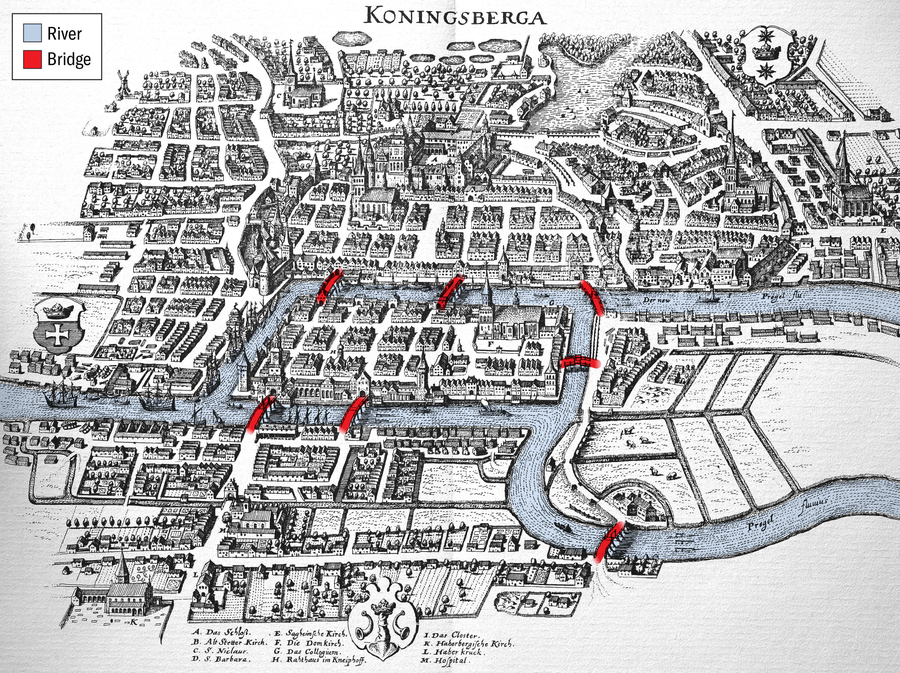
    The Prussian city of Königsberg, now Kaliningrad, Russia, in the Middle Ages. The 18th-century city map is a digitally enhanced reproduction that was modified to highlight river and bridges.

    Alamy Stock Photo (map); Amanda Montañez (highlighting)

    Say you were a resident of Königsberg. Looking at the map above could you design a path that traverses every bridge once? You’ll have to think like a mathematician. The first hurdle in wrangling any math problem is to strip away extraneous information until only the essential elements remain, a process called abstraction. Many features of the map don’t affect the question at hand. The lengths of the bridges, the sizes of the landmasses, even the geographical orientation of the land and bridges can all be discarded. All that matters is which pieces of land connect to which other ones and how many times. Now we can create a much simpler diagram consisting only of circles and lines to represent land and bridges, respectively.

    Cropped image shows a section of the Königsberg map with colors overlaid to highlight the bridges and the landmasses they connect. Accompanying diagram uses lines and circles in corresponding colors to represent the bridges and landmasses.

    Alamy Stock Photo (map); Amanda Montañez (highlighting and diagram)

    Modern math parlance calls this a “graph,” not to be confused with other unrelated mathematical graphs like plots in the x-y plane or statistical visualizations like bar graphs. Perhaps “network” would have been a better term to avoid any confusion. We call the circles “vertices” and the lines “edges.” Today graph theory is a major area of math and computer science with wide-ranging applications. Graphs don’t have to represent land and bridges. They can represent social networks, protein interactions, state borders, neural networks, the World Wide Web or any other data involving pairwise relationships.

    Abstraction allows mathematicians to translate a highly specific problem about a particular arrangement of bridges in an old city to a general problem about all graphs. Given a graph with any number of vertices and edges, is there a path that traverses every edge exactly once? It turns out that an amazingly simple test can answer this for any graph: For every vertex (landmass in our current puzzle), count the number of edges (bridges) emanating from it. If all of those counts are even numbers, or if all but two of them are even, then the path exists; otherwise, the path is impossible.

    Let’s explore the reasoning. Imagine a path through a graph that crosses each edge once. Consider a vertex in the middle of that path (not the starting or ending vertex). If that vertex has many edges, then your path will visit it multiple times, but every time you enter the vertex, you must also exit it via a different edge. So each time a vertex in the middle of the path gets visited, two edges get visited. That only works if every vertex in the middle of the path has an even number of edges. The start and end of the path are the only exceptions, because the starting vertex doesn’t have to be entered, and the ending vertex doesn’t have to be exited. So if we have exactly two vertices with an odd number of edges, then our path is possible if you start and end at those vertices. If every vertex has an even number of edges, then there will be a path that starts and ends at the same vertex forming a loop.

    This argument is considered the first result in graph theory, and paths through graphs that visit every edge once are now called Eulerian paths. Technically Euler’s argument describes only the conditions that make an Eulerian path impossible, and the proof that such a path always exists under these conditions came later. Applying what we’ve learned to the bridges of Königsberg, we see that all four vertices have an odd number of edges emanating from them, meaning, alas, the Prussian amblers searched in vain.

    Here’s a peculiar side note. Finding a path through a graph that visits every vertex (the land rather than the bridges in our example) exactly once sounds like a closely related problem, but is actually an entirely different beast. Though a simple test can determine whether a graph contains an Eulerian path, we don’t know any general efficient procedure for this vertex-focused variant. This variant is called the Hamiltonian path problem, and it belongs to a class of problems widely believed to be computationally intractable.

    Although Euler initially sneered at the bridge problem, he was ultimately drawn in by his inability to solve it with his usual tool kit. He wrote to a friend: “This question is so banal, but seemed to me worthy of attention in that neither geometry, nor algebra, nor even the art of counting was sufficient to solve it.” At the time, geometry concerned quantitative notions like distance, angle and area. But while the bridge problem appeared geometric in nature, it didn’t ask for any kind of measurement. The problem required a new abstraction that ignored traditional geometric quantities, while respecting the pairwise connections at the heart of the question.

    The idea to reduce the map of Königsberg to a bare-bones graph might seem obvious in retrospect, but many of the best abstractions do. The history of math tells the story of the power of abstraction. If ancient mathematical minds had quantitative questions about oranges, pearls or even the Earth, they could develop bespoke language and techniques for tackling each new challenge. But the endeavor becomes so much easier and clearer once one recognizes that these disparate-seeming objects all instantiate the same higher-order entity: a sphere. Giving the abstraction a name and a definition allows people who have never even met to build on each other’s work without reinventing the wheel.

    Euler’s paper not only launched the field of graph theory, but it also sowed the seeds for another major branch of math called topology. Topology refers to the study of geometric properties that persist even when we stretch, compress or deform objects as though they were made of highly elastic rubber. So while one level of abstraction took us from real-world objects such as oranges, mountains and dice to their shapes (spheres, pyramids and cubes), topology introduces a second level of abstraction in which we view spheres, pyramids and cubes as instantiations of some even higher-order entity. Topologists view these solids as equivalent because they can each be molded into the others in a rubbery world, unlike a doughnut, which would maintain a hole no matter how you stretched it.

    By abstracting away the quantitative particulars in the map of Königsberg, Euler opened the door to a new kind of geometric thinking, unmoored from the quantitative particulars of distance and angle that had dominated the subject for millennia. Graph theory and topology continue to yield new mathematical insights today, and we have a bygone civilization of saunterers to thank.


    Original Source Link

    Share. Facebook Twitter Pinterest LinkedIn WhatsApp Email Reddit Telegram
    Previous Article‘Super Mario Bros. Movie’ Announces Sequel Set for 2026
    Next Article Why does every startup want to help you get paid?

    RELATED POSTS

    Quantum ‘Jamming’ Could Help Unlock the Mysteries of Causality

    May 23, 2026

    SpaceX launches Starship V3—the world’s most powerful and tallest rocket ever

    May 23, 2026

    Mercury may have gained all of its unexpected water in a single day

    May 22, 2026

    All the Fancy Measuring Devices Used in Science Rely on Two Stone-Age Techniques

    May 22, 2026

    Hidden structural features inside Egypt’s Great Pyramid may have helped it withstand earthquakes, new study finds

    May 21, 2026

    Women’s body temperature rises from age 18 to 42 but we don’t know why

    May 21, 2026
    latest posts

    Kaitlyn Aurelia Smith Launches Label With New Album Ruin: It’s Not Just Music

    Kaitlyn Aurelia Smith is readying a new album. The composer and synthesist will release Ruin:…

    Law enforcement authorities respond to reports of shots fired near White House as Trump was inside

    May 24, 2026

    Half Of GOP Senators Were Ready To Vote With Democrats To Kill Trump’s Slush Fund

    May 24, 2026

    Giants’ Abdul Carter and Jaxson Dart squash potential locker room rift over Trump event appearance

    May 24, 2026

    Memorial Day Dyson Vacuum Deals: V15 Detect, Gen5Detect, PencilVac On Sale

    May 24, 2026

    Quantum ‘Jamming’ Could Help Unlock the Mysteries of Causality

    May 23, 2026

    2026 Cannes Film Festival 5 Takeaways: AI, Queer Cinema

    May 23, 2026
    Categories
    • Books (1,261)
    • Business (6,165)
    • Events (54)
    • Film (6,102)
    • Lifestyle (4,199)
    • Music (6,219)
    • Politics (6,164)
    • Science (5,519)
    • Technology (6,097)
    • Television (5,784)
    • Uncategorized (7)
    • US News (6,153)
    popular posts

    DuckDuckGo Isn’t as Private as You Think

    After another week of dismally tragic news and moral failures by the powerful, it’s good…

    These Nanobots Can Swim Around a Wound and Kill Bacteria

    May 12, 2022

    Senate Democrats Will Move To End Tommy Tuberville’s Military Promotions Blockade

    October 26, 2023

    Can Hollywood’s Most Troubled Awards Show Be Saved?

    January 6, 2024
    Archives
    Browse By Category
    • Books (1,261)
    • Business (6,165)
    • Events (54)
    • Film (6,102)
    • Lifestyle (4,199)
    • Music (6,219)
    • Politics (6,164)
    • Science (5,519)
    • Technology (6,097)
    • Television (5,784)
    • Uncategorized (7)
    • US News (6,153)
    About Us

    We are a creativity led international team with a digital soul. Our work is a custom built by the storytellers and strategists with a flair for exploiting the latest advancements in media and technology.

    Most of all, we stand behind our ideas and believe in creativity as the most powerful force in business.

    What makes us Different

    We care. We collaborate. We do great work. And we do it with a smile, because we’re pretty damn excited to do what we do. If you would like details on what else we can do visit out Contact page.

    Our Picks

    Quantum ‘Jamming’ Could Help Unlock the Mysteries of Causality

    May 23, 2026

    2026 Cannes Film Festival 5 Takeaways: AI, Queer Cinema

    May 23, 2026

    Khloe Kardashian In New Romance With Oscar-Winning Actor?

    May 23, 2026
    © 2026 New York Examiner News. All rights reserved. All articles, images, product names, logos, and brands are property of their respective owners. All company, product and service names used in this website are for identification purposes only. Use of these names, logos, and brands does not imply endorsement unless specified. By using this site, you agree to the Terms & Conditions and Privacy Policy.

    Type above and press Enter to search. Press Esc to cancel.

    We use cookies on our website to give you the most relevant experience by remembering your preferences and repeat visits. By clicking “Accept All”, you consent to the use of ALL the cookies. However, you may visit "Cookie Settings" to provide a controlled consent.
    Cookie SettingsAccept All
    Manage consent

    Privacy Overview

    This website uses cookies to improve your experience while you navigate through the website. Out of these, the cookies that are categorized as necessary are stored on your browser as they are essential for the working of basic functionalities of the website. We also use third-party cookies that help us analyze and understand how you use this website. These cookies will be stored in your browser only with your consent. You also have the option to opt-out of these cookies. But opting out of some of these cookies may affect your browsing experience.
    Necessary
    Always Enabled
    Necessary cookies are absolutely essential for the website to function properly. These cookies ensure basic functionalities and security features of the website, anonymously.
    CookieDurationDescription
    cookielawinfo-checkbox-analytics11 monthsThis cookie is set by GDPR Cookie Consent plugin. The cookie is used to store the user consent for the cookies in the category "Analytics".
    cookielawinfo-checkbox-functional11 monthsThe cookie is set by GDPR cookie consent to record the user consent for the cookies in the category "Functional".
    cookielawinfo-checkbox-necessary11 monthsThis cookie is set by GDPR Cookie Consent plugin. The cookies is used to store the user consent for the cookies in the category "Necessary".
    cookielawinfo-checkbox-others11 monthsThis cookie is set by GDPR Cookie Consent plugin. The cookie is used to store the user consent for the cookies in the category "Other.
    cookielawinfo-checkbox-performance11 monthsThis cookie is set by GDPR Cookie Consent plugin. The cookie is used to store the user consent for the cookies in the category "Performance".
    viewed_cookie_policy11 monthsThe cookie is set by the GDPR Cookie Consent plugin and is used to store whether or not user has consented to the use of cookies. It does not store any personal data.
    Functional
    Functional cookies help to perform certain functionalities like sharing the content of the website on social media platforms, collect feedbacks, and other third-party features.
    Performance
    Performance cookies are used to understand and analyze the key performance indexes of the website which helps in delivering a better user experience for the visitors.
    Analytics
    Analytical cookies are used to understand how visitors interact with the website. These cookies help provide information on metrics the number of visitors, bounce rate, traffic source, etc.
    Advertisement
    Advertisement cookies are used to provide visitors with relevant ads and marketing campaigns. These cookies track visitors across websites and collect information to provide customized ads.
    Others
    Other uncategorized cookies are those that are being analyzed and have not been classified into a category as yet.
    SAVE & ACCEPT