
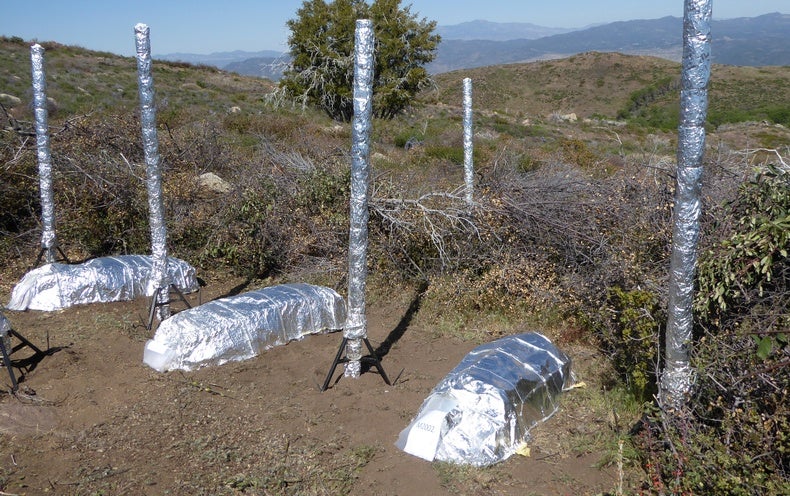
Wildfires burn hot, fast and unpredictably. Although wildland firefighters receive extensive training to keep themselves safe, they sometimes become cut off by flames that can reach temperatures of 1,600 to more than 2,000 degrees Fahrenheit. To protect themselves in these extremely dire situations, each carries a portable fire shelter (essentially a small, specially formulated foil tent) that can be deployed to shield them from flames and hot gasses. But this technology has serious limits, and researchers are now exploring new materials and designs—and putting prototypes through a gauntlet of fiery tests.
The National Wildfire Coordinating Group (NWCG), a federal government organization that sets standards for wildland fire equipment, reports that fire shelters have been deployed more than 200 times between 2006 and 2020. But this last line of defense does not always work. For example, 19 of the 20 members of the Granite Mountain firefighting crew tragically perished despite using their shelters in Arizona’s 2013 Yarnell Hill Fire. The need for better shelters will only become more crucial as fire seasons continue to grow more severe: last year alone, firefighters battled almost 60,000 wildfires that turned seven million acres of U.S. forest into blackened ash.
“The fire seasons are lengthening, getting more severe, and wildland firefighters are seeing fire behavior that we haven’t seen before,” says Camille Stevens-Rumann, an assistant professor of forest and rangeland stewardship at Colorado State University, who was not involved in the recent fire shelter tests. “In Colorado, we had a fire that burned 6,000 acres an hour. Those conditions lead to more risk for firefighters.” Such situations are particularly dangerous when flames spread quickly in a short period of time, forcing firefighters to retreat to their emergency shelters. “We’re also seeing an increase in extreme fire events, where you see many acres burning over a short period of time,” Stevens-Rumann adds. “With factors like wind, lack of moisture and plentiful fuels, you see fires exploding quickly in a single day.”
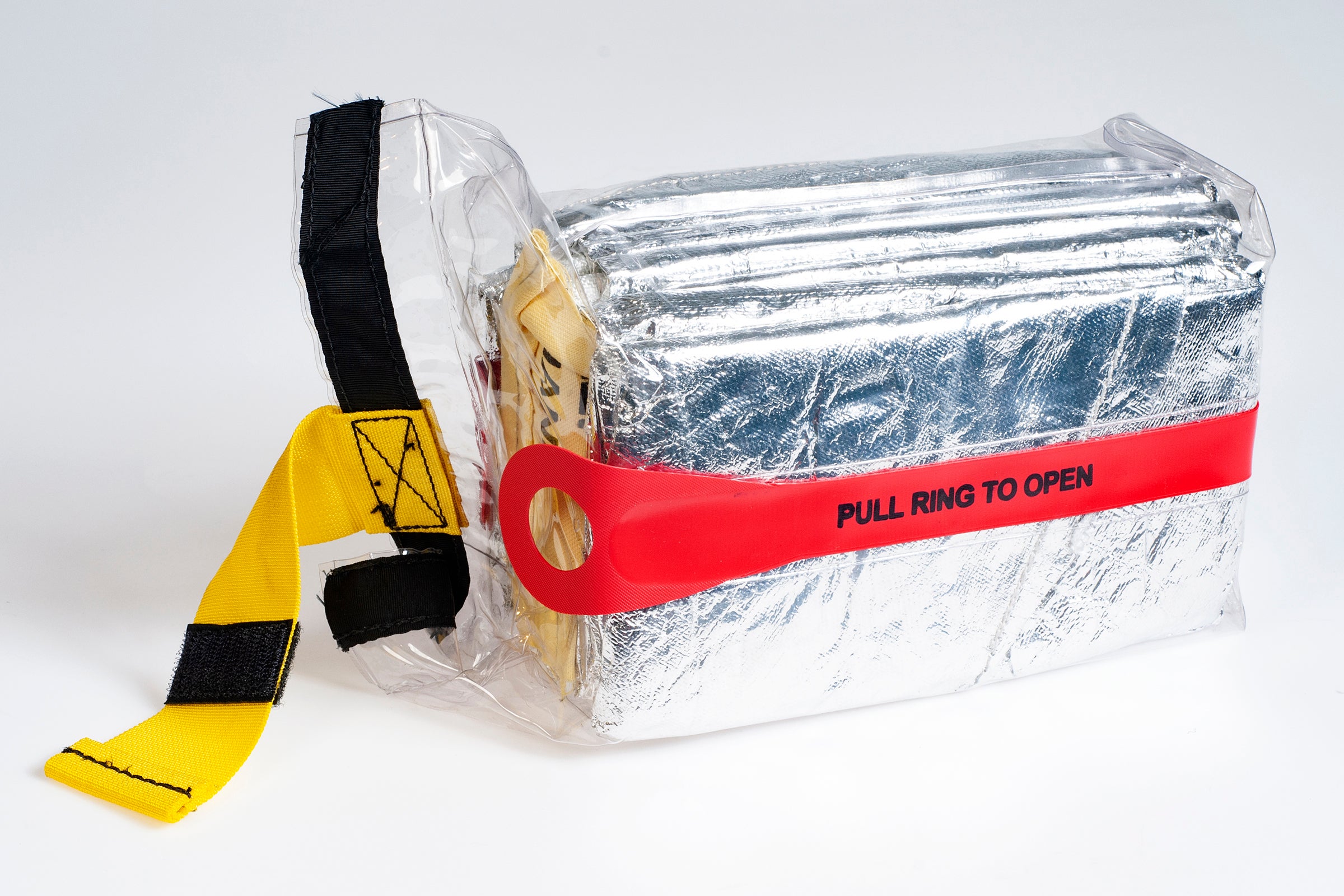
The current M2002 fire shelter, the only model approved for use by government-agency firefighters, folds down to a 4.3-pound packet about the size of a loaf of bread. It is typically stored in a plastic sleeve and carried in a special compartment on wildland firefighters’ backpacks. The packet can be unfolded into a half-tube that is just large enough for one person to lie down inside. Its fire resistance comes from a two-layer construction, with an air gap in between for added insulation. The outer layer consists of woven silica that is laminated, or bonded, to aluminum foil. The inner layer is fiberglass laminated to a separate layer of aluminum foil.
In 2019 a five-year NWCG review recommended retaining the existing fire shelter design. But the organization is always looking for improvements. Now researchers at North Carolina State University (N.C. State) have followed NWCG fire protection guidelines to evaluate the M2002, along with four prototypes developed by university researchers. Their work was detailed in a report published this past spring.
“We’re just trying to improve on [the current design],” says the study’s lead author Joseph Roise, a professor of forestry and environmental resources at N.C. State. “The domelike shape is really as good as you can get. You want to be close to the ground because heat rises—the closer you are to the ground, the less heat you have on your body.” Because the existing shape is hard to beat, the new emergency fire shelter prototypes focus on other ways to improve heat resistance. From the outside, they look a lot like the M2002. But some add an additional layer of advanced heat-resistant material. Others experiment with the placement of the seams, which can be a weak point.
To test the fire shelters’ thermal protective performance in a controlled laboratory environment, the N.C. State researchers used a specially built fire chamber called the PyroDome Turbulent Flame Fire Shelter Test System. Within the chamber, propane burners blasted full-size fire shelters with a direct flame for one minute. Sensitive instruments measured the time needed for the temperature at their floor to hit 302 degrees F, the established maximum temperature level for survivability in a shelter. A video camera inside each test shelter documented how the inside walls and seams changed with exposure to the flames.
During such tests, fire shelters must withstand two types of heat. First, there is radiant heat—think of it as the warmth experienced when standing by a campfire. The outer layer of aluminum reflects approximately 95 percent of this heat, according to Roise. He notes that aluminum is very durable, and when combined with a silica base, which slows the rate of heat transfer to lower the temperature inside the shelter, the materials work together well at reflecting radiant energy.
A more serious challenge is convective heat, which is experienced when a fire moves through a shelter deployment site and the flames or hot gasses directly touch the outside of the shelter. The outer layer can absorb this convective heat, raising its temperature. As that temperature nears 500 degrees F, the adhesives that bind the layers together can break down. If the aluminum foil exterior is separated from the cloth of the shelter’s outer layer, it can be torn away by turbulent winds, destroying much of the shelter’s reflective protection. Any torn spots in the material can also allow convective heat to breach the shelter and rapidly raise internal temperatures.
Because real wildfires create such unpredictable conditions, it is necessary to test fire shelters in the field, as well as in the laboratory. The N.C. State researchers also conducted eight field tests in four locations around North America. The test sites offered different fuel types, such as chaparral (where the ground is covered with shrubs or small trees), grassland and boreal forest, as well as multiple kinds of topography, from flat to hilly. The tests exposed the prototype shelters to different flame configurations, temperatures and weather conditions. This variety made it challenging to compare the M2002 model with prototypes, however. High winds, inconsistent amounts of fuel, and varying fire behavior produced different conditions for each shelter tested.
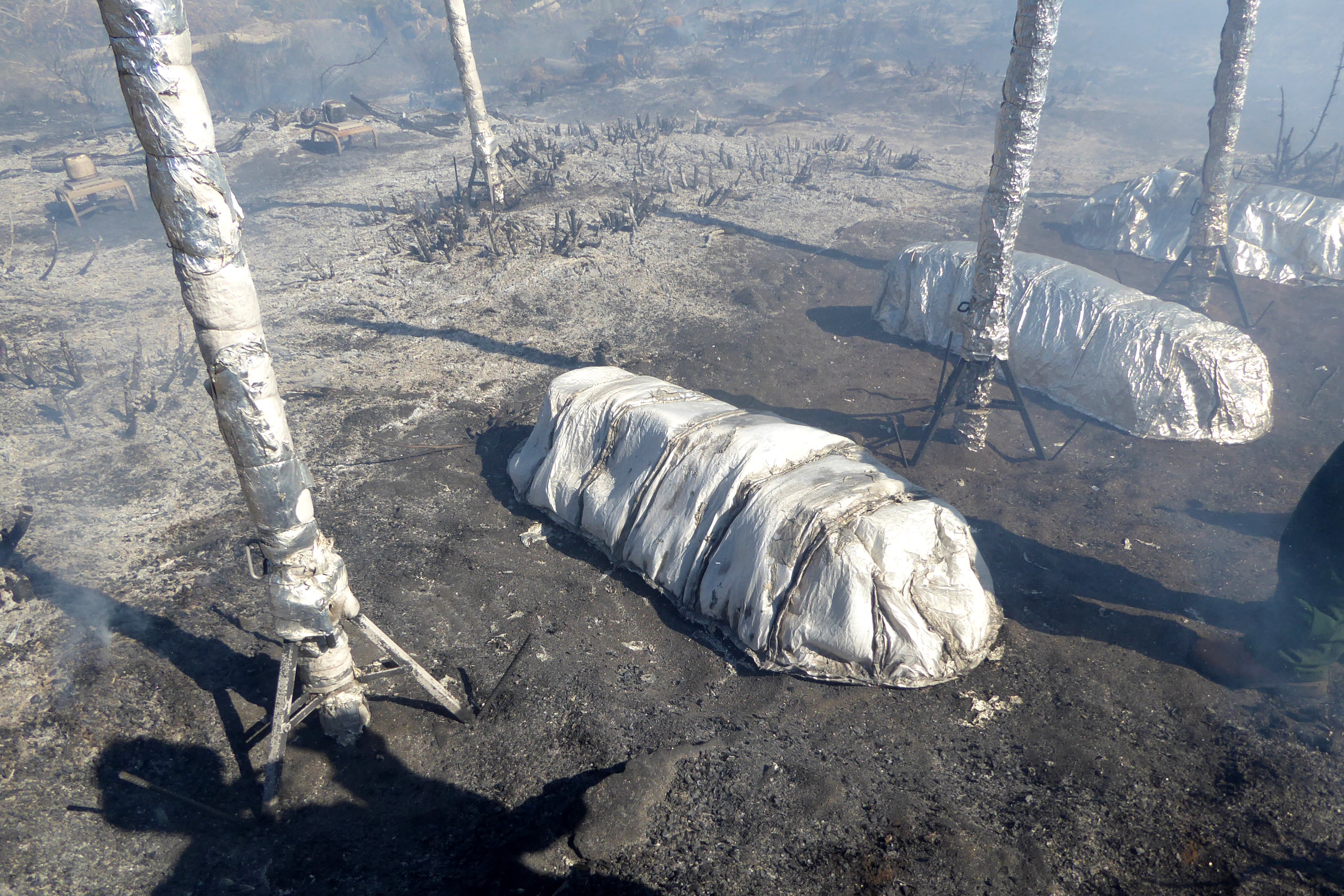
“There are a lot of variables in a wildfire environment. It’s very unpredictable. You could have a shelter next to another shelter, and when fire runs through the area, you’ve got surprisingly different results between the two,” says David Maclay-Schulte, an equipment specialist at the U.S. Forest Service’s National Technology and Development Program, who did not work on the new N.C. State report. “It’s very challenging to get repeatable and reliable data that way.”
Despite such challenges, the M2002 and all four prototypes passed the fire protection tests: they preserved a survivable air temperature inside the shelters during the field test operations, even in situations where flames breached the outer layer. The tests also proved the effectiveness of prototypes that included advanced thermal-insulation layers. And adding an insulating layer actually prevented some of the convective energy from burning through a shelter’s outer layers of aluminum foil, according to Roise: all of the prototypes outperformed the M2002 in the lab tests, and the one that performed best included a layer of a heat-resistant material called Kapton, developed by chemical company DuPont.
But this prototype was also much heavier and bulkier than the current model. That’s a problem because a shelter’s weight (as well as its durability and cost) are important considerations. Wildland firefighters already must carry 45-pound packs of equipment, sometimes in sweltering heat, so a shelter that adds too much to that burden will not make the cut.
Another critical criterion is toxicity, which the N.C. State study did not test for. Researchers have studied certain materials that offer increased protection from radiant and convective heating. When exposed to high heat, however, these substances release toxic fumes that would endanger firefighters using the shelters. “Firefighters can survive the fire but suffer negative consequences because the thermally decomposed material becomes poisonous,” Maclay-Schulte says.
Although the prototypes proved promising, they failed to dethrone the M2002 as the model wildland firefighters carry into the field. But the quest for better fire shelters still continues. “We’re always testing different materials and materials composites to see if they react differently and perform better,” Maclay-Schulte says. “There’s always something going on with fire shelter development.”