
Close Menu
New York Examiner News

    Subscribe to Updates

    Get the latest creative news from FooBar about art, design and business.

    What's Hot

    Fontaines D.C. Is in World-Beating Form on Dopamine Chamber Tour: 7 Best Moments From Amsterdam

    November 11, 2026

    Siri co-founder backs Helix for its voice ID tech | TechCrunch

    November 11, 2026

    Interview with Donell Jackson, Author of The Human Season: Forty-Eight Hours of Red – NewInBooks

    November 11, 2026
    Facebook X (Twitter) Instagram
    New York Examiner News
    • Home
    • US News
    • Politics
    • Business
    • Science
    • Technology
    • Lifestyle
    • Music
    • Television
    • Film
    • Books
    • Contact
      • About
      • Amazon Disclaimer
      • DMCA / Copyrights Disclaimer
      • Terms and Conditions
      • Privacy Policy
    New York Examiner News
    Home»Science»Land-Building Marsh Plants are Champions of Carbon Capture
    Science

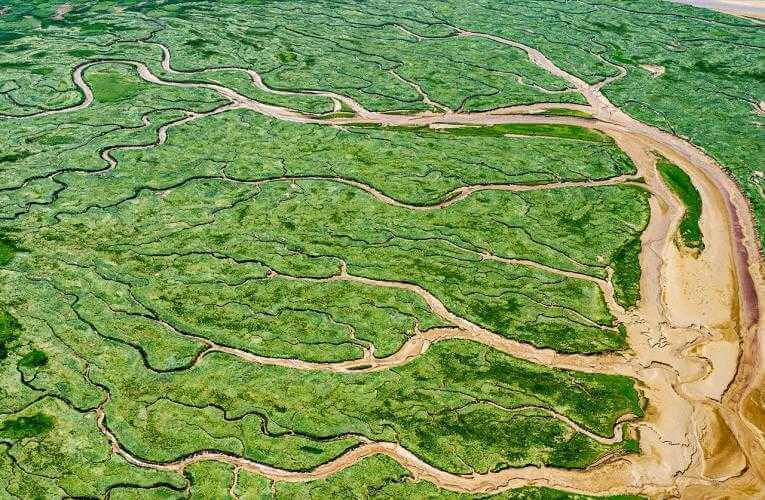
    Land-Building Marsh Plants are Champions of Carbon Capture

    By AdminMay 11, 2022
    Facebook Twitter Pinterest LinkedIn WhatsApp Email Reddit Telegram
    Land-Building Marsh Plants are Champions of Carbon Capture

    [ad_1]

    Human activities such as marsh draining for agriculture and logging are increasingly eating away at saltwater and freshwater wetlands that cover only 1% of Earth’s surface but store more than 20% of all the climate-warming carbon dioxide absorbed by ecosystems worldwide.

    A new study published May 5 in Science by a team of Dutch, American and German scientists shows that it’s not too late to reverse the losses.

    The key to success, the paper’s authors say, is using innovative restoration practices — identified in the new paper — that replicate natural landscape-building processes and enhance the restored wetlands’ carbon-storing potential.

    And doing it on a large scale.

    “About 1 percent of the world’s wetlands are being lost each year to pollution or marsh draining for agriculture, development and other human activities,” said Brian R. Silliman, Rachel Carson Distinguished Professor of Marine Conservation Biology at Duke University, who coauthored the study.

    “Once disturbed, these wetlands release enormous amounts of CO2 from their soils, accounting for about 5 percent of global CO2 emissions annually,” Silliman said. “Hundreds, even thousands of years of stored carbon are exposed to air and start to rapidly decompose and release greenhouse gases. The result is an invisible reverse waterfall of CO2  draining into the atmosphere. The wetlands switch from being carbon sinks to sources.”

    “The good news is, we now know how to restore these wetlands at a scale that was never before possible and in a way that both stops this release of carbon and re-establishes the wetland’s carbon storing capacity,” he said.

    What makes most wetlands so effective at carbon storage is that they are formed and held together by plants that grow close to each other, Silliman explained. Their dense above- and below-ground mats of stems and roots trap nutrient-rich debris and defend the soil against erosion or drying out — all of which helps the plants to grow better and the soil layer to build up, locking in a lot more CO2 in the process.

    In the case of raised peat bogs, the process works a little differently, Silliman noted. Layers of living peat moss on the surface act as sponges, holding enormous amounts of rainwater that sustain its own growth and keeps a much thicker layer of dead peat moss below it permanently under water. This prevents the lower layer of peat, which can measure up to 10 meters thick, from drying out, decomposing, and releasing its stored carbon back into the atmosphere. As the living mosses gradually build up, the amount of carbon stored below ground continually grows.

    Successful restorations must replicate these processes, he said.

    “More than half of all wetland restorations fail because the landscape-forming properties of the plants are insufficiently taken into account,” said study coauthor Tjisse van der Heide of the Royal Institute for Sea Research and the University of Groningen in the Netherlands. Planting seedlings and plugs in orderly rows equidistant from each other may seem logical, but it’s counter-productive, he said.

    “Restoration is much more successful when the plants are placed in large dense clumps, when their landscape-forming properties are mimicked, or simply when very large areas are restored in one go,” van der Heide said.

    “Following this guidance will allow us to restore lost wetlands at a much larger scale and increase the odds that they will thrive and continue to store carbon and perform other vital ecosystem services for years to come,” Silliman said. “The plants win, the planet wins, we all win.”

    Silliman and van der Heide conducted the new study with scientists from the Netherlands’ Royal Institute for Sea Research, Utrecht University, Radboud University, the University of Groningen, the University of Florida, Duke University, and Greifswald University.

    By synthesizing data on carbon capture from recent scientific studies, they found that oceans and forests hold the most CO2 globally, followed by wetlands.

    “But when we looked at the amount of CO2 stored per square meter, it turned out that wetlands store about five times more CO2 than forests and as much as 500 times more than oceans,” says Ralph Temmink, a researcher at Utrecht University, who was first author on the study.

    Funding for the new study came from the Dutch Research Council, the Oak Foundation, Duke RESTORE, the Lenfest Ocean Program, the National Science Foundation, and Natuurmonumenten.

    In addition to his faculty appointment at Duke’s Nicholas School, Silliman is director of Duke RESTORE.


    CITATION: “Recovering Wetland Biogeomorphic Feedbacks to Restore the World’s Biotic Carbon Hotspots,” R.J.M. Temmink, L.P.M. Lamers, C. Angelini, T.J. Bouma, C. Fritz, J. van de Koppel, R. Lexmond, M. Rietkerk, B.R. Silliman, H. Joosten and T. van der Heide.  Science, May 6, 2022. DOI: http://www.science.org/doi/10.1126/science.abn1479

    Related

    [ad_2]

    Original Source Link

    Share. Facebook Twitter Pinterest LinkedIn WhatsApp Email Reddit Telegram
    Previous Article‘The Big Lebowski’ Actor Was 75 – The Hollywood Reporter
    Next Article Identitypass, an identity verification API for Africa, raises $2.8M seed funding – TechCrunch

    RELATED POSTS

    Chatbots Are Leading Hikers Astray, With Dangerous Consequences

    November 1, 2026

    A Newly Discovered Trail of Cosmic Debris Illustrates How the End of the Solar System Could Look

    November 1, 2026

    An AI Agent Injected Drugs Into a Live Mouses Brain

    October 31, 2026

    Are Memories Transferable? Meet the Scientists Replicating an Infamous Study to Find Out

    October 31, 2026

    White Dwarfs Arent Just White. Scientists Discover Dying Stars Turning Pink and Green

    October 31, 2026

    Crematoria Are Being Used to Heat Homes and Swimming Pools

    October 30, 2026
    latest posts

    Fontaines D.C. Is in World-Beating Form on Dopamine Chamber Tour: 7 Best Moments From Amsterdam

    For the past decade, the idea of a rock band once again capturing or defining…

    Siri co-founder backs Helix for its voice ID tech | TechCrunch

    November 11, 2026

    Interview with Donell Jackson, Author of The Human Season: Forty-Eight Hours of Red – NewInBooks

    November 11, 2026

    Youve Got Mail Reboot in the Works at Warner Bros.

    November 11, 2026

    NCIS Gives Major Update on McGees Son Mateo

    November 11, 2026

    PETA ask Cage The Elephant to change their name

    November 10, 2026

    Get Past Your Writer’s Block

    November 10, 2026
    Categories
    • Books (1,584)
    • Business (6,481)
    • Events (85)
    • Film (6,440)
    • Lifestyle (4,495)
    • Music (6,573)
    • Politics (6,446)
    • Science (5,841)
    • Technology (6,429)
    • Television (6,135)
    • US News (6,480)
    popular posts

    Ken Paxton Tries To Blackmail The Senate Into Rigging The Midterm Election

    [ad_1] Things are getting very weird in the Republican U.S. Senate primary runoff election in…

    Dems, union leaders responsible for school lockdowns face few repercussions, despite evidence that kids harmed

    August 1, 2022

    ‘Big Short’ Michael Burry bought a slew of regional banks last quarter amid banking crisis

    May 15, 2023

    Darren Aronofsky on ‘Postcard from Earth’ Film – The Hollywood Reporter

    October 7, 2023
    Archives
    Browse By Category
    • Books (1,584)
    • Business (6,481)
    • Events (85)
    • Film (6,440)
    • Lifestyle (4,495)
    • Music (6,573)
    • Politics (6,446)
    • Science (5,841)
    • Technology (6,429)
    • Television (6,135)
    • US News (6,480)
    About Us

    We are a creativity led international team with a digital soul. Our work is a custom built by the storytellers and strategists with a flair for exploiting the latest advancements in media and technology.

    Most of all, we stand behind our ideas and believe in creativity as the most powerful force in business.

    What makes us Different

    We care. We collaborate. We do great work. And we do it with a smile, because we’re pretty damn excited to do what we do. If you would like details on what else we can do visit out Contact page.

    Our Picks

    PETA ask Cage The Elephant to change their name

    November 10, 2026

    Get Past Your Writer’s Block

    November 10, 2026

    Clutch Announce 2027 North American Tour, Unveil Single Beware the Fever

    November 10, 2026
    © 2026 New York Examiner News. All rights reserved. All articles, images, product names, logos, and brands are property of their respective owners. All company, product and service names used in this website are for identification purposes only. Use of these names, logos, and brands does not imply endorsement unless specified. By using this site, you agree to the Terms & Conditions and Privacy Policy.

    Type above and press Enter to search. Press Esc to cancel.

    We use cookies on our website to give you the most relevant experience by remembering your preferences and repeat visits. By clicking “Accept All”, you consent to the use of ALL the cookies. However, you may visit "Cookie Settings" to provide a controlled consent.
    Cookie SettingsAccept All
    Manage consent

    Privacy Overview

    This website uses cookies to improve your experience while you navigate through the website. Out of these, the cookies that are categorized as necessary are stored on your browser as they are essential for the working of basic functionalities of the website. We also use third-party cookies that help us analyze and understand how you use this website. These cookies will be stored in your browser only with your consent. You also have the option to opt-out of these cookies. But opting out of some of these cookies may affect your browsing experience.
    Necessary
    Always Enabled
    Necessary cookies are absolutely essential for the website to function properly. These cookies ensure basic functionalities and security features of the website, anonymously.
    CookieDurationDescription
    cookielawinfo-checkbox-analytics11 monthsThis cookie is set by GDPR Cookie Consent plugin. The cookie is used to store the user consent for the cookies in the category "Analytics".
    cookielawinfo-checkbox-functional11 monthsThe cookie is set by GDPR cookie consent to record the user consent for the cookies in the category "Functional".
    cookielawinfo-checkbox-necessary11 monthsThis cookie is set by GDPR Cookie Consent plugin. The cookies is used to store the user consent for the cookies in the category "Necessary".
    cookielawinfo-checkbox-others11 monthsThis cookie is set by GDPR Cookie Consent plugin. The cookie is used to store the user consent for the cookies in the category "Other.
    cookielawinfo-checkbox-performance11 monthsThis cookie is set by GDPR Cookie Consent plugin. The cookie is used to store the user consent for the cookies in the category "Performance".
    viewed_cookie_policy11 monthsThe cookie is set by the GDPR Cookie Consent plugin and is used to store whether or not user has consented to the use of cookies. It does not store any personal data.
    Functional
    Functional cookies help to perform certain functionalities like sharing the content of the website on social media platforms, collect feedbacks, and other third-party features.
    Performance
    Performance cookies are used to understand and analyze the key performance indexes of the website which helps in delivering a better user experience for the visitors.
    Analytics
    Analytical cookies are used to understand how visitors interact with the website. These cookies help provide information on metrics the number of visitors, bounce rate, traffic source, etc.
    Advertisement
    Advertisement cookies are used to provide visitors with relevant ads and marketing campaigns. These cookies track visitors across websites and collect information to provide customized ads.
    Others
    Other uncategorized cookies are those that are being analyzed and have not been classified into a category as yet.
    SAVE & ACCEPT