
Although we know early Mars was wetter, warmer and more habitable than the freeze-dried desert world of today, researchers have yet to find any direct proof that life of any kind ever graced the Martian surface. If Mars did once host life, key questions remain: How did such life impact the planet, and where could we find evidence for its past existence? A new study considering these mysteries counterintuitively finds that a plausible Martian biosphere could’ve been instrumental for tipping the planet into its presently inhospitable state. The findings further suggest certain regions of Mars—including Jezero Crater, where NASA’s Perseverance rover now roams—as the planet’s best locales to search for signs of life. And they ominously hint that life may be its own worst enemy on worlds throughout the cosmos.
Using climate and terrain models to re-create Mars as it was four billion years ago, French researchers concluded microbes may once have thrived mere centimeters below much of the Red Planet’s surface, protected against harsh cosmic radiation by overlying soil. But that buried biosphere would have ultimately retreated deeper into the planet, perhaps to its doom, driven by freezing temperatures of its own making. The study, published in Nature Astronomy, proposes that these hypothetical ancient microbes gobbled hydrogen and carbon dioxide from the Martian atmosphere and, in turn, produced methane. All three substances can act as heat-trapping greenhouse gasses, meaning that changes in each one’s abundance can have significant effects on a planet’s surface temperature. In this case, the net reduction in atmospheric greenhouse gasses from this putative “methanogen” biosphere would have triggered global cooling that covered most of Mars’s surface with ice, helping to create the planet’s inhospitable and barren current state.
“Basically what we say is that life, when it appears on the planet and in the right condition, might be self-destructive,” says Boris Sauterey, a postdoctoral fellow at Sorbonne University in Paris and lead author of the paper. “It’s that self-destructive tendency which might be limiting the ability of life to emerge widely in the universe.”
Gaia’s Blessing—Or Medea’s Curse?
In 1965 the late chemist James Lovelock—then a researcher at NASA’s Jet Propulsion Laboratory—devised a feasible strategy for detecting life on other worlds. Lovelock and his fellow researchers argued that certain chemical compounds in a planet’s atmosphere act as so-called biosignatures indicating life’s global presence. On Earth, for instance, the coexistence of methane (from methanogens) with oxygen (from photosynthetic organisms) constitutes a potent biosignature: each gas eradicates the other in ambient conditions, so the persistence of both indicates a steady replenishment most easily explained by biological sources. Lovelock’s work formed the basis for the scientific search for alien life on other worlds that continues today.
The idea that life intimately influenced Earth’s atmospheric chemistry became the basis for what Lovelock called his Gaia hypothesis, which he would go on to perfect with microbiologist Lynn Margulis throughout the 1970s. The Gaia hypothesis, named after a “Mother Earth” deity from Greek mythology, puts forward the idea that life is self-regulating. Earth’s organisms collectively interact with their surroundings in such a way that the habitability of their environment—in this case, the planet itself—is maintained. For instance, higher global temperatures from excess atmospheric carbon dioxide can also boost plant growth, which in turn can siphon more of the greenhouse gas from the air, eventually returning the planet to a cooler state.
In 2009 paleontologist Peter Ward of the University of Washington put forward a less optimistic view. At planetary scales, Ward argued, life is more self-destructive than self-regulating and eventually wipes itself out. In opposition to the Gaia hypothesis, he named his idea after another figure from Greek mythology: Medea, a mother who kills her own children. To support his “Medea hypothesis,” Ward cited several mass extinction events from Earth’s history that may indicate life’s inherently suicidal nature. During the Great Oxidation Event more than two billion years ago, photosynthetic cyanobacteria pumped huge amounts of oxygen into Earth’s atmosphere, which until then had been almost bereft of the highly reactive gas. This inevitably led to annihilation of the planet’s previous masters—the methanogens and other “anoxic” organisms for which oxygen was toxic. “You just look back at Earth’s history, and you see periods where life was its own worst enemy,” Ward says, commenting on the apparent connection between his Medea hypothesis and the study from Sauterey and his colleagues. “And I think this certainly could’ve been the case on Mars.”
In a decidedly Gaian twist, this catastrophic event for Earth’s anoxic life was also catalytic for allowing other organisms to flourish: the flood of atmospheric oxygen proved crucial for our planet’s biological diversification and the eventual emergence of our modern-day biosphere’s multicellular ancestors. Discerning whether life is ultimately Gaian or Medean therefore may be a matter of perspective requiring a more expansive—and interplanetary—point of view. But until life is found and studied on other worlds, only speculative comparisons can be made via theoretical studies such as Sauterey’s.
A Deeper Look for Martian Life
Kaveh Pahlevan, a research scientist at the SETI Institute, says that the study, in which he was not involved, “does broaden the way we think about the effects that biospheres can have on habitability.” But he also says the study only considers the planet-altering effects of one type of metabolism. It would, for instance, fail to capture the intricacy of something akin to the Great Oxidation Event, which hinged on the conflicting influences of methanogens and cyanobacteria. Sauterey acknowledges this potential shortcoming: “You can imagine that a more complex, more diversified biosphere [on Mars] would not have had the negative effect on planet habitability as the one that just methanogens would have had,” he says.
Still, that limit on the study’s conclusions could itself be diagnostic of a more fundamental truth. The early Earth’s bounty of diverse microbial life—and the resulting evolutionary flexibility to recover from otherwise-catastrophic environmental change—may be why the elaborate terrestrial biosphere endured while a presumably simpler one on Mars merely faded away. In Ward’s view, an ascent toward ever greater complexity might help a biosphere avoid an otherwise-dismal Medean fate. “I truly believe the only way out—the only way any planet escapes once it gets life—is to evolve intelligence,” he says. Only then, Ward says, could technological solutions emerge to mitigate Medean tendencies for life to foul its planetary nest.
The study did not consider the possibility of present-day methanogens lurking within the Martian subsurface. Such a situation could help explain enigmatic plumes of methane that scientists have repeatedly detected in the planet’s atmosphere (although lifeless geophysical activity could also account for the plumes as well).
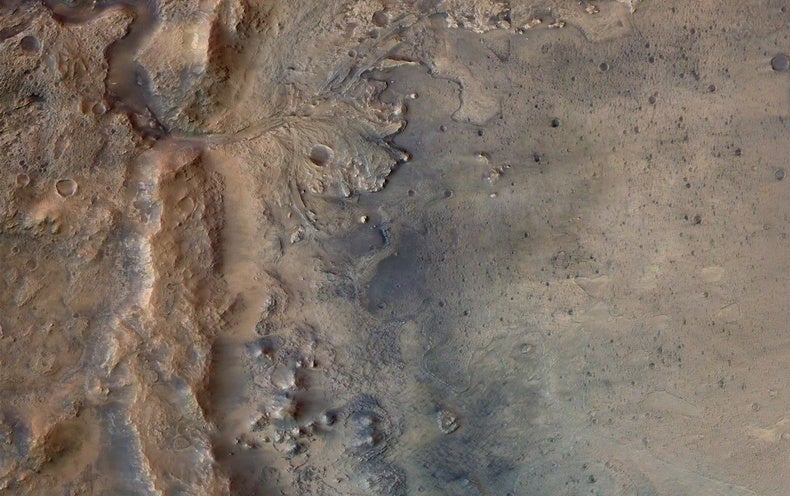
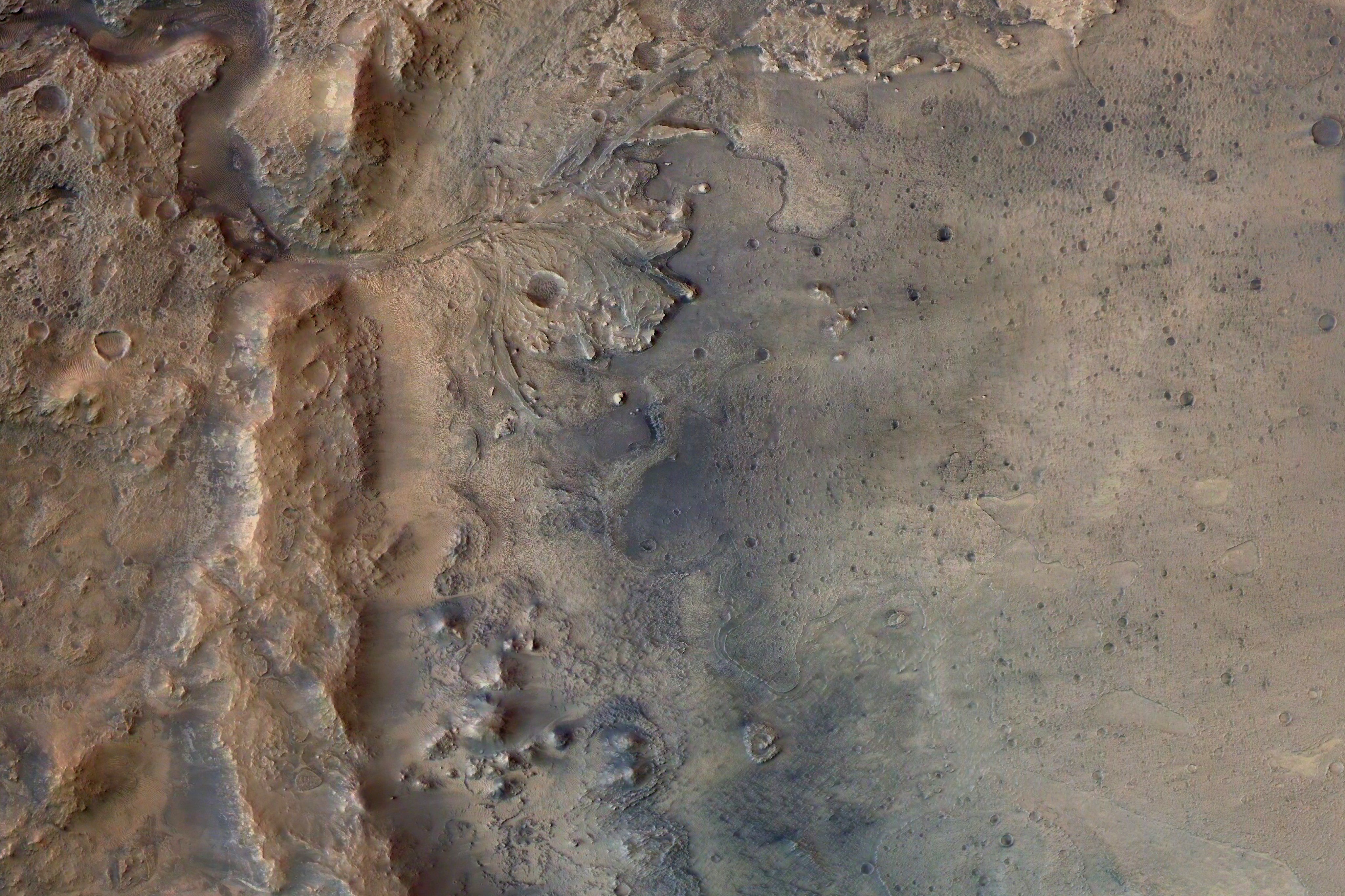
For ancient Mars, however, the study pinpoints places on the planet where the theoretical microbes could have thrived closer to the surface (and thus within reach of present-day investigations for fossilized remains). Such hot spots align with rare regions of Mars that could have remained ice-free for large swaths of the planet’s ensuing history despite a near-global glaciation from a worldwide cooling event. Jezero Crater—the site of an ancient lake and a sprawling sedimentary delta that might preserve fossils—is one such locale. By happy coincidence, this is also where NASA’s Perseverance rover is now working to retrieve potentially biosignature-bearing materials for subsequent analysis in labs back on Earth. But whether fossil evidence of early methanogens would be accessible there is unclear. They may be buried beneath deep layers of sediment, beyond Perseverance’s reach.
Outside of Jezero Crater, the study finds two even more promising sites for potential near-surface evidence of past methanogens: the Hellas Planitia and Isidis Planitia regions of Mars. This profusion of possible targets is part of a broader trend of rising interest in the Martian subsurface that may lead to investigations more focused on seeking signs of life there, says Victoria Orphan, a geobiologist at the California Institute of Technology, who was not involved in the study. Sauterey’s study, she says, is “a reference point to help stimulate debates and deeper thinking about future missions.”
“But of course, all of this is super hypothetical, and so it’s tricky,” Sauterey says. “All we can say is that the crust was habitable with that given likelihood, in that given location of Mars.” Sauterey is careful to point out that just because Mars was once habitable, that does not mean the planet was ever inhabited.
Whether or not ancient methanogens ever lived on Mars, the results of the new study are a reminder of how life itself can set the conditions for its own flourishing—or fizzling—on any world in the cosmos. Even single-celled organisms have the power to transform an otherwise-habitable planet into a hostile place. And, Sauterey darkly adds, “with the technological means that we have, humans can do that even faster.”