
Close Menu
New York Examiner News

    Subscribe to Updates

    Get the latest creative news from FooBar about art, design and business.

    What's Hot

    Florence + The Machine call on crowd to “put your phones the fuck away” and “experience” set at Reading 2026

    August 31, 2026

    Shein CEO’s wealth slumps $15 billion after whittled-down IPO

    August 31, 2026

    College Football Player Dies After Medical Emergency

    August 31, 2026
    Facebook X (Twitter) Instagram
    New York Examiner News
    • Home
    • US News
    • Politics
    • Business
    • Science
    • Technology
    • Lifestyle
    • Music
    • Television
    • Film
    • Books
    • Contact
      • About
      • Amazon Disclaimer
      • DMCA / Copyrights Disclaimer
      • Terms and Conditions
      • Privacy Policy
    New York Examiner News
    Home»Science»Magic: The Gathering Fans Harness Prime Number Puzzle as a Game Strategy
    Science

    Magic: The Gathering Fans Harness Prime Number Puzzle as a Game Strategy

    By AdminApril 22, 2025
    Facebook Twitter Pinterest LinkedIn WhatsApp Email Reddit Telegram
    Magic: The Gathering Fans Harness Prime Number Puzzle as a Game Strategy


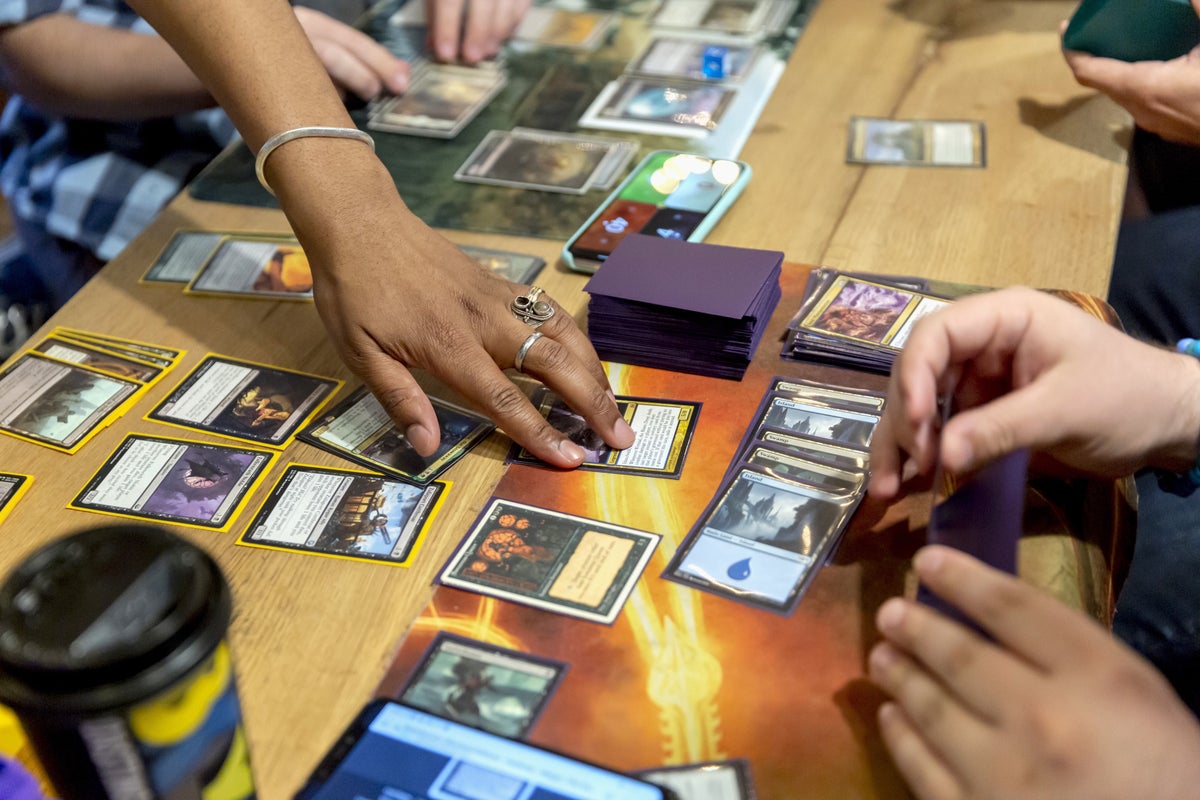
    A game of Magic: The Gathering begins well before players lay down their first card. As a collectible card game, Magic requires competitive players to select the optimal deck of cards based on how they think it will function against hypothetical opponents with many different strategies—then the game itself offers proof or disproof of the player’s predictive powers. Because about 30,000 different cards are available today—though they’re likely not all owned by a single individual—there are many degrees of variation.

    This abundance of possibilities has sparked plenty of questions and ideas. Some players have wondered how complicated the game really is. For example, does it involve enough complexity to perform calculations, as you would with a computer? To this end, software engineer Alex Churchill and two other Magic players created a game situation in which the cards act as a universal computer—as a Turing machine. They posted their work to the preprint server arXiv.org in 2019.

    Their computer model sealed the deal: Magic is the most complex type of game, they concluded. Theoretically, any kind of calculation that a computer can perform, a particular Magic game can do the same. Ever since I learned this, the game has held a certain fascination for me.


    On supporting science journalism

    If you’re enjoying this article, consider supporting our award-winning journalism by subscribing. By purchasing a subscription you are helping to ensure the future of impactful stories about the discoveries and ideas shaping our world today.


    But in practice, of course, using a Magic deck for its calculating prowess is not particularly helpful. Coding such a Turing machine alone is extremely time-consuming. And who has the time to go one step further and go through the billions of different card combinations necessary to solve a math problem with Magic cards? The quicker option would be to type the problem into a computer through some elegant Python code (or another programming language).

    As it turns out, people are quite willing to give their time to such “Magical” endeavors. For example, in 2024 Churchill and mathematician Howe Choong Yin developed a Magic programming language that used Magic moves to code elementary calculations such as addition, multiplication or division. Say you wanted to calculate 3 + 5. All you would need are a few cards (such as Vaevictis Asmadi, the Dire), Churchill and Howe’s instructions, and a little patience. Forget supercomputers, quantum computing and all that fancy stuff: the future of computing lies in Magic cards, right?

    Probably not—even solving a division problem with Magic cards is cumbersome, and tackling more complex problems in this way proves to be nearly impossible, especially when it comes to dealing with open questions in mathematics. That hasn’t stopped others from trying, however.

    Gameplay with Twin Primes

    In the fall of 2024 Reddit user its-summer-somewhere posted a combination of 14 moves that use about two dozen Magic cards and could potentially deal infinite damage. The outcome of the game depends on the answer to a mathematical puzzle that is almost 180 years old: Are there an infinite number of prime number twins? Prime numbers, such as 2, 3, 5, 7, 11, and so on, are divisible only by 1 and themselves. Twin primes are pairs of prime numbers that differ by only two, such as 3 and 5, 5 and 7, 11 and 13, and 17 and 19.

    Mathematicians have previously proven that there are an infinite number of primes. But their number decreases with increasing size: the further you progress in the number line, the less often prime numbers appear. This is even more true for prime number twins. The question that mathematicians have been asking themselves for centuries is: Are there also an infinite number of twin primes? Or will this parade end at some point?

    In 1849 French mathematician Alphonse de Polignac put forward the now famous twin prime conjecture: there are an infinite number of prime number twins. But despite numerous attempts, the assumption has so far neither been proven nor disproven. The largest known twin prime pair is 2,996,863,034,895 x 21,290,000 + 1 and 2,996,863,034,895 x 21,290,000 – 1. Is it perhaps the last?

    A Mathematical Magic Card

    Interest in prime numbers among Magic players increased with the introduction of the new card set Duskmourn: House of Horror on September 27, 2024. The deck contains, among other things, the card Zimone, All-Questioning. Its description reads: “At the beginning of your end step, if a land entered the battlefield under your control this turn and you control a prime number of lands, create Primo, the Indivisible, a legendary 0/0 green and blue Fractal creature token, then put that many +1/+1 counters on it. (2, 3, 5, 7, 11, 13, 17, 19, 23, 29, and 31 are prime numbers.)”

    That sounds cryptic, at least for Magic-inexperienced people like me. But the action of the card depends on the number of currency-generating cards called “lands” that a player controls—specifically on whether that number is prime.

    After its-summer-somewhere posted their complicated, and not particularly realistic, game situation, the outcome of which depends on whether there are an infinite number of prime twins, another Redditor promptly commented, “Somehow I knew that introducing the concept of prime numbers into the game would be a bad idea. Good to know I’m not wrong.” (“To be fair,” responded a third user, “prime numbers have always been in the game, as have non-prime numbers. [This set] just introduced the concept of that mattering.”)

    The idea, its-summer-somewhere wrote, is to create situations in which certain cards called “creatures” can be copied as often as desired using a particular card combination. Another card ensures that the copied creatures function as lands. If the number of lands controlled is not prime, a certain combination of cards creates two more lands. As soon as the number of lands corresponds to a prime number p, however, Zimone comes into play: It then creates two new Primo creatures, which in turn automatically also become lands. This means that you now have p + 2 lands. If p + 2 is also a prime, Zimone’s ability gets triggered again, leaving four Primo creatures on the battlefield. At that point you can use three of them to cause damage to the enemy. Thus, the opponent can only be harmed if Zimone is triggered twice in a row—in other words, only if the number of lands corresponds to a prime number twin. You can then repeat certain steps to increase your number of lands to the number of the next largest twin prime. The maximum damage that can be inflicted depends on the number of all existing twin primes: “Our maximum damage is infinite, if and only if the twin primes conjecture is true,” its-summer-somewhere wrote.

    Does this now bring humanity closer to a solution to the prime twin conjecture? Probably not. Sure, you could sit two people down and have them play Magic for ages. But ultimately the gameplay is based on knowing whether numbers are prime twins instead of explicitly proving the conjecture.

    Regardless, the imagined game is always entertaining and bizarre—and apparently it tempts nonmathematicians to deal with problems related to number theory. It may also have the opposite effect: As a math fan, I’ve been looking for a new hobby for a long time. Maybe I should give Magic a try.

    This article originally appeared in Spektrum der Wissenschaft and was reproduced with permission.


    Original Source Link

    Share. Facebook Twitter Pinterest LinkedIn WhatsApp Email Reddit Telegram
    Previous ArticleApril review – eerily elusive, superbly acted and crafted
    Next Article After Tesla’s Earnings Slide, Pressure’s On for Cybercab

    RELATED POSTS

    NASA’s Nancy Grace Roman Telescope launches to space

    August 31, 2026

    Scientists Create the Littlest Big Bang to Study the Universe’s Origins

    August 30, 2026

    NASA’s Roman Space Telescope could find alien Earths—but not like you think

    August 30, 2026

    NASA’s Nancy Grace Roman Space Telescope Has a Hidden Technological Leap

    August 29, 2026

    Where are all the aliens? A new book explores possible answers

    August 29, 2026

    There Are So Many Conspiracy Theories About Dolly Parton and Vaccines

    August 28, 2026
    latest posts

    Florence + The Machine call on crowd to “put your phones the fuck away” and “experience” set at Reading 2026

    Florence + The Machine headlined Reading Festival for the first time tonight (August 30) – see the full…

    Shein CEO’s wealth slumps $15 billion after whittled-down IPO

    August 31, 2026

    College Football Player Dies After Medical Emergency

    August 31, 2026

    Lindsay Clancy verdict pending as NC mother raises insanity defense

    August 31, 2026

    Google Maps Now Shows ‘Lake America’ Instead of Lake Ontario

    August 31, 2026

    NASA’s Nancy Grace Roman Telescope launches to space

    August 31, 2026

    Naya Rivera & Ryan Dorsey’s 10-Year-Old Son Josey Lands 1st Film Role

    August 31, 2026
    Categories
    • Books (1,461)
    • Business (6,364)
    • Events (70)
    • Film (6,299)
    • Lifestyle (4,372)
    • Music (6,426)
    • Politics (6,349)
    • Science (5,716)
    • Technology (6,297)
    • Television (5,987)
    • Uncategorized (9)
    • US News (6,352)
    popular posts

    Why Are Americans Uneasy? We Are Sitting On The Edge Of A Volcano By Howard Bloom

    Why are Americans uneasy?  A year ago, in the spring of 2024, ​The Chapman University Survey…

    Stephen Colbert Explains The Constitution To Greg Abbott

    January 31, 2024

    Pete Davidson Reveals His ‘Dream’ Is To Become A Dad: ‘Favorite Thing Ever’

    July 13, 2022

    Van Jones Stuns CNN Hosts With Some Harsh Truths About The State Of The Democrat Party (VIDEO)

    June 18, 2022
    Archives
    Browse By Category
    • Books (1,461)
    • Business (6,364)
    • Events (70)
    • Film (6,299)
    • Lifestyle (4,372)
    • Music (6,426)
    • Politics (6,349)
    • Science (5,716)
    • Technology (6,297)
    • Television (5,987)
    • Uncategorized (9)
    • US News (6,352)
    About Us

    We are a creativity led international team with a digital soul. Our work is a custom built by the storytellers and strategists with a flair for exploiting the latest advancements in media and technology.

    Most of all, we stand behind our ideas and believe in creativity as the most powerful force in business.

    What makes us Different

    We care. We collaborate. We do great work. And we do it with a smile, because we’re pretty damn excited to do what we do. If you would like details on what else we can do visit out Contact page.

    Our Picks

    NASA’s Nancy Grace Roman Telescope launches to space

    August 31, 2026

    Naya Rivera & Ryan Dorsey’s 10-Year-Old Son Josey Lands 1st Film Role

    August 31, 2026

    Shirley Ballas Gives Input On AJ & Rylee Drama, Defends Dancer

    August 31, 2026
    © 2026 New York Examiner News. All rights reserved. All articles, images, product names, logos, and brands are property of their respective owners. All company, product and service names used in this website are for identification purposes only. Use of these names, logos, and brands does not imply endorsement unless specified. By using this site, you agree to the Terms & Conditions and Privacy Policy.

    Type above and press Enter to search. Press Esc to cancel.

    We use cookies on our website to give you the most relevant experience by remembering your preferences and repeat visits. By clicking “Accept All”, you consent to the use of ALL the cookies. However, you may visit "Cookie Settings" to provide a controlled consent.
    Cookie SettingsAccept All
    Manage consent

    Privacy Overview

    This website uses cookies to improve your experience while you navigate through the website. Out of these, the cookies that are categorized as necessary are stored on your browser as they are essential for the working of basic functionalities of the website. We also use third-party cookies that help us analyze and understand how you use this website. These cookies will be stored in your browser only with your consent. You also have the option to opt-out of these cookies. But opting out of some of these cookies may affect your browsing experience.
    Necessary
    Always Enabled
    Necessary cookies are absolutely essential for the website to function properly. These cookies ensure basic functionalities and security features of the website, anonymously.
    CookieDurationDescription
    cookielawinfo-checkbox-analytics11 monthsThis cookie is set by GDPR Cookie Consent plugin. The cookie is used to store the user consent for the cookies in the category "Analytics".
    cookielawinfo-checkbox-functional11 monthsThe cookie is set by GDPR cookie consent to record the user consent for the cookies in the category "Functional".
    cookielawinfo-checkbox-necessary11 monthsThis cookie is set by GDPR Cookie Consent plugin. The cookies is used to store the user consent for the cookies in the category "Necessary".
    cookielawinfo-checkbox-others11 monthsThis cookie is set by GDPR Cookie Consent plugin. The cookie is used to store the user consent for the cookies in the category "Other.
    cookielawinfo-checkbox-performance11 monthsThis cookie is set by GDPR Cookie Consent plugin. The cookie is used to store the user consent for the cookies in the category "Performance".
    viewed_cookie_policy11 monthsThe cookie is set by the GDPR Cookie Consent plugin and is used to store whether or not user has consented to the use of cookies. It does not store any personal data.
    Functional
    Functional cookies help to perform certain functionalities like sharing the content of the website on social media platforms, collect feedbacks, and other third-party features.
    Performance
    Performance cookies are used to understand and analyze the key performance indexes of the website which helps in delivering a better user experience for the visitors.
    Analytics
    Analytical cookies are used to understand how visitors interact with the website. These cookies help provide information on metrics the number of visitors, bounce rate, traffic source, etc.
    Advertisement
    Advertisement cookies are used to provide visitors with relevant ads and marketing campaigns. These cookies track visitors across websites and collect information to provide customized ads.
    Others
    Other uncategorized cookies are those that are being analyzed and have not been classified into a category as yet.
    SAVE & ACCEPT