
Close Menu
New York Examiner News

    Subscribe to Updates

    Get the latest creative news from FooBar about art, design and business.

    What's Hot

    I Am a Proudly Gay Man

    May 24, 2026

    BofA says you’ll be 10x more productive with AI. Ignore the 0.1% result so far

    May 24, 2026

    Teen takeovers sweep US cities with fights, robberies and gunfire

    May 24, 2026
    Facebook X (Twitter) Instagram
    New York Examiner News
    • Home
    • US News
    • Politics
    • Business
    • Science
    • Technology
    • Lifestyle
    • Music
    • Television
    • Film
    • Books
    • Contact
      • About
      • Amazon Disclaimer
      • DMCA / Copyrights Disclaimer
      • Terms and Conditions
      • Privacy Policy
    New York Examiner News
    Home»Science»Making Computer Chips Act More like Brain Cells
    Science

    Making Computer Chips Act More like Brain Cells

    By AdminAugust 29, 2022
    Facebook Twitter Pinterest LinkedIn WhatsApp Email Reddit Telegram
    Making Computer Chips Act More like Brain Cells


    The human brain is an amazing computing machine. Weighing only three pounds or so, it can process information a thousand times faster than the fastest supercomputer, store a thousand times more information than a powerful laptop, and do it all using no more energy than a 20-watt lightbulb.

    Researchers are trying to replicate this success using soft, flexible organic materials that can operate like biological neurons and someday might even be able to interconnect with them. Eventually, soft “neuromorphic” computer chips could be implanted directly into the brain, allowing people to control an artificial arm or a computer monitor simply by thinking about it.

    Like real neurons — but unlike conventional computer chips — these new devices can send and receive both chemical and electrical signals. “Your brain works with chemicals, with neurotransmitters like dopamine and serotonin. Our materials are able to interact electrochemically with them,” says Alberto Salleo, a materials scientist at Stanford University who wrote about the potential for organic neuromorphic devices in the 2021 Annual Review of Materials Research.

    Salleo and other researchers have created electronic devices using these soft organic materials that can act like transistors (which amplify and switch electrical signals) and memory cells (which store information) and other basic electronic components. 

    The work grows out of an increasing interest in neuromorphic computer circuits that mimic how human neural connections, or synapses, work. These circuits, whether made of silicon, metal or organic materials, work less like those in digital computers and more like the networks of neurons in the human brain.

    Conventional digital computers work one step at a time, and their architecture creates a fundamental division between calculation and memory. This division means that ones and zeroes must be shuttled back and forth between locations on the computer processor, creating a bottleneck for speed and energy use.

    The brain does things differently. An individual neuron receives signals from many other neurons, and all these signals together add up to affect the electrical state of the receiving neuron. In effect, each neuron serves as both a calculating device — integrating the value of all the signals it has received — and a memory device: storing the value of all of those combined signals as an infinitely variable analog value, rather than the zero-or-one of digital computers.

    Researchers have developed a number of different “memristive” devices that mimic this ability. When you run electric currents through them, you change the electrical resistance. Like biological neurons, these devices calculate by adding up the values of all the currents they have been exposed to. And they remember through the resulting value their resistance takes. 

    A simple organic memristor, for example, might have two layers of electrically conducting materials. When a voltage is applied, electric current drives positively charged ions from one layer into the other, changing how easily the second layer will conduct electricity the next time it is exposed to an electric current. (See diagram.) “It’s a way of letting the physics do the computing,” says Matthew Marinella, a computer engineer at Arizona State University in Tempe who researches neuromorphic computing.
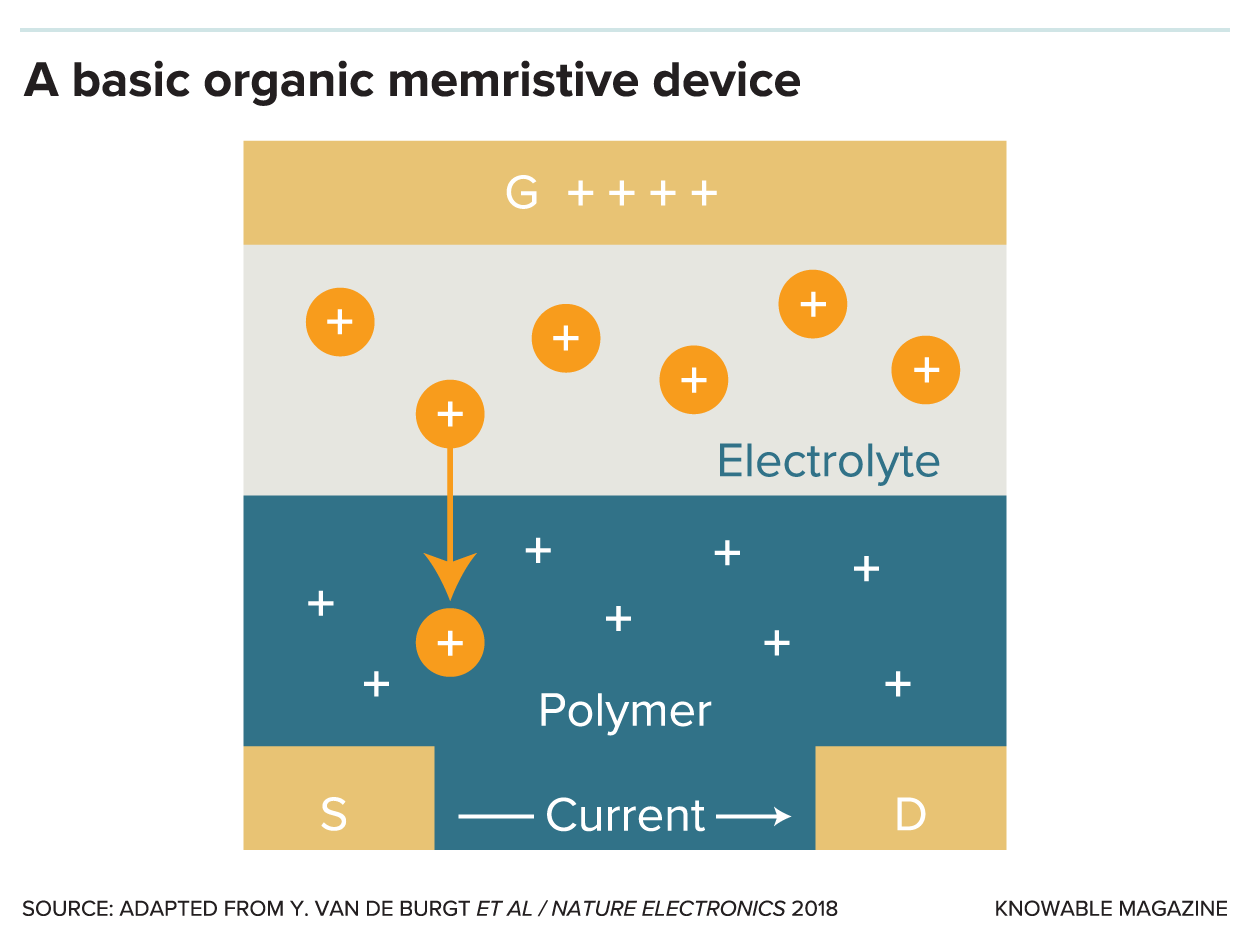
    Voltage applied at the gate (G)—for example, from a sensor—drives positive ions from one layer, called the electrolyte, into an adjacent layer, an organic polymer. This changes the polymer’s resistance to a current moving from the source (S) to the drain (D). The amount of resistance represents the value being stored. Credit: Knowable; Source: “Organic electronics for neuromorphic computing,” by Yoeri van de Burgt et al., in Nature Electronics, Vol. 1. Published July 13, 2018 https://doi.org/10.1038/s41928-018-0103-3

    The technique also liberates the computer from strictly binary values. “When you have classical computer memory, it’s either a zero or a one. We make a memory that could be any value between zero and one. So you can tune it in an analog fashion,” Salleo says.

    At the moment, most memristors and related devices aren’t based on organic materials but use standard silicon chip technology. Some are even used commercially as a way of speeding up artificial intelligence programs. But organic components have the potential to do the job faster while using less energy, Salleo says. Better yet, they could be designed to integrate with your own brain. The materials are soft and flexible, and also have electrochemical properties that allow them to interact with biological neurons. 

    For instance, Francesca Santoro, an electrical engineer now at RWTH Aachen University in Germany, is developing a polymer device that takes input from real cells and “learns” from it. In her device, the cells are separated from the artificial neuron by a small space, similar to the synapses that separate real neurons from one another. As the cells produce dopamine, a nerve-signaling chemical, the dopamine changes the electrical state of the artificial half of the device. The more dopamine the cells produce, the more the electrical state of the artificial neuron changes, just as you might see with two biological neurons. (See diagram.) “Our ultimate goal is really to design electronics which look like neurons and act like neurons,” Santoro says. 
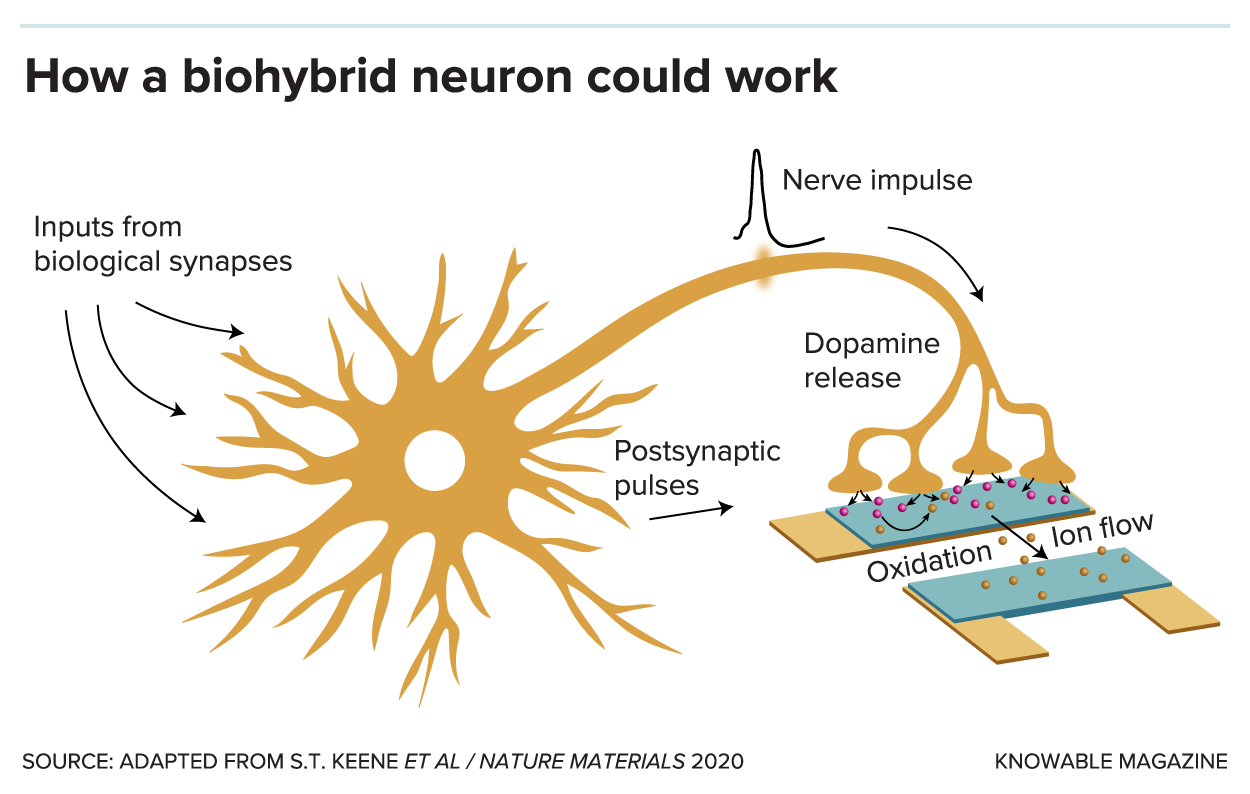
    The biological neuron releases dopamine (red balls) at its junction with the artificial neuron. A solution in the gap gives the dopamine a positive charge (gold balls), which allows it to flow across the device. Electrical resistance depends on how fast the dopamine is released and how much has accumulated on the artificial neuron. Credit: Knowable; Source: “A biohybrid synapse with neurotransmitter-mediated plasticity,” by Scott T. Keene et al., in Nature Materials, Vol. 19. Published June 15, 2020 https://doi.org/10.1038/s41563-020-0703-y

    The approach could offer a better way to use brain activity to drive prosthetics or computer monitors. Today’s systems use standard electronics, including electrodes that can pick up only broad patterns of electrical activity. And the equipment is bulky and requires external computers to operate.

    Flexible, neuromorphic circuits could improve this in at least two ways. They would be capable of translating neural signals in a much more granular way, responding to signals from individual neurons. And the devices might also be able to handle some of the necessary computations themselves, Salleo says, which could save energy and boost processing speed.

    Low-level, decentralized systems of this sort — with small, neuromorphic computers processing information as it is received by local sensors — are a promising avenue for neuromorphic computing, Salleo and Santoro say. “The fact that they so nicely resemble the electrical operation of neurons makes them ideal for physical and electrical coupling with neuronal tissue,” Santoro says, “and ultimately the brain.”

    This article originally appeared in Knowable Magazine, an independent journalistic endeavor from Annual Reviews. Sign up for the newsletter.


    Original Source Link

    Share. Facebook Twitter Pinterest LinkedIn WhatsApp Email Reddit Telegram
    Previous ArticleTHR Critic’s Most Anticipated Titles – The Hollywood Reporter
    Next Article Best Gear to Make Professional Videos (2022): Mics, Lights, Tripods, Tips

    RELATED POSTS

    Experimental mRNA vaccine may protect against multiple Ebola viruses

    May 24, 2026

    Quantum ‘Jamming’ Could Help Unlock the Mysteries of Causality

    May 23, 2026

    SpaceX launches Starship V3—the world’s most powerful and tallest rocket ever

    May 23, 2026

    Mercury may have gained all of its unexpected water in a single day

    May 22, 2026

    All the Fancy Measuring Devices Used in Science Rely on Two Stone-Age Techniques

    May 22, 2026

    Hidden structural features inside Egypt’s Great Pyramid may have helped it withstand earthquakes, new study finds

    May 21, 2026
    latest posts

    I Am a Proudly Gay Man

    Beartooth singer Caleb Shomo has come out as a “proudly gay man” in a social…

    BofA says you’ll be 10x more productive with AI. Ignore the 0.1% result so far

    May 24, 2026

    Teen takeovers sweep US cities with fights, robberies and gunfire

    May 24, 2026

    SolarSquare in talks to raise up to $60M as India’s rooftop solar market draws major VC interest

    May 24, 2026

    Experimental mRNA vaccine may protect against multiple Ebola viruses

    May 24, 2026

    The Dreamed Adventure – first-look review

    May 24, 2026

    Do You Remember These ’80s Fads?

    May 24, 2026
    Categories
    • Books (1,262)
    • Business (6,166)
    • Events (54)
    • Film (6,103)
    • Lifestyle (4,200)
    • Music (6,220)
    • Politics (6,164)
    • Science (5,520)
    • Technology (6,098)
    • Television (5,785)
    • Uncategorized (7)
    • US News (6,154)
    popular posts

    Watch Charmed (2018) Online: Season 4 Episode 10

    Did the sisters and Kaela manage to find a way to navigate their love…

    LinkedIn plans to add gaming to its platform

    March 17, 2024

    At Cannes, Moccasins-Wearing Indigenous Director Turned Away – The Hollywood Reporter

    May 26, 2022

    Katie Ledecky warms up Olympic journey with first US swimming medal

    July 27, 2024
    Archives
    Browse By Category
    • Books (1,262)
    • Business (6,166)
    • Events (54)
    • Film (6,103)
    • Lifestyle (4,200)
    • Music (6,220)
    • Politics (6,164)
    • Science (5,520)
    • Technology (6,098)
    • Television (5,785)
    • Uncategorized (7)
    • US News (6,154)
    About Us

    We are a creativity led international team with a digital soul. Our work is a custom built by the storytellers and strategists with a flair for exploiting the latest advancements in media and technology.

    Most of all, we stand behind our ideas and believe in creativity as the most powerful force in business.

    What makes us Different

    We care. We collaborate. We do great work. And we do it with a smile, because we’re pretty damn excited to do what we do. If you would like details on what else we can do visit out Contact page.

    Our Picks

    The Dreamed Adventure – first-look review

    May 24, 2026

    Do You Remember These ’80s Fads?

    May 24, 2026

    The Lookbook: 9 Classy Outfits for Every Occasion

    May 24, 2026
    © 2026 New York Examiner News. All rights reserved. All articles, images, product names, logos, and brands are property of their respective owners. All company, product and service names used in this website are for identification purposes only. Use of these names, logos, and brands does not imply endorsement unless specified. By using this site, you agree to the Terms & Conditions and Privacy Policy.

    Type above and press Enter to search. Press Esc to cancel.

    We use cookies on our website to give you the most relevant experience by remembering your preferences and repeat visits. By clicking “Accept All”, you consent to the use of ALL the cookies. However, you may visit "Cookie Settings" to provide a controlled consent.
    Cookie SettingsAccept All
    Manage consent

    Privacy Overview

    This website uses cookies to improve your experience while you navigate through the website. Out of these, the cookies that are categorized as necessary are stored on your browser as they are essential for the working of basic functionalities of the website. We also use third-party cookies that help us analyze and understand how you use this website. These cookies will be stored in your browser only with your consent. You also have the option to opt-out of these cookies. But opting out of some of these cookies may affect your browsing experience.
    Necessary
    Always Enabled
    Necessary cookies are absolutely essential for the website to function properly. These cookies ensure basic functionalities and security features of the website, anonymously.
    CookieDurationDescription
    cookielawinfo-checkbox-analytics11 monthsThis cookie is set by GDPR Cookie Consent plugin. The cookie is used to store the user consent for the cookies in the category "Analytics".
    cookielawinfo-checkbox-functional11 monthsThe cookie is set by GDPR cookie consent to record the user consent for the cookies in the category "Functional".
    cookielawinfo-checkbox-necessary11 monthsThis cookie is set by GDPR Cookie Consent plugin. The cookies is used to store the user consent for the cookies in the category "Necessary".
    cookielawinfo-checkbox-others11 monthsThis cookie is set by GDPR Cookie Consent plugin. The cookie is used to store the user consent for the cookies in the category "Other.
    cookielawinfo-checkbox-performance11 monthsThis cookie is set by GDPR Cookie Consent plugin. The cookie is used to store the user consent for the cookies in the category "Performance".
    viewed_cookie_policy11 monthsThe cookie is set by the GDPR Cookie Consent plugin and is used to store whether or not user has consented to the use of cookies. It does not store any personal data.
    Functional
    Functional cookies help to perform certain functionalities like sharing the content of the website on social media platforms, collect feedbacks, and other third-party features.
    Performance
    Performance cookies are used to understand and analyze the key performance indexes of the website which helps in delivering a better user experience for the visitors.
    Analytics
    Analytical cookies are used to understand how visitors interact with the website. These cookies help provide information on metrics the number of visitors, bounce rate, traffic source, etc.
    Advertisement
    Advertisement cookies are used to provide visitors with relevant ads and marketing campaigns. These cookies track visitors across websites and collect information to provide customized ads.
    Others
    Other uncategorized cookies are those that are being analyzed and have not been classified into a category as yet.
    SAVE & ACCEPT