
Close Menu
New York Examiner News

    Subscribe to Updates

    Get the latest creative news from FooBar about art, design and business.

    What's Hot

    How Often Should You Wash Your Pillow?

    August 31, 2026

    Florence + The Machine call on crowd to “put your phones the fuck away” and “experience” set at Reading 2026

    August 31, 2026

    Shein CEO’s wealth slumps $15 billion after whittled-down IPO

    August 31, 2026
    Facebook X (Twitter) Instagram
    New York Examiner News
    • Home
    • US News
    • Politics
    • Business
    • Science
    • Technology
    • Lifestyle
    • Music
    • Television
    • Film
    • Books
    • Contact
      • About
      • Amazon Disclaimer
      • DMCA / Copyrights Disclaimer
      • Terms and Conditions
      • Privacy Policy
    New York Examiner News
    Home»Science»Monster Black Hole Merger Is Most Massive Ever Seen
    Science

    Monster Black Hole Merger Is Most Massive Ever Seen

    By AdminJuly 15, 2025
    Facebook Twitter Pinterest LinkedIn WhatsApp Email Reddit Telegram
    Monster Black Hole Merger Is Most Massive Ever Seen


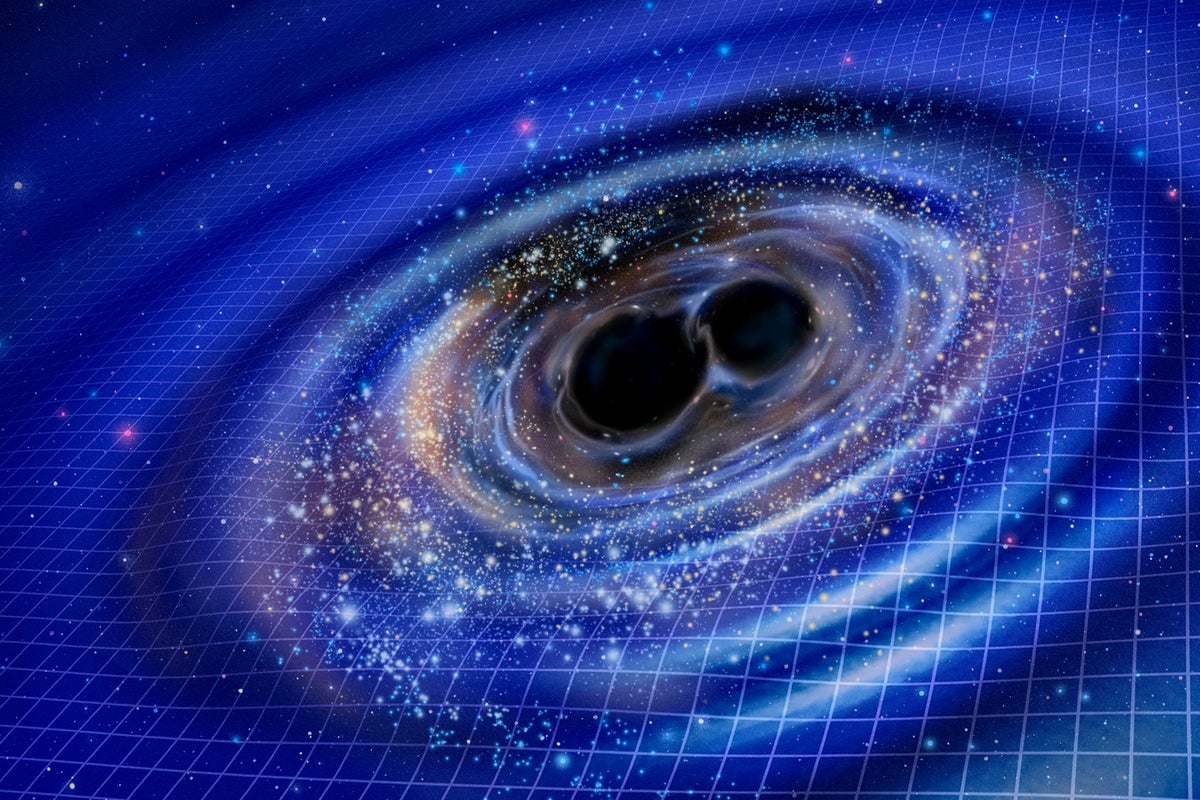
    Physicists have detected the biggest ever merger of colliding black holes. The discovery has major implications for researchers’ understanding of how such bodies grow in the Universe.

    “It’s super exciting,” says Priyamvada Natarajan, a theoretical astrophysicist at Yale University in New Haven, Connecticut, who was not involved in the research. The merger was between black holes with masses too big for physicists to easily explain. “We’re seeing these forbidden high-mass black holes,” she says.

    The discovery was made by the Laser Interferometer Gravitational-Wave Observatory (LIGO), a facility involving two detectors in the United States. It comes at a time when US funding for gravitational-wave detection faces devastating cuts. The results, released as a preprint on the arXiv server1, were presented at the GR-Amaldi gravitational-waves meeting in Glasgow, UK, on 14 July.


    On supporting science journalism

    If you’re enjoying this article, consider supporting our award-winning journalism by subscribing. By purchasing a subscription you are helping to ensure the future of impactful stories about the discoveries and ideas shaping our world today.


    Forbidden mass

    LIGO detects gravitational waves by firing lasers down long, L-shaped arms. Minuscule changes in arm length reveal the passage of gravitational waves through the planet. The waves are ripples in space-time, caused by massive bodies accelerating, such as when two inspiralling black holes or neutron stars merge.

    Hundreds of these mergers have been observed using gravitational waves since LIGO’s first detection in 2015. But this latest detection, made in November 2023, is the biggest yet. By modelling the signal detected by LIGO, scientists have calculated that the event, dubbed GW231123, was caused by two black holes with masses of about 100 and 140 times that of the Sun merging to form a final black hole weighing in at some 225 solar masses.

    “It’s the most massive [merger] so far,” says Mark Hannam, a physicist at Cardiff University, UK, and part of the LVK Collaboration, a wider network of gravitational-wave detectors that encompasses LIGO, Virgo in Italy and KAGRA in Japan. It’s “about 50% more than the previous record holder”, he says.

    Most of the events captured by LIGO involve stellar mass black holes — those ranging from a few to 100 times the mass of the Sun — which are thought to form when massive stars end their lives as supernovae. However, the two black holes involved in GW231123 fall in or near a predicted range, of 60–130 solar masses, at which this process isn’t expected to work, with theories instead predicting that the stars should be blown apart. “So they probably didn’t form by this normal mechanism,” says Hannam.

    Instead, the two black holes probably formed from earlier merger events — hierarchical mergers of massive bodies that led to the event detected by LIGO, which is estimated to have happened 0.7 to 4.1 billion parsecs away (2.3—13.4 billion light years).

    It’s like “four grandparents merging into two parents merging into one baby black hole”, says Alan Weinstein, a physicist at the California Institute of Technology in Pasadena and also part of the LVK Collaboration.

    Models of the black holes also suggest that they were spinning exceedingly fast — about 40 times per second, which is near the limit of what Einstein’s general theory of relativity predicts black holes can reach while remaining stable. “They’re spinning very close to the maximal spin allowable,” says Weinstein.

    Both the spin and the mass could provide clues to how black holes grow in the Universe. One of the biggest questions in astronomy is how the largest black holes, the supermassive black holes found at the centres of galaxies such as the Milky Way, grew in the early cosmos.

    Although there is plenty of evidence for the existence of stellar mass black holes and supermassive black holes — those of more than a million solar masses — intermediate mass black holes in the range of 100 to 100,000 solar masses have been harder to find. “We don’t see them,” says Natarajan.

    The latest detection might tell us that “these intermediate-mass black holes of several hundred solar masses play a role in the evolution of galaxies”, says Hannam, perhaps through hierarchical mergers, which could increase the spin speed, as well as the mass, of the resulting black holes. “Little by little, we’re building up a list of the kind of black holes that are out there,” he says.

    Cuts ahead

    That growth in knowledge could be hampered by the administration of US President Donald Trump and its proposed cuts to the US National Science Foundation, which runs LIGO. Under the proposal, one of LIGO’s two gravitational-wave observatories would be shut down.

    At the time of this detection in November 2023, Virgo and KAGRA were not operational. Without two detectors, scientists would not have been sure that they had made a real detection of two merging black holes, says Hannam. “Because we had two detectors, we saw the same blip at the same time,” he says.

    The closure of one of the observatories would be “catastrophic”, says Natarajan. “This discovery would not be possible if one arm was turned off.”

    Planned upgrades to LIGO in the coming years, and the addition of new detectors around the world, including one in India, could greatly increase physicists’ capabilities in gravitational-wave research, an area of astronomy that is still in its infancy.

    “We’re going to be seeing thousands of black holes in the next few years,” says Hannam. “There’s this huge investment that’s been done, and it’s only just beginning to pay off.”

    This article is reproduced with permission and was first published on July 15, 2025.


    Original Source Link

    Share. Facebook Twitter Pinterest LinkedIn WhatsApp Email Reddit Telegram
    Previous ArticleFriendship review – The Wario to I Love You Man’s…
    Next Article US Army soldier pleads guilty to hacking telcos and extortion

    RELATED POSTS

    NASA’s Nancy Grace Roman Telescope launches to space

    August 31, 2026

    Scientists Create the Littlest Big Bang to Study the Universe’s Origins

    August 30, 2026

    NASA’s Roman Space Telescope could find alien Earths—but not like you think

    August 30, 2026

    NASA’s Nancy Grace Roman Space Telescope Has a Hidden Technological Leap

    August 29, 2026

    Where are all the aliens? A new book explores possible answers

    August 29, 2026

    There Are So Many Conspiracy Theories About Dolly Parton and Vaccines

    August 28, 2026
    latest posts

    How Often Should You Wash Your Pillow?

    How Often Should You Wash Your Pillow? -…

    Florence + The Machine call on crowd to “put your phones the fuck away” and “experience” set at Reading 2026

    August 31, 2026

    Shein CEO’s wealth slumps $15 billion after whittled-down IPO

    August 31, 2026

    College Football Player Dies After Medical Emergency

    August 31, 2026

    Lindsay Clancy verdict pending as NC mother raises insanity defense

    August 31, 2026

    Google Maps Now Shows ‘Lake America’ Instead of Lake Ontario

    August 31, 2026

    NASA’s Nancy Grace Roman Telescope launches to space

    August 31, 2026
    Categories
    • Books (1,461)
    • Business (6,364)
    • Events (70)
    • Film (6,299)
    • Lifestyle (4,373)
    • Music (6,426)
    • Politics (6,349)
    • Science (5,716)
    • Technology (6,297)
    • Television (5,987)
    • Uncategorized (9)
    • US News (6,352)
    popular posts

    Science Reveals the Surprising Origins of the Potato

    There are more than a hundred ways to prepare a potato, and thousands of stories…

    Two 17-Year-Olds Arrested For Stabbing Death of Asian Store Owner in Downtown Los Angeles

    October 2, 2022

    Roger Stone Sets the Record Straight on the Watergate Break-in and President Richard Nixon

    June 17, 2022

    NASA Artemis II splashes down in Pacific Ocean in ‘perfect’ landing for Moon mission

    April 11, 2026
    Archives
    Browse By Category
    • Books (1,461)
    • Business (6,364)
    • Events (70)
    • Film (6,299)
    • Lifestyle (4,373)
    • Music (6,426)
    • Politics (6,349)
    • Science (5,716)
    • Technology (6,297)
    • Television (5,987)
    • Uncategorized (9)
    • US News (6,352)
    About Us

    We are a creativity led international team with a digital soul. Our work is a custom built by the storytellers and strategists with a flair for exploiting the latest advancements in media and technology.

    Most of all, we stand behind our ideas and believe in creativity as the most powerful force in business.

    What makes us Different

    We care. We collaborate. We do great work. And we do it with a smile, because we’re pretty damn excited to do what we do. If you would like details on what else we can do visit out Contact page.

    Our Picks

    Google Maps Now Shows ‘Lake America’ Instead of Lake Ontario

    August 31, 2026

    NASA’s Nancy Grace Roman Telescope launches to space

    August 31, 2026

    Naya Rivera & Ryan Dorsey’s 10-Year-Old Son Josey Lands 1st Film Role

    August 31, 2026
    © 2026 New York Examiner News. All rights reserved. All articles, images, product names, logos, and brands are property of their respective owners. All company, product and service names used in this website are for identification purposes only. Use of these names, logos, and brands does not imply endorsement unless specified. By using this site, you agree to the Terms & Conditions and Privacy Policy.

    Type above and press Enter to search. Press Esc to cancel.

    We use cookies on our website to give you the most relevant experience by remembering your preferences and repeat visits. By clicking “Accept All”, you consent to the use of ALL the cookies. However, you may visit "Cookie Settings" to provide a controlled consent.
    Cookie SettingsAccept All
    Manage consent

    Privacy Overview

    This website uses cookies to improve your experience while you navigate through the website. Out of these, the cookies that are categorized as necessary are stored on your browser as they are essential for the working of basic functionalities of the website. We also use third-party cookies that help us analyze and understand how you use this website. These cookies will be stored in your browser only with your consent. You also have the option to opt-out of these cookies. But opting out of some of these cookies may affect your browsing experience.
    Necessary
    Always Enabled
    Necessary cookies are absolutely essential for the website to function properly. These cookies ensure basic functionalities and security features of the website, anonymously.
    CookieDurationDescription
    cookielawinfo-checkbox-analytics11 monthsThis cookie is set by GDPR Cookie Consent plugin. The cookie is used to store the user consent for the cookies in the category "Analytics".
    cookielawinfo-checkbox-functional11 monthsThe cookie is set by GDPR cookie consent to record the user consent for the cookies in the category "Functional".
    cookielawinfo-checkbox-necessary11 monthsThis cookie is set by GDPR Cookie Consent plugin. The cookies is used to store the user consent for the cookies in the category "Necessary".
    cookielawinfo-checkbox-others11 monthsThis cookie is set by GDPR Cookie Consent plugin. The cookie is used to store the user consent for the cookies in the category "Other.
    cookielawinfo-checkbox-performance11 monthsThis cookie is set by GDPR Cookie Consent plugin. The cookie is used to store the user consent for the cookies in the category "Performance".
    viewed_cookie_policy11 monthsThe cookie is set by the GDPR Cookie Consent plugin and is used to store whether or not user has consented to the use of cookies. It does not store any personal data.
    Functional
    Functional cookies help to perform certain functionalities like sharing the content of the website on social media platforms, collect feedbacks, and other third-party features.
    Performance
    Performance cookies are used to understand and analyze the key performance indexes of the website which helps in delivering a better user experience for the visitors.
    Analytics
    Analytical cookies are used to understand how visitors interact with the website. These cookies help provide information on metrics the number of visitors, bounce rate, traffic source, etc.
    Advertisement
    Advertisement cookies are used to provide visitors with relevant ads and marketing campaigns. These cookies track visitors across websites and collect information to provide customized ads.
    Others
    Other uncategorized cookies are those that are being analyzed and have not been classified into a category as yet.
    SAVE & ACCEPT