
Close Menu
New York Examiner News

    Subscribe to Updates

    Get the latest creative news from FooBar about art, design and business.

    What's Hot

    Paul McCartney’s new album to feature collaboration with Ringo Starr

    April 17, 2026

    White House chief of staff to meet with Anthropic CEO about dangerous new Mythos model, official says

    April 17, 2026

    Jared Kushner Under Investigation For Potential Violations Of Federal Bribery And Foreign Agent Laws

    April 17, 2026
    Facebook X (Twitter) Instagram
    New York Examiner News
    • Home
    • US News
    • Politics
    • Business
    • Science
    • Technology
    • Lifestyle
    • Music
    • Television
    • Film
    • Books
    • Contact
      • About
      • Amazon Disclaimer
      • DMCA / Copyrights Disclaimer
      • Terms and Conditions
      • Privacy Policy
    New York Examiner News
    Home»Science»Mouse Embryos Grown without Eggs or Sperm
    Science

    Mouse Embryos Grown without Eggs or Sperm

    By AdminAugust 27, 2022
    Facebook Twitter Pinterest LinkedIn WhatsApp Email Reddit Telegram
    Mouse Embryos Grown without Eggs or Sperm


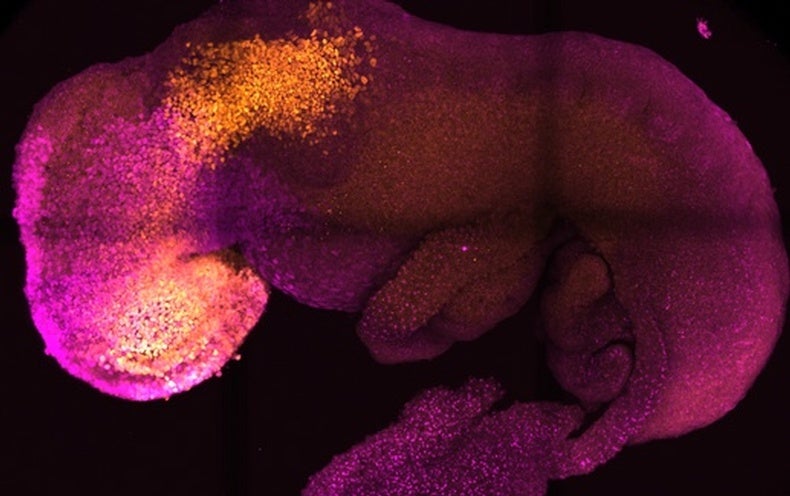
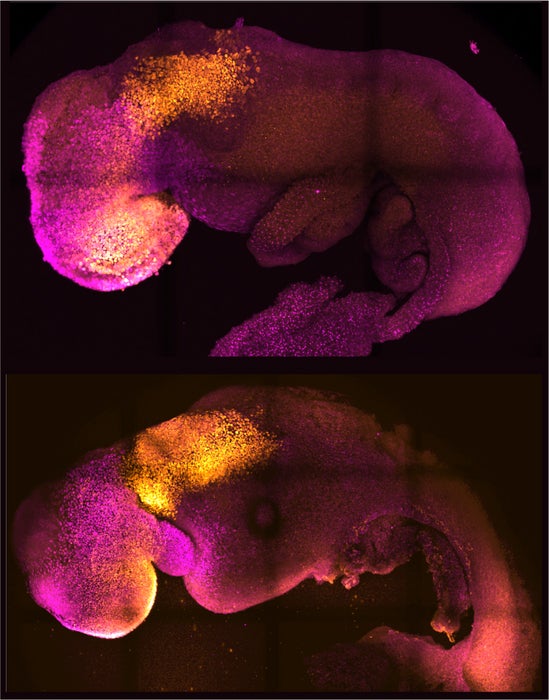
    The recipe for mammalian life is simple: take an egg, add sperm and wait. But two new papers demonstrate that there’s another way. Under the right conditions, stem cells can divide and self-organize into an embryo on their own. In studies published in Cell and Nature this month, two groups report that they have grown synthetic mouse embryos for longer than ever before. The embryos grew for 8.5 days, long enough for them to develop distinct organs — a beating heart, a gut tube and even neural folds.

    The process is far from perfect. Just a tiny fraction of the cells develop these features and those that do don’t entirely mimic a natural embryo. But the work still represents a major advance that will help scientists to see organ development in unprecedented detail. “This is very, very exciting,” says Jianping Fu, a bioengineer at the University of Michigan in Ann Arbor. “The next milestone in this field very likely will be a synthetic stem-cell based human embryo,” he says.

    The two research teams achieved the feat using similar techniques. Magdalena Zernicka-Goetz, a developmental and stem-cell biologist with laboratories at the University of Cambridge, UK, and the California Institute of Technology in Pasadena, has been working on this problem for a decade. “We started with only embryonic stem cells,” she says. “They can mimic early stages of development, but we couldn’t take it any further.” Then, a few years ago, her team discovered that when they added stem cells that give rise to the placenta and yolk sac, their embryos developed further. Last year, they demonstrated that they could use this technique to culture embryos until day 7. In their latest paper, published in Nature today, Zernicka-Goetz’s team describes how they grew embryos for another 1.5 days.

    Embryos in glass

    Zernicka-Goetz’s team did so with the help of a technique developed by Jacob Hanna, a stem-cell biologist at the Weizmann Institute of Science in Israel, who has also been working on this problem for years. Last year, Hanna’s team reported that they had developed a device that allowed them to culture natural mouse embryos for an unprecedented length of time outside the uterus. This incubator, which kept the embryos going from day 5 to day 11, takes aspects of a previous technology — in which the embryos reside in glass vials that rotate on a ferris-wheel-like system — and adds ventilation. The ventilation system controls the mixture of oxygen and carbon dioxide going into the vials, and the pressure.

    After Hanna’s paper came out last year, his team shared part of their incubator with other developmental and stem-cell biologists. “The brain of this machine we shared with everyone who asked for it,” he says, including Zernicka-Goetz and her colleagues, who tweaked it slightly for their experiments. In a paper published in Cell on 1 August, Hanna’s team describes how they used the system to also grow embryos for 8.5 days. Full gestation in mice is about 20 days.

    That period is long enough for the brain regions to develop, the heart to start beating, and the neural and gut tubes to form. These synthetic embryos look a lot like natural embryos that form when mouse sperm meets egg, but they “were not 100% identical”, Hanna says. “You can see some defects and some changes in the organ size.”

    Each team grew their embryos by combining three different cell types, and Hanna’s team also managed to create all three types from naïve embryonic stem cells. “It offers a way to simplify the process,” Hanna says. “You can start everything from one population.” Zernicka-Goetz’s team reported a similar accomplishment in a preprint published on bioRxiv (In their Nature paper, the researchers relied on placenta precursor cells from a cell line to create the embryos.)

    Brain development

    Zernicka-Goetz’s team also conducted an experiment in which they knocked out a gene called Pax6, which has a key role in brain development. When they eliminated this gene, the mouse heads didn’t develop correctly, mimicking what occurs in natural embryos that lack that gene. The result demonstrates “that the system is actually functional”, says Zernicka-Goetz.

    “These two papers, they empower one another,” says Martin Pera, a stem-cell biologist at the Jackson Laboratory Center for Precision Genetics in Bar Harbor, Maine. “Two very skilled groups can really produce rather similar results independently.”

    For researchers, these synthetic models have many advantages over natural embryos created from eggs and sperm. Because they grow outside of the uterus, they’re much easier to observe. They’re also easier to manipulate using genome-editing tools. “We can perturb, we can manipulate, we can knock out every possible mouse or human gene,” Fu says. That could make them useful for uncovering the role of different genes in birth defects or developmental disorders. Zernicka-Goetz plans to use this model to understand why pregnancies fail.

    Hanna hopes to use the technique to develop human synthetic embryos that can be a source of new organs and tissues for people who need them.

    What about humans?

    But translating this work into humans won’t be easy. Researchers have coaxed human stem cells to become blastocysts and even to mimic some aspects of gastrulation — when the early embryo organizes into distinct layers composed of different cell types. But reaching the stage of organ formation in human cells, which happens about a month after fertilization, presents a significant technical challenge. Still, Ali Brivanlou, a developmental biologist at Rockefeller University in New York, is optimistic. “The field is not too far away.”

    And the more advanced these embryos become, the greater the ethical concerns. One key question is whether these synthetic structures should be considered embryos, a point of debate in the field. The International Society for Stem Cell Research has long advised against culturing human embryos past day 14 (equivalent to day 6 in a mouse) — roughly when the ‘primitive steak’ appears, the structure that marks the beginning of gastrulation. In 2021, the society removed the limit and issued news guidelines saying that such research should have a compelling scientific rationale, and should use the minimum number of embryos necessary to achieve the scientific objective.

    Still, Pera sees a need for a continued conversation about the ethics of such models. Researchers have been working on human embryo models for years without much opposition. But he worries about a backlash as researchers begin to develop human embryo models that start developing organs. “The reaction to that could jeopardize this whole field of research,” he says. “It’s important that people know what is being proposed and that it’s done with some kind of ethical consensus,” adds Pera. “We have to go cautiously.”

    This article is reproduced with permission and was first published on August 25 2022.


    Original Source Link

    Share. Facebook Twitter Pinterest LinkedIn WhatsApp Email Reddit Telegram
    Previous ArticleStar Trek 4 Loses Director Matt Shakman for 2023 Movie – The Hollywood Reporter
    Next Article Artemis I is NASA’s moonshot mission to kickstart a new age of space exploration – TechCrunch

    RELATED POSTS

    How Can Astronauts Tell How Fast They’re Going?

    April 17, 2026

    Former deputy surgeon general Erica Schwartz nominated as new CDC chief

    April 17, 2026

    Our dreams become more emotive and symbolic as we approach death

    April 16, 2026

    The US Government Will Ask Data Centers How Much Power They Use

    April 16, 2026

    The Trump administration is looking to experts to weigh in on peptides

    April 15, 2026

    Is a super El Niño imminent, and what could the impacts be?

    April 15, 2026
    latest posts

    Paul McCartney’s new album to feature collaboration with Ringo Starr

    Paul McCartney’s upcoming solo album is set to include a new collaboration with Ringo Starr. The Beatles icon will…

    White House chief of staff to meet with Anthropic CEO about dangerous new Mythos model, official says

    April 17, 2026

    Jared Kushner Under Investigation For Potential Violations Of Federal Bribery And Foreign Agent Laws

    April 17, 2026

    Bride gets doused in black paint as sister-in-law attacker sentenced for crime

    April 17, 2026

    OpenAI Executive Kevin Weil Is Leaving the Company

    April 17, 2026

    How Can Astronauts Tell How Fast They’re Going?

    April 17, 2026

    Minions & Monsters Nabs John Powell as Composer

    April 17, 2026
    Categories
    • Books (1,189)
    • Business (6,092)
    • Events (44)
    • Film (6,029)
    • Lifestyle (4,131)
    • Music (6,141)
    • Politics (6,091)
    • Science (5,446)
    • Technology (6,023)
    • Television (5,711)
    • Uncategorized (6)
    • US News (6,081)
    popular posts

    28 Years Ago – Sepultura Release the Groundbreaking ‘Roots’

    Celebrating the anniversary of Sepultura’s influential album ‘Roots,’ which came out on Feb. 20, 1996.“I…

    Is sharing your smartphone PIN part of a healthy relationship?

    July 18, 2024

    ‘Mary & George’ Trailer Couldn’t Be Sexier — Scheming Julianne Moore & Nicholas Galitzine Plot Their Rise (VIDEO)

    February 1, 2024

    New Mystery and Thriller Books to Read | March 17

    March 17, 2026
    Archives
    Browse By Category
    • Books (1,189)
    • Business (6,092)
    • Events (44)
    • Film (6,029)
    • Lifestyle (4,131)
    • Music (6,141)
    • Politics (6,091)
    • Science (5,446)
    • Technology (6,023)
    • Television (5,711)
    • Uncategorized (6)
    • US News (6,081)
    About Us

    We are a creativity led international team with a digital soul. Our work is a custom built by the storytellers and strategists with a flair for exploiting the latest advancements in media and technology.

    Most of all, we stand behind our ideas and believe in creativity as the most powerful force in business.

    What makes us Different

    We care. We collaborate. We do great work. And we do it with a smile, because we’re pretty damn excited to do what we do. If you would like details on what else we can do visit out Contact page.

    Our Picks

    How Can Astronauts Tell How Fast They’re Going?

    April 17, 2026

    Minions & Monsters Nabs John Powell as Composer

    April 17, 2026

    ‘AI’ Brooks Rosser Fuels Romance Rumors With Rae Boyd

    April 17, 2026
    © 2026 New York Examiner News. All rights reserved. All articles, images, product names, logos, and brands are property of their respective owners. All company, product and service names used in this website are for identification purposes only. Use of these names, logos, and brands does not imply endorsement unless specified. By using this site, you agree to the Terms & Conditions and Privacy Policy.

    Type above and press Enter to search. Press Esc to cancel.

    We use cookies on our website to give you the most relevant experience by remembering your preferences and repeat visits. By clicking “Accept All”, you consent to the use of ALL the cookies. However, you may visit "Cookie Settings" to provide a controlled consent.
    Cookie SettingsAccept All
    Manage consent

    Privacy Overview

    This website uses cookies to improve your experience while you navigate through the website. Out of these, the cookies that are categorized as necessary are stored on your browser as they are essential for the working of basic functionalities of the website. We also use third-party cookies that help us analyze and understand how you use this website. These cookies will be stored in your browser only with your consent. You also have the option to opt-out of these cookies. But opting out of some of these cookies may affect your browsing experience.
    Necessary
    Always Enabled
    Necessary cookies are absolutely essential for the website to function properly. These cookies ensure basic functionalities and security features of the website, anonymously.
    CookieDurationDescription
    cookielawinfo-checkbox-analytics11 monthsThis cookie is set by GDPR Cookie Consent plugin. The cookie is used to store the user consent for the cookies in the category "Analytics".
    cookielawinfo-checkbox-functional11 monthsThe cookie is set by GDPR cookie consent to record the user consent for the cookies in the category "Functional".
    cookielawinfo-checkbox-necessary11 monthsThis cookie is set by GDPR Cookie Consent plugin. The cookies is used to store the user consent for the cookies in the category "Necessary".
    cookielawinfo-checkbox-others11 monthsThis cookie is set by GDPR Cookie Consent plugin. The cookie is used to store the user consent for the cookies in the category "Other.
    cookielawinfo-checkbox-performance11 monthsThis cookie is set by GDPR Cookie Consent plugin. The cookie is used to store the user consent for the cookies in the category "Performance".
    viewed_cookie_policy11 monthsThe cookie is set by the GDPR Cookie Consent plugin and is used to store whether or not user has consented to the use of cookies. It does not store any personal data.
    Functional
    Functional cookies help to perform certain functionalities like sharing the content of the website on social media platforms, collect feedbacks, and other third-party features.
    Performance
    Performance cookies are used to understand and analyze the key performance indexes of the website which helps in delivering a better user experience for the visitors.
    Analytics
    Analytical cookies are used to understand how visitors interact with the website. These cookies help provide information on metrics the number of visitors, bounce rate, traffic source, etc.
    Advertisement
    Advertisement cookies are used to provide visitors with relevant ads and marketing campaigns. These cookies track visitors across websites and collect information to provide customized ads.
    Others
    Other uncategorized cookies are those that are being analyzed and have not been classified into a category as yet.
    SAVE & ACCEPT