
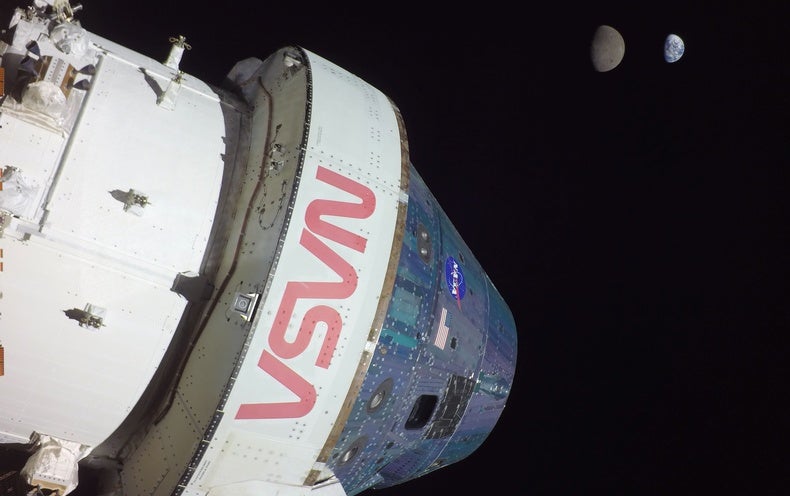
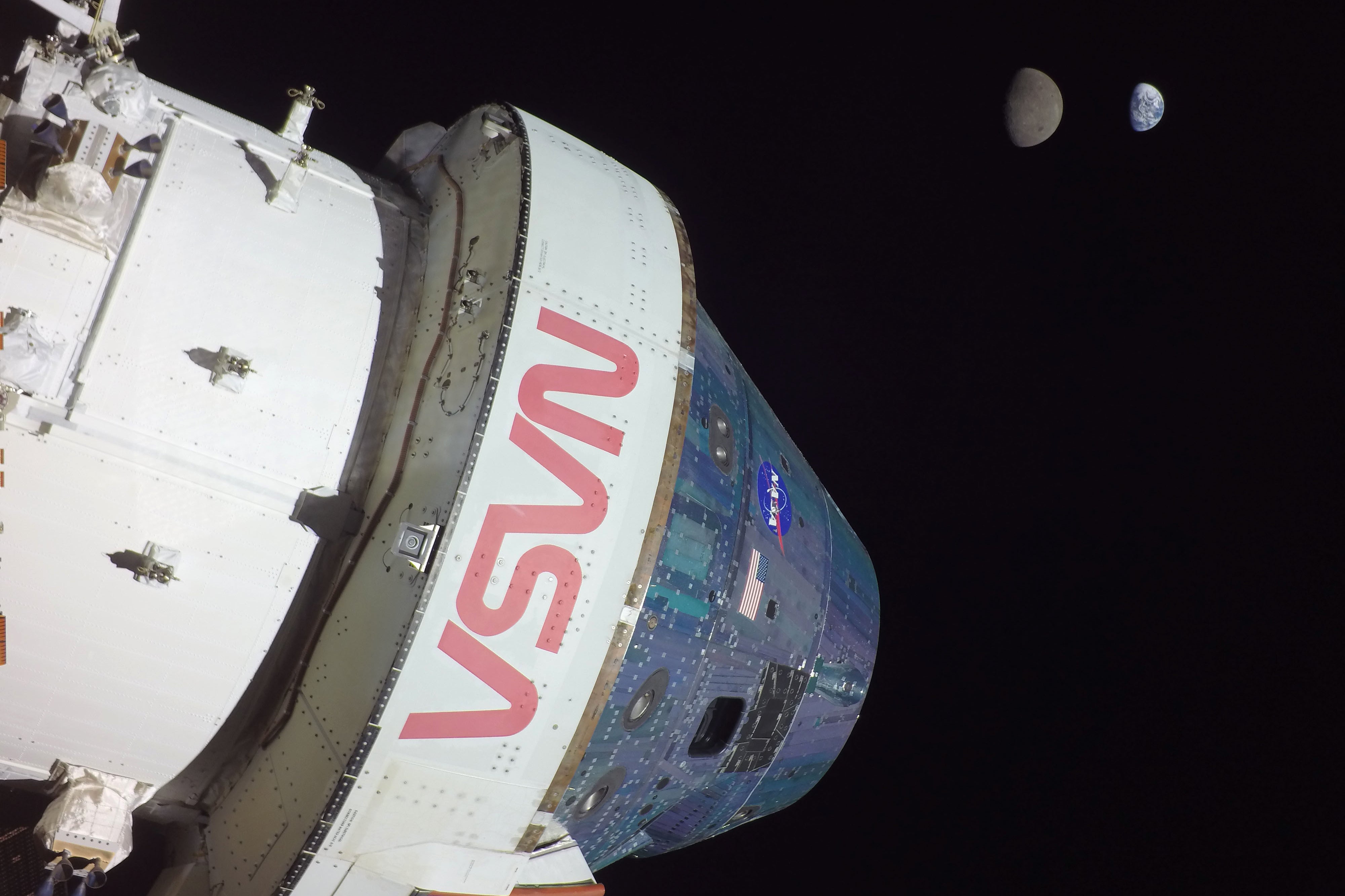
Fifty years ago today humans landed on the lunar surface for the last time during NASA’s Apollo 17 mission. And now, after a journey of 1.4 million miles, NASA’s Orion spacecraft is safely back on Earth—marking the completion of the agency’s Artemis I mission and the first step toward returning humans to the moon.
“Artemis is paving the way to live and work in deep space, in a hostile environment—to invent, to create and ultimately to go on with humans to Mars,” NASA Administrator Bill Nelson told reporters nearly two weeks before the splashdown.
Launched in the wee hours of November 16, Artemis I is the first flight test of NASA’s massive Space Launch System (SLS) rocket and the first lunar foray of the agency’s crew-rated Orion spacecraft. During its 26-day mission, Orion traced a record-setting path around the moon, looping to within 80 miles of the lunar surface—and, at its farthest, flying beyond the moon to a point about 270,000 miles from Earth. NASA managers put the spacecraft through its paces and challenged it to stay functional in the hostile environment of deep space for much longer than a typical crewed mission would last. They tested its propulsion, communication, life support and navigation systems—and found no major issues.
“It’s been an incredible success, and the issues that have arisen have been really minor, as far as we know,” says Teasel Muir-Harmony, a space historian and curator of the Apollo collection at the National Air and Space Museum. “With a new launch vehicle and a really complicated mission, it’s exciting to see that it’s working so well.”
The most crucial—and dangerous—test happened today, when Orion left space and made its high-speed return to Earth. Traveling about 25,000 miles an hour, the spacecraft performed what’s called a skip reentry, briefly dipping in and out of the atmosphere’s outskirts to bleed off speed before making a second, final plunge. The next time it touched Earth’s air, instead of skimming across the atmosphere like a skipping stone, Orion dove all the way through. As the spacecraft plummeted, atmospheric friction heated its exterior to more than 5,000 degrees Fahrenheit, or roughly half as hot as the surface of the sun.
“They’re basically going through a blowtorch,” says Daniel Dumbacher, who oversaw the SLS’s initial development while he was at NASA and now serves as executive director of the American Institute of Aeronautics and Astronautics. “We will never, ever be comfortable and complacent about reentry. Reentry is a high-risk, high-energy [maneuver]; you want to make sure you get it right.”
Surviving that plunge without burning up required the spacecraft’s heat shield to work perfectly—and it did. Next up were the drogue and main onboard parachutes, that latter of which deployed when the capsule was 5,300 feet above the Pacific Ocean, slowing its speed to a mere 20 miles an hour.
By 12:40 P.M. ET Orion was safely bobbing like an oversize, multibillion-dollar cork amid the whitecaps off the coast of Guadalupe Island, awaiting recovery by a contingent of NASA and U.S. Navy personnel.
A Smooth Shakedown Cruise
Just after 1:45 A.M. ET on November 16, NASA’s orange-hued SLS rocket roared to life and blazed into the sky, illuminating Florida’s Space Coast in an artificial dawn. The launch was a triumph: this was the largest rocket humans have so far sent into space and the first time in a half-century that a crew-rated spacecraft would visit the vicinity of the moon. These milestones came after years of delays in development and testing, during which costs ballooned. And they followed frustrating months of inaction on the launchpad, after leaks during fueling scrubbed previous flight attempts and multiple hurricanes blew through, one lashing the SLS-and-Orion “stack” with torrential rain and 100-mile-an-hour gales.
But after that rocky start, the road smoothed out. The SLS perfectly delivered Orion into orbit. The spacecraft set itself on a course for the moon, flawlessly performing a crucial 20-minute-long engine burn. The engines stayed true as it flew, firing multiple times to slip into and out of lunar orbit and then to return home. Along the way, mission managers detected no major onboard anomalies, just a series of small occurrences they termed “funnies”—that is, things that were unexpected but not exactly problems.
“The surprises that we are having are pleasant surprises,” said Mike Sarafin, NASA’s Artemis mission manager, during a pre-splashdown press briefing on November 30. “We continue to build that confidence that this is our deep-space human transportation system, and it is meeting or exceeding expectations across the board.”
Perhaps the most serious problem during the mission occurred on the ground in the first weekend of December, when the Goldstone radio telescope that is the backbone of NASA’s Deep Space Network went offline, preventing communication with the spacecraft for a number of hours. The launch facility at Kennedy Space Center also sustained some unexpected damage as the SLS leaped from the pad, with shockwaves and exhaust plumes battering the mobile launch structure and blowing the doors off the elevators.
Things proceeded so swimmingly, in fact, that as the mission progressed, managers felt confident enough to conduct additional, on-the-fly tests of the spacecraft’s capability. And in the end, it all worked.
“We’re getting exactly what we needed from this, which is a shakedown cruise of the systems to make sure they all work,” Dumbacher says. “The fact that it’s working so well tells us that we have a system that is ready to go, and I’m guessing that they will come to the conclusion that it’s going to be safe to put humans on the next one.”
Problematic Payloads
Although Artemis I achieved its primary objectives—to demonstrate Orion’s capability in deep space and successfully return the spacecraft to Earth—some of the mission’s lower-priority secondary tasks produced decidedly mixed results. When the spacecraft rocketed into orbit, it carried 10 CubeSats, or shoebox-size science experiments. Some of these were aiming for the moon to study ice and other features on its surface. Others were sent to monitor the space environment. One, NASA’s NEA Scout, was even targeted for a rendezvous with a near-Earth asteroid.
Of those 10 CubeSats, about half worked as planned. It’s not clear whether the troubles with the others are related to the experiments’ lengthy stay onboard the rocket—they were loaded onto the SLS more than a year ago, and some were deployed without fully charged batteries—or to the challenge of designing a small satellite to work in deep space.
NEA Scout is presumed lost, having yet to make contact with the ground; its team doesn’t even know whether the spacecraft ever powered on. A Japanese CubeSat, OMOTENASHI, was meant to send a small lander to the lunar surface, but it spun out of control after deployment, preventing further operations. LunaH-Map, another NASA CubeSat, failed to perform a crucial propulsion maneuver and now can’t complete its goal of mapping ice deposits around the moon’s south pole.
“All of them are going into deep space, which is not a conventional environment for CubeSats—it’s more challenging,” says the Massachusetts Institute of Technology’s Paulo Lozano, who builds propulsion systems for small satellites. Lozano says he’s actually impressed with how well the CubeSats have performed overall and characterizes the missions that are experiencing the biggest problems as “ambitious.”
“There are not that many opportunities to actually go to deep space with CubeSats, so having more of those opportunities available—I think it’s a great thing for little satellites,” Lozano says. “I think there’s going to be a lot of things to be learned about how to design these spacecraft so that, in the future, we can design little spacecraft that can accomplish what big spacecraft can achieve.”
“Earthrise,” Again
Despite that hiccup, Artemis I has performed much better than its equivalent mission during the Apollo program: 1968’s Apollo 6, the final uncrewed test flight of the Saturn V rocket and Apollo spacecraft, which was very nearly a failure.
“It didn’t fulfill its mission profile. There were major problems with [engine] oscillations at launch. They had engine failures—the engines shut down early. It wasn’t able to go to the moon; it had to stay in Earth orbit,” Muir-Harmony says. “These were pretty significant issues that arose on that mission. But they did get data. They were able to analyze the mission. They were able to feel like they could move on to the next mission.”
Even as Apollo 6 limped across the finish line, NASA chose to put humans onboard Apollo 7, which orbited Earth for 10 days and set the stage for subsequent missions that delivered astronauts to lunar orbit and then the lunar surface.
“I would be surprised—if this mission had gone like Apollo 6—if we wouldn’t do another test mission, but it’s hard to say,” Muir-Harmony says. “We have many more decades of spaceflight experience now. It’s a very different situation than it would have been in the 1960s, when we barely had any spaceflight experience.”
Perhaps it’s fitting that a half-century to the day after Apollo 17 touched down in a mountain range along the southeastern edge of the lunar region of Mare Serenitatis, Orion returned to Earth in much the same manner as the splashdowns of yore. Before reaching the moon, the Apollo 17 crew captured an image of Earth—a swirling, sandy blue marble, resplendent against inky nothingness—that has become one of the most recognizable depictions of our planet. Orion also captured cosmic views during its journey and sent a stream of gorgeous images back home. In one series, as Orion rounds the bend of the moon and is visible in the foreground, a crescent Earth glimmers above the monochromatic lunar horizon—an homage to Apollo 8’s “Earthrise” for the Artemis generation.
December 14 will mark the 50th anniversary of Apollo 17’s departure from the surface—when, after hauling several hundred pounds of moon rocks into his spacecraft, NASA astronaut Eugene Cernan became the last human to date to walk on the moon. Although Cernan knew as he left that the moon would once again revert to uninhabited desolate solitude, at the time, he couldn’t foresee that it would be decades before humans came back.
“I’m on the surface. And as I take man’s last step from the surface, back home for some time to come—but we believe not too long into the future—I’d like to just [say] what I believe history will record,” Cernan said, “that America’s challenge of today has forged man’s destiny of tomorrow.”