
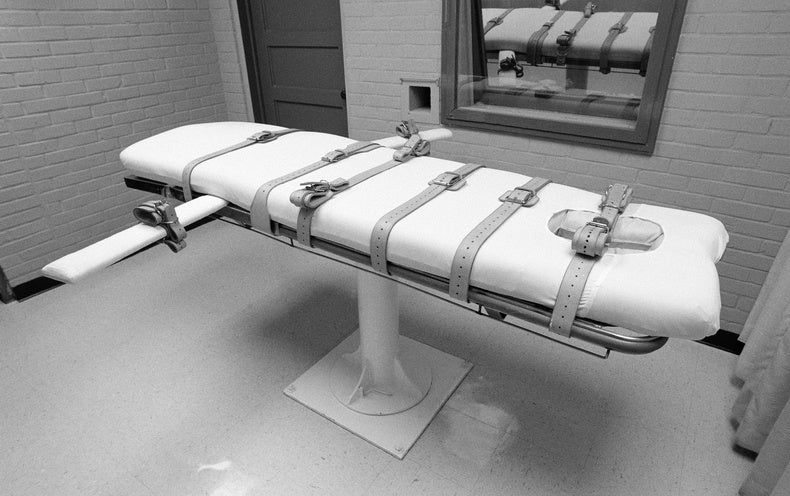
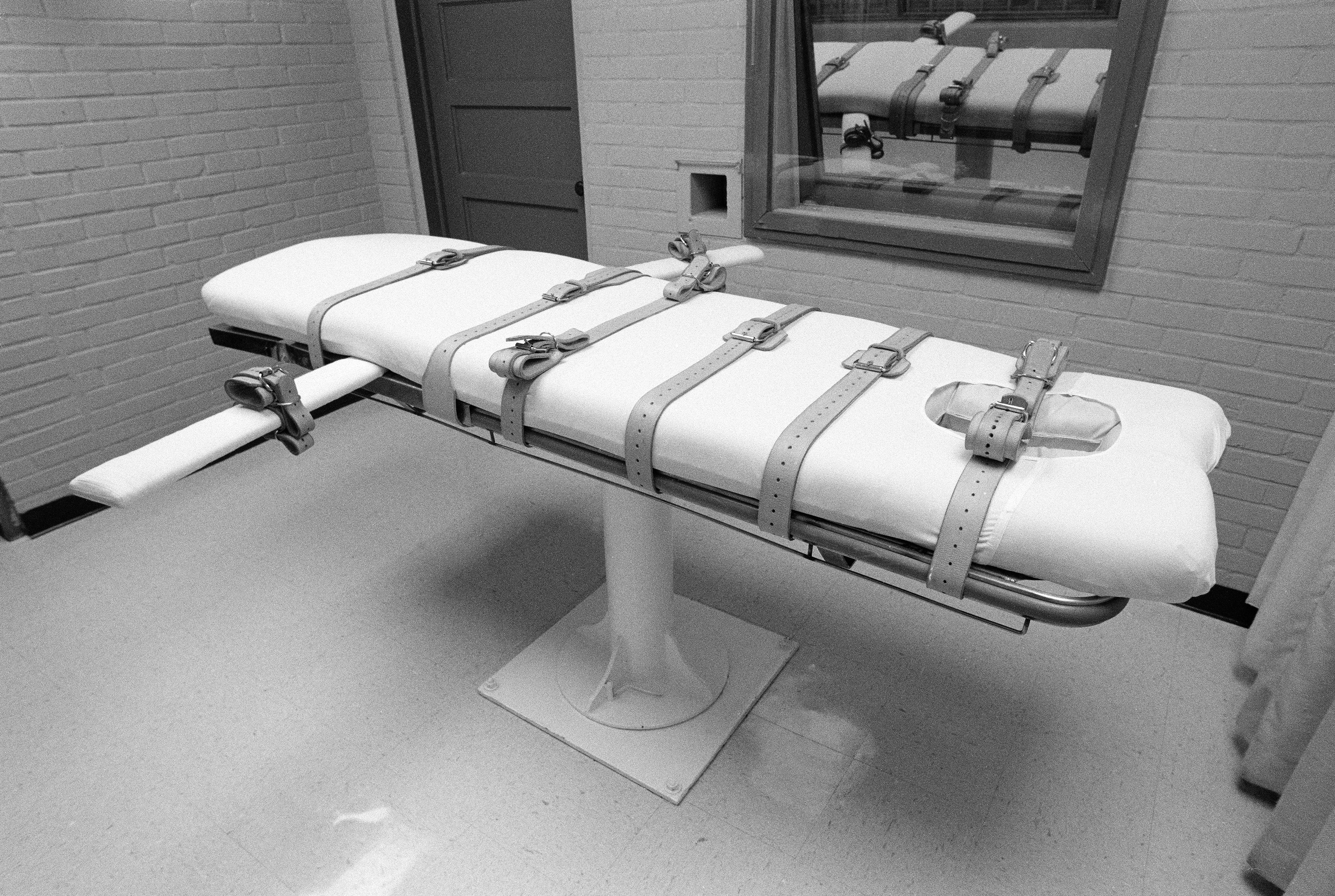
Alan Eugene Miller, who killed three men in workplace shootings in 1999, was scheduled to be the first person executed by nitrogen hypoxia—a new method never before used for the death penalty—on September 22. But a week before his execution, the state of Alabama admitted it was not prepared to go forward with the procedure and would use lethal injection instead.
On September 19 the U.S. District Court for the Middle District of Alabama issued a preliminary injunction barring the state from killing Miller by any means other than nitrogen hypoxia, essentially amounting to a stay of execution until the state was ready to administer the new method. Earlier this month three academics filed a human rights complaint with the United Nations on Miller’s behalf regarding Alabama’s use of lethal injection, which has been criticized as inhumane for causing excessive suffering.
Less than three hours before Miller’s death warrant expired at midnight, the U.S. Supreme Court granted Alabama’s appeal to the injunction and ruled that the execution could proceed. But in the early hours of September 23, the state announced that it had called off the execution, saying it was unable to access Miller’s veins in time. The execution is expected to be rescheduled.
The case raises numerous questions: What is nitrogen hypoxia? What is required to administer it? Why is a new form of execution necessary? And what’s wrong with lethal injection?
Scientific American spoke with experts in anesthesiology, law and capital punishment to find out.
What is nitrogen hypoxia?
Nitrogen hypoxia is a method of suffocating a person by forcing them to breathe pure nitrogen, starving them of oxygen until they die. Despite its scientific-sounding name, “nitrogen hypoxia” is not a real medical term, says Joel Zivot, an associate professor of anesthesiology at Emory University, who co-authored the human rights complaint.
“There is nitrogen gas—that’s a real thing. There’s hypoxia—that means low oxygen,” Zivot says. “But ‘nitrogen hypoxia’ is a made-up two-word expression meant to sound like you’re on the bridge of the starship Enterprise,” he says, referring to the spaceship of Star Trek fame. Instead Zivot recommends calling the procedure “nitrogen gas execution.”
Nitrogen is an inert gas that makes up 78 percent of the air we breathe, passing in and out of the body harmlessly with every breath. A person can breathe pure nitrogen and not immediately realize there is a problem, but their cells and organs are slowly being deprived of the oxygen needed to function and will rapidly start to break down. Someone deprived of oxygen will pass out in minutes and die soon after when the heart stops beating, according to Zivot.
Where did the idea for nitrogen hypoxia come from?
Then representative Mike Christian of Oklahoma first proposed using nitrogen gas as a potential form of execution in 2014, after the state came under fire for multiple botched execution attempts using lethal injection. The idea partly came from Michael Copeland, then an assistant professor of criminal justice at East Central University in Ada, Okla., who co-authored a white paper on the subject with two of his colleagues at the university.
“The entire proposal for nitrogen gas was the product of a 14-page report made by a criminal justice professor,” says Corinna Barrett Lain, a law professor at the University of Richmond, who’s writing a book on lethal injection. “He’s not a doctor. He doesn’t have any medical training. He’s not a scientist. But he knew one of the legislators.”
At the hearings where the method was introduced, legislators heard stories of pilots and scuba divers dying when they accidentally breathed pure nitrogen instead of the proper mix of nitrogen and oxygen. No scientific evidence was presented because there is little medical research on death by nitrogen gas. It is not clear exactly how long the process would take or how much the person would suffer.
“There is a claim, that I think is baseless, that nitrogen gas inhalation would cause a death that would be peaceful and not cruel,” Zivot says. “There’s no evidence for any of that.”
There is no requirement for a state to demonstrate that a method of execution is not “cruel and unusual punishment,” as defined by the Eighth Amendment of the U.S. Constitution, Lain says. Instead “the burden is on the condemned inmate to show that it is torturous rather than the burden being on the state to show that it’s not,” she says. “So the state can make up anything it wants.”
Why has there been a holdup in Alabama’s use of this new method?
The Alabama execution has not been held up by the question of whether nitrogen hypoxia would be cruel and unusual. Instead there is most likely a problem with logistics.
“Alabama doesn’t have a protocol [for the new execution method] yet. Alabama doesn’t say how it will be carried out. Alabama certainly hasn’t trained its personnel … in how to conduct a nitrogen hypoxia execution,” says Robert Dunham, executive director of the Death Penalty Information Center, a national nonprofit that provides information and analysis on death penalty issues. “And as far as anyone can tell, no one has considered the potentially lethal danger to execution personnel if [they] don’t carry it out properly.”
There are two ways to administer a gas execution. The state can build a gas chamber, such as those used in executions with hydrogen cyanide (the method by which the last gas execution in the U.S. was conducted in Arizona in 1999), or it could use a specialized gas mask. If a mask is used, it must have an airtight seal so that the inmate cannot breathe any oxygen and prolong their death and so that the execution team and witnesses are not exposed to potentially deadly levels of the gas.
“Nitrogen is colorless, and it is odorless, and the same thing that led the Oklahoma legislature to think that this would be swift and painless—the fact that people were unaware that they were being poisoned at depth or at altitude—those very same factors could make it potentially lethal if gas leaks into areas where the execution team was,” Dunham says.
What’s wrong with using lethal injection?
The reason nitrogen hypoxia—which, despite these concerns, is now authorized in Oklahoma, Alabama and Mississippi—was initially proposed is because numerous problems have arisen with lethal injection over the past decade.
Lethal injection has been the standard method of execution in the U.S. since the 1990s. The original three-drug protocol was developed by an Oklahoma state medical examiner and included the anesthetic sodium thiopental, a paralytic drug called pancuronium bromide, and potassium chloride, which is supposed to stop the heart within minutes. Dunham described the latter as “chemical fire.”
Doctors and drug manufacturers have protested lethal injection since its inception, not wanting their products and techniques to be used for killing rather than healing. In 2011 the sole U.S. manufacturer of sodium thiopental stopped producing it. The following year a ruling by the U.S. District Court for the District of Columbia essentially declared that the U.S. Food and Drug Administration could no longer allow the drug to be imported from overseas for the purpose of execution.
These changes left states scrambling for another method of execution. Some switched to using a single drug, the barbiturate pentobarbital, which is a sedative and anticonvulsant often used before surgeries or to treat epilepsy. It’s also commonly used in both veterinary and human euthanasia. Other states replaced sodium thiopental with the benzodiazepine midazolam, which is also used as a sedative before medical procedures. Neither pentobarbital nor midazolam function as an anesthetic or pain reliever.
With these changes, problems during lethal injections started to arise more frequently. In the case of John Marion Grant in Oklahoma, the drugs caused vomiting and full-body convulsions over the course of 15 minutes. In an even more horrifying event, in Arizona, Joseph Wood III gasped and snorted for nearly two hours before dying. Most recently, the people carrying out the executions for Joe Nathan James, Jr. and Doyle Lee Hamm in Alabama were unable to insert the IV lines to administer the drugs. This resulted in numerous puncture wounds and incisions in James’s and Hamm’s skin, delaying the former’s execution for hours and halting the latter’s altogether.
“The lethal-injection process, in many respects, created a myth that what you had was a simple medical procedure in which the prisoner was put to sleep,” Dunham says. “That created a false distance between the reality of capital punishment and the public perception of capital punishment.”
Experts now believe that the paralytic used in the original three-drug protocol masked the torture inmates were experiencing. Zivot and others have performed more than 200 autopsies on people killed by lethal injection using thiopental, pentobarbital or midazolam. An NPR investigation of these autopsies found that most inmates’ lungs showed evidence of pulmonary edema, the buildup of fluid that produces a feeling of drowning.
“Instead of falling off to sleep and dying, they were drowning in their own secretions and suffocating to death, sometimes masked by a paralytic,” Zivot says. “That’s, in fact, how they were dying.”
There have been court cases in several states brought by prisoners claiming that lethal injection violates the Eighth Amendment. In the highest-profile case, four Oklahoma prisoners contended that using midazolam constituted cruel and unusual punishment because it “fails to render a person insensate to pain.” But in a 2015 decision, the U.S. Supreme Court ruled 5–4 against the inmates, in part because, the justices said, they had failed to identify a less painful option.
What other execution methods are available?
The heightened scrutiny on lethal injection has led states to consider other methods of execution, including electrocution, firing squad and gas (either hydrogen cyanide or pure nitrogen). With the exception of Tennessee, where there have been five executions by electrocution since 2018, no other methods have been used for nearly a decade. Given the problems that arose during Miller’s case, it doesn’t appear that will change any time soon.
When asked what the most humane way to execute someone would be, Lain’s answer is the firing squad. “Death by firing squad is nearly instantaneous,” she says. “That’s certainly better than being electrocuted for five or six minutes or being gassed to death for six to 10 minutes or being slowly suffocated under a veneer of peacefulness for 10 to 20 minutes.”