
Close Menu
New York Examiner News

    Subscribe to Updates

    Get the latest creative news from FooBar about art, design and business.

    What's Hot

    Brent Smith Ranks Every Shinedown Album (Even the New One)

    April 17, 2026

    Trump says Iran war will end ‘pretty soon’ as uranium deal is in sight

    April 17, 2026

    Donald Trump Has Lost His Power To Gaslight America

    April 17, 2026
    Facebook X (Twitter) Instagram
    New York Examiner News
    • Home
    • US News
    • Politics
    • Business
    • Science
    • Technology
    • Lifestyle
    • Music
    • Television
    • Film
    • Books
    • Contact
      • About
      • Amazon Disclaimer
      • DMCA / Copyrights Disclaimer
      • Terms and Conditions
      • Privacy Policy
    New York Examiner News
    Home»Science»Ocean Acidification Threshold Pushes Earth Past Another Planetary Boundary
    Science

    Ocean Acidification Threshold Pushes Earth Past Another Planetary Boundary

    By AdminOctober 6, 2025
    Facebook Twitter Pinterest LinkedIn WhatsApp Email Reddit Telegram
    Ocean Acidification Threshold Pushes Earth Past Another Planetary Boundary


    Our planet is sick, and its life-threatening symptoms are getting worse, a new report warns.

    Earth has been pushed past multiple physical and chemical boundaries crucial for keeping the world a livable place. Beyond already exceeded thresholds set by scientists for rising temperatures, biodiversity loss and chemical pollution, we have now also breached the boundary on ocean acidification. The milestone comes with grim ramifications for marine ecosystems and human livelihoods.

    “More than three-quarters of the Earth’s support systems are not in the safe zone,” Johan Rockström, director of the Potsdam Institute for Climate Impact Research (PIK) in Germany, said in a statement announcing the 2025 evaluation of the planetary boundaries. “Humanity is pushing beyond the limits of a safe operating space, increasing the risk of destabilizing the planet.”


    On supporting science journalism

    If you’re enjoying this article, consider supporting our award-winning journalism by subscribing. By purchasing a subscription you are helping to ensure the future of impactful stories about the discoveries and ideas shaping our world today.


    Humans and many other species evolved to thrive in the climate of the Holocene, a period that began around 10,000 years ago. But as societies industrialized and began widely burning fossil fuels in the 19th century, greenhouse gases built up in the atmosphere, trapping heat and transforming Earth and its climate in many ways besides raising global temperatures.

    Beginning in 2009, PIK flagged and prioritized research on nine geophysical limits that make up a sort of planetary life-support system; staying within these limits, they argue, is the best hope for maintaining the clement climatic conditions we and most of Earth’s other denizens have adapted to. In 2023 researchers published a study that quantified those boundaries and established where we are in relation to them. At the time, six of the boundaries had been surpassed, with many well into what the scientists called a “zone of increasing risk.”
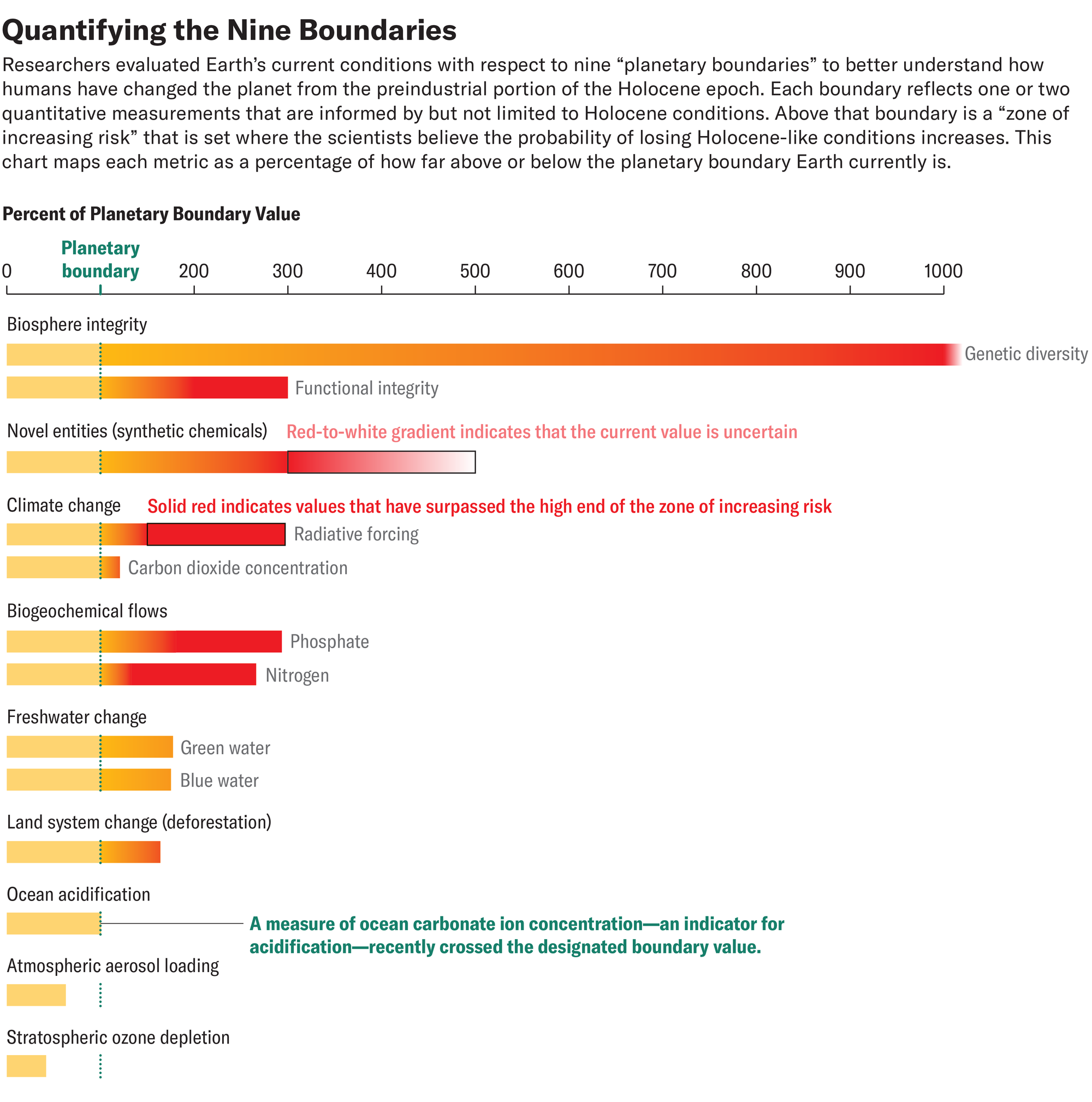
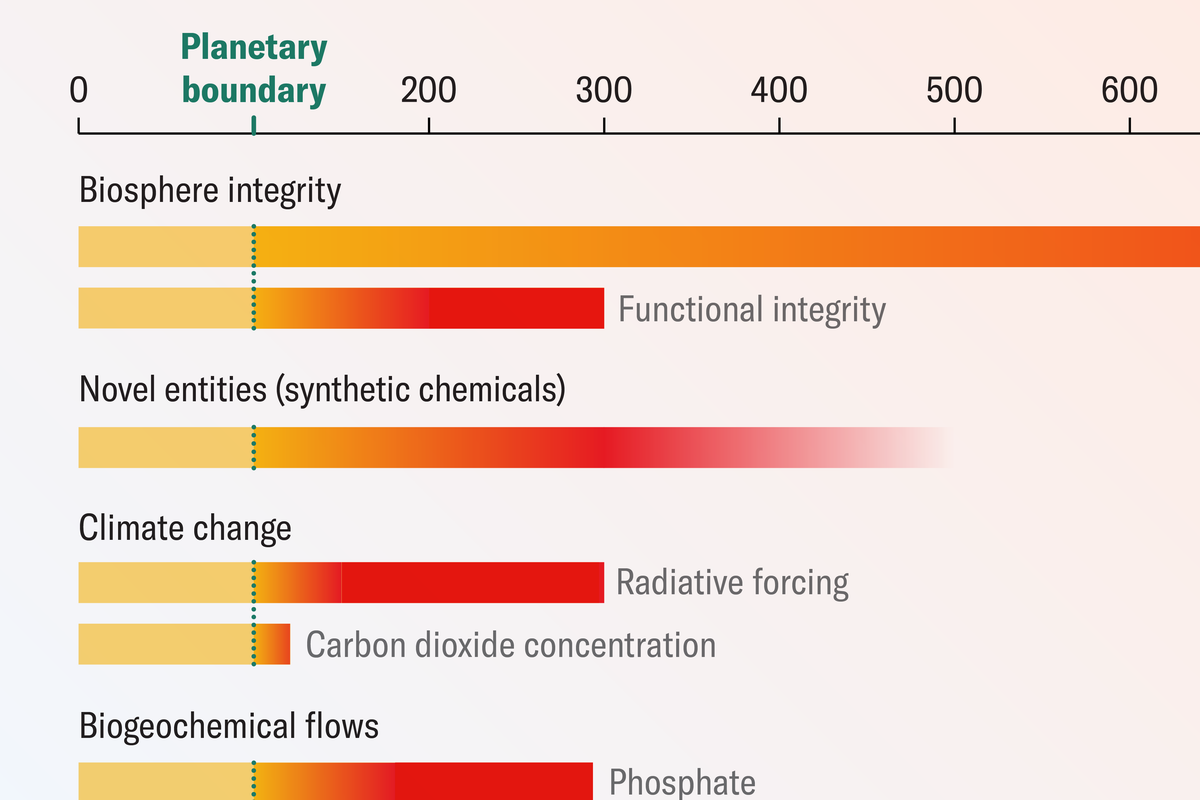
    Bar chart shows how far above or below nine planetary boundaries Earth currently is and highlights measures for which we have surpassed the high end of the zone of increasing risk, where scientists believe the probability of losing Holocene-like conditions increases.

    “It’s like blood pressure,” said the 2023 study’s lead author Katherine Richardson, an earth systems scientist at the University of Copenhagen, in an interview with Scientific American at the time. “If your blood pressure is over 120 over 80, it’s not a guarantee that you’re going to have a heart attack, but it does raise the risk, and therefore we do what we can to bring it down.”

    Among the nine boundaries is of course climate change, which is measured in part by the amount of world-warming carbon dioxide in Earth’s atmosphere. Carbon dioxide concentrations reached a record global high of 422.7 parts per million (ppm) last year, compared with 280 ppm prior to the industrial revolution and the 350 ppm that many scientists consider a “safe” limit (which was surpassed in 1987). The burning of fossil fuels is the indisputable culprit.

    Fossil fuels are also behind the new boundary breaching—the ocean absorbs some of the atmosphere’s excess carbon dioxide, causing waters to become more acidic. Since the industrial revolution, the ocean’s surface pH has dropped by 0.1; this may seem minuscule, but because the pH scale is logarithmic, it reflects roughly a 30 percent increase in acidity.

    Ocean acidification can have profound impacts on marine ecosystems by depleting seawater of certain carbon compounds that corals and other shell building animals need to construct their protective homes. At low enough pH levels, corals and shells can even begin to dissolve. These effects could destabilize entire ecosystems and devastate many commercially valuable species, such as oysters. A 2020 report by the U.S. National Oceanic and Atmospheric Administration found that ocean acidification would cost the country’s economy billions of dollars.

    “The movement we’re seeing is absolutely headed in the wrong direction. The ocean is becoming more acidic, oxygen levels are dropping, and marine heatwaves are increasing. This is ramping up pressure on a system vital to stabilize conditions on planet Earth,” Levke Caesar, co-lead of PIK’s Planetary Boundaries Science Lab, said in the new evaluation’s press statement.

    The not-so-short list of other boundaries we’ve blown past is sobering. Excess phosphorus and nitrogen from the widespread use of fertilizers flows into rivers and seas to spark toxic algal blooms. Artificial chemicals, such as plastics, dichlorodiphenyltrichloroethane (DDT) and “forever chemical” perfluoroalkyl and polyfluoroalkyl substances (PFAS) disruptively accumulate in food chains. Agriculture and other changes in land use strip away forests and diminish available fresh water. And as all these problems grow, more and more of Earth’s biodiversity is disappearing.

    According to the new report, just two of the nine limits remain intact: ozone depletion and aerosols in the atmosphere. Only the former shows clear progress away from the planetary boundary, as a result of the success of the Montreal Protocol, the international agreement through which countries are phasing out chemicals that erode Earth’s protective ozone layer. Aerosol emissions have declined globally—partly from efforts to reduce pollution from global shipping—but absent any unified policy framework for reductions, levels could easily surge back.

    The overall prognosis for the planet’s health is poor, given that a number of countries, including the U.S. in particular, are moving away from meaningful action to tackle environmental problems.

    “We are witnessing widespread decline in the health of our planet. But this is not an inevitable outcome. The drop in aerosol pollution and healing of the ozone layer, shows that it is possible to turn the direction of global development. Even if the diagnosis is dire, the window of cure is still open,” Rockström said in the press statement. “Failure is not inevitable; failure is a choice. A choice that must and can be avoided.”

    It’s Time to Stand Up for Science

    If you enjoyed this article, I’d like to ask for your support. Scientific American has served as an advocate for science and industry for 180 years, and right now may be the most critical moment in that two-century history.

    I’ve been a Scientific American subscriber since I was 12 years old, and it helped shape the way I look at the world. SciAm always educates and delights me, and inspires a sense of awe for our vast, beautiful universe. I hope it does that for you, too.

    If you subscribe to Scientific American, you help ensure that our coverage is centered on meaningful research and discovery; that we have the resources to report on the decisions that threaten labs across the U.S.; and that we support both budding and working scientists at a time when the value of science itself too often goes unrecognized.

    In return, you get essential news, captivating podcasts, brilliant infographics, can’t-miss newsletters, must-watch videos, challenging games, and the science world’s best writing and reporting. You can even gift someone a subscription.

    There has never been a more important time for us to stand up and show why science matters. I hope you’ll support us in that mission.


    Original Source Link

    Share. Facebook Twitter Pinterest LinkedIn WhatsApp Email Reddit Telegram
    Previous ArticleMonster: The Ed Gein Story Review
    Next Article Our Favorite Humidifiers for Home, Travel & More (2025)

    RELATED POSTS

    Former deputy surgeon general Erica Schwartz nominated as new CDC chief

    April 17, 2026

    Our dreams become more emotive and symbolic as we approach death

    April 16, 2026

    The US Government Will Ask Data Centers How Much Power They Use

    April 16, 2026

    The Trump administration is looking to experts to weigh in on peptides

    April 15, 2026

    Is a super El Niño imminent, and what could the impacts be?

    April 15, 2026

    Marine Animals in the Strait of Hormuz Don’t Get a Ceasefire

    April 14, 2026
    latest posts

    Brent Smith Ranks Every Shinedown Album (Even the New One)

    With a new album underway, Brent Smith ranked every Shinedown album — even the new…

    Trump says Iran war will end ‘pretty soon’ as uranium deal is in sight

    April 17, 2026

    Donald Trump Has Lost His Power To Gaslight America

    April 17, 2026

    Trump nominates former deputy surgeon general Erica Schwartz for CDC director

    April 17, 2026

    New leaders, new fund: Sequoia has raised $7B to expand its AI bets

    April 17, 2026

    Former deputy surgeon general Erica Schwartz nominated as new CDC chief

    April 17, 2026

    Paramount Skydance Confirming New Star Trek Movie After 10-Year Hiatus Is A Familiar Refrain

    April 17, 2026
    Categories
    • Books (1,188)
    • Business (6,091)
    • Events (44)
    • Film (6,028)
    • Lifestyle (4,130)
    • Music (6,140)
    • Politics (6,090)
    • Science (5,445)
    • Technology (6,022)
    • Television (5,710)
    • Uncategorized (6)
    • US News (6,080)
    popular posts

    Mariah the Scientist Shares New Song “Christmas in Toronto”: Listen

    Mariah the Scientist has gotten into the holiday spirit with the new song “Christmas in…

    13 Rock + Metal Genres as Emoji

    July 18, 2022

    Chris Stirewalt, Bill Stepien to Testify at January 6th Committee Hearing Monday; Trump 2020 Manager Stepien, Who Helms Campaign of Liz Cheney GOP Opponent Harriet Hageman, Is Appearing Under Subpoena

    June 12, 2022

    American Dream Gone: Gen Z Dumps Owning Homes for Luxury Rentals | The Gateway Pundit

    January 3, 2024
    Archives
    Browse By Category
    • Books (1,188)
    • Business (6,091)
    • Events (44)
    • Film (6,028)
    • Lifestyle (4,130)
    • Music (6,140)
    • Politics (6,090)
    • Science (5,445)
    • Technology (6,022)
    • Television (5,710)
    • Uncategorized (6)
    • US News (6,080)
    About Us

    We are a creativity led international team with a digital soul. Our work is a custom built by the storytellers and strategists with a flair for exploiting the latest advancements in media and technology.

    Most of all, we stand behind our ideas and believe in creativity as the most powerful force in business.

    What makes us Different

    We care. We collaborate. We do great work. And we do it with a smile, because we’re pretty damn excited to do what we do. If you would like details on what else we can do visit out Contact page.

    Our Picks

    Former deputy surgeon general Erica Schwartz nominated as new CDC chief

    April 17, 2026

    Paramount Skydance Confirming New Star Trek Movie After 10-Year Hiatus Is A Familiar Refrain

    April 17, 2026

    Stars on Robby and Abbot’s Trauma Talk, Mohan’s Future, More (Exclusive)

    April 17, 2026
    © 2026 New York Examiner News. All rights reserved. All articles, images, product names, logos, and brands are property of their respective owners. All company, product and service names used in this website are for identification purposes only. Use of these names, logos, and brands does not imply endorsement unless specified. By using this site, you agree to the Terms & Conditions and Privacy Policy.

    Type above and press Enter to search. Press Esc to cancel.

    We use cookies on our website to give you the most relevant experience by remembering your preferences and repeat visits. By clicking “Accept All”, you consent to the use of ALL the cookies. However, you may visit "Cookie Settings" to provide a controlled consent.
    Cookie SettingsAccept All
    Manage consent

    Privacy Overview

    This website uses cookies to improve your experience while you navigate through the website. Out of these, the cookies that are categorized as necessary are stored on your browser as they are essential for the working of basic functionalities of the website. We also use third-party cookies that help us analyze and understand how you use this website. These cookies will be stored in your browser only with your consent. You also have the option to opt-out of these cookies. But opting out of some of these cookies may affect your browsing experience.
    Necessary
    Always Enabled
    Necessary cookies are absolutely essential for the website to function properly. These cookies ensure basic functionalities and security features of the website, anonymously.
    CookieDurationDescription
    cookielawinfo-checkbox-analytics11 monthsThis cookie is set by GDPR Cookie Consent plugin. The cookie is used to store the user consent for the cookies in the category "Analytics".
    cookielawinfo-checkbox-functional11 monthsThe cookie is set by GDPR cookie consent to record the user consent for the cookies in the category "Functional".
    cookielawinfo-checkbox-necessary11 monthsThis cookie is set by GDPR Cookie Consent plugin. The cookies is used to store the user consent for the cookies in the category "Necessary".
    cookielawinfo-checkbox-others11 monthsThis cookie is set by GDPR Cookie Consent plugin. The cookie is used to store the user consent for the cookies in the category "Other.
    cookielawinfo-checkbox-performance11 monthsThis cookie is set by GDPR Cookie Consent plugin. The cookie is used to store the user consent for the cookies in the category "Performance".
    viewed_cookie_policy11 monthsThe cookie is set by the GDPR Cookie Consent plugin and is used to store whether or not user has consented to the use of cookies. It does not store any personal data.
    Functional
    Functional cookies help to perform certain functionalities like sharing the content of the website on social media platforms, collect feedbacks, and other third-party features.
    Performance
    Performance cookies are used to understand and analyze the key performance indexes of the website which helps in delivering a better user experience for the visitors.
    Analytics
    Analytical cookies are used to understand how visitors interact with the website. These cookies help provide information on metrics the number of visitors, bounce rate, traffic source, etc.
    Advertisement
    Advertisement cookies are used to provide visitors with relevant ads and marketing campaigns. These cookies track visitors across websites and collect information to provide customized ads.
    Others
    Other uncategorized cookies are those that are being analyzed and have not been classified into a category as yet.
    SAVE & ACCEPT