

Close Menu
New York Examiner News

    Subscribe to Updates

    Get the latest creative news from FooBar about art, design and business.

    What's Hot

    Electric Forest Planning 2027 Festival After Two Deaths at 2026 Event

    November 18, 2026

    Elizabeth Hurley, 61, Wows In See-Through Red Dress With Billy Ray By Her Side

    November 18, 2026

    Mega Tours by Oasis, Dua Lipa and Coldplay Drive U.K. Musics Economic Contribution to Record-Highs

    November 17, 2026
    Facebook X (Twitter) Instagram
    New York Examiner News
    • Home
    • US News
    • Politics
    • Business
    • Science
    • Technology
    • Lifestyle
    • Music
    • Television
    • Film
    • Books
    • Contact
      • About
      • Amazon Disclaimer
      • DMCA / Copyrights Disclaimer
      • Terms and Conditions
      • Privacy Policy
    New York Examiner News
    Home»Science»Parasites from feasting at Stonehenge found in prehistoric faeces
    Science

    Parasites from feasting at Stonehenge found in prehistoric faeces

    By AdminMay 22, 2022
    Facebook Twitter Pinterest LinkedIn WhatsApp Email Reddit Telegram
    Parasites from feasting at Stonehenge found in prehistoric faeces

    [ad_1]

    A new analysis of ancient faeces found at the site of a prehistoric village near Stonehenge has uncovered evidence of the eggs of parasitic worms, suggesting the inhabitants feasted on the internal organs of cattle and fed leftovers to their dogs.

    Durrington Walls was a Neolithic settlement situated just 2.8km from Stonehenge, and dating from around 2500 BC, when much of the famous stone monument was constructed. It is believed that the site housed the people who built Stonehenge.

    A team of archaeologists led by the University of Cambridge investigated nineteen pieces of ancient faeces, or ‘coprolite’, found at Durrington Walls and preserved for over 4,500 years. Five of the coprolites (26%) – one human and four dog – were found to contain the eggs of parasitic worms.

    Researchers say it is the earliest evidence for intestinal parasites in the UK where the host species that produced the faeces has also been identified. The findings are published today in the journal Parasitology.

    “This is the first time intestinal parasites have been recovered from Neolithic Britain, and to find them in the environment of Stonehenge is really something,” said study lead author Dr Piers Mitchell from Cambridge’s Department of Archaeology.
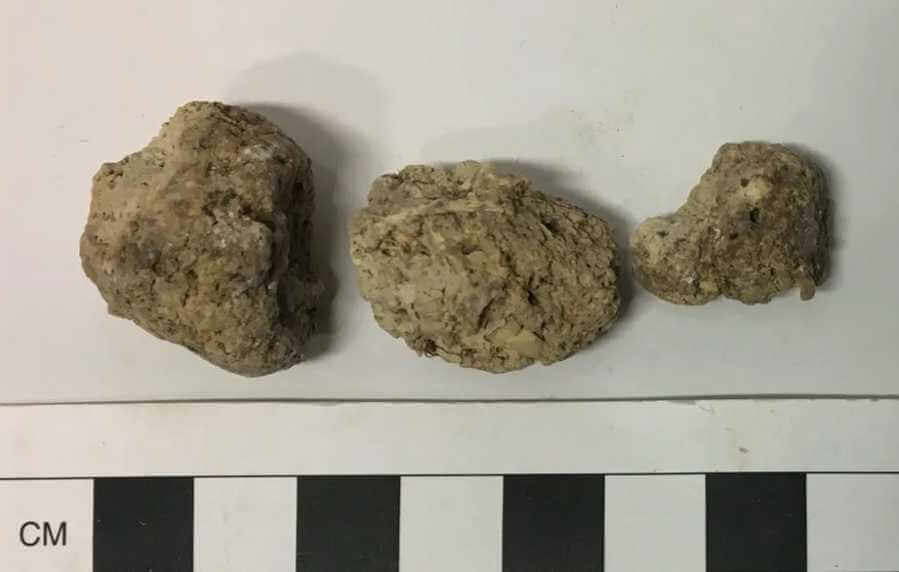
    Human coprolite (preserved human faeces) from Durrington Walls. Image credit: Dr Lisa-Marie Shillito
    Human coprolite (preserved human faeces) from Durrington Walls. Image credit: Dr Lisa-Marie Shillito

    “The type of parasites we find are compatible with previous evidence for winter feasting on animals during the building of Stonehenge,” he said.

    Four of the coprolites, including the human one, contained the eggs of capillariid worms, identified in part by their lemon shape.

    While the many types of capillariid around the world infect a wide range of animals, on the rare occasion that a European species infects humans the eggs get lodged in the liver and don’t appear in stool.

    The evidence of capillariid eggs in human faeces indicates that the person had eaten the raw or undercooked lungs or liver from an already infected animal, resulting in the parasite’s eggs passing straight through the body.

    During excavations of the main ‘midden’ – or dung and refuse heap – at Durrington Walls, archaeologists uncovered pottery and stone tools along with over 38,000 animal bones. Some 90% of the bones were from pigs, with less than 10% from cows. This is also where the partially mineralised faeces used in the study were found.

    “As capillariid worms can infect cattle and other ruminants, it seems that cows may have been the most likely source of the parasite eggs,” said Mitchell.

    Previous isotopic analyses of cow teeth from Durrington Walls suggest that some cattle were herded almost 100km from Devon or Wales to the site for large-scale feasting. Patterns of butchery previously identified on cattle bones from the site suggest beef was primarily chopped for stewing, and bone marrow was extracted.

    “Finding the eggs of capillariid worms in both human and dog coprolites indicates that the people had been eating the internal organs of infected animals, and also fed the leftovers to their dogs,” said co-author Dr Evilena Anastasiou, who assisted with the research while at Cambridge.

    To determine whether the coprolites excavated from the midden were from human or animal faeces, they were analysed for sterols and bile acids at the National Environment Isotope Facility at the University of Bristol.

    One of the coprolites belonging to a dog contained the eggs of fish tapeworm, indicating it had previously eaten raw freshwater fish to become infected. However, no other evidence of fish consumption, such as bones, has been found at the site.

    “Durrington Walls was occupied on a largely seasonal basis, mainly in winter periods. The dog probably arrived already infected with the parasite,” said Mitchell.

    The dates for Durrington Walls match those for stage two of the construction of Stonehenge, when the world-famous ‘trilithons’ – two massive vertical stones supporting a third horizontal stone – were erected, most likely by the seasonal residents of this nearby settlement.

    While Durrington Walls was a place of feasting and habitation, as evidenced by the pottery and vast number of animal bones, Stonehenge itself was not, with little found to suggest people lived or ate there en masse.

    Prof Mike Parker Pearson from UCL’s Institute of Archaeology, who excavated Durrington Walls between 2005 and 2007, added: “This new evidence tells us something new about the people who came here for winter feasts during the construction of Stonehenge.”

    “Pork and beef were spit-roasted or boiled in clay pots but it looks as if the offal wasn’t always so well cooked. The population weren’t eating freshwater fish at Durrington Walls, so they must have picked up the tapeworms at their home settlements.”

    [ad_2]

    Original Source Link

    Share. Facebook Twitter Pinterest LinkedIn WhatsApp Email Reddit Telegram
    Previous ArticleRMN – first-look review
    Next Article 5 Best Rain Jackets (2022): Cheap, Eco-Friendly, Hiking, and Running

    RELATED POSTS

    Climate Change Has Pushed the World's Ice Out of Its Safe Zone

    November 12, 2026

    Synchron Pauses Trials of Its Brain Implant Due to Performance Issues

    November 12, 2026

    The Polar Vortex Is About to Make Weather Weird From the UK to the US

    November 12, 2026

    A Startup Wants to Fight AI Bioweapons With AI

    November 11, 2026

    Michigan Residents Voted to Get Corporate Money Out of Politics. Now Utilities Are Suing

    November 11, 2026

    A New Benchmark for De-Aging Comes From Slowly Turning Back Cells Clocks

    November 11, 2026
    latest posts

    Electric Forest Planning 2027 Festival After Two Deaths at 2026 Event

    Electric Forest is moving forward with plans for a 2027 festival after two deaths, including…

    Elizabeth Hurley, 61, Wows In See-Through Red Dress With Billy Ray By Her Side

    November 18, 2026

    Mega Tours by Oasis, Dua Lipa and Coldplay Drive U.K. Musics Economic Contribution to Record-Highs

    November 17, 2026

    Uber and Ziplines drone delivery service takes off in Texas, with dozens of cities to follow | TechCrunch

    November 17, 2026

    We Now Know What Robert Pattinson Was Doing When the James Bond Casting News Broke

    November 17, 2026

    Grammys 2027: Check out the full list of nominations here

    November 17, 2026

    The Voice Live Blog: Who Will Make the Top 10?

    November 17, 2026
    Categories
    • Books (1,591)
    • Business (6,481)
    • Events (85)
    • Film (6,452)
    • Lifestyle (4,503)
    • Music (6,586)
    • Politics (6,447)
    • Science (5,854)
    • Technology (6,441)
    • Television (6,145)
    • US News (6,488)
    popular posts

    Fortune 500 Power Moves: Which executives gained and lost power this week, Sept. 12-18, 2026

    [ad_1] This is Fortune 500 Power Moves, a column tracking executive shifts—from appointments and promotions…

    Kayla Wallace Talks My Grown-Up Christmas List and Returning to When Calls the Heart

    July 9, 2022

    New Orleans’ 65-Year-Old DEI Police Chief Faces Backlash Amid Reports of Teaching FBI Course on ‘Bias and Diversity’ | The Gateway Pundit

    January 2, 2025

    Nude Videos of Kids From Hacked Baby Monitors Were Sold on Telegram

    July 15, 2023
    Archives
    Browse By Category
    • Books (1,591)
    • Business (6,481)
    • Events (85)
    • Film (6,452)
    • Lifestyle (4,503)
    • Music (6,586)
    • Politics (6,447)
    • Science (5,854)
    • Technology (6,441)
    • Television (6,145)
    • US News (6,488)
    About Us

    We are a creativity led international team with a digital soul. Our work is a custom built by the storytellers and strategists with a flair for exploiting the latest advancements in media and technology.

    Most of all, we stand behind our ideas and believe in creativity as the most powerful force in business.

    What makes us Different

    We care. We collaborate. We do great work. And we do it with a smile, because we’re pretty damn excited to do what we do. If you would like details on what else we can do visit out Contact page.

    Our Picks

    Grammys 2027: Check out the full list of nominations here

    November 17, 2026

    The Voice Live Blog: Who Will Make the Top 10?

    November 17, 2026

    Star Trek: Return To Duty Officially Announced

    November 17, 2026
    © 2026 New York Examiner News. All rights reserved. All articles, images, product names, logos, and brands are property of their respective owners. All company, product and service names used in this website are for identification purposes only. Use of these names, logos, and brands does not imply endorsement unless specified. By using this site, you agree to the Terms & Conditions and Privacy Policy.

    Type above and press Enter to search. Press Esc to cancel.

    We use cookies on our website to give you the most relevant experience by remembering your preferences and repeat visits. By clicking “Accept All”, you consent to the use of ALL the cookies. However, you may visit "Cookie Settings" to provide a controlled consent.
    Cookie SettingsAccept All
    Manage consent

    Privacy Overview

    This website uses cookies to improve your experience while you navigate through the website. Out of these, the cookies that are categorized as necessary are stored on your browser as they are essential for the working of basic functionalities of the website. We also use third-party cookies that help us analyze and understand how you use this website. These cookies will be stored in your browser only with your consent. You also have the option to opt-out of these cookies. But opting out of some of these cookies may affect your browsing experience.
    Necessary
    Always Enabled
    Necessary cookies are absolutely essential for the website to function properly. These cookies ensure basic functionalities and security features of the website, anonymously.
    CookieDurationDescription
    cookielawinfo-checkbox-analytics11 monthsThis cookie is set by GDPR Cookie Consent plugin. The cookie is used to store the user consent for the cookies in the category "Analytics".
    cookielawinfo-checkbox-functional11 monthsThe cookie is set by GDPR cookie consent to record the user consent for the cookies in the category "Functional".
    cookielawinfo-checkbox-necessary11 monthsThis cookie is set by GDPR Cookie Consent plugin. The cookies is used to store the user consent for the cookies in the category "Necessary".
    cookielawinfo-checkbox-others11 monthsThis cookie is set by GDPR Cookie Consent plugin. The cookie is used to store the user consent for the cookies in the category "Other.
    cookielawinfo-checkbox-performance11 monthsThis cookie is set by GDPR Cookie Consent plugin. The cookie is used to store the user consent for the cookies in the category "Performance".
    viewed_cookie_policy11 monthsThe cookie is set by the GDPR Cookie Consent plugin and is used to store whether or not user has consented to the use of cookies. It does not store any personal data.
    Functional
    Functional cookies help to perform certain functionalities like sharing the content of the website on social media platforms, collect feedbacks, and other third-party features.
    Performance
    Performance cookies are used to understand and analyze the key performance indexes of the website which helps in delivering a better user experience for the visitors.
    Analytics
    Analytical cookies are used to understand how visitors interact with the website. These cookies help provide information on metrics the number of visitors, bounce rate, traffic source, etc.
    Advertisement
    Advertisement cookies are used to provide visitors with relevant ads and marketing campaigns. These cookies track visitors across websites and collect information to provide customized ads.
    Others
    Other uncategorized cookies are those that are being analyzed and have not been classified into a category as yet.
    SAVE & ACCEPT