
Close Menu
New York Examiner News

    Subscribe to Updates

    Get the latest creative news from FooBar about art, design and business.

    What's Hot

    Olivia Dean Kicks Off ‘The Art of Loving’ Tour: See Full Setlist

    April 23, 2026

    Ceasefire is indefinite, Trump says, as economist puts recession risk at 40% if Hormuz stays closed

    April 23, 2026

    Republicans Try To Overturn Election After Virginia Makes Trump’s Gerrymander Backfire

    April 23, 2026
    Facebook X (Twitter) Instagram
    New York Examiner News
    • Home
    • US News
    • Politics
    • Business
    • Science
    • Technology
    • Lifestyle
    • Music
    • Television
    • Film
    • Books
    • Contact
      • About
      • Amazon Disclaimer
      • DMCA / Copyrights Disclaimer
      • Terms and Conditions
      • Privacy Policy
    New York Examiner News
    Home»Science»Physicists Find a Shortcut to Seeing an Elusive Quantum Glow
    Science

    Physicists Find a Shortcut to Seeing an Elusive Quantum Glow

    By AdminMay 21, 2022
    Facebook Twitter Pinterest LinkedIn WhatsApp Email Reddit Telegram
    Physicists Find a Shortcut to Seeing an Elusive Quantum Glow


    Theoretical physics is full of weird and wonderful concepts: wormholes, quantum foam and multiverses, just to name a few. The problem is that while such things easily emerge from theorists’ equations, they are practically impossible to create and test in a laboratory setting. But for one such “untestable” theory, an experimental setup might be just on the horizon.

    Researchers at the Massachusetts Institute of Technology and the University of Waterloo in Ontario say they’ve found a way to test the Unruh effect, a bizarre phenomenon predicted to arise from objects moving through empty space. If scientists are able to observe the effect, the feat could confirm some long-held assumptions about the physics of black holes. Their proposal was published in Physical Review Letters on April 21.

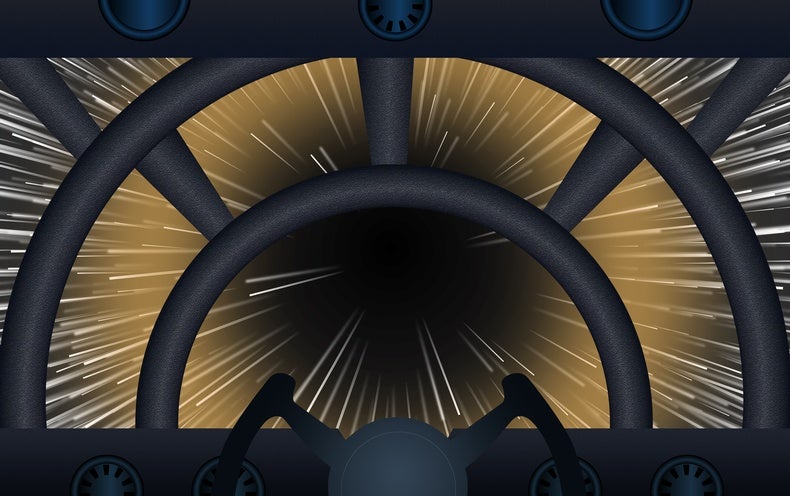
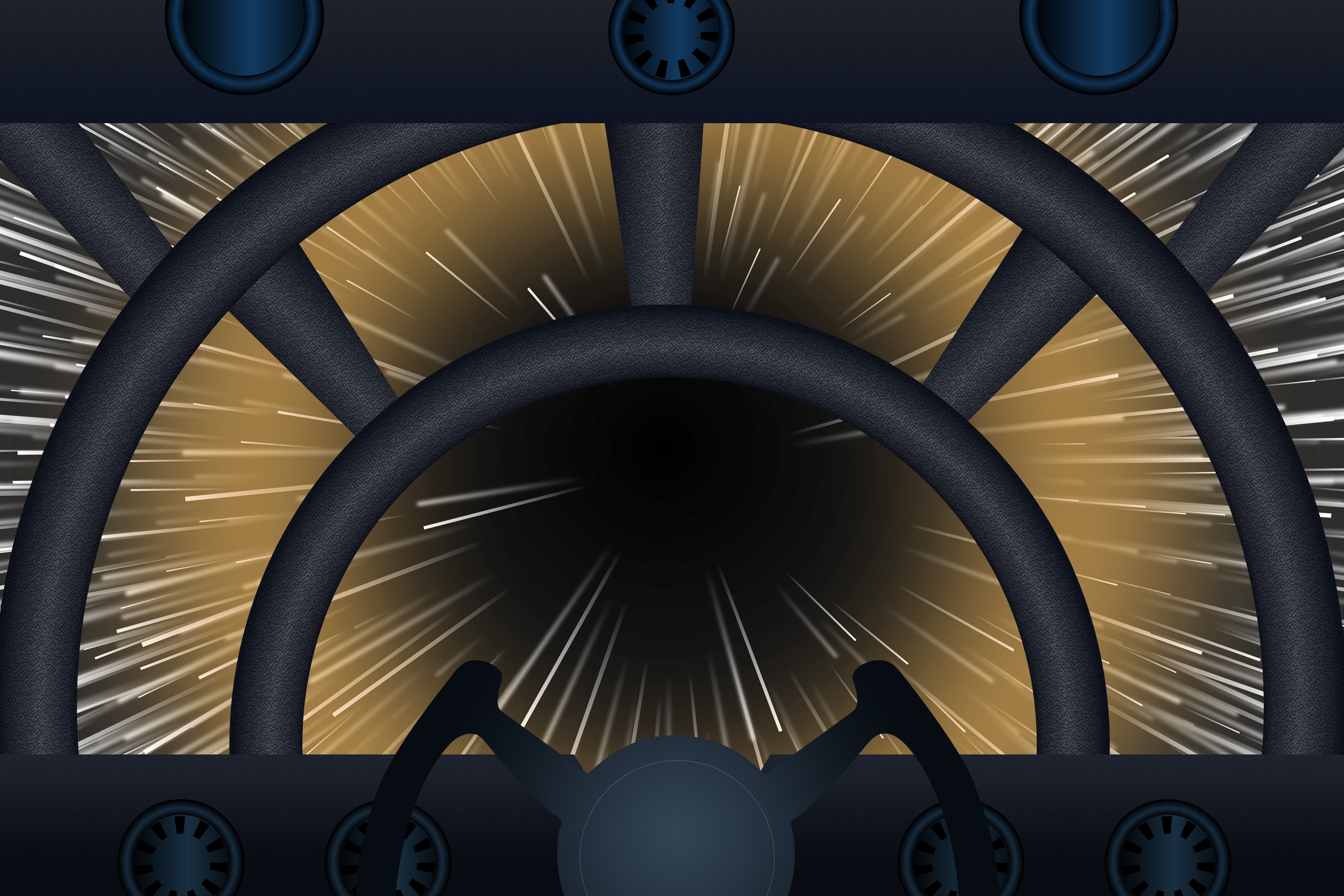
    If you could observe the Unruh effect in person, it might look a bit like jumping to hyperspace in the Millennium Falcon—a sudden rush of light bathing your view of an otherwise black void. As an object accelerates in a vacuum, it becomes swaddled in a warm cloak of glowing particles. The faster the acceleration, the warmer the glow. “That’s enormously strange” because a vacuum is supposed to be empty by definition, explains quantum physicist Vivishek Sudhir of M.I.T., one of the study’s co-authors. “You know, where did this come from?”

    Where it comes from has to do with the fact that so-called empty space is not exactly empty at all but rather suffused by overlapping energetic quantum fields. Fluctuations in these fields can give rise to photons, electrons, and other particles and can be sparked by an accelerating body. In essence, an object speeding through a field-soaked vacuum picks up a fraction of the fields’ energy, which is subsequently reemitted as Unruh radiation.

    The effect takes its name from the theoretical physicist Bill Unruh, who described his eponymous phenomenon in 1976. But two other researchers—mathematician Stephen Fulling and physicist Paul Davies—worked out the formula independently within three years of Unruh (in 1973 and 1975, respectively).

    “I remember it vividly,” says Davies, who is now a Regents Professor at Arizona State University. “I did the calculations sitting at my wife’s dressing table because I didn’t have a desk or an office.”

    A year later Davies met Unruh at a conference where Unruh was giving a lecture about his recent breakthrough. Davies was surprised to hear Unruh describe a very similar phenomenon to what had emerged from his own dressing-table calculations. “And so we got together in the bar afterward,” Davies recalls. The two quickly struck up a collaboration that continued for several years.

    Davies, Fulling and Unruh all approached their work from a purely theoretical standpoint; they never expected anyone to design a real-world experiment around it. As technology advances, however, ideas that were once relegated to the world of theory, such as gravitational waves and the Higgs boson, can come within reach of actual observation. And observing the Unruh effect, it turns out, could help cement another far-out physics concept.

    “The reason people are working on the Unruh effect is not because they think that accelerated observers are so important,” says Christoph Adami, a professor of physics, astronomy and molecular biology at Michigan State University, who was not involved in the research. “They are working on this because of the direct link to black hole physics.”

    Essentially, the Unruh effect is the flip side of a far more famous physics phenomenon: Hawking radiation, named for the physicist Stephen Hawking, who theorized that an almost imperceptible halo of light should leak from black holes as they slowly evaporate.

    In the case of Hawking radiation, that warm fuzzy effect is essentially a result of particles being pulled into a black hole by gravity. But for the Unruh effect, it’s a matter of acceleration—which is, per Einstein’s equivalence principle, gravity’s mathematical equal.

    Imagine you are standing in an elevator. With a jolt, the car rushes up to the next floor, and for a moment, you feel yourself pulled toward the floor. From your viewpoint, “that is essentially indistinguishable from Earth’s gravity suddenly being turned up,” Sudhir says.

    The same holds true, he says, from a math perspective. “It’s as simple as that: there is an equivalence between gravity and acceleration,” Sudhir adds.

    Despite its theoretical prominence, scientists have yet to observe the Unruh effect. (And for that matter, they haven’t managed to see Hawking radiation either.) That’s because the Unruh effect has long been considered extraordinarily difficult to test experimentally. Under most circumstances, researchers would need to subject an object to ludicrous accelerations—upward of 25 quintillion times the force of Earth’s gravity—in order to produce a measurable emission. Alternatively, more accessible accelerations might be used—but in that case, the probability of generating a detectable effect would be so low that such an experiment would need to run continuously for billions of years. Sudhir and his co-authors believe that they have found a loophole, however.

    By grabbing hold of a single electron in a vacuum with a magnetic field, then accelerating it through a carefully configured bath of photons, the researchers realized that they could “stimulate” the particle, artificially bumping it up to a higher energy state. This added energy multiplies the effect of acceleration, which means that, using the electron itself as a sensor, researchers could pick out Unruh radiation surrounding the particle without having to apply so many g-forces (or having to wait for eons).

    Unfortunately, an energy-boosting photon bath also adds background “noise” by amplifying other quantum-field effects in the vacuum. “That’s exactly what we don’t want to happen,” Sudhir says. But by carefully controlling the trajectory of the electron, the experimenters should be able to nullify this potential interference—a process that Sudhir likens to throwing an invisibility cloak over the particle.

    And unlike the kit required for most other cutting-edge particle physics experiments, such as the giant superconducting magnets and sprawling beamlines of the Large Hadron Collider at CERN, the researchers say that their Unruh effect simulation could be set up in most university labs. “It doesn’t have to be some huge experiment,” says paper co-author Barbara Šoda, a physicist at the University of Waterloo. In fact, Sudhir and his Ph.D. students are currently designing a version they intend to actually build, which they hope to have running in the next few years.

    Adami sees the new research as an elegant synthesis of several different disciplines, including classical physics, atomic physics and quantum field theory. “I think this paper is correct,” he says. But much like the Unruh effect itself, “to some extent, it’s clear that this calculation has been done before.”

    For Davies, the potential to test the effect could open up exciting new doors for both theoretical and applied physics, further validating nigh-unobservable phenomena predicted by theorists while expanding the tool kit experimentalists can use to interrogate nature. “The thing about physics that makes it such a successful discipline is that experiment and theory very much go hand in hand,” he says. “The two are in lockstep.” Testing the Unruh effect promises to be a pinnacle achievement for both.


    Original Source Link

    Share. Facebook Twitter Pinterest LinkedIn WhatsApp Email Reddit Telegram
    Previous ArticleBrother and Sister – first-look review
    Next Article Boeing’s Starliner finally makes it all the way to the ISS – TechCrunch

    RELATED POSTS

    Passage from Homer’s Iliad discovered in the abdomen of a Roman-era Egyptian mummy

    April 23, 2026

    98 per cent of meat and dairy sustainability pledges are greenwashing

    April 22, 2026

    New Gas-Powered Data Centers Could Emit More Greenhouse Gases Than Entire Nations

    April 22, 2026

    Hegseth says U.S. military no longer requires flu vaccination, drawing criticism from health experts

    April 21, 2026

    Diamonds are surprisingly elastic when you make them tiny

    April 21, 2026

    There’s New Evidence for How Loneliness Affects Memory in Old Age

    April 20, 2026
    latest posts

    Olivia Dean Kicks Off ‘The Art of Loving’ Tour: See Full Setlist

    Olivia Dean kicked off her global The Art of Loving arena tour in Glasgow, Scotland…

    Ceasefire is indefinite, Trump says, as economist puts recession risk at 40% if Hormuz stays closed

    April 23, 2026

    Republicans Try To Overturn Election After Virginia Makes Trump’s Gerrymander Backfire

    April 23, 2026

    Republicans cut Democrats out entirely with marathon overnight vote on border cash and more top headlines

    April 23, 2026

    India’s app market is booming — but global platforms are capturing most of the gains

    April 23, 2026

    Passage from Homer’s Iliad discovered in the abdomen of a Roman-era Egyptian mummy

    April 23, 2026

    Hudson’s Charm Saves Sitcom From Flaws

    April 23, 2026
    Categories
    • Books (1,200)
    • Business (6,103)
    • Events (45)
    • Film (6,040)
    • Lifestyle (4,141)
    • Music (6,153)
    • Politics (6,102)
    • Science (5,457)
    • Technology (6,034)
    • Television (5,722)
    • Uncategorized (7)
    • US News (6,092)
    popular posts

    The Best Summer Candles to Buy in 2023

    For many—alongside blankets aplenty and holiday baking marathons—it’s a candle’s captivating glow that epitomizes winter.…

    80 Fall Dinner Recipes | Easy Weeknight Dinner Ideas for Fall | Recipes, Dinners and Easy Meal Ideas

    September 21, 2022

    Starbucks, Uber, CVS to Report Earnings Amid Shrinking Economy

    July 31, 2022

    Buffy Sainte-Marie Responds to CBC Report in New Statement

    November 26, 2023
    Archives
    Browse By Category
    • Books (1,200)
    • Business (6,103)
    • Events (45)
    • Film (6,040)
    • Lifestyle (4,141)
    • Music (6,153)
    • Politics (6,102)
    • Science (5,457)
    • Technology (6,034)
    • Television (5,722)
    • Uncategorized (7)
    • US News (6,092)
    About Us

    We are a creativity led international team with a digital soul. Our work is a custom built by the storytellers and strategists with a flair for exploiting the latest advancements in media and technology.

    Most of all, we stand behind our ideas and believe in creativity as the most powerful force in business.

    What makes us Different

    We care. We collaborate. We do great work. And we do it with a smile, because we’re pretty damn excited to do what we do. If you would like details on what else we can do visit out Contact page.

    Our Picks

    Passage from Homer’s Iliad discovered in the abdomen of a Roman-era Egyptian mummy

    April 23, 2026

    Hudson’s Charm Saves Sitcom From Flaws

    April 23, 2026

    Inside Violet & Novak’s Tense Hostage Situation (Exclusive)

    April 23, 2026
    © 2026 New York Examiner News. All rights reserved. All articles, images, product names, logos, and brands are property of their respective owners. All company, product and service names used in this website are for identification purposes only. Use of these names, logos, and brands does not imply endorsement unless specified. By using this site, you agree to the Terms & Conditions and Privacy Policy.

    Type above and press Enter to search. Press Esc to cancel.

    We use cookies on our website to give you the most relevant experience by remembering your preferences and repeat visits. By clicking “Accept All”, you consent to the use of ALL the cookies. However, you may visit "Cookie Settings" to provide a controlled consent.
    Cookie SettingsAccept All
    Manage consent

    Privacy Overview

    This website uses cookies to improve your experience while you navigate through the website. Out of these, the cookies that are categorized as necessary are stored on your browser as they are essential for the working of basic functionalities of the website. We also use third-party cookies that help us analyze and understand how you use this website. These cookies will be stored in your browser only with your consent. You also have the option to opt-out of these cookies. But opting out of some of these cookies may affect your browsing experience.
    Necessary
    Always Enabled
    Necessary cookies are absolutely essential for the website to function properly. These cookies ensure basic functionalities and security features of the website, anonymously.
    CookieDurationDescription
    cookielawinfo-checkbox-analytics11 monthsThis cookie is set by GDPR Cookie Consent plugin. The cookie is used to store the user consent for the cookies in the category "Analytics".
    cookielawinfo-checkbox-functional11 monthsThe cookie is set by GDPR cookie consent to record the user consent for the cookies in the category "Functional".
    cookielawinfo-checkbox-necessary11 monthsThis cookie is set by GDPR Cookie Consent plugin. The cookies is used to store the user consent for the cookies in the category "Necessary".
    cookielawinfo-checkbox-others11 monthsThis cookie is set by GDPR Cookie Consent plugin. The cookie is used to store the user consent for the cookies in the category "Other.
    cookielawinfo-checkbox-performance11 monthsThis cookie is set by GDPR Cookie Consent plugin. The cookie is used to store the user consent for the cookies in the category "Performance".
    viewed_cookie_policy11 monthsThe cookie is set by the GDPR Cookie Consent plugin and is used to store whether or not user has consented to the use of cookies. It does not store any personal data.
    Functional
    Functional cookies help to perform certain functionalities like sharing the content of the website on social media platforms, collect feedbacks, and other third-party features.
    Performance
    Performance cookies are used to understand and analyze the key performance indexes of the website which helps in delivering a better user experience for the visitors.
    Analytics
    Analytical cookies are used to understand how visitors interact with the website. These cookies help provide information on metrics the number of visitors, bounce rate, traffic source, etc.
    Advertisement
    Advertisement cookies are used to provide visitors with relevant ads and marketing campaigns. These cookies track visitors across websites and collect information to provide customized ads.
    Others
    Other uncategorized cookies are those that are being analyzed and have not been classified into a category as yet.
    SAVE & ACCEPT