
Close Menu
New York Examiner News

    Subscribe to Updates

    Get the latest creative news from FooBar about art, design and business.

    What's Hot

    Schedule, Time & Full WWE Event Card

    August 1, 2026

    A dead SpaceX rocket that’s been adrift for over a year is about to slam into the moon

    August 1, 2026

    Trump Is Under Investigation For Scheme To Sell Insider Access

    August 1, 2026
    Facebook X (Twitter) Instagram
    New York Examiner News
    • Home
    • US News
    • Politics
    • Business
    • Science
    • Technology
    • Lifestyle
    • Music
    • Television
    • Film
    • Books
    • Contact
      • About
      • Amazon Disclaimer
      • DMCA / Copyrights Disclaimer
      • Terms and Conditions
      • Privacy Policy
    New York Examiner News
    Home»Science»Restrictions on Psilocybin ‘Magic Mushrooms’ Are Easing as Research Ramps Up
    Science

    Restrictions on Psilocybin ‘Magic Mushrooms’ Are Easing as Research Ramps Up

    By AdminJanuary 4, 2023
    Facebook Twitter Pinterest LinkedIn WhatsApp Email Reddit Telegram
    Restrictions on Psilocybin ‘Magic Mushrooms’ Are Easing as Research Ramps Up


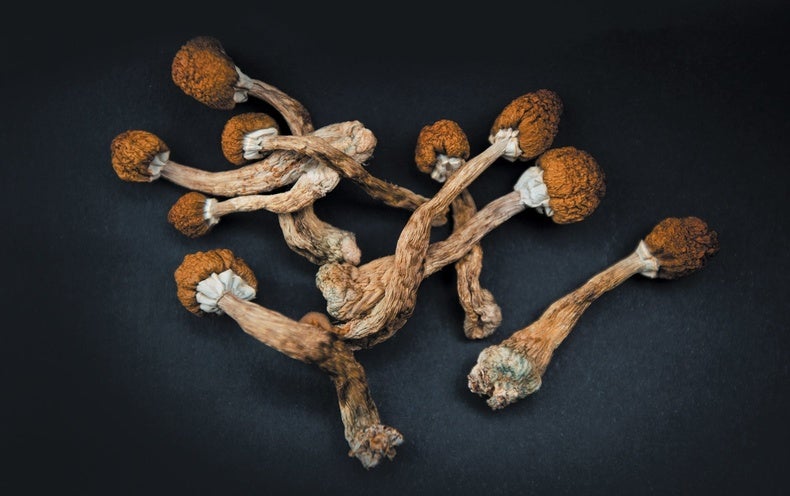
    Magic mushrooms are undergoing a transformation from illicit recreational drug to promising mental health treatment. Numerous studies have reported positive findings using psilocybin—the mushrooms’ main psychoactive compound—for treating depression as well as smoking and alcohol addiction, and for reducing anxiety in the terminally ill. Ongoing and planned studies are testing the drug for conditions that include opioid dependence, PTSD and anorexia nervosa.

    This scientific interest, plus growing social acceptance, is contributing to legal changes in cities across the U.S. In 2020 Oregon passed statewide legislation decriminalizing magic mushrooms, and the state is building a framework for regulating legal therapeutic use—becoming the first jurisdiction in the world to do so. For now psilocybin remains illegal and strictly controlled at the national level in most countries, slowing research. But an international push to get the drug reclassified aims to lower barriers everywhere.

    After a flurry of research in the 1950s and 1960s, psilocybin and all other psychedelics were abruptly banned, partly in response to their embrace by the counterculture. Following the 1971 United Nations Convention on Psychotropic Substances, psilocybin was classed in the U.S. as a Schedule I substance—defined as having “no currently accepted medical use and a high potential for abuse.” Psilocybin production was limited, and a host of administrative and financial burdens effectively ended study for decades. “It’s the worst censorship of research in history,” says David Nutt, a neuropsychopharmacologist at Imperial College London.
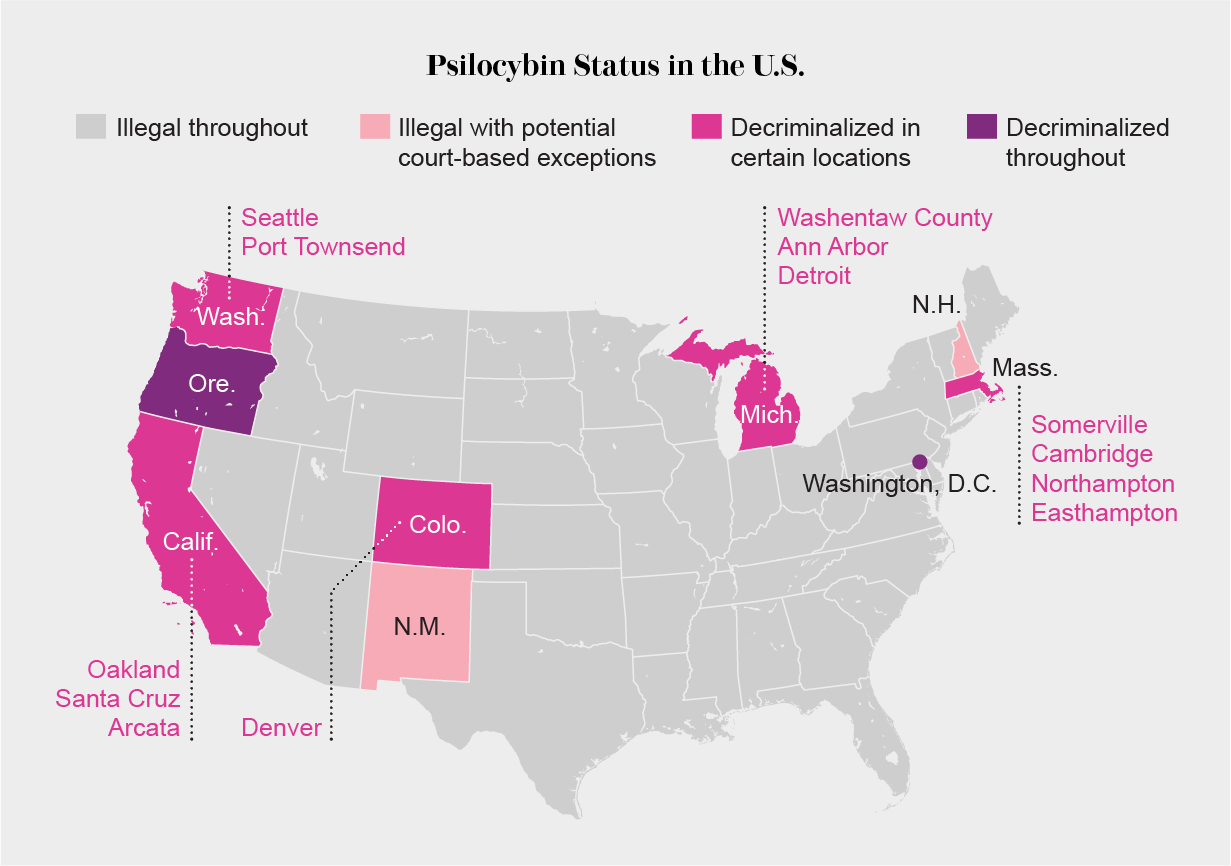
    U.S. map highlights states where psilocybin is decriminalized either throughout, in certain locations, or in special cases.


    Credit: Amanda Montañez

    Despite these legal hurdles, the current research resurgence has seen Nutt and others exploring how psilocybin changes the brain’s connectivity patterns: reducing connections within the usual networks while increasing links between less connected regions. Just this year a study showed that treatment involving psilocybin led to sustained network alterations, which seemed to correlate with reduced depression symptoms. Two organizations are beginning final rounds of trials for psilocybin’s use for depression, which could lead to the substance’s first approval by the U.S. Food and Drug Administration.

    As news of psilocybin’s promise spreads, several U.S. cities have passed measures decriminalizing magic mushrooms. This is not the same as legalization; the molecule and the mushrooms themselves remain illegal, but prosecuting people for their possession or use is deprioritized or discouraged.

    In 2019 Denver voters passed a ballot measure that prohibits using city money to prosecute people for magic mushroom–related offenses. City councils soon took similar steps in Oakland and Santa Cruz in California and in Ann Arbor, Mich. In November 2020 voters in Washington, D.C., passed a ballot measure making natural psychedelics one of law enforcement’s lowest priorities. Cities and counties in Michigan, Massachusetts, California and Washington State have followed suit.

    As part of Oregon’s legislation, the state health authority created a scientific advisory board to recommend regulations for psilocybin service centers, such as designating mushroom species and preparations to use and production standards to follow. These centers, which can apply for licenses starting next January, will not claim to treat depression but will aim to improve general well-being.

    “My worry is that people won’t necessarily get that distinction … and turn up with horrible, treatment-resistant depression, expecting an expert in treating that condition,” says Johns Hopkins University psychiatrist Natalie Gukasyan, who led a recent psilocybin trial.

    Oregon’s advisory board is determining how best to train facilitators and screen clients for risk factors, such as a family history of schizophrenia or bipolar disorder. “All our decisions revolve around consumer safety,” says Oregon State University mycologist Jessie Uehling, who chairs the board’s product subcommittee. “We want to know that we’re avoiding all the potential risks and creating the safest environment for people.” The centers will focus on fungi and natural preparations rather than the synthetic psilocybin used in clinical trials so far, Gukasyan notes.

    Regardless of local decriminalization, U.S. researchers must still abide by federal Schedule I regulations. The International Therapeutic Psilocybin Rescheduling Initiative, a coalition of research and advocacy organizations, aims to get the World Health Organization to conduct a review of the relevant evidence for reclassifying the drug. “It’s inconceivable the WHO could now say psilocybin doesn’t have medical value. It can work where other drugs have not,” Nutt says.

    Various laws already facilitate research and treatment in some countries. Canada classifies magic mushrooms as Schedule III, so penalties are lower, and certain research and trials are granted exceptions. A Canadian charity called TheraPsil has a fast-track process for end-of-life psilocybin therapy.

    Some countries such as Jamaica never made magic mushrooms illegal, although the psilocybin molecule often is. Research is limited in most of these places, but many have thriving “psychedelic retreat” industries that are not medically regulated. The Netherlands has specifically banned the mushrooms—but its laws don’t mention the psilocybin-containing lumps of underground material that eventually sprout them, better known as truffles. This loophole has paved the way for numerous therapeutic retreats, but little organized research.

    Portugal has famously decriminalized all drugs. Some countries ban the mushrooms but not their spores, because the latter do not contain psilocybin. Others simply do not enforce their laws on magic mushrooms.

    The 1971 U.N. treaty has a clause allowing countries to exempt traditional Indigenous uses of psychedelic plants. Indigenous people in some South American countries have used psychedelics for centuries and have fought governments for their right to engage in related ceremonies. There is even a religious organization in New Mexico, the Oratory of Mystical Sacraments, that claims members can legally use magic mushrooms in certain circumstances.

    “This idea that psilocybin is helpful for mental health conditions is not a new one. There are thousands of years of history of efficacious treatment; it’s just in a different knowledge format,” Uehling says. “We’re trying hard here in Oregon to honor that knowledge system.”

    Public perceptions of psilocybin are changing, and as increasing interest generates more evidence, this trend looks set to accelerate. “It’s a thrilling time to be a mycologist,” Uehling says. Many are waiting to see what happens in Oregon, she adds: “Other states will come up with variations on—hopefully—what we get right, and also on what needs to be changed.”


    Original Source Link

    Share. Facebook Twitter Pinterest LinkedIn WhatsApp Email Reddit Telegram
    Previous ArticleAlcarràs review – a joy to watch
    Next Article 12 Best Laptops (2022): MacBooks, Windows, Chromebooks

    RELATED POSTS

    Astronomers Have Detected an Exomoon for the First Time

    August 1, 2026

    Postpartum psychosis is at the center of the Lindsay Clancy trial. What is it?

    August 1, 2026

    The World Is Too Hot. El Niño Is Partly to Blame

    July 31, 2026

    Spacecraft will swarm asteroid Apophis during fateful 2029 Earth flyby

    July 31, 2026

    Tropical Diseases Like Dengue Fever and Chikungunya Are on the Rise in Europe

    July 30, 2026

    Bizarre new material discovered in Hiroshima bombing debris

    July 30, 2026
    latest posts

    Schedule, Time & Full WWE Event Card

    All products and services featured are independently chosen by editors. However, Billboard may receive a…

    A dead SpaceX rocket that’s been adrift for over a year is about to slam into the moon

    August 1, 2026

    Trump Is Under Investigation For Scheme To Sell Insider Access

    August 1, 2026

    ‘American Idol’ winner says husband left law enforcement for tour life

    August 1, 2026

    Apps that help you break free from doomscrolling and get active

    August 1, 2026

    Astronomers Have Detected an Exomoon for the First Time

    August 1, 2026

    10 Movies To Watch If You Love Back To The Future

    August 1, 2026
    Categories
    • Books (1,401)
    • Business (6,305)
    • Events (64)
    • Film (6,241)
    • Lifestyle (4,316)
    • Music (6,364)
    • Politics (6,287)
    • Science (5,658)
    • Technology (6,237)
    • Television (5,931)
    • Uncategorized (8)
    • US News (6,293)
    popular posts

    Tiny Frog (Brachycephalus Brunneus) is Definitely Not Built for Jumping, These Videos Show Why

    Photo credit: Ribeiro et al., (2017)This tiny frog (brachycephalus brunneus), a pumpkin toadlet, just isn’t…

    Planning permission for new 8,500-capacity arena in Edinburgh Park secured by AEG

    June 12, 2024

    Meta’s Reality Labs loses $3.7 billion in third quarter

    October 25, 2023

    Trump Indictments Drain Oxygen From GOP Primary: Ron DeSantis

    December 22, 2023
    Archives
    Browse By Category
    • Books (1,401)
    • Business (6,305)
    • Events (64)
    • Film (6,241)
    • Lifestyle (4,316)
    • Music (6,364)
    • Politics (6,287)
    • Science (5,658)
    • Technology (6,237)
    • Television (5,931)
    • Uncategorized (8)
    • US News (6,293)
    About Us

    We are a creativity led international team with a digital soul. Our work is a custom built by the storytellers and strategists with a flair for exploiting the latest advancements in media and technology.

    Most of all, we stand behind our ideas and believe in creativity as the most powerful force in business.

    What makes us Different

    We care. We collaborate. We do great work. And we do it with a smile, because we’re pretty damn excited to do what we do. If you would like details on what else we can do visit out Contact page.

    Our Picks

    Astronomers Have Detected an Exomoon for the First Time

    August 1, 2026

    10 Movies To Watch If You Love Back To The Future

    August 1, 2026

    ‘The Voice’ Carson Daly Done With Series, Final Episode Revealed

    August 1, 2026
    © 2026 New York Examiner News. All rights reserved. All articles, images, product names, logos, and brands are property of their respective owners. All company, product and service names used in this website are for identification purposes only. Use of these names, logos, and brands does not imply endorsement unless specified. By using this site, you agree to the Terms & Conditions and Privacy Policy.

    Type above and press Enter to search. Press Esc to cancel.

    We use cookies on our website to give you the most relevant experience by remembering your preferences and repeat visits. By clicking “Accept All”, you consent to the use of ALL the cookies. However, you may visit "Cookie Settings" to provide a controlled consent.
    Cookie SettingsAccept All
    Manage consent

    Privacy Overview

    This website uses cookies to improve your experience while you navigate through the website. Out of these, the cookies that are categorized as necessary are stored on your browser as they are essential for the working of basic functionalities of the website. We also use third-party cookies that help us analyze and understand how you use this website. These cookies will be stored in your browser only with your consent. You also have the option to opt-out of these cookies. But opting out of some of these cookies may affect your browsing experience.
    Necessary
    Always Enabled
    Necessary cookies are absolutely essential for the website to function properly. These cookies ensure basic functionalities and security features of the website, anonymously.
    CookieDurationDescription
    cookielawinfo-checkbox-analytics11 monthsThis cookie is set by GDPR Cookie Consent plugin. The cookie is used to store the user consent for the cookies in the category "Analytics".
    cookielawinfo-checkbox-functional11 monthsThe cookie is set by GDPR cookie consent to record the user consent for the cookies in the category "Functional".
    cookielawinfo-checkbox-necessary11 monthsThis cookie is set by GDPR Cookie Consent plugin. The cookies is used to store the user consent for the cookies in the category "Necessary".
    cookielawinfo-checkbox-others11 monthsThis cookie is set by GDPR Cookie Consent plugin. The cookie is used to store the user consent for the cookies in the category "Other.
    cookielawinfo-checkbox-performance11 monthsThis cookie is set by GDPR Cookie Consent plugin. The cookie is used to store the user consent for the cookies in the category "Performance".
    viewed_cookie_policy11 monthsThe cookie is set by the GDPR Cookie Consent plugin and is used to store whether or not user has consented to the use of cookies. It does not store any personal data.
    Functional
    Functional cookies help to perform certain functionalities like sharing the content of the website on social media platforms, collect feedbacks, and other third-party features.
    Performance
    Performance cookies are used to understand and analyze the key performance indexes of the website which helps in delivering a better user experience for the visitors.
    Analytics
    Analytical cookies are used to understand how visitors interact with the website. These cookies help provide information on metrics the number of visitors, bounce rate, traffic source, etc.
    Advertisement
    Advertisement cookies are used to provide visitors with relevant ads and marketing campaigns. These cookies track visitors across websites and collect information to provide customized ads.
    Others
    Other uncategorized cookies are those that are being analyzed and have not been classified into a category as yet.
    SAVE & ACCEPT