

Close Menu
New York Examiner News

    Subscribe to Updates

    Get the latest creative news from FooBar about art, design and business.

    What's Hot

    North West shares teaser of new single with father Kanye, ‘Piercing On My Hand’

    January 17, 2026

    Trump launches trade war vs. NATO after European countries sent troops to Greenland

    January 17, 2026

    'Scourge' of sexual predators, violent criminals being removed from Minneapolis

    January 17, 2026
    Facebook X (Twitter) Instagram
    New York Examiner News
    • Home
    • US News
    • Politics
    • Business
    • Science
    • Technology
    • Lifestyle
    • Music
    • Television
    • Film
    • Books
    • Contact
      • About
      • Amazon Disclaimer
      • DMCA / Copyrights Disclaimer
      • Terms and Conditions
      • Privacy Policy
    New York Examiner News
    Home»Science»Rising Temperatures Boost Sugar Consumption, Raising Health Concerns
    Science

    Rising Temperatures Boost Sugar Consumption, Raising Health Concerns

    By AdminSeptember 9, 2025
    Facebook Twitter Pinterest LinkedIn WhatsApp Email Reddit Telegram
    Rising Temperatures Boost Sugar Consumption, Raising Health Concerns


    September 8, 2025

    3 min read

    Rising Temperatures Lead to A Spike in Sugar Consumption

    Warmer temperatures are associated with higher consumption of sugary beverages and frozen treats, raising concerns about long-term health effects

    By Andrea Thompson edited by Dean Visser

    A child holds and sips from a glass full of fizzy cola in a sunny room

    Catherine Falls Commercial/Getty Images

    When the heat sets in, the siren song of the ice cream truck begins to drift through the air, and lemonade stands run by enterprising neighborhood children pop up along sidewalks. These sweet treats are often synonymous with summer, and a new study has found that sugar consumption in the U.S. rises noticeably as temperatures climb. The increase is particularly apparent among certain groups of people and raises concerns over the health implications as the climate continues to heat up.

    Much of the research on global warming and food to date has looked at how changes in the climate affect, for example, crop yields or the nutritional content of food or at how food production and consumption contribute to greenhouse gas emissions. Pan He, an environmental scientist at Cardiff University in Wales, hit on the idea to look at the inverse relationship: how rising temperatures affect food consumption. She and her colleagues decided to focus on sugar because its overconsumption is a known problem in the U.S. and is linked to diabetes, heart disease and certain kinds of cancer.

    The researchers paired temperature data with a unique dataset that showed household grocery purchases around the U.S. from 2004 to 2019 and used purchases as a proxy for consumption. They found little difference in consumption below 12 degrees Celsius (about 54 degrees Fahrenheit). But between that temperature and 30 degrees C (86 degrees F), something happened: consumption increased by 0.7 gram per degree C. There was a slowdown above 30 degrees C, which the study authors posit could be related to extreme heat often suppressing appetite.


    On supporting science journalism

    If you’re enjoying this article, consider supporting our award-winning journalism by subscribing. By purchasing a subscription you are helping to ensure the future of impactful stories about the discoveries and ideas shaping our world today.


    Most of the overall increase came from beverages with added sugar, such as sodas or fruit drinks, as opposed to 100 percent juice. Frozen desserts such as ice cream or popsicles made a smaller contribution. There was a slight decrease in the consumption of sugary foods such as cakes or cookies, which suggests people may be substituting chilled treats for other options.

    Bar chart shows change in added sugar consumption for each two-degree increment, from 0 to more than 34 degrees Celsius. Three more charts show the equivalent values for specific product types: beverages; frozen desserts; and baked goods, oils and sugar products.

    The increase is concerning because the average recommended daily sugar intake for a 2,400-calorie diet is about 60 grams—and a single can of soda can have around 40. (The American Heart Association recommends even lower limits of sugar intake each day: 24 grams for women and 36 grams for men.)

    There were noticeable differences in consumption patterns, though. People with higher levels of income or educational attainment showed very little change in sugar consumption as temperatures rose compared with those with lower incomes or less formal education. “The difference can be up to more than five times,” says study co-author Duo Chan, a climate scientist at the University of Southampton in England. “So this is a drastic difference, and I believe this should raise some concerns and awareness among society.”
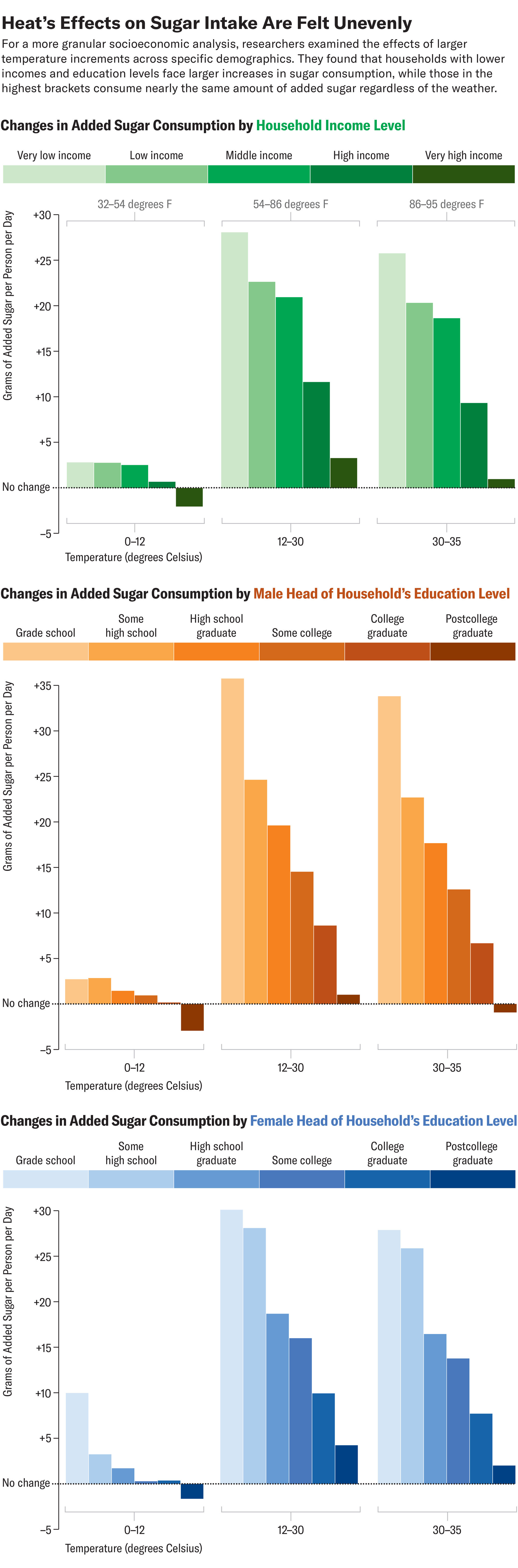
    Bar charts shows change in added sugar consumption for specific temperature increments across different household income levels and education levels of male and female heads of household.

    The difference could be linked to a number of factors: Those with higher incomes often have more reliable access to safely drinkable tap water. They tend to work in indoor environments, where air-conditioning may mean there is less need to stay hydrated. And they may be more aware of the potential health consequences of high sugar consumption.

    The researchers projected that, without any interventions, sugar consumption in the U.S. will continue to rise as human-caused warming continues.

    Besides addressing the root causes of climate change, ways to tackle this problem could include increasing nutritional education, requiring sugar content to be more prominently labeled on packaging or instituting an added sugar tax. Such a tax already exists in the U.K., and “you see a very, very significant difference” in the price of regular versus diet soda, Chan says. Other strategies could also tackle two problems at once: for example, requiring accessible drinking water and breaks at outdoor workplaces such as farms or construction sites could lower the consumption of sugary beverages—as well as the general risk of heat-related illness.

    Alice Lichtenstein, a nutrition scientist at Tufts University, who wasn’t involved with the new study, says she would like to see more research into how the accessibility and pricing of such beverages compare with those of water for disadvantaged groups in attempt to come up with possible interventions. “We need to understand more about what the behavioral triggers are for making negative health-related decisions, such as increased sugar-sweetened beverage intake in hot weather,” she says, “and use that information to design strategies to mitigate the behaviors.”

    It’s Time to Stand Up for Science

    If you enjoyed this article, I’d like to ask for your support. Scientific American has served as an advocate for science and industry for 180 years, and right now may be the most critical moment in that two-century history.

    I’ve been a Scientific American subscriber since I was 12 years old, and it helped shape the way I look at the world. SciAm always educates and delights me, and inspires a sense of awe for our vast, beautiful universe. I hope it does that for you, too.

    If you subscribe to Scientific American, you help ensure that our coverage is centered on meaningful research and discovery; that we have the resources to report on the decisions that threaten labs across the U.S.; and that we support both budding and working scientists at a time when the value of science itself too often goes unrecognized.

    In return, you get essential news, captivating podcasts, brilliant infographics, can’t-miss newsletters, must-watch videos, challenging games, and the science world’s best writing and reporting. You can even gift someone a subscription.

    There has never been a more important time for us to stand up and show why science matters. I hope you’ll support us in that mission.


    Original Source Link

    Share. Facebook Twitter Pinterest LinkedIn WhatsApp Email Reddit Telegram
    Previous ArticleThe Christophers – first-look review
    Next Article Hasan Piker Will Never Run for Office

    RELATED POSTS

    How Does the Hive Mind Work in ‘Pluribus?

    January 17, 2026

    RFK, Jr., shifts focus to questioning whether cell phones are safe. Here’s what the science says

    January 17, 2026

    Meat may play an unexpected role in helping people reach 100

    January 16, 2026

    OpenAI Invests in Sam Altman’s New Brain-Tech Startup Merge Labs

    January 16, 2026

    Americans Overwhelmingly Support Science, but Some Think the U.S. Is Lagging Behind: Pew

    January 15, 2026

    Woolly rhino genome recovered from meat in frozen wolf pup’s stomach

    January 15, 2026
    latest posts

    North West shares teaser of new single with father Kanye, ‘Piercing On My Hand’

    North West has shared a teaser of a new collaborative single with her father Kanye West – check…

    Trump launches trade war vs. NATO after European countries sent troops to Greenland

    January 17, 2026

    'Scourge' of sexual predators, violent criminals being removed from Minneapolis

    January 17, 2026

    Chris D’Elia calls comedians ‘spineless’ following sexual misconduct allegations

    January 17, 2026

    Reddit Has Thoughts on Paris Hilton Cookware. So Do We

    January 17, 2026

    How Does the Hive Mind Work in ‘Pluribus?

    January 17, 2026

    The Uncertain Future Of The 4-Part Western Epic

    January 17, 2026
    Categories
    • Books (1,007)
    • Business (5,912)
    • Events (29)
    • Film (5,848)
    • Lifestyle (3,958)
    • Music (5,949)
    • Politics (5,913)
    • Science (5,263)
    • Technology (5,842)
    • Television (5,526)
    • Uncategorized (6)
    • US News (5,900)
    popular posts

    Mysterious ‘Retron’ DNA Helps Scientists Edit Human Genes

    Deep in a bacterium’s gelatinous matrix dwell little “cellular machines” called retrons, which produce single…

    Sam Heughan Teases That He Sang to Celine Dion for Upcoming Film – Billboard

    June 9, 2022

    Lunar eclipse 2023: What time is the October Blood moon partial eclipse?

    October 26, 2023

    ‘Law & Order’ Season 22: ‘Supergirl’s Mehcad Brooks Joins Cast

    June 14, 2022
    Archives
    Browse By Category
    • Books (1,007)
    • Business (5,912)
    • Events (29)
    • Film (5,848)
    • Lifestyle (3,958)
    • Music (5,949)
    • Politics (5,913)
    • Science (5,263)
    • Technology (5,842)
    • Television (5,526)
    • Uncategorized (6)
    • US News (5,900)
    About Us

    We are a creativity led international team with a digital soul. Our work is a custom built by the storytellers and strategists with a flair for exploiting the latest advancements in media and technology.

    Most of all, we stand behind our ideas and believe in creativity as the most powerful force in business.

    What makes us Different

    We care. We collaborate. We do great work. And we do it with a smile, because we’re pretty damn excited to do what we do. If you would like details on what else we can do visit out Contact page.

    Our Picks

    How Does the Hive Mind Work in ‘Pluribus?

    January 17, 2026

    The Uncertain Future Of The 4-Part Western Epic

    January 17, 2026

    Where Can You Watch Betty White’s Classic TV Shows?

    January 17, 2026
    © 2026 New York Examiner News. All rights reserved. All articles, images, product names, logos, and brands are property of their respective owners. All company, product and service names used in this website are for identification purposes only. Use of these names, logos, and brands does not imply endorsement unless specified. By using this site, you agree to the Terms & Conditions and Privacy Policy.

    Type above and press Enter to search. Press Esc to cancel.

    We use cookies on our website to give you the most relevant experience by remembering your preferences and repeat visits. By clicking “Accept All”, you consent to the use of ALL the cookies. However, you may visit "Cookie Settings" to provide a controlled consent.
    Cookie SettingsAccept All
    Manage consent

    Privacy Overview

    This website uses cookies to improve your experience while you navigate through the website. Out of these, the cookies that are categorized as necessary are stored on your browser as they are essential for the working of basic functionalities of the website. We also use third-party cookies that help us analyze and understand how you use this website. These cookies will be stored in your browser only with your consent. You also have the option to opt-out of these cookies. But opting out of some of these cookies may affect your browsing experience.
    Necessary
    Always Enabled
    Necessary cookies are absolutely essential for the website to function properly. These cookies ensure basic functionalities and security features of the website, anonymously.
    CookieDurationDescription
    cookielawinfo-checkbox-analytics11 monthsThis cookie is set by GDPR Cookie Consent plugin. The cookie is used to store the user consent for the cookies in the category "Analytics".
    cookielawinfo-checkbox-functional11 monthsThe cookie is set by GDPR cookie consent to record the user consent for the cookies in the category "Functional".
    cookielawinfo-checkbox-necessary11 monthsThis cookie is set by GDPR Cookie Consent plugin. The cookies is used to store the user consent for the cookies in the category "Necessary".
    cookielawinfo-checkbox-others11 monthsThis cookie is set by GDPR Cookie Consent plugin. The cookie is used to store the user consent for the cookies in the category "Other.
    cookielawinfo-checkbox-performance11 monthsThis cookie is set by GDPR Cookie Consent plugin. The cookie is used to store the user consent for the cookies in the category "Performance".
    viewed_cookie_policy11 monthsThe cookie is set by the GDPR Cookie Consent plugin and is used to store whether or not user has consented to the use of cookies. It does not store any personal data.
    Functional
    Functional cookies help to perform certain functionalities like sharing the content of the website on social media platforms, collect feedbacks, and other third-party features.
    Performance
    Performance cookies are used to understand and analyze the key performance indexes of the website which helps in delivering a better user experience for the visitors.
    Analytics
    Analytical cookies are used to understand how visitors interact with the website. These cookies help provide information on metrics the number of visitors, bounce rate, traffic source, etc.
    Advertisement
    Advertisement cookies are used to provide visitors with relevant ads and marketing campaigns. These cookies track visitors across websites and collect information to provide customized ads.
    Others
    Other uncategorized cookies are those that are being analyzed and have not been classified into a category as yet.
    SAVE & ACCEPT