
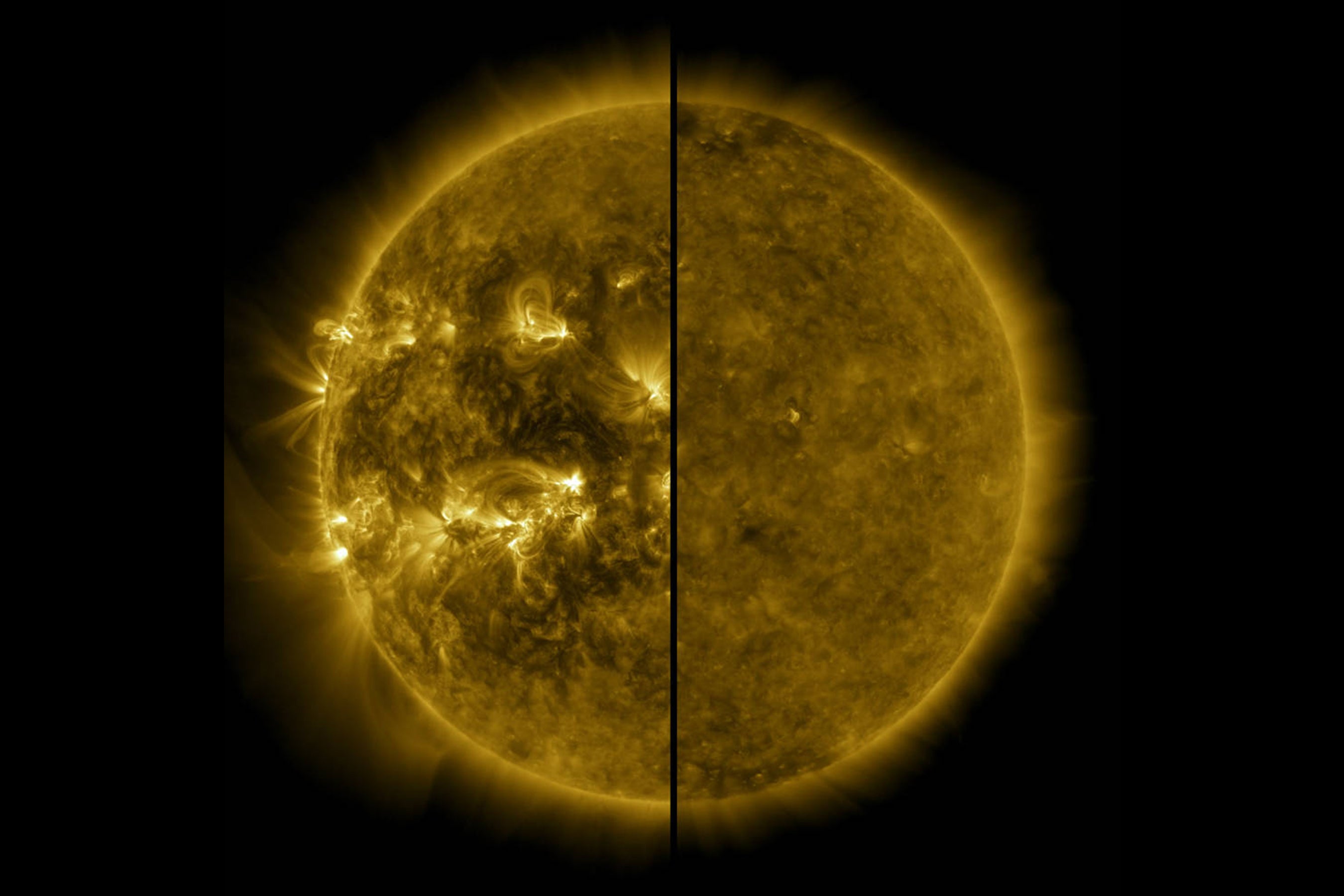
From a distance, the sun may seem calm and steady. But zoom in, and our home star is actually in a perpetual state of flux, transforming over time from a uniform sea of fire to a chaotic jumble of warped plasma and back again in a recurring cycle.
Every 11 years or so, the sun’s magnetic field gets tangled up like a ball of tightly wound rubber bands until it eventually snaps and completely flips — turning the north pole into the south pole and vice versa. In the lead-up to this gargantuan reversal, the sun amps up its activity: belching out fiery blobs of plasma, growing dark planet-size spots and emitting streams of powerful radiation.
This period of increased activity, known as solar maximum, is also a potentially perilous time for Earth, which gets bombarded by solar storms that can disrupt communications, damage power infrastructure, harm some living creatures (including astronauts) and send satellites plummeting toward the planet.
And some scientists think the next solar maximum may be coming sooner — and be much more powerful — than we thought.
Originally, scientists predicted that the current solar cycle would peak in 2025. But a bumper crop of sunspots, solar storms and rare solar phenomena suggest solar maximum could arrive by the end of this year at the earliest — and several experts told Live Science we are poorly prepared.
Related: 10 signs the sun is gearing up for its explosive peak — the solar maximum
What causes the solar cycle?
Approximately every 11 years, the sun goes from a low point in solar activity, known as solar minimum, to solar maximum and back again. It’s not clear exactly why the sun’s cycles last this long, but astronomers have noted the pattern ever since the first, aptly named Solar Cycle 1, which occurred between 1755 and 1766. The current cycle, Solar Cycle 25, officially began in December 2019, according to NASA.
So what causes our home star’s fluctuation? “It all comes down to the sun’s magnetic field,” Alex James, a solar physicist at University College London in the U.K., told Live Science.
At solar minimum, the sun’s magnetic field is strong and organized, with two clear poles like a normal dipole magnet, James said. The magnetic field acts as a “giant forcefield” that contains the sun’s superheated plasma, or ionized gas, close to the surface, suppressing solar activity, he added.
But the magnetic field slowly gets tangled, with some regions becoming more magnetized than others, James said. As a result, the sun’s magnetic field gradually weakens, and solar activity begins to ramp up: Plasma rises from the star’s surface and forms massive magnetized horseshoes, known as coronal loops, that pepper the sun’s lower atmosphere. These fiery ribbons can then snap as the sun’s magnetic field realigns, releasing bright flashes of light and radiation, known as solar flares. Sometimes, flares also bring enormous, magnetized clouds of fast-moving particles, known as coronal mass ejections (CMEs).
A few years after the maximum, the sun’s magnetic field “snaps” and then completely flips. This ushers in the end of the cycle and the beginning of a new solar minimum, James said.
Related: Could a solar storm ever destroy Earth?
To determine where we are in the solar cycle, researchers monitor sunspots — darker, cooler, circular patches of our local star’s surface where coronal loops form.
“Sunspots appear when strong magnetic fields poke through the surface of the sun,” James said. “By looking at those sunspots we can get an idea of how strong and complex the sun’s magnetic field is at that moment.”
Sunspots are almost completely absent at solar minimum and increase in numbers until a peak at solar maximum, but there’s a lot of variation from cycle to cycle.
“Every cycle is different,” James said.
Solar Cycle 25
In April 2019, the Solar Cycle 25 Prediction Panel, which is made up of dozens of scientists from NASA and the National Oceanic and Atmospheric Administration (NOAA), released its forecast for Solar Cycle 25, suggesting that the solar maximum would likely begin sometime in 2025 and would be comparable in size to the maximum of Solar Cycle 24, which peaked unusually late between mid-2014 and early 2016 and was quite weak compared with past solar maximums.
But from the beginning, the forecast seemed off. For instance, the number of observed sunspots has been much higher than predicted.
In December 2022, the sun reached an eight-year sunspot peak. And in January 2023, scientists observed more than twice as many sunspots as NASA had predicted (143 observed versus 63 estimated), with the numbers staying nearly as high over the following months. In total, the number of observed sunspots has exceeded the predicted number for 27 months in a row.
While the bounty of sunspots is a major red flag, they are not the only evidence solar maximum could be here soon.
Another key indicator of solar activity is the number and intensity of solar flares. In 2022, there were fivefold more C-class and M-class solar flares than there were in 2021, and year on year, the number of the most powerful, X-class solar flares is also increasing, according to SpaceWeatherLive.com. The first half of 2023 logged more X-class flares than in all of 2022, and at least one has directly hit Earth. (Solar flare classes include A, B, C, M and X, with each class being at least 10 times more powerful than the previous one.)
Related: 10 solar storms that blew us away in 2022
Solar flares can also bring geomagnetic storms — major disturbances of Earth’s magnetosphere caused by solar wind or CMEs. For instance, on March 24, a “stealth” CME hit Earth without warning and triggered the most powerful geomagnetic storm in more than six years, which created vast auroras, or northern lights, that were visible in more than 30 U.S. states. An overall increase in the number of geomagnetic storms this year has also caused the temperature in the thermosphere — the second-highest layer of Earth’s atmosphere ― to reach a 20-year peak.
Rare solar phenomena also become increasingly common near solar maximum — and several have happened in recent months. On March 9, a 60,000-mile-tall (96,560 kilometers) plasma waterfall rose above and then fell back towards the sun; on Feb. 2 an enormous polar vortex, or ring of fire, swirled around the sun’s north pole for more than 8 hours; and in March, a “solar tornado” raged for three days and stood taller than 14 Earths stacked on top of each other.
All this evidence suggests that the solar maximum is “going to peak earlier and it’s going to peak higher than expected,” James told Live Science. This opinion is shared by many other solar physicists, experts told Live Science.
The exact start to solar maximum will likely only be obvious once it has passed and solar activity decreases. However, one research group led by Scott McIntosh, a solar physicist and deputy director of the National Center for Atmospheric Research in Colorado, has predicted the solar maximum could peak later this year.
Past cycles suggest the solar maximum may last for somewhere between one and two years, though scientists don’t know for sure.
Potential impacts on Earth
So, the solar maximum may be coming on stronger and sooner than we anticipated. Why does that matter?
The answer primarily depends on whether solar storms barrel into Earth, Tzu-Wei Fang, a researcher at NOAA’s Space Weather Prediction Center who was not part of the Solar Cycle 25 Prediction Panel, told Live Science. To hit Earth, solar storms must be pointing in the right direction at the right time. Increases in solar activity make this more likely but don’t guarantee the planet will be slammed with more storms, she added.
But if a solar storm does hit, it can ionize Earth’s upper atmosphere and fuel radio and satellite blackouts. Big storms that block the planet’s connections to satellites can temporarily wipe out long-range radio and GPS systems for up to half the planet, Fang said. On its own, that is just a minor inconvenience, but if a lengthy blackout coincided with a major disaster, such as an earthquake or tsunami, the results could be catastrophic, she added.
Strong solar storms can also generate ground-based electrical currents that can damage metallic infrastructure, including older power grids and rail lines, Fang said.
Airplane passengers may also be walloped by higher levels of radiation during solar storms, although it’s not clear if the doses would be high enough to have any health impacts, Fang said. However, such spikes in radiation would be much more significant for astronauts onboard spacecraft, such as the International Space Station or the upcoming Artemis mission to the moon. As a result, “future missions should factor solar cycles into consideration,” she added.
Related: Could a powerful solar storm wipe out the internet?
Past research has also revealed that geomagnetic storms can disrupt the migrations of gray whales and other animals that rely on the Earth’s magnetic field lines to navigate, such as sea turtles and some birds, which can have disastrous consequences.
An ionized upper atmosphere also becomes denser, which can create additional drag for Earth-orbiting satellites. This extra drag can push satellites into each other or force them out of orbit. For instance, In February 2022, 40 of SpaceX’s Starlink satellites burned up in Earth’s atmosphere when they plummeted to Earth during a geomagnetic storm the day after they were launched.
And the number of satellites has exponentially increased compared with past solar cycles, Fang said. Most are operated by commercial companies that rarely factor space weather into satellite design or launch schedules, she added.
“Companies want to launch satellites as soon as they can to make sure they don’t delay rocket launches,” Fang said. “Sometimes it’s better for them to launch a group and lose half than not launch at all.” This all raises the risks of major collisions or deorbiting satellites during the solar maximum, she added.
The chances of a once-in-a-century superstorm, such as the Carrington Event in 1859, also slightly increase during solar maximum, Fang said. While a long shot, such a storm could cause trillions of dollars’ worth of damage and majorly impact everyday life, she added.
Humans can do little to shield ourselves from a direct solar storm hit, but we can prepare for them by altering satellite trajectories, grounding planes and identifying vulnerable infrastructure, Fang said. As a result, more accurate solar weather forecasts are needed to help us prepare for the worst, she added
Why were the forecasts wrong?
If so many clues point to solar maximum being stronger and earlier than predicted, why didn’t scientists see it coming? Part of the problem is the way the prediction panels come up with their forecasts, Scott McIntosh told Live Science.
NASA and NOAA’s models have barely changed in the last 30 years, “but the science has,” McIntosh said. The models use data from past solar cycles such as sunspot number and cycle length, but do not fully account for each cycle’s individual progression, he added.
Related: When will the sun explode?
“It’s kind of like a big game of pin the tail on the donkey,” McIntosh said, where the “donkey” is the upcoming solar maximum and the prediction panel has blindfolded themselves by not using all available methods at their disposal.
McIntosh and colleagues have proposed an alternative way to predict the strength of an upcoming solar maximum: so-called “solar terminators,” which occur right at the end of each solar minimum after the sun’s magnetic field has already flipped.
During solar minimum, a localized magnetic field, which is left behind from the sun’s magnetic-field flip, surrounds the sun’s equator. This localized field prevents the sun’s main magnetic field from growing stronger and getting tangled up, meaning the localized field essentially acts like a handbrake preventing solar activity from increasing.
But suddenly and without warning, this localized field disappears, releasing the brake and enabling solar activity to ramp up. This drastic change is what the team dubbed solar cycle termination events, or terminators. (Because solar terminators occur at the exact moment solar minimums end, they occur after each solar cycle has officially begun.)
Looking back over centuries of data, the team identified 14 individual solar terminators that preceded the start of solar maximums. The researchers noticed that the timing of these terminators correlates with the strength of the subsequent solar peaks. (The early years of data are sparse, so the team couldn’t identify solar terminators in every cycle.)
For example, the terminator at the start of Solar Cycle 24 happened later than expected, which allowed for less magnetic field growth during Solar Cycle 24, resulting in a weaker solar maximum. But the terminator at the start of Solar Cycle 25, which occurred on Dec. 13, 2021, was earlier than expected, which the researchers took as a sign that the solar maximum would be stronger than the previous one. Ever since the 2021 terminator, solar activity has been ramping up faster than expected.
The way Solar Cycle 25 is progressing suggests that solar terminators could be the best way of predicting future solar cycles, McIntosh said. In July 2022, NASA acknowledged the work done by McIntosh and colleagues and noted that solar activity seemed to be ramping up sooner than expected.
Still, NASA hasn’t updated its 2025 forecast in light of McIntosh’s data and is probably not going to incorporate terminators into future forecasts, McIntosh predicted. “I think they will just stick with their models.”
Copyright 2023 LiveScience, a Future company. All rights reserved. This material may not be published, broadcast, rewritten or redistributed.