
Close Menu
New York Examiner News

    Subscribe to Updates

    Get the latest creative news from FooBar about art, design and business.

    What's Hot

    North West shares teaser of new single with father Kanye, ‘Piercing On My Hand’

    January 17, 2026

    Trump launches trade war vs. NATO after European countries sent troops to Greenland

    January 17, 2026

    'Scourge' of sexual predators, violent criminals being removed from Minneapolis

    January 17, 2026
    Facebook X (Twitter) Instagram
    New York Examiner News
    • Home
    • US News
    • Politics
    • Business
    • Science
    • Technology
    • Lifestyle
    • Music
    • Television
    • Film
    • Books
    • Contact
      • About
      • Amazon Disclaimer
      • DMCA / Copyrights Disclaimer
      • Terms and Conditions
      • Privacy Policy
    New York Examiner News
    Home»Science»The Arctic Is Warming Four Times Faster Than the Rest of the Planet
    Science

    The Arctic Is Warming Four Times Faster Than the Rest of the Planet

    By AdminAugust 13, 2022
    Facebook Twitter Pinterest LinkedIn WhatsApp Email Reddit Telegram
    The Arctic Is Warming Four Times Faster Than the Rest of the Planet


    CLIMATEWIRE | One study after another is coming to the same conclusion about the rapidly warming Arctic: It’s heating up a lot faster than earlier research suggested.

    The latest figures indicate that the planet’s northernmost region is warming a whopping four times faster than the Earth as a whole.

    That’s a significant update compared to earlier estimates.

    Scientists have known for years that the Arctic is warming faster than the rest of the planet, a phenomenon known as “Arctic amplification.” But until recently, both scientific papers and news reports have typically reported that temperatures there are rising at about two to three times the global average rate.

    A new study, just out yesterday in the journal Communications Earth & Environment, is the latest to weigh in. It finds that the Arctic Circle — the area located above 66.5 degrees latitude — has warmed by more than 5 degrees Fahrenheit since 1979.

    In all, the study concludes, the Arctic has warmed at about four times the global average rate over the last 43 years.

    “Of course everyone knows that … the Arctic warms faster than the rest of the globe,” said Alexey Karpechko, a scientist at the Finnish Meteorological Institute and a co-author of the new study. “But I think the number — nearly four times that we found now — is simply quite impressive.”

    It’s one of several recent studies that have all come to similar conclusions.

    A separate group of scientists presented research at the annual meeting of the American Geophysical Union last December with similar findings. And just in June, another study by a different research team also cited a four-times Arctic warming figure (Climatewire, July 11).

    The main reason for the update is simple: more data. The rate of Arctic warming has accelerated over time. Older studies relying on earlier time periods may not have fully captured the scale of recent warming.

    The study published last month, for instance, found that Arctic warming has increased in uneven jumps over the last few decades. It spiked sharply in the mid-1980s and then again around 1999.

    “Arctic amplification was not constant — it really changed in individual decades after 1970,” said Petr Chylek, a researcher at Los Alamos National Laboratory and lead author of the study.

    The latest acceleration over the last two decades helped push the Arctic warming rate up to around four times the global average, the study suggests.

    The newest study also suggests the rate of Arctic warming varies by season and by geography. It tends to be strongest in the autumn. And it’s also higher above the Arctic Circle. Studies looking at broader geographic regions may find slightly lower warming rates.

    All of this means that previous studies citing lower Arctic warming rates weren’t necessarily wrong. They just used earlier datasets or different geographic boundaries.

    Mark Serreze, director of the National Snow and Ice Data Center, says he’s often reluctant to “pin a number” on Arctic warming at all. The exact figure is a mutable thing, shifting with different time periods and geographic areas.

    Serreze wasn’t involved with the most recent studies, but has researched Arctic warming rates in the past. What’s most important is that the Arctic is warming significantly faster than the rest of the planet as a whole, he says, regardless of the exact number any individual study points to.

    “When I see all these numbers coming up there — whether it’s twice as fast as the globe as a whole, three times, four times — I take it with a little bit of a grain of salt,” he said. “That it is warming at an outsized rate, there is no doubt about it.”

    ‘Not a simple thing’

    So why is the Arctic warming so much faster than the rest of the globe? It’s a matter of physics.

    Various physical processes are helping rapidly raise temperatures at the top of the world. Melting ice is among the most important.

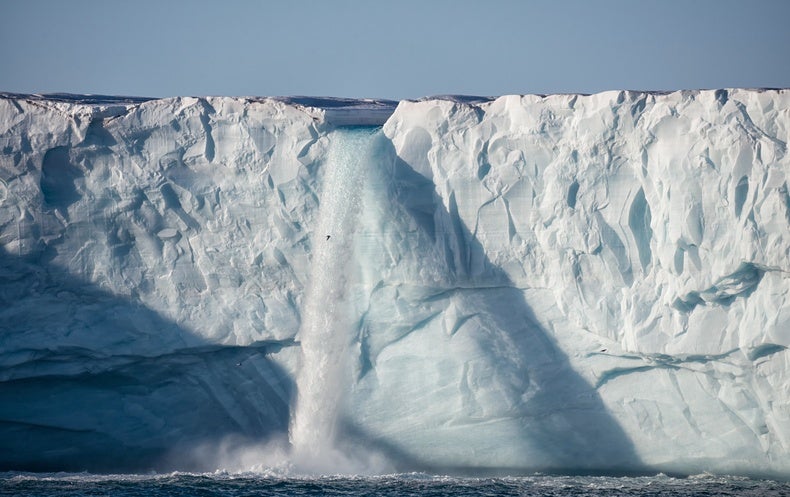
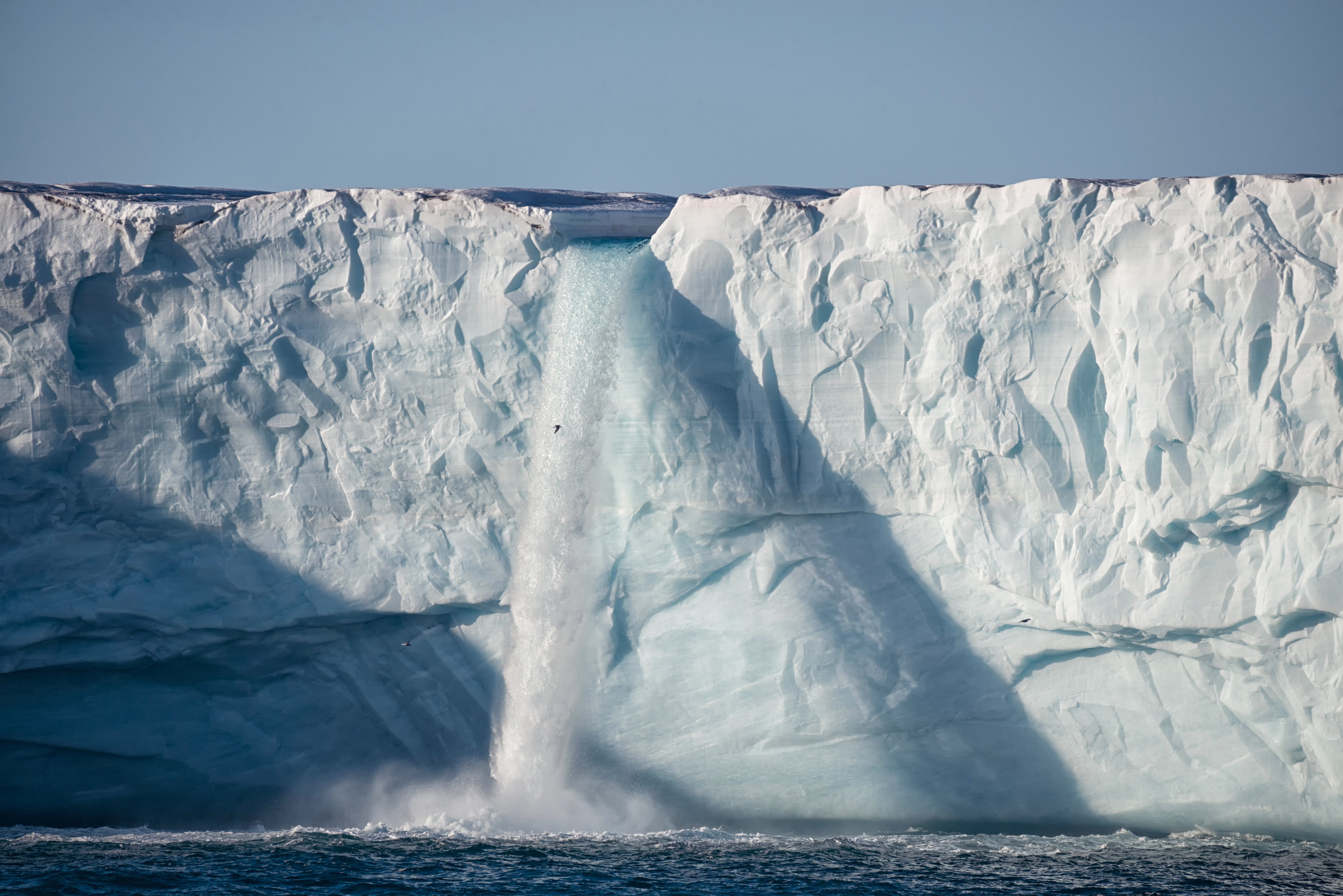
    Much of the Arctic Ocean is covered with a layer of sparkling sea ice. But the sea ice is steadily shrinking as the planet warms — in fact, it’s been declining for decades now. As it disappears, it exposes more of the ocean surface, allowing heat to escape from the warmer water into the colder atmosphere.

    It’s a kind of feedback process, raising Arctic temperatures faster and faster as more ice vanishes from the sea.

    At the same time, the atmosphere itself is changing in a number of ways as the planet heats up. Some of these changes are altering the ways that heat flows north from the warm equator, affecting Arctic temperatures. These changes can, in turn, affect the speed at which Arctic sea ice melts.

    It’s a complicated web of physical mechanisms that all relate to one another, according to Serreze of the National Snow and Ice Data Center.

    “The moral of the story is that Arctic amplification is not a simple thing,” he said.

    It’s also not likely to last forever.

    Some of the feedback processes driving rapid Arctic warming may taper off. Melting sea ice is a prime example.

    Large areas of ice are still disappearing and contributing to the Arctic’s swiftly rising temperatures. But eventually, enough ice will vanish that the feedback process will naturally slow down.

    “It’s very unlikely that this large Arctic amplification will last for long,” Karpechko said. “Definitely by midcentury we should get lower values, because by that time, we have already lost quite a lot of sea ice.”

    If Arctic amplification does slow down in the future, it’s not exactly a cause for celebration. The Arctic region will have fundamentally changed and temperatures will have already risen dramatically. The region will also likely continue on warming — just, perhaps, not at four times the global average.

    As Serreze bluntly put it: “What it really means is that it’s freakin’ warm.”

    Models versus observations

    Scientists use model simulations to make projections about the future of Arctic climate change. And some climate models do suggest that Arctic amplification is likely to slow as sea ice continues to decline.

    But there’s a catch: Models, on the whole, might not be completely capturing the scale of Arctic warming or all the processes driving it.

    This week’s study finds that climate models tend to underestimate the rate of Arctic warming. It’s still unclear why — but there are a few possible explanations.

    It could be that natural climate fluctuations are working alongside the influence of greenhouse gases and human-caused climate change, causing the Arctic’s temperatures to temporarily climb faster than the models predict they should be rising.

    Or it could be that the models aren’t capturing some physical process contributing to Arctic amplification. That’s Karpechko’s theory — and if it’s right, it means more research and future improvements to climate models could help solve the problem.

    The study “highlights the importance of comparing observations and climate models using a systematic approach to identify ways in which our climate models can be improved,” said Karen Smith, a climate scientist at the University of Toronto, in an email to E&E News. Smith wasn’t involved with the new study, but has researched Arctic amplification in the past.

    Improving model simulations of Arctic climate change is important, experts say. They help scientists predict not only the future of the Arctic, but the rest of the world, too.

    Human communities and natural ecosystems in the Arctic will be strongly affected by future warming. And studies suggest that Arctic warming may affect weather and climate patterns elsewhere around the globe. It’s important to make sure model projections aren’t underestimating those effects.

    “From the Arctic, we can learn what may be waiting for the globe in the next couple decades,” said Chylek, the Los Alamos researcher. “So there’s a reason why everybody is looking into the Arctic.”

    Reprinted from E&E News with permission from POLITICO, LLC. Copyright 2022. E&E News provides essential news for energy and environment professionals.


    Original Source Link

    Share. Facebook Twitter Pinterest LinkedIn WhatsApp Email Reddit Telegram
    Previous ArticleTaylor Swift, Kendrick Lamar Eligible for Best Live Action Short Oscar – The Hollywood Reporter
    Next Article A Single Flaw Broke Every Layer of Security in MacOS

    RELATED POSTS

    How Does the Hive Mind Work in ‘Pluribus?

    January 17, 2026

    RFK, Jr., shifts focus to questioning whether cell phones are safe. Here’s what the science says

    January 17, 2026

    Meat may play an unexpected role in helping people reach 100

    January 16, 2026

    OpenAI Invests in Sam Altman’s New Brain-Tech Startup Merge Labs

    January 16, 2026

    Americans Overwhelmingly Support Science, but Some Think the U.S. Is Lagging Behind: Pew

    January 15, 2026

    Woolly rhino genome recovered from meat in frozen wolf pup’s stomach

    January 15, 2026
    latest posts

    North West shares teaser of new single with father Kanye, ‘Piercing On My Hand’

    North West has shared a teaser of a new collaborative single with her father Kanye West – check…

    Trump launches trade war vs. NATO after European countries sent troops to Greenland

    January 17, 2026

    'Scourge' of sexual predators, violent criminals being removed from Minneapolis

    January 17, 2026

    Chris D’Elia calls comedians ‘spineless’ following sexual misconduct allegations

    January 17, 2026

    Reddit Has Thoughts on Paris Hilton Cookware. So Do We

    January 17, 2026

    How Does the Hive Mind Work in ‘Pluribus?

    January 17, 2026

    The Uncertain Future Of The 4-Part Western Epic

    January 17, 2026
    Categories
    • Books (1,007)
    • Business (5,912)
    • Events (29)
    • Film (5,848)
    • Lifestyle (3,958)
    • Music (5,949)
    • Politics (5,913)
    • Science (5,263)
    • Technology (5,842)
    • Television (5,526)
    • Uncategorized (6)
    • US News (5,900)
    popular posts

    BMG Names Global Synch Head, Live Nation Hires Regulatory EVP & More – Billboard

    Allegra Willis Knerr was promoted to executive vp of global synch licensing at BMG, where…

    Carbon-Rich Peat Is Disappearing. But Is It Also Growing?

    May 18, 2022

    Ranking the Success of Saved Shows: ‘Magnum P.I.’ ‘Manifest,’ ‘B99,’ & More

    July 7, 2022

    Jared Padalecki Exits, Camden Spinoff Possibility

    December 7, 2024
    Archives
    Browse By Category
    • Books (1,007)
    • Business (5,912)
    • Events (29)
    • Film (5,848)
    • Lifestyle (3,958)
    • Music (5,949)
    • Politics (5,913)
    • Science (5,263)
    • Technology (5,842)
    • Television (5,526)
    • Uncategorized (6)
    • US News (5,900)
    About Us

    We are a creativity led international team with a digital soul. Our work is a custom built by the storytellers and strategists with a flair for exploiting the latest advancements in media and technology.

    Most of all, we stand behind our ideas and believe in creativity as the most powerful force in business.

    What makes us Different

    We care. We collaborate. We do great work. And we do it with a smile, because we’re pretty damn excited to do what we do. If you would like details on what else we can do visit out Contact page.

    Our Picks

    How Does the Hive Mind Work in ‘Pluribus?

    January 17, 2026

    The Uncertain Future Of The 4-Part Western Epic

    January 17, 2026

    Where Can You Watch Betty White’s Classic TV Shows?

    January 17, 2026
    © 2026 New York Examiner News. All rights reserved. All articles, images, product names, logos, and brands are property of their respective owners. All company, product and service names used in this website are for identification purposes only. Use of these names, logos, and brands does not imply endorsement unless specified. By using this site, you agree to the Terms & Conditions and Privacy Policy.

    Type above and press Enter to search. Press Esc to cancel.

    We use cookies on our website to give you the most relevant experience by remembering your preferences and repeat visits. By clicking “Accept All”, you consent to the use of ALL the cookies. However, you may visit "Cookie Settings" to provide a controlled consent.
    Cookie SettingsAccept All
    Manage consent

    Privacy Overview

    This website uses cookies to improve your experience while you navigate through the website. Out of these, the cookies that are categorized as necessary are stored on your browser as they are essential for the working of basic functionalities of the website. We also use third-party cookies that help us analyze and understand how you use this website. These cookies will be stored in your browser only with your consent. You also have the option to opt-out of these cookies. But opting out of some of these cookies may affect your browsing experience.
    Necessary
    Always Enabled
    Necessary cookies are absolutely essential for the website to function properly. These cookies ensure basic functionalities and security features of the website, anonymously.
    CookieDurationDescription
    cookielawinfo-checkbox-analytics11 monthsThis cookie is set by GDPR Cookie Consent plugin. The cookie is used to store the user consent for the cookies in the category "Analytics".
    cookielawinfo-checkbox-functional11 monthsThe cookie is set by GDPR cookie consent to record the user consent for the cookies in the category "Functional".
    cookielawinfo-checkbox-necessary11 monthsThis cookie is set by GDPR Cookie Consent plugin. The cookies is used to store the user consent for the cookies in the category "Necessary".
    cookielawinfo-checkbox-others11 monthsThis cookie is set by GDPR Cookie Consent plugin. The cookie is used to store the user consent for the cookies in the category "Other.
    cookielawinfo-checkbox-performance11 monthsThis cookie is set by GDPR Cookie Consent plugin. The cookie is used to store the user consent for the cookies in the category "Performance".
    viewed_cookie_policy11 monthsThe cookie is set by the GDPR Cookie Consent plugin and is used to store whether or not user has consented to the use of cookies. It does not store any personal data.
    Functional
    Functional cookies help to perform certain functionalities like sharing the content of the website on social media platforms, collect feedbacks, and other third-party features.
    Performance
    Performance cookies are used to understand and analyze the key performance indexes of the website which helps in delivering a better user experience for the visitors.
    Analytics
    Analytical cookies are used to understand how visitors interact with the website. These cookies help provide information on metrics the number of visitors, bounce rate, traffic source, etc.
    Advertisement
    Advertisement cookies are used to provide visitors with relevant ads and marketing campaigns. These cookies track visitors across websites and collect information to provide customized ads.
    Others
    Other uncategorized cookies are those that are being analyzed and have not been classified into a category as yet.
    SAVE & ACCEPT