
Close Menu
New York Examiner News

    Subscribe to Updates

    Get the latest creative news from FooBar about art, design and business.

    What's Hot

    North West shares teaser of new single with father Kanye, ‘Piercing On My Hand’

    January 17, 2026

    Trump launches trade war vs. NATO after European countries sent troops to Greenland

    January 17, 2026

    'Scourge' of sexual predators, violent criminals being removed from Minneapolis

    January 17, 2026
    Facebook X (Twitter) Instagram
    New York Examiner News
    • Home
    • US News
    • Politics
    • Business
    • Science
    • Technology
    • Lifestyle
    • Music
    • Television
    • Film
    • Books
    • Contact
      • About
      • Amazon Disclaimer
      • DMCA / Copyrights Disclaimer
      • Terms and Conditions
      • Privacy Policy
    New York Examiner News
    Home»Science»The Paris Climate Agreement Is Turning 10—These 5 Charts Show What Progress We’ve Made
    Science

    The Paris Climate Agreement Is Turning 10—These 5 Charts Show What Progress We’ve Made

    By AdminNovember 23, 2025
    Facebook Twitter Pinterest LinkedIn WhatsApp Email Reddit Telegram
    The Paris Climate Agreement Is Turning 10—These 5 Charts Show What Progress We’ve Made


    November 22, 2025

    4 min read

    5 Charts Show Climate Progress as Paris Agreement Turns 10

    The 2015 Paris Agreement forged a path for the world to stave off the worst climate change scenarios. Here’s where we stand 10 years later
    By Meghan Bartels edited by Andrea Thompson

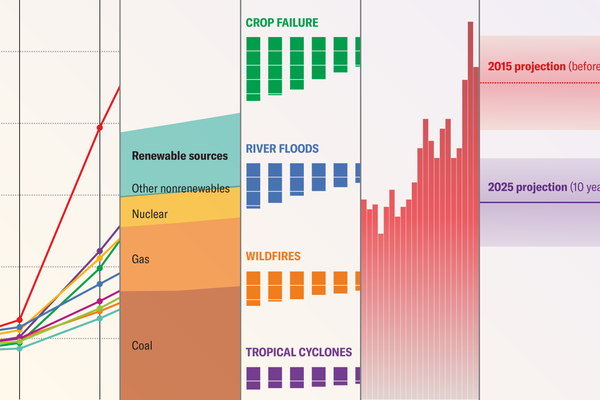
    Image shows crops of five climate-themed charts.

    Ten years ago the world came together to forge a path out of the climate emergency in the form of a global treaty dubbed the Paris Agreement.

    Under the accord, nations committed to keeping global temperatures to “well below” a two-degree-Celsius increase over preindustrial levels and to striving to limit that increase to 1.5 degrees C. These goals were ambitious and required greenhouse gas emissions to begin declining by 2025.

    Yet emissions continue to rise. Annual negotiations around seeing the Paris Agreement through have continued over the past two weeks at this year’s United Nations Climate Change Conference, or COP30, in Brazil, where participants are acknowledging two simultaneous truths: we have made meaningful strides in protecting our planet, but huge leaps are still needed to avoid the worst outcomes. Those leaps are daunting, given that President Donald Trump is once again pulling the U.S. out of the accord and that countries such as China and Saudi Arabia are also still trying to keep fossil fuels in the energy mix. China, however, is rapidly overtaking the U.S. as a renewable energy powerhouse, and solar and wind have seen exponential gains globally in recent years.


    On supporting science journalism

    If you’re enjoying this article, consider supporting our award-winning journalism by subscribing. By purchasing a subscription you are helping to ensure the future of impactful stories about the discoveries and ideas shaping our world today.


    These five charts show why the Paris Agreement is vital—and how the world is doing 10 years into the endeavor.
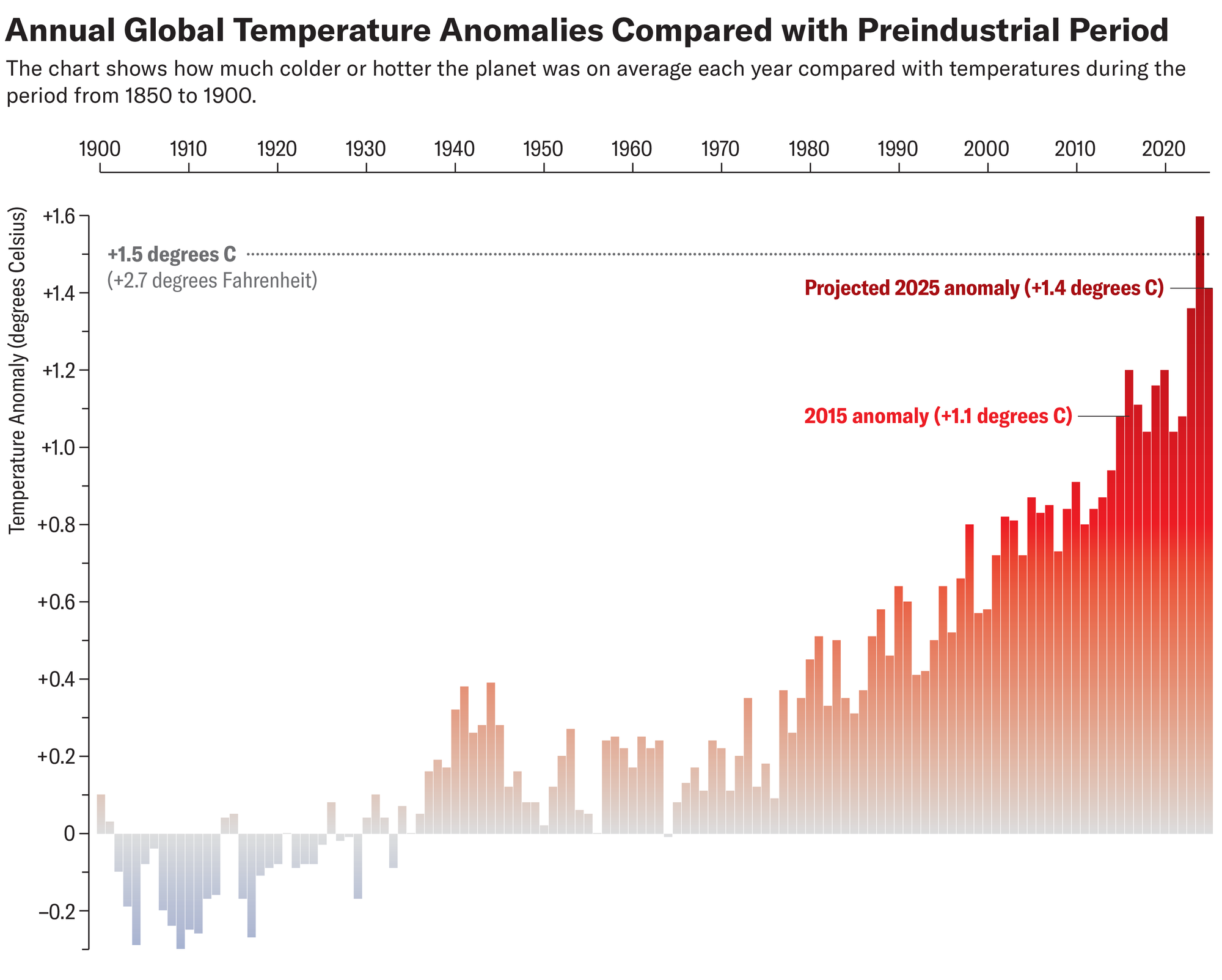
    Bar chart shows annual global temperature anomalies from 1900 to 2025 compared with the preindustrial period.

    The Paris Agreement is built around temperature increases compared with an unspecified preindustrial baseline, generally taken as the latter half of the 19th century. Every year since 1970—more than half a century—temperatures have been above this average and soaring upward.

    In 2015 the average global temperature was 1.1 degrees C hotter than it was during the preindustrial period. Today it is around 1.3 degrees C. (In 2024—the hottest year on record—the planet was more than 1.5 degrees C, but the Paris agreement looks at the average over many years. The World Meteorological Organization projects that 2025 will be around 1.4 degrees C above the preindustrial average and either the second or third hottest year on record.)

    The increase is grim but not the end of the story—especially if humans can stop climate pollution quickly enough to reverse the warming trend. “Every ton matters; every tenth of a degree we avoid matters; every year matters,” says Costa Samaras, an energy policy expert at Carnegie Mellon University.
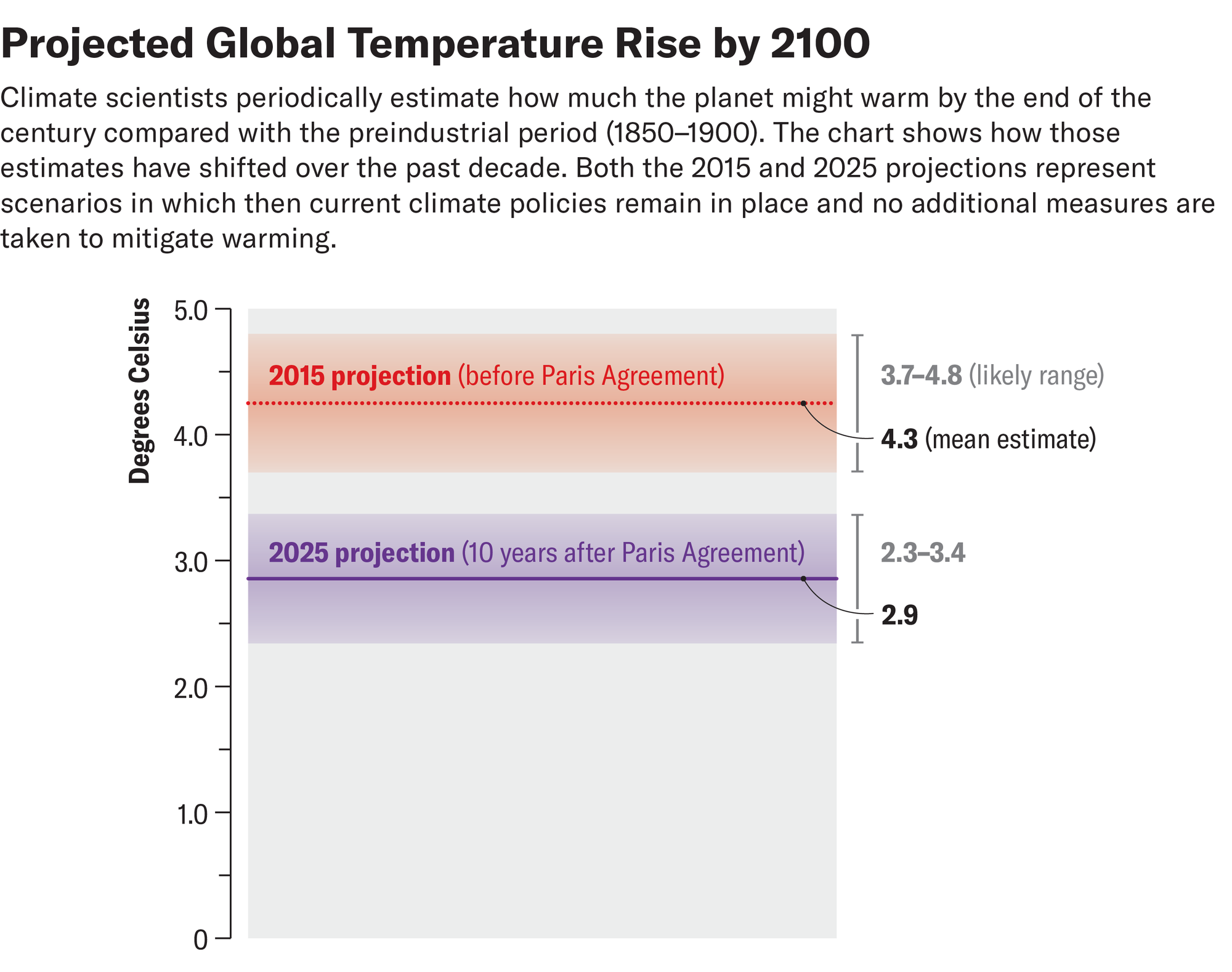
    Chart shows 2015 and 2025 estimates for global temperature rise by 2100 compared with the preindustrial period.

    In fact, before the Paris Agreement, the world was set to see between 3.7 and 4.8 degrees C of warming by 2100. But if nations follow through on their Paris commitments to reduce emissions, that level of warming will drop to around 2.9 degrees C, with a likely range of 2.3 to 3.4 degrees C, according to one recent estimate.

    It’s still a steep challenge to follow through even on the Paris road map, however—and its goals permit some spewing of carbon pollution into the atmosphere.

    “Until global emissions are at net zero,” Samaras says, “the climate outcomes of tomorrow are going to be worse than today.”
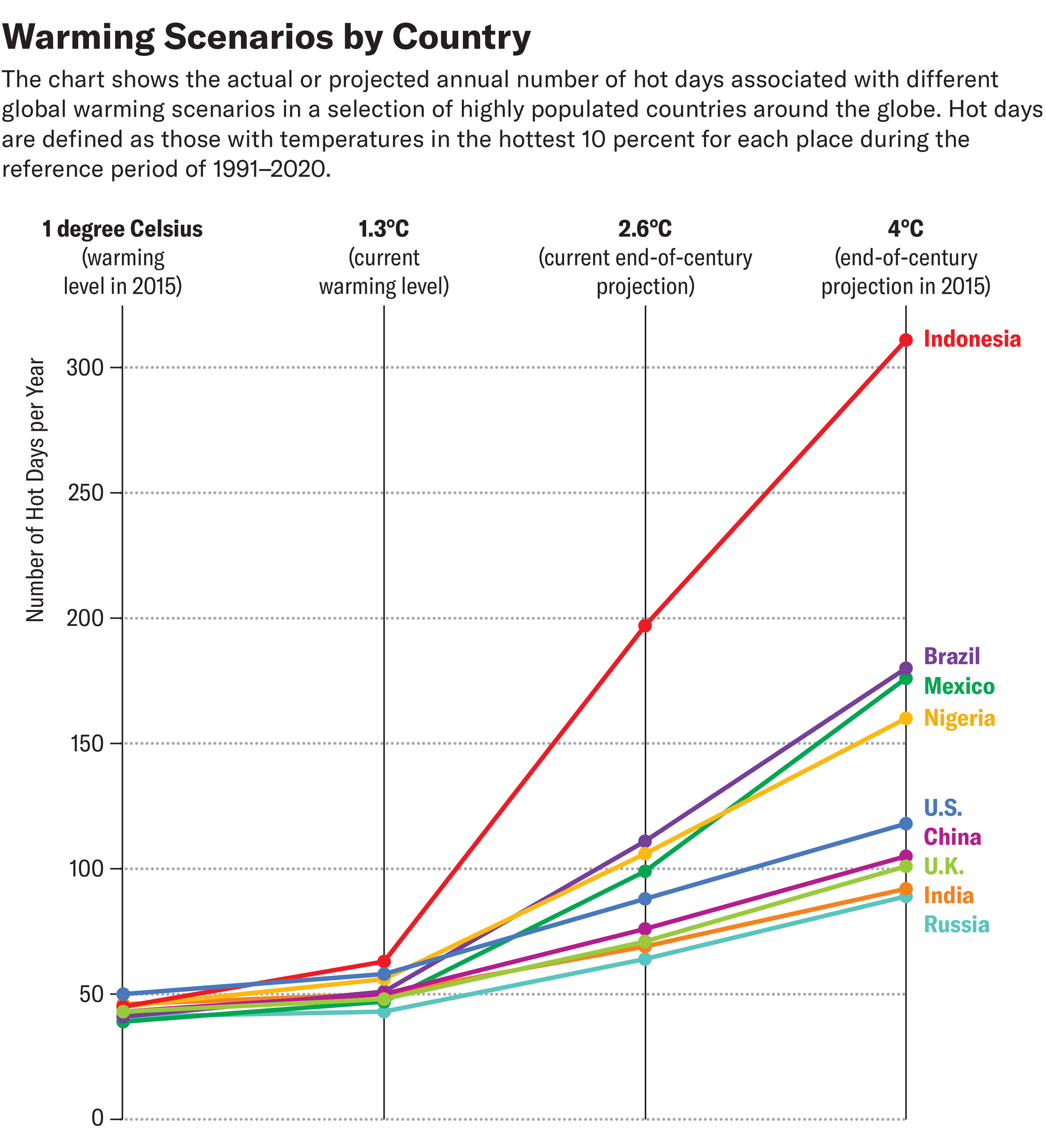
    Line chart shows actual or projected annual number of hot days associated with different global warming scenarios in a selection of nine highly populated countries.

    Amanda Montañez; Source: “Ten Years of the Paris Agreement: The Present and Future of Extreme Heat,” Climate Central and World Weather Attribution (data)

    Those climate outcomes could be dire, though not as dire as those that would occur on our pre-Paris track. New research shows that with around four degrees C of warming, U.S. residents would see some 118 more extremely hot days than would occur under a preindustrial climate by the end of the century. (Other nations would fare even worse.)

    If we achieve the current commitments to reduce emissions, the number of days with the worst heat in 2100 will drop to 88 in the U.S. If we can limit global warming to 1.3 degrees C, the U.S. will see just 58 such days per year on average.
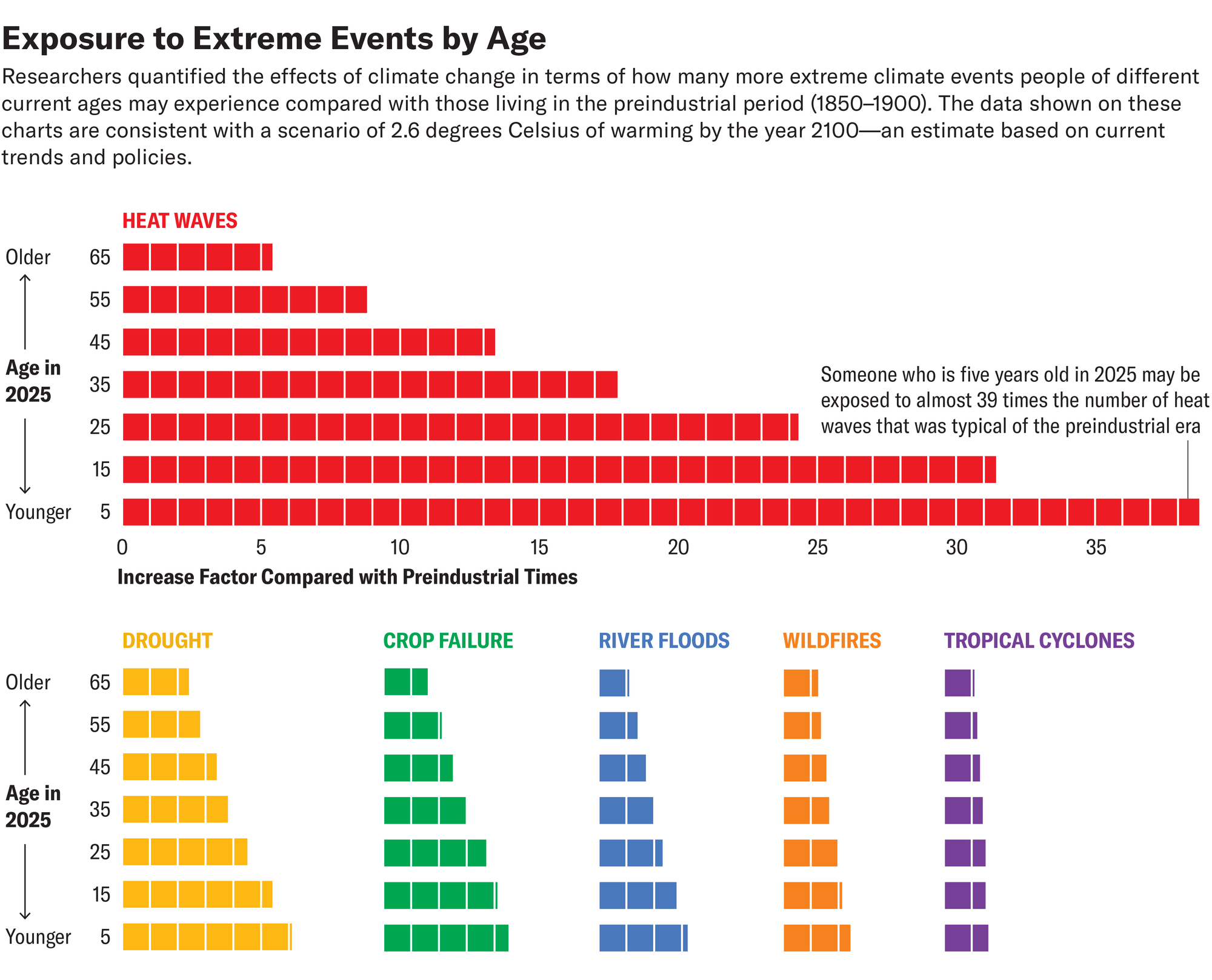
    Chart shows how many more extreme climate events people of different current ages may experience compared with those living in the preindustrial period.

    Of course, even if we follow through on current commitments, there will be climate consequences regardless. With 2.6 degrees C of warming, today’s five-year-olds will experience an extra 22 percent more heat waves than today’s 15-year-olds, work by climate scientist Wim Thiery of Vrije University of Brussels shows. Similarly, today’s children will experience more than twice as many heat waves than their 35-year-old parents will—and more than six times as many as their 65-year-old grandparents.

    Other climate-fueled disasters, including droughts, wildfires and tropical cyclones, are also increasing in frequency.
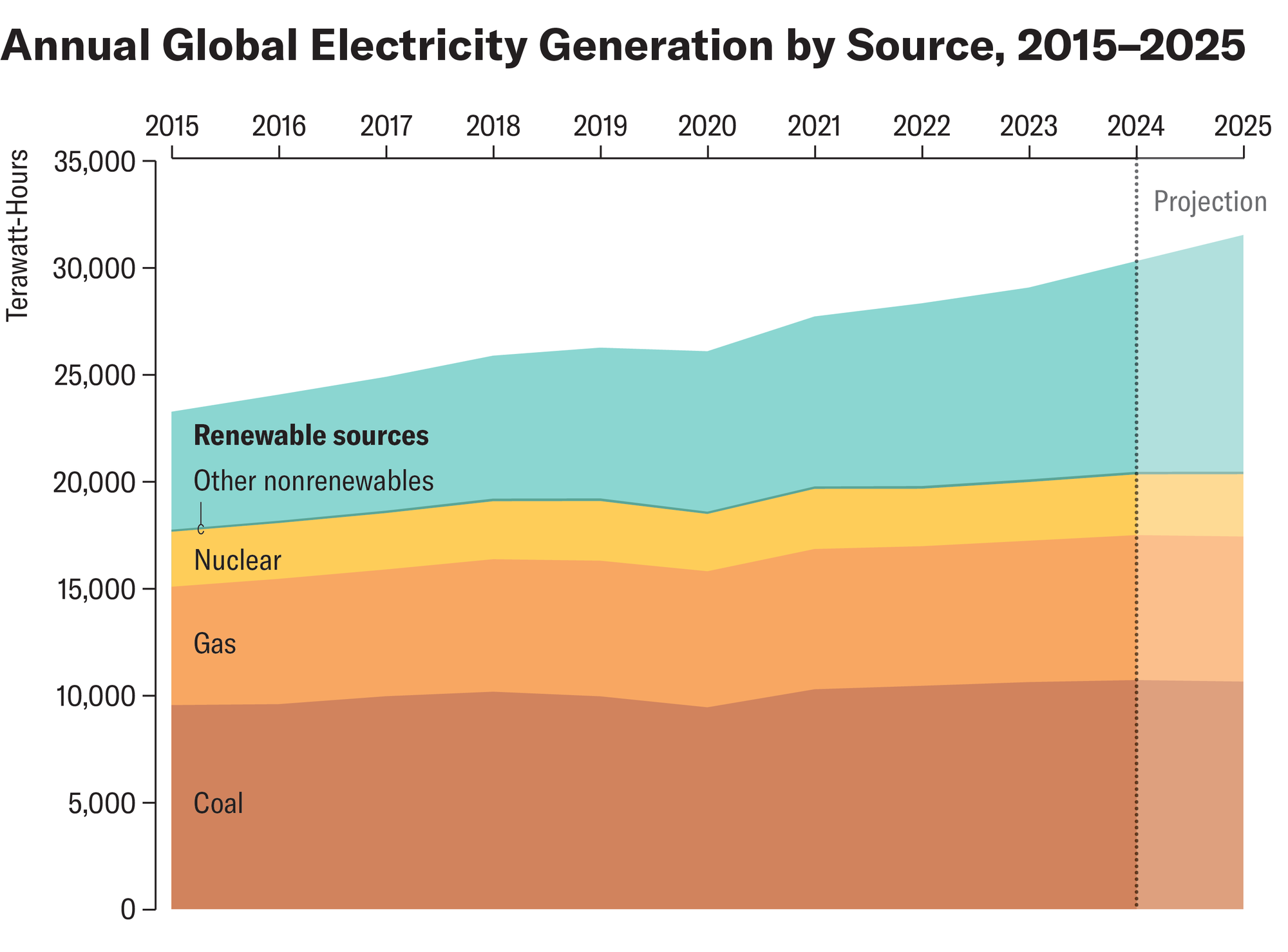
    Area chart shows annual global electricity generation by source from 2015 to 2025.

    One of the key bright spots since the Paris Agreement was signed is the surge of renewable energy. A particular win has been that solar power facilities are coming online much faster than anyone expected in 2015. Better yet, energy from these facilities is being stored for nighttime use thanks to battery technology that was nonexistent when the Paris Agreement was signed. “Batteries is really the miracle story here,” Samaras says.

    Now we need a similar miracle story for sectors such as transportation, agriculture, industry and land use. “I hope that we can revisit this in 10 years and be able to say that the Paris Agreement started a rapid reduction in greenhouse gas emissions,” Samaras says. “But we need to work for the next 10 years in order to make that happen.”

    It’s Time to Stand Up for Science

    If you enjoyed this article, I’d like to ask for your support. Scientific American has served as an advocate for science and industry for 180 years, and right now may be the most critical moment in that two-century history.

    I’ve been a Scientific American subscriber since I was 12 years old, and it helped shape the way I look at the world. SciAm always educates and delights me, and inspires a sense of awe for our vast, beautiful universe. I hope it does that for you, too.

    If you subscribe to Scientific American, you help ensure that our coverage is centered on meaningful research and discovery; that we have the resources to report on the decisions that threaten labs across the U.S.; and that we support both budding and working scientists at a time when the value of science itself too often goes unrecognized.

    In return, you get essential news, captivating podcasts, brilliant infographics, can’t-miss newsletters, must-watch videos, challenging games, and the science world’s best writing and reporting. You can even gift someone a subscription.

    There has never been a more important time for us to stand up and show why science matters. I hope you’ll support us in that mission.


    Original Source Link

    Share. Facebook Twitter Pinterest LinkedIn WhatsApp Email Reddit Telegram
    Previous ArticleFor Good Box Office Scores Record-Smashing Debut As Holiday Season Finally Heats Up (Sunday Update)
    Next Article The 73 Best Deals From REI’s 2025 Holiday Sale

    RELATED POSTS

    How Does the Hive Mind Work in ‘Pluribus?

    January 17, 2026

    RFK, Jr., shifts focus to questioning whether cell phones are safe. Here’s what the science says

    January 17, 2026

    Meat may play an unexpected role in helping people reach 100

    January 16, 2026

    OpenAI Invests in Sam Altman’s New Brain-Tech Startup Merge Labs

    January 16, 2026

    Americans Overwhelmingly Support Science, but Some Think the U.S. Is Lagging Behind: Pew

    January 15, 2026

    Woolly rhino genome recovered from meat in frozen wolf pup’s stomach

    January 15, 2026
    latest posts

    North West shares teaser of new single with father Kanye, ‘Piercing On My Hand’

    North West has shared a teaser of a new collaborative single with her father Kanye West – check…

    Trump launches trade war vs. NATO after European countries sent troops to Greenland

    January 17, 2026

    'Scourge' of sexual predators, violent criminals being removed from Minneapolis

    January 17, 2026

    Chris D’Elia calls comedians ‘spineless’ following sexual misconduct allegations

    January 17, 2026

    Reddit Has Thoughts on Paris Hilton Cookware. So Do We

    January 17, 2026

    How Does the Hive Mind Work in ‘Pluribus?

    January 17, 2026

    The Uncertain Future Of The 4-Part Western Epic

    January 17, 2026
    Categories
    • Books (1,007)
    • Business (5,912)
    • Events (29)
    • Film (5,848)
    • Lifestyle (3,958)
    • Music (5,949)
    • Politics (5,913)
    • Science (5,263)
    • Technology (5,842)
    • Television (5,526)
    • Uncategorized (6)
    • US News (5,900)
    popular posts

    James Watson, co-discoverer of DNA’s double helix, has died aged 97

    Molecular biologist James Watson helped reveal DNA’s hidden shapeEverett Collection Historical / Alamy Stock Photo…

    Fireworks safety tips: Avoid injury on the Fourth of July by taking precautions

    July 3, 2024

    Climate Change Has Finally Come for Burning Man

    September 5, 2023

    President Trump Gets Huge Show of Support From Law Enforcement at Los Angeles International Airport (VIDEO) | The Gateway Pundit | by Cristina Laila

    July 10, 2023
    Archives
    Browse By Category
    • Books (1,007)
    • Business (5,912)
    • Events (29)
    • Film (5,848)
    • Lifestyle (3,958)
    • Music (5,949)
    • Politics (5,913)
    • Science (5,263)
    • Technology (5,842)
    • Television (5,526)
    • Uncategorized (6)
    • US News (5,900)
    About Us

    We are a creativity led international team with a digital soul. Our work is a custom built by the storytellers and strategists with a flair for exploiting the latest advancements in media and technology.

    Most of all, we stand behind our ideas and believe in creativity as the most powerful force in business.

    What makes us Different

    We care. We collaborate. We do great work. And we do it with a smile, because we’re pretty damn excited to do what we do. If you would like details on what else we can do visit out Contact page.

    Our Picks

    How Does the Hive Mind Work in ‘Pluribus?

    January 17, 2026

    The Uncertain Future Of The 4-Part Western Epic

    January 17, 2026

    Where Can You Watch Betty White’s Classic TV Shows?

    January 17, 2026
    © 2026 New York Examiner News. All rights reserved. All articles, images, product names, logos, and brands are property of their respective owners. All company, product and service names used in this website are for identification purposes only. Use of these names, logos, and brands does not imply endorsement unless specified. By using this site, you agree to the Terms & Conditions and Privacy Policy.

    Type above and press Enter to search. Press Esc to cancel.

    We use cookies on our website to give you the most relevant experience by remembering your preferences and repeat visits. By clicking “Accept All”, you consent to the use of ALL the cookies. However, you may visit "Cookie Settings" to provide a controlled consent.
    Cookie SettingsAccept All
    Manage consent

    Privacy Overview

    This website uses cookies to improve your experience while you navigate through the website. Out of these, the cookies that are categorized as necessary are stored on your browser as they are essential for the working of basic functionalities of the website. We also use third-party cookies that help us analyze and understand how you use this website. These cookies will be stored in your browser only with your consent. You also have the option to opt-out of these cookies. But opting out of some of these cookies may affect your browsing experience.
    Necessary
    Always Enabled
    Necessary cookies are absolutely essential for the website to function properly. These cookies ensure basic functionalities and security features of the website, anonymously.
    CookieDurationDescription
    cookielawinfo-checkbox-analytics11 monthsThis cookie is set by GDPR Cookie Consent plugin. The cookie is used to store the user consent for the cookies in the category "Analytics".
    cookielawinfo-checkbox-functional11 monthsThe cookie is set by GDPR cookie consent to record the user consent for the cookies in the category "Functional".
    cookielawinfo-checkbox-necessary11 monthsThis cookie is set by GDPR Cookie Consent plugin. The cookies is used to store the user consent for the cookies in the category "Necessary".
    cookielawinfo-checkbox-others11 monthsThis cookie is set by GDPR Cookie Consent plugin. The cookie is used to store the user consent for the cookies in the category "Other.
    cookielawinfo-checkbox-performance11 monthsThis cookie is set by GDPR Cookie Consent plugin. The cookie is used to store the user consent for the cookies in the category "Performance".
    viewed_cookie_policy11 monthsThe cookie is set by the GDPR Cookie Consent plugin and is used to store whether or not user has consented to the use of cookies. It does not store any personal data.
    Functional
    Functional cookies help to perform certain functionalities like sharing the content of the website on social media platforms, collect feedbacks, and other third-party features.
    Performance
    Performance cookies are used to understand and analyze the key performance indexes of the website which helps in delivering a better user experience for the visitors.
    Analytics
    Analytical cookies are used to understand how visitors interact with the website. These cookies help provide information on metrics the number of visitors, bounce rate, traffic source, etc.
    Advertisement
    Advertisement cookies are used to provide visitors with relevant ads and marketing campaigns. These cookies track visitors across websites and collect information to provide customized ads.
    Others
    Other uncategorized cookies are those that are being analyzed and have not been classified into a category as yet.
    SAVE & ACCEPT