
Close Menu
New York Examiner News

    Subscribe to Updates

    Get the latest creative news from FooBar about art, design and business.

    What's Hot

    Twisted Sister Cancel Reunion Tour Plans Due to Snider’s Health

    February 6, 2026

    Top analyst Tom Lee on gold’s black swan risk: Elon Musk becoming ‘the new central bank’

    February 6, 2026

    Trump Level Of Core Support Has Cratered To An Astonishing New Low

    February 6, 2026
    Facebook X (Twitter) Instagram
    New York Examiner News
    • Home
    • US News
    • Politics
    • Business
    • Science
    • Technology
    • Lifestyle
    • Music
    • Television
    • Film
    • Books
    • Contact
      • About
      • Amazon Disclaimer
      • DMCA / Copyrights Disclaimer
      • Terms and Conditions
      • Privacy Policy
    New York Examiner News
    Home»Science»The Purpose of Dolphins’ Mysterious Brain Net May Finally Be Understood
    Science

    The Purpose of Dolphins’ Mysterious Brain Net May Finally Be Understood

    By AdminSeptember 23, 2022
    Facebook Twitter Pinterest LinkedIn WhatsApp Email Reddit Telegram
    The Purpose of Dolphins’ Mysterious Brain Net May Finally Be Understood


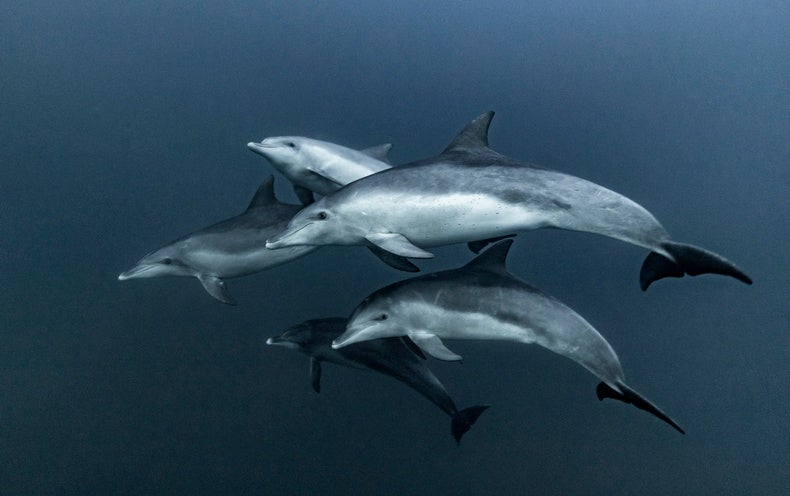
    When dolphins swim through the ocean, it looks effortless. By whipping their tail up and down, the sleek marine mammals propel themselves forward in a seamless glide that could make any human swimmer jealous. But this up-down tail motion puts a lot of stress on a dolphin’s body, compressing its organs and sending pulses of blood pressure to its brain.

    Now researchers in Canada have a theory as to how cetaceans—dolphins, whales and porpoises—manage to protect their brain from these swimming-induced blood pressure pulses. As described in a new paper published in Science, it’s all thanks to specialized networks of blood vessels known as “retia mirabilia.”

    Scientists have long known that many animals have retia mirabilia. Greek physician Galen described the structures in the second century C.E. and gave them their name, which translates to “wonderful nets.” Indeed, retia mirabilia resemble complex stringy nets made up of thin veins and thick arteries. They can be found in a variety of mammals, birds and fish—but rarely humans.

    In most animals that have them, retia mirabilia serve as a mechanism for temperature regulation, and they have a unique structure. “You can almost imagine drawing a flower with a really big center—like a sunflower, for example—and think of it as one large central tube surrounded by several smaller tubes around that circle,” says Sarah Kienle, a biologist at Baylor University, who was not involved in the recent study. “That’s essentially what we’re talking about.”

    That big central artery carries warm blood from the body’s heart to its extremities, while the surrounding veins carry cold blood in the opposite direction, Kienle explains. And because they’re situated right next to each other, heat transfers between the artery and the veins to ensure that neither ends up too cold or hot.

    Flamingos are a classic example of animals that benefit from retia mirabilia, Kienle says. “Because they stand in water overnight, [retia mirabilia] in their lower legs help prevent all the cool water from causing their body temperature to become too cold,” she adds. Similar retia mirabilia have been found in marine mammals, helping to regulate the temperature of their flippers, tongue and testicles.

    Dolphins and other cetaceans possess additional retia mirabilia snaking around their lungs, up their spine and into their brain. These particular networks are quite different from those found in other animals. For one thing, the blood vessels involved are much larger, resembling a writhing mass of worms. For another, they don’t seem to function as a temperature regulator.
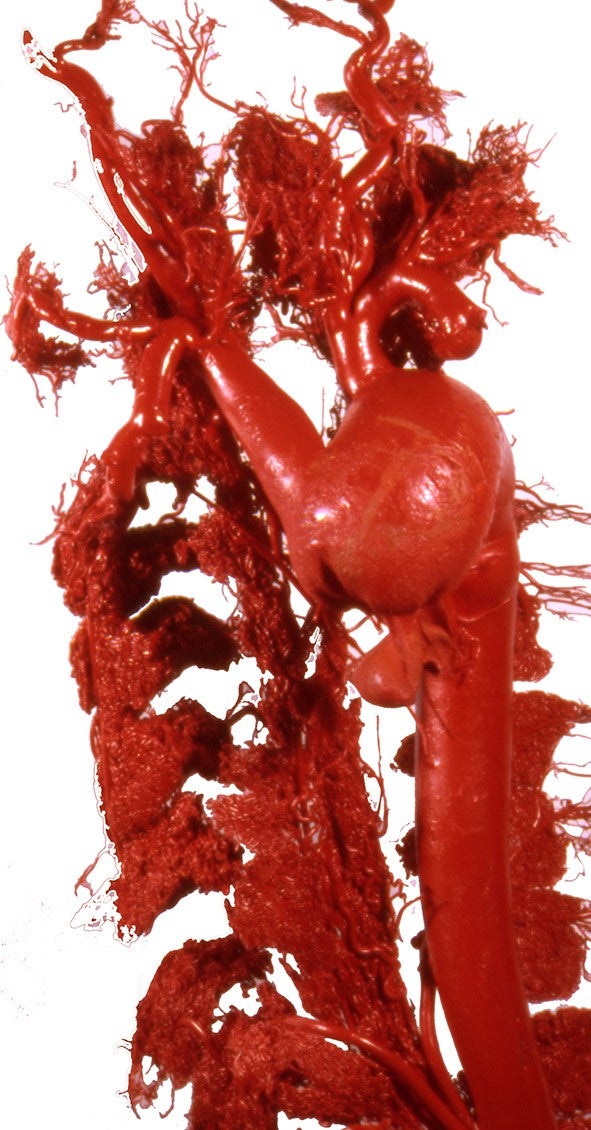
    Resin cast showing aorta and arteries in the retia of a beluga whale.
    Resin cast showing aorta and arteries in the retia of a beluga whale. Credit: Wayne Vogl

    “This area—this thoracic cavity region leading to the brain—is much less studied and identified among mammals and especially among marine mammals,” Kienle says. She adds that there have been a number of hypotheses about the function of structures in this area, but no explanation had been well tested or widely accepted. The authors of the new Science paper believe they have found the answer.

    The researchers looked at the internal biological structure of 11 different cetacean species, including fin whales and bottlenose dolphins. Some of the animals were dissected by these scientists, whereas others had been analyzed by other biologists as part of prior research. “All were animals that had already died,” most by beaching themselves, says Robert Shadwick, a biomechanics researcher at the University of British Columbia, who co-authored the paper.

    Analyzing the innards of all these cetaceans took some time. “It’s taken about 10 years for this study to come to fruition—more than 10 years, actually,” says Wayne Vogl, a biologist at the University of British Columbia, who also took part in the study.

    Based on their analysis, the researchers now believe that one of these previously perplexing retia mirabilia that is present around the brains of cetaceans likely developed as an adaptation to protect against the physical demands of swimming.

    Whales, dolphins and porpoises evolved from mammals that once lived on land. Tens of millions of years ago, cetaceans’ ancestors rejected terrestrial life in favor of the open ocean. Transitioning to an aquatic existence was no small feat for these mammals; it required a number of specialized adaptations.

    One challenge these creatures had to overcome was the stress swimming creates on the body. As previously noted, dolphins propel themselves forward by pushing their large tail up and down, which causes such stress. This is the case for other cetaceans today as well. “The body cavity is all below the spine, so on the downstroke, everything below the spine is being squeezed,” Shadwick says. “And on the upstroke, it’s being unsqueezed.”

    That constriction and relaxation, Shadwick explains, is the source of a tremendous amount of pressure—not just on cetaceans’ organs but also on the surrounding blood vessels. Eric Ekdale, a biologist and paleontologist at San Diego State University, who was not involved in the study, compares this process to sit-ups. “When we’re doing crunches or sit-ups, we’re compressing our abdominal cavity,” he says. “We take a breath, and then when we do the sit-up, we exhale, and that relieves some of the pressure.”

    But marine mammals don’t have the luxury of exhaling. With the exception of the moments when they surface for air, cetaceans have to hold their breaths while they swim. How, then, do cetaceans manage the internal pressures caused by their tail whips? In particular, how do they ensure that the pulses of blood pressure generated by each downward stroke won’t result in brain damage when they reach the cranium?

    That’s where the retia mirabilia come in. Shadwick and his colleagues hypothesize that one of these spongy networks that sits next to cetaceans’ brain mitigates pressure pulses as the blood passes through. Specifically, the researchers propose that this rete mirabile (the singular form of “retia mirabilia”) transfers pulses from veins to adjoining arteries in a way that protects the brain from damage.

    To test this claim, the researchers developed a computer model based on the internal biological structures of the 11 species they observed. And indeed, they found that their hypothetical pressure-transfer system worked: it was able to protect the animals’ brain from 97 percent of pressure pulses. They are now confident they have found the long-sought-after secret purpose of the cetaceans’ “wonderful nets.”

    Vogl also points out that seals—which belong to a different marine mammal group—don’t have a rete mirabile around their brain. This further supports the team’s hypothesis about the network’s function. While cetaceans swing their tails up and down, compressing their organs against their spine, seals swing their tail left and right, which doesn’t cause the same internal pressure. Seals don’t need to regulate swimming-related blood pulses—and if that’s what a cranial rete mirabile is for, it explains why seals don’t have one.

    Vogl speculates that the ancestors of cetaceans probably had retia mirabilia leading to the brain before they ever took to the oceans—but that this network served a different purpose on land. “I suspect that it was at one time probably thermoregulatory and that the function changed,” Vogl says.

    But Ekdale, who studies mammals’ evolutionary transition to the ocean, isn’t sure about that. He suspects that cetaceans’ terrestrial ancestors didn’t have retia mirabilia leading up the spine to the brain and that this network only developed after those mammals took to the oceans and had to adapt to breathless swimming. “It’s probably a novel structure—a novel adaptation for life in water,” he says. But he admits that it’s impossible to know exactly when this structure developed because soft tissues such as blood vessels aren’t preserved in the fossil record.

    Despite taking a different stance on its origins, Ekdale says he finds the new paper to be a plausible explanation for the function of the once mysterious, undeniably wonderful network of blood vessels around whales’ and dolphins’ brain. “I think it’s kind of a neat solution to the specific problem of a fully aquatic mammal,” Ekdale says.


    Original Source Link

    Share. Facebook Twitter Pinterest LinkedIn WhatsApp Email Reddit Telegram
    Previous ArticleReckoning with the ghoulish visual spectacle of the Queen’s funeral
    Next Article US Lawmakers Push Tech Firms on Abortion Benefits for Gig Workers

    RELATED POSTS

    Two Titanic Structures Hidden Deep Within the Earth Have Altered the Magnetic Field for Millions of Years

    February 6, 2026

    Katharine Burr Blodgett’s brilliant career began at the ‘House of Magic’

    February 5, 2026

    Nasal spray could prevent infections from any flu strain

    February 5, 2026

    Why Are Some Women Training for Pregnancy Like It’s a Marathon?

    February 4, 2026

    NASA’s Artemis II moon mission engulfed by debate over its controversial heat shield

    February 4, 2026

    Dutch air force reads pilots’ brainwaves to make training harder

    February 3, 2026
    latest posts

    Twisted Sister Cancel Reunion Tour Plans Due to Snider’s Health

    Twisted Sister have canceled their plans for a 2026 50th anniversary reunion tour due to…

    Top analyst Tom Lee on gold’s black swan risk: Elon Musk becoming ‘the new central bank’

    February 6, 2026

    Trump Level Of Core Support Has Cratered To An Astonishing New Low

    February 6, 2026

    U.S. forces strike kills 2 suspected narco-terrorists in Eastern Pacific

    February 6, 2026

    Sapiom raises $15M to help AI agents buy their own tech tools

    February 6, 2026

    Two Titanic Structures Hidden Deep Within the Earth Have Altered the Magnetic Field for Millions of Years

    February 6, 2026

    Badlands Dan Trachtenberg First-Look Deal Paramount

    February 6, 2026
    Categories
    • Books (1,046)
    • Business (5,950)
    • Events (31)
    • Film (5,887)
    • Lifestyle (3,997)
    • Music (5,990)
    • Politics (5,952)
    • Science (5,302)
    • Technology (5,881)
    • Television (5,565)
    • Uncategorized (6)
    • US News (5,939)
    popular posts

    Ep. 489 — Shaka Senghor – The Axe Files with David Axelrod

    Ep. 489 — Shaka Senghor – The Axe Files with David Axelrod – Podcast on…

    Samsung Electronics Floats Nearly $200 Billion Spend on New Texas Plants in Next Decades

    July 22, 2022

    Man Finds $2 Million Worth of Gold Coins Buried in Kentucky Field | The Gateway Pundit

    July 19, 2023

    Joints that could heal themselves? Researchers could get there in five years

    March 27, 2024
    Archives
    Browse By Category
    • Books (1,046)
    • Business (5,950)
    • Events (31)
    • Film (5,887)
    • Lifestyle (3,997)
    • Music (5,990)
    • Politics (5,952)
    • Science (5,302)
    • Technology (5,881)
    • Television (5,565)
    • Uncategorized (6)
    • US News (5,939)
    About Us

    We are a creativity led international team with a digital soul. Our work is a custom built by the storytellers and strategists with a flair for exploiting the latest advancements in media and technology.

    Most of all, we stand behind our ideas and believe in creativity as the most powerful force in business.

    What makes us Different

    We care. We collaborate. We do great work. And we do it with a smile, because we’re pretty damn excited to do what we do. If you would like details on what else we can do visit out Contact page.

    Our Picks

    Two Titanic Structures Hidden Deep Within the Earth Have Altered the Magnetic Field for Millions of Years

    February 6, 2026

    Badlands Dan Trachtenberg First-Look Deal Paramount

    February 6, 2026

    ‘Today’ Host Craig Melvin Loses Big Opportunity

    February 6, 2026
    © 2026 New York Examiner News. All rights reserved. All articles, images, product names, logos, and brands are property of their respective owners. All company, product and service names used in this website are for identification purposes only. Use of these names, logos, and brands does not imply endorsement unless specified. By using this site, you agree to the Terms & Conditions and Privacy Policy.

    Type above and press Enter to search. Press Esc to cancel.

    We use cookies on our website to give you the most relevant experience by remembering your preferences and repeat visits. By clicking “Accept All”, you consent to the use of ALL the cookies. However, you may visit "Cookie Settings" to provide a controlled consent.
    Cookie SettingsAccept All
    Manage consent

    Privacy Overview

    This website uses cookies to improve your experience while you navigate through the website. Out of these, the cookies that are categorized as necessary are stored on your browser as they are essential for the working of basic functionalities of the website. We also use third-party cookies that help us analyze and understand how you use this website. These cookies will be stored in your browser only with your consent. You also have the option to opt-out of these cookies. But opting out of some of these cookies may affect your browsing experience.
    Necessary
    Always Enabled
    Necessary cookies are absolutely essential for the website to function properly. These cookies ensure basic functionalities and security features of the website, anonymously.
    CookieDurationDescription
    cookielawinfo-checkbox-analytics11 monthsThis cookie is set by GDPR Cookie Consent plugin. The cookie is used to store the user consent for the cookies in the category "Analytics".
    cookielawinfo-checkbox-functional11 monthsThe cookie is set by GDPR cookie consent to record the user consent for the cookies in the category "Functional".
    cookielawinfo-checkbox-necessary11 monthsThis cookie is set by GDPR Cookie Consent plugin. The cookies is used to store the user consent for the cookies in the category "Necessary".
    cookielawinfo-checkbox-others11 monthsThis cookie is set by GDPR Cookie Consent plugin. The cookie is used to store the user consent for the cookies in the category "Other.
    cookielawinfo-checkbox-performance11 monthsThis cookie is set by GDPR Cookie Consent plugin. The cookie is used to store the user consent for the cookies in the category "Performance".
    viewed_cookie_policy11 monthsThe cookie is set by the GDPR Cookie Consent plugin and is used to store whether or not user has consented to the use of cookies. It does not store any personal data.
    Functional
    Functional cookies help to perform certain functionalities like sharing the content of the website on social media platforms, collect feedbacks, and other third-party features.
    Performance
    Performance cookies are used to understand and analyze the key performance indexes of the website which helps in delivering a better user experience for the visitors.
    Analytics
    Analytical cookies are used to understand how visitors interact with the website. These cookies help provide information on metrics the number of visitors, bounce rate, traffic source, etc.
    Advertisement
    Advertisement cookies are used to provide visitors with relevant ads and marketing campaigns. These cookies track visitors across websites and collect information to provide customized ads.
    Others
    Other uncategorized cookies are those that are being analyzed and have not been classified into a category as yet.
    SAVE & ACCEPT