
When Erinn Baldeschwiler was diagnosed with stage 4 metastatic breast cancer in March 2020, the then 48-year-old mother of two knew she wanted to seek treatment—but not just for the cancer itself. She also wanted something to address the emotional anguish that accompanies a terminal diagnosis. So she began investigating various therapies that might help her “make sense of everything and find peace,” as she put it at the time.
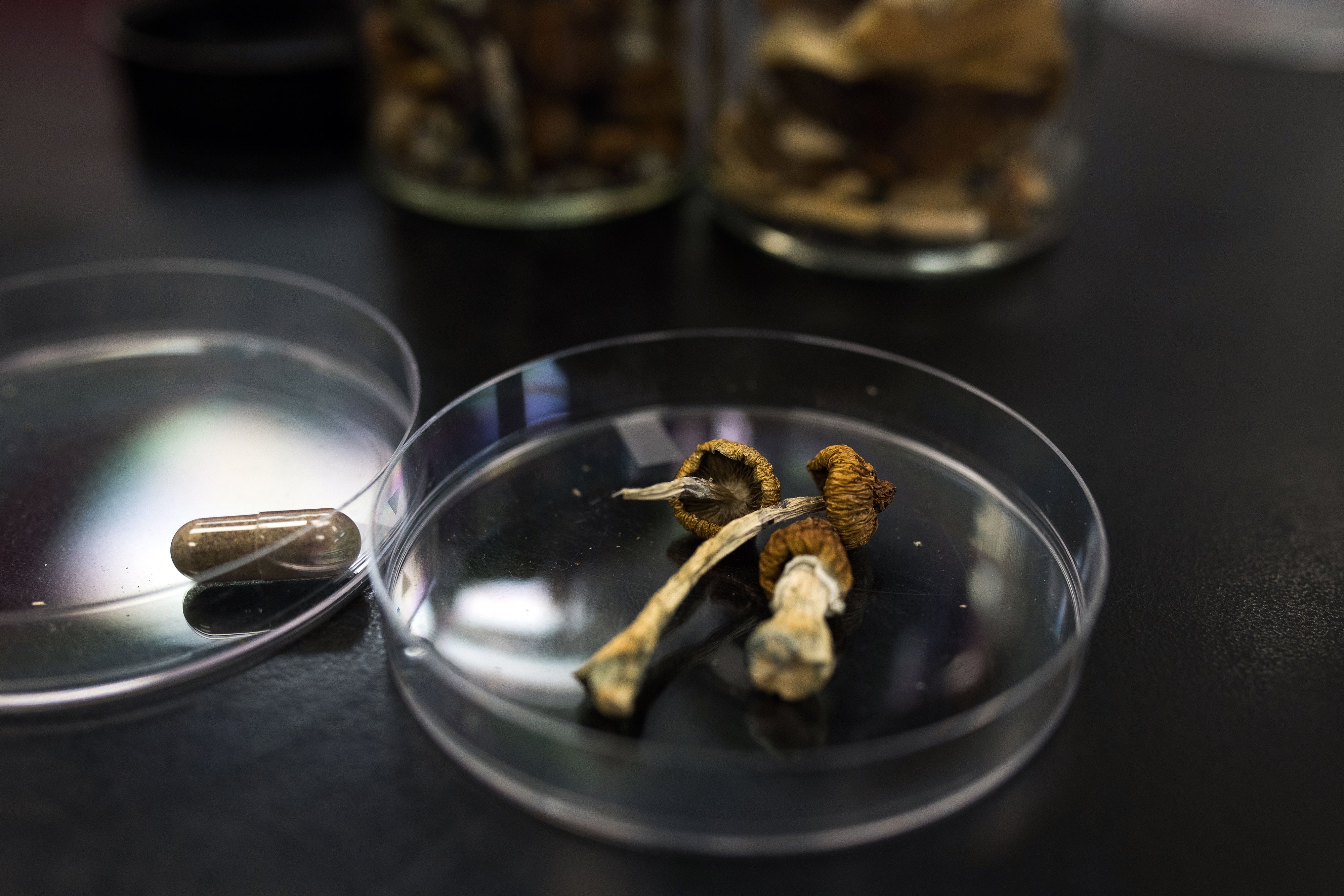
Baldeschwiler’s palliative care doctor, Sunil Aggarwal of the Advanced Integrative Medical Science (AIMS) Institute in Seattle, suggested that she might benefit from therapy with psilocybin, the main psychoactive ingredient in “magic mushrooms.” Baldeschwiler had only taken such mushrooms recreationally a couple times in her early 20s, but her interest in the therapeutic use of psilocybin was piqued.
There was a catch, however. Although psilocybin therapy has shown compelling results for addressing depression and anxiety in patients with life-threatening cancer, the treatment remains investigational and has yet to be approved by the Food and Drug Administration for any purpose. Psilocybin itself is also strictly banned in the U.S. as a Schedule I substance.
In theory, Aggarwal explained, Baldeschwiler could bypass these obstacles through the Right to Try Act, a 2018 federal law that permits people with life-threatening illnesses to try investigational drugs that have made it past phase 1 clinical trials. Forty-one states, including Washington, where Baldeschwiler lives, have also enacted Right to Try at the state level.
Baldeschwiler is not the first cancer patient to use Right to Try to access an investigational drug. But she and another cancer patient, Michal Bloom, do seem to be the first to seek to use the law for treatment with a Schedule I drug. Because of this, Aggarwal had to attempt to obtain some form of permission from the Drug Enforcement Administration to access and administer psilocybin.
Getting the DEA’s permission to administer psilocybin therapy for a cancer patient should have been straightforward, because there is nothing in state or federal law that excludes scheduled drugs from the Right to Try Act, says Kathryn Tucker a Portland, Ore.–based lawyer at Emerge Law Group, who is lead counsel in a legal effort seeking to compel the DEA to open access to psilocybin under Right to Try laws. “But it turned out to be anything but simple.”
A year and a half after first reaching out to the DEA, Baldeschwiler finds herself stuck in a frustrating holding pattern of bureaucratic delays. She and Bloom, along with Aggarwal and AIMS, went as far as to file a lawsuit against the DEA, but it was dismissed on a technicality. The agency has not yet issued a final decision that will permit Baldeschwiler and Bloom to either access psilocybin therapy or reopen their lawsuit.
DEA Administrator Anne Milgram did not respond to interview requests for this story. DEA spokesperson Katherine Pfaff wrote in a separate e-mail to Scientific American that “we will respectfully decline this opportunity.”
The most frustrating part of the experience, Baldeschwiler says, is “knowing there are substances out there that can help but that they’re being taken off the table by some third-party agency that’s making my choice for me.”
Existential Relief
For decades, political vilification prevented all but the most determined investigators from conducting research on the medical use of Schedule I drugs, including marijuana, MDMA, psilocybin and LSD. But in the past few years, support for psychedelics has grown dramatically. Studies increasingly demonstrate that certain strictly banned substances in this category can be safely administered and do have medical value—including for difficult-to-treat conditions such as severe post-traumatic stress disorder, substance use disorders and depression.
In addition to treating specific maladies, mind-altering drugs also have a long history of easing the death process, according to some researchers. “The use of these medicines to help with major life transitions is an extremely ancient, pan-cultural practice,” Aggarwal says.
Western science first took note of psychedelic substances’ ability to address complications surrounding death in the early 1960s, when Eric Kast, an assistant professor of medicine and psychiatry at Chicago Medical School, tested whether LSD could substitute for opioids to relieve physical pain in cancer patients. LSD not only lessened pain while patients were on the drug but also for up to two weeks after.
Kast also noted an unexpected side effect: LSD seemed to offer some relief from the existential distress that often accompanies a terminal illness. As he wrote in a 1964 study, “These patients displayed a peculiar disregard for the gravity of their situations, and talked freely about their impending death with an affect considered inappropriate in our western civilization, but most beneficial to their own psychic states.”
Psychedelic studies were cut short in the 1970s. But before that, more than 200 cancer patients had received treatment with LSD. “People and their family members were saying it transformed the time before their death,” says Matthew Johnson, a professor of psychiatry at the Johns Hopkins University School of Medicine. “Their psychological suffering was attenuated.”
After decades of struggle to resume research on the medical use of psychedelics, scientists were able to return in earnest to this promising line of investigation around a decade ago. They began working their way through clinical trials of psychedelics, including psilocybin, to treat various conditions and provide mental relief to terminal patients. Clinical trials involve three phases; the first establishes safety in humans, and the second and third further test safety and efficacy. In 2011 researchers published a double-blind Phase I study involving 12 advanced-stage cancer patients who received psilocybin therapy. Two Phase II investigations followed, the largest of which was a 2016 study involving 51 cancer patients. All three studies found that psilocybin therapy produced mood-elevating effects and that the benefits lasted weeks or even months following a single active-treatment session.
“The sense of unfairness, punishment, helplessness and uncertainty is particularly extreme with cancer, but there’s something about that existential distress that psilocybin really seems to get at the heart of,” says Johnson, who co-authored the 2016 paper. “It helps a lot of people and not just trivially.”
Phase III trials—the necessary next step to gain FDA approval—typically cost millions of dollars, however, and Johnson is not aware of any such study currently being conducted using psychedelics to treat cancer distress. But the need is there, he says. Johnson has lost count of the number of patients and family members who have reached out to him in the hopes of accessing psilocybin therapy for conditions ranging from depression to nicotine addiction. “With cancer, I would certainly say it’s in the dozens of calls,” he says. “It’s just heartbreaking.”
Rights and Autonomy
Before setting her sights on psilocybin therapy, Baldeschwiler sought psychological relief for the distress surrounding her diagnosis by using ketamine therapy. But while she did enjoy some gains, both she and Aggarwal, who administered the therapy, agreed that she could benefit from a longer and more potent treatment. “There was still persistent spiritual and existential distress that needed addressing,” Aggarwal says. “I felt like there was more in this space that we could offer her.”
Aggarwal teamed up with Tucker to navigate the legal intricacies of conducting psilocybin therapy with Baldeschwiler and Bloom, who is also his patient. DEA officials seemed confused when Tucker contacted them in January 2021. It quickly became apparent, she says, that “the DEA had not familiarized itself with Right to Try laws.”
Subsequently, the DEA issued a “standard knee-jerk response,” Tucker says: the request was denied. Outlining the decision in a two-page letter, Thomas Prevoznik, a DEA deputy assistant administrator, wrote that the administration “has no authority to waive any of the [Controlled Substances Act’s] requirements.” Prevoznik did not respond to interview requests for this story.
The Right to Try Act is an amendment to the 1938 Federal Food, Drug and Cosmetic Act (FDCA), however, and the 1970 Controlled Substances Act includes a provision clarifying that nothing in its text overrides the FDCA. “That’s an alphabet soup of acronyms, but at the end of the day, legal analysis would conclude that the Right to Try Act should not be thwarted or obstructed by the DEA,” Tucker says.
Tucker filed a lawsuit on Baldeschwiler and Bloom’s behalf in the U.S. Court of Appeals for the Ninth Circuit to seek judicial review of the DEA’s decision. After 10 months of arguments and legal briefings, the DEA claimed that the decision outlined in the two-page letter sent to Tucker was not “sufficiently final” to allow for judicial review, she says. A three-judge panel dismissed the suit.
That was January 2022, and Baldeschwiler and Bloom are still waiting on the DEA to issue a final decision. “The name of the game for the DEA is delay,” Tucker says. “But we have the urgent reality that our clients are patients with inexorably advancing terminal illnesses, and they don’t have the time for the DEA to just stand there and do nothing.”
Baldeschwiler says she has reached out to Senator Patty Murray of Washington State to ask for help with the case. In May Baldeschwiler also joined demonstrators at the DEA’s headquarters to protest the administration’s practices and was one of 17 people arrested for refusing to leave the premises.
As the delays continue, Aggarwal is looking into other options for helping Baldeschwiler and Bloom get legal access to psilocybin, including through a possible religious exemption. For those who have the resources to seek it out, underground psilocybin-assisted therapy is also an option but remains illegal. Baldeschwiler declined to comment on whether she has been able or has plans to access psilocybin therapy in an underground setting.
If she and Bloom see their case resolved—and if the outcome is favorable—it could benefit not only them but other people with life-threatening illnesses or conditions who wish to seek relief through therapy with psilocybin, MDMA or other scheduled drugs currently being investigated in clinical trials.
In the meantime, Baldeschwiler says she will continue to invest her limited time and energy in pursuing her rights under the law because she believes in the importance of giving patients autonomy. “At the end of your life, when cancer’s taken over your body, my God, choice is all you have left,” she says. “This is my way of being of service.”