
[ad_1]
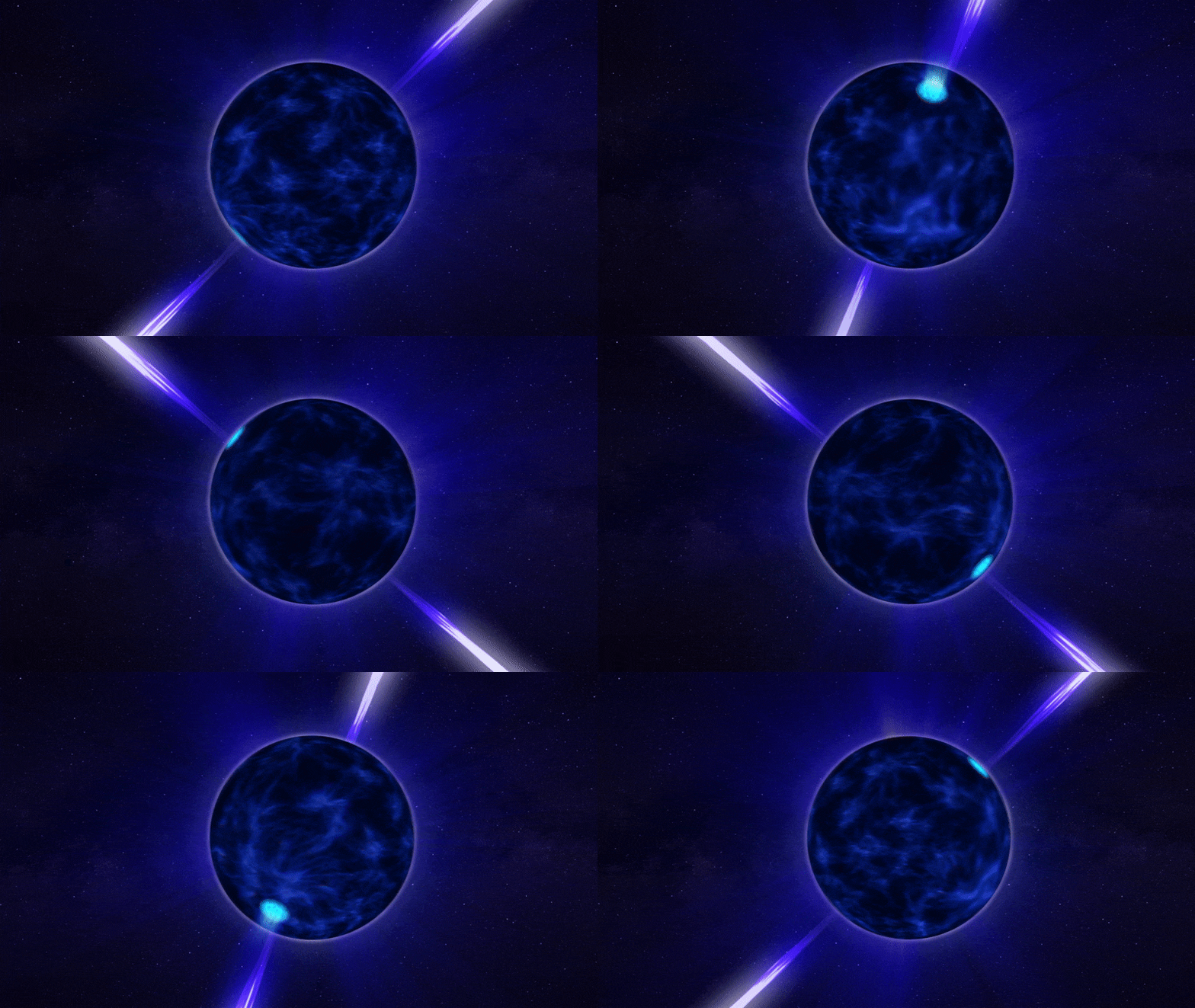
Ever since neutron stars were discovered, researchers have been using their unusual properties to probe our universe. The superdense remnants of stellar explosions, neutron stars pack a mass greater than the Sun’s into a ball about as wide as San Francisco. A single cup of this star matter would weigh about as much as Mount Everest.
These odd celestial bodies could alert us to distant disturbances in the fabric of spacetime, teach us about the formation of elements, and unlock the secrets of how gravity and particle physics work in some of the most extreme conditions in the universe.
“They’re at the center of a lot of open questions in astronomy and astrophysics,” says astrophysicist Vanessa Graber of the Institute of Space Sciences in Barcelona.
But to accurately interpret some of the neutron stars’ signals, researchers must first understand what goes on inside them. They have their hunches, but experimenting directly on a neutron star is out of the question. So scientists need another way to test their theories. The behavior of matter in such a superdense object is so complicated that even computer simulations aren’t up to the task. But researchers think they may have found a solution: an earthly analog.
Though young neutron stars can have temperatures in the millions of degrees in their interior, by one important energetic measure neutrons are considered “cold.” Physicists think that is a characteristic they can exploit to study the inner workings of neutron stars. Instead of looking to the sky, researchers are peering into clouds of ultracold atoms created in laboratories here on Earth. And that might help them finally answer some longstanding questions about these enigmatic objects.
Space oddities
The existence of neutron stars was first proposed in 1934, two years after the discovery of the neutron itself, when astronomers Walter Baade and Fritz Zwicky wondered if a celestial body made entirely of neutrons might remain after a supernova explosion. Though they didn’t get all the details right, their general idea is now widely accepted.
Stars power themselves by fusing the nuclei of lighter atoms into those of heavier atoms. But when stars run out of those lighter atoms, nuclear fusion stops and there is no longer an outward pressure to fight against the inward force of gravity. The core collapses and the star’s outer layer races inward. When this layer hits the dense core, it bounces off and explodes outward, producing a supernova. The dense core that remains afterward is a neutron star.
It wasn’t until the 1960s that Zwicky and Baade’s hypothetical neutron stars were finally detected. Radio astronomer Jocelyn Bell Burnell noticed a strange, regularly pulsed radio wave signal from space while working as a graduate student at the University of Cambridge. She was detecting something that had never been seen before: a special kind of neutron star called a pulsar, which flashes beams of radiation at regular intervals as it spins, like a lighthouse. (Her adviser, along with the director of the observatory — but not Bell Burnell — later received the Nobel Prize for the discovery.)
Since then, thousands of neutron stars have been detected. As some of the densest, highest-pressure objects in the universe, neutron stars might help us learn about what happens to matter at extremely high densities. Understanding their structure and the behavior of the neutron matter composing them is of paramount importance to physicists.
Scientists already know that the neutrons, protons and other subatomic particles that compose a neutron star arrange themselves differently depending on where in the star they are. In certain sections, they pack rigidly like water molecules in a block of ice. In others, they flow and swirl like a frictionless fluid. But exactly where the transition happens and how the different phases of matter behave, physicists aren’t sure.
A superdense star born of a nuclear fireball seems, on its face, to have very little in common with a dilute cloud of ultracold particles. But they can share at least one useful characteristic: They are both below a threshold known as the Fermi temperature that depends on — and is calculated based on — the matter each system is made of. A system that is well above this temperature will largely behave according to the laws of classical physics; if it is well below, its behavior will be ruled by quantum mechanics. Certain ultracold gases and neutron star material can both be well below their Fermi temperatures and consequently can act in similar ways, says Christopher Pethick, a theoretical physicist at the Niels Bohr Institute in Copenhagen and coauthor of an early overview of neutron stars in the 1975 Annual Review of Nuclear Science.
Matter that is below its Fermi temperature can obey remarkably universal laws. This universality means that, while we don’t have easy access to several-million-degree neutron star matter, we could learn about some of its behavior by experimenting with ultracold gases that can be created and manipulated in laboratory vacuum chambers on Earth, says theoretical astrophysicist James Lattimer of Stony Brook University in New York, author of a summary of the science of nuclear matter in the 2012 Annual Review of Nuclear and Particle Science.
Of particular interest to Lattimer is a theoretical state called a unitary gas. A gas is unitary when each of its particles’ sphere of influence becomes infinite, meaning that they would influence each other no matter how far apart they are. This is impossible to have in reality, but ultracold atom clouds can get close — and so can the matter inside of neutron stars. “It’s similar to a unitary gas,” Lattimer says, “but it’s not a perfect unitary gas.”
Down to Earth
For a long time, the exact relationship between a gas’s pressure and its density was simply too complex to accurately calculate. But when experimental physicists developed the ability to control clouds of cold atoms and tune them to get very, very close to a unitary gas, this opened a new avenue to determining such a gas’s properties: Simply measure it directly, instead of struggling to wrangle the unwieldy math on a computer.
These ultracold atom clouds are actually closer to being a unitary gas than neutron star matter, so the analogy isn’t perfect. But it’s close enough that Lattimer has been able to take almost-unitary-gas measurements from the cold-atom clouds and apply them to neutron matter to refine some of the theoretical models that describe the internal workings of neutron stars. And experiments with cold atoms can help scientists develop theories about what physics might be at play in some unexplained neutron star phenomena.
In particular, Graber and other scientists are hoping to find clues to one of the biggest mysteries, called pulsar glitches. Generally, the regularly timed ticking of a pulsar “clock” is so reliable that its accuracy rivals that of atomic clocks. But not always: Sometimes, the pulsar’s rate of rotation increases abruptly, causing a glitch. Where that extra oomph comes from is unclear. The answer lies with how that matter moves around inside a neutron star.
Both cold gases and neutron matter in some parts of a neutron star are superfluids — the particles flow without any friction. When a superfluid rotates, little whirlpools, or vortices, develop. How exactly these vortices move and interact with one another and other structures inside a rotating neutron star is still an open question. “It’s probably not this nice, regular lattice of vortices,” says Michael McNeil Forbes, who studies theoretical physics at Washington State University in Pullman. “It might be some tangle of vortices that’s in the entire star. We don’t know.”
Forbes and others suspect that the glitches they observe in the rotation of pulsars have something to do with how these vortices get “pinned” to structures in the star. Generally, a single vortex meanders freely around a fluid. But when the fluid contains a rigidly packed area of matter that obstructs the vortex’s motion, the vortex will stop and sometimes even wrap its swirling arms around the rigid object and position itself so that its center is right on top of it.
Vortices tend to stay pinned in this way, but sometimes they can unpin and migrate away from the object. When this happens, the flow of fluid exerts a torque on the object. If hundreds of thousands of vortices unpin from various structures in a neutron star all at once, they can suddenly speed up the star’s rotation. Forbes explains how so many vortices might all unpin at once: “Like dropping sand onto a sand pile — nothing really happens until … you get a whole avalanche.”
But it’s almost impossible for classical computers to exactly calculate all the intricacies of the dance of so many vortices at once. So Forbes plans to team up with experimental groups that can form these vortices in their clouds of cold atoms and see what happens. The idea is to use “cold atom experiments as analog quantum computers for calculating stuff that we can’t do any other way,” he says.
Researchers are busy examining how other ultracold phenomena they regularly see in the lab can inspire new lines of research into the behavior of neutron stars. Recently, Graber and her colleagues outlined so many possibilities that they needed 125 pages to publish them all. In 2019, dozens of astronomers, nuclear physicists and ultracold atomic physicists from around the world gathered to discuss more of the surprising connections between their fields. Researchers are just beginning to test some of the ideas generated by these brainstorms.
They’re also learning more from the stars themselves, says Pethick. “It’s an exciting field, because at the moment there are a lot of observations coming in.”
With better telescopes and new methods to glean properties about a neutron star’s inscrutable interior, scientists can hope to find out just how far this analogy between cold atoms and neutron stars can be taken.
This article originally appeared in Knowable Magazine, an independent journalistic endeavor from Annual Reviews. Sign up for the newsletter.
[ad_2]
Original Source Link