
Close Menu
New York Examiner News

    Subscribe to Updates

    Get the latest creative news from FooBar about art, design and business.

    What's Hot

    New York City Declares West 8th Street as “Jimi Hendrix Way”

    June 11, 2026

    Digital sovereignty isn’t the same thing as digital isolation. Asia’s governments should be careful

    June 11, 2026

    Democrats Have All The Info They Need To End Trump And Vance With A Real Epstein Investigation

    June 11, 2026
    Facebook X (Twitter) Instagram
    New York Examiner News
    • Home
    • US News
    • Politics
    • Business
    • Science
    • Technology
    • Lifestyle
    • Music
    • Television
    • Film
    • Books
    • Contact
      • About
      • Amazon Disclaimer
      • DMCA / Copyrights Disclaimer
      • Terms and Conditions
      • Privacy Policy
    New York Examiner News
    Home»Science»Water Shortages Threaten to Increase Violence and Disappearances in Mexico
    Science

    Water Shortages Threaten to Increase Violence and Disappearances in Mexico

    By AdminFebruary 15, 2023
    Facebook Twitter Pinterest LinkedIn WhatsApp Email Reddit Telegram
    Water Shortages Threaten to Increase Violence and Disappearances in Mexico


    In 2006, Mexico declared war against drug traffickers in the wake of escalating inter-cartel warfare. Since then, there have been more than 300,000 murders in the country, a death toll escalated by violence between law enforcement, the military and the cartels. An official list of the missing has risen to over 100,000 people, called los desaparecidos—the disappeared. Many of them are presumably among the ­­roughly 52,000 unidentified bodies in Mexican morgues. The disappeared are, legally speaking, neither alive nor dead; they include people whose remains are undiscovered or unidentified, and others who may be still alive and held in captivity.

    In 2021 and 2022, with the No Están Solas project, I worked with Mexican human rights advocates who were trying to locate and identify the remains of some of the disappeared. I learned the crisis in Mexico is one with many faces: cartel violence, forced migration, and clashes between the Mexican government, its people and the drug traffickers who offer jobs, protection and resources, often through coercion.

    I believe the violence will worsen if we do not address a powerful new factor: climate change and its effect on Mexico’s water supply. Changing weather patterns, the failure of government institutions to accommodate growing and moving populations, and the realities of decaying infrastructure are reducing the availability of usable fresh water in several parts of Mexico. This, I believe, is adding to crime, civil unrest and migration, as people search for more habitable or safer ground.

     In the first half of 2021 Mexico had an average rain shortfall of 20 percent, and by 2022 several states experienced shortfalls greater than 90 percent  compared to expected levels. The loss of rainfall is putting greater stress on already overexploited aquifers and depleted reservoirs. To make matters worse, the government has mismanaged the water supply, failing to crack down on illegal pumping by cartels and farmers, and preferentially allotting scarce public water supplies to large companies. This has inflamed the water crisis and caused the brunt of drought to be endured by Mexico’s poorer and marginalized communities.

    From what I’ve seen, I believe that climate change will increasingly lead to the kind of violence that has defined the country’s drug war, much in the same way researchers have linked climate change to the Syrian Civil War. And here is where I think the U.S. can make a difference.  The U.S. government has committed billions of dollars in aid to a war on drugs that has failed, with drug seizures at the US-Mexico border remaining high and drug-war related murders soaring since 2006. If the United States reallocated some of its drug war funding from militarized aid and law enforcement to water collection and distribution projects, this could reduce water’s role as a driver of violence and displacement. 

    It was during my work cataloging mass graves and helping spread legal information to people affected by disappearances that I saw how the distribution of violence was not random and saw how the disappearance crisis and the murder epidemic are extensions of one another. It seems to me that disappearances and confirmed murders are disproportionately concentrated in areas where water reserves are strained.

    Water access has long driven conflict in Mexico. Shortages of drinkable water create a new market for drug cartels who capitalize on soaring water prices by siphoning and reselling water from public utilities. At the same time the urban poor and farmers , desperate for water are increasingly resorting to theft, kidnapping, and sabotage, along with peaceful protest in an effort to save themselves and their livelihoods. Government crackdowns on these escalating disruptions pose a growing threat to Mexican civilians. Though long ignored by Mexico’s federal officials, state-sponsored violence is responsible for many of Mexico’s unsolved deaths and forced disappearances.

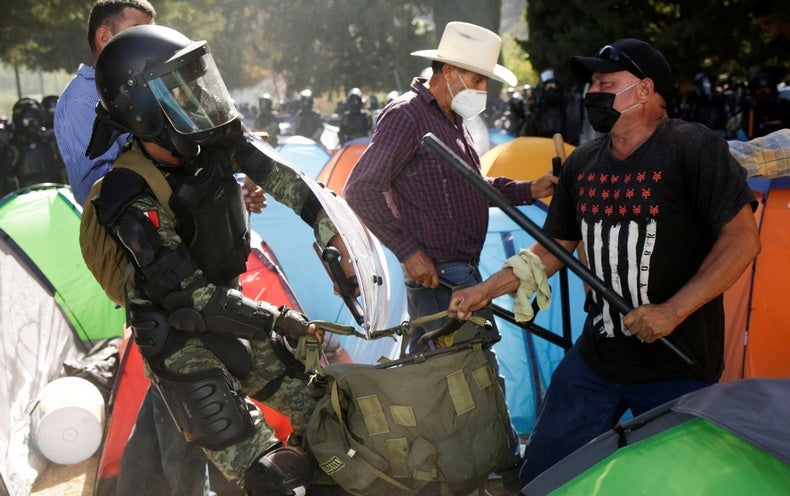
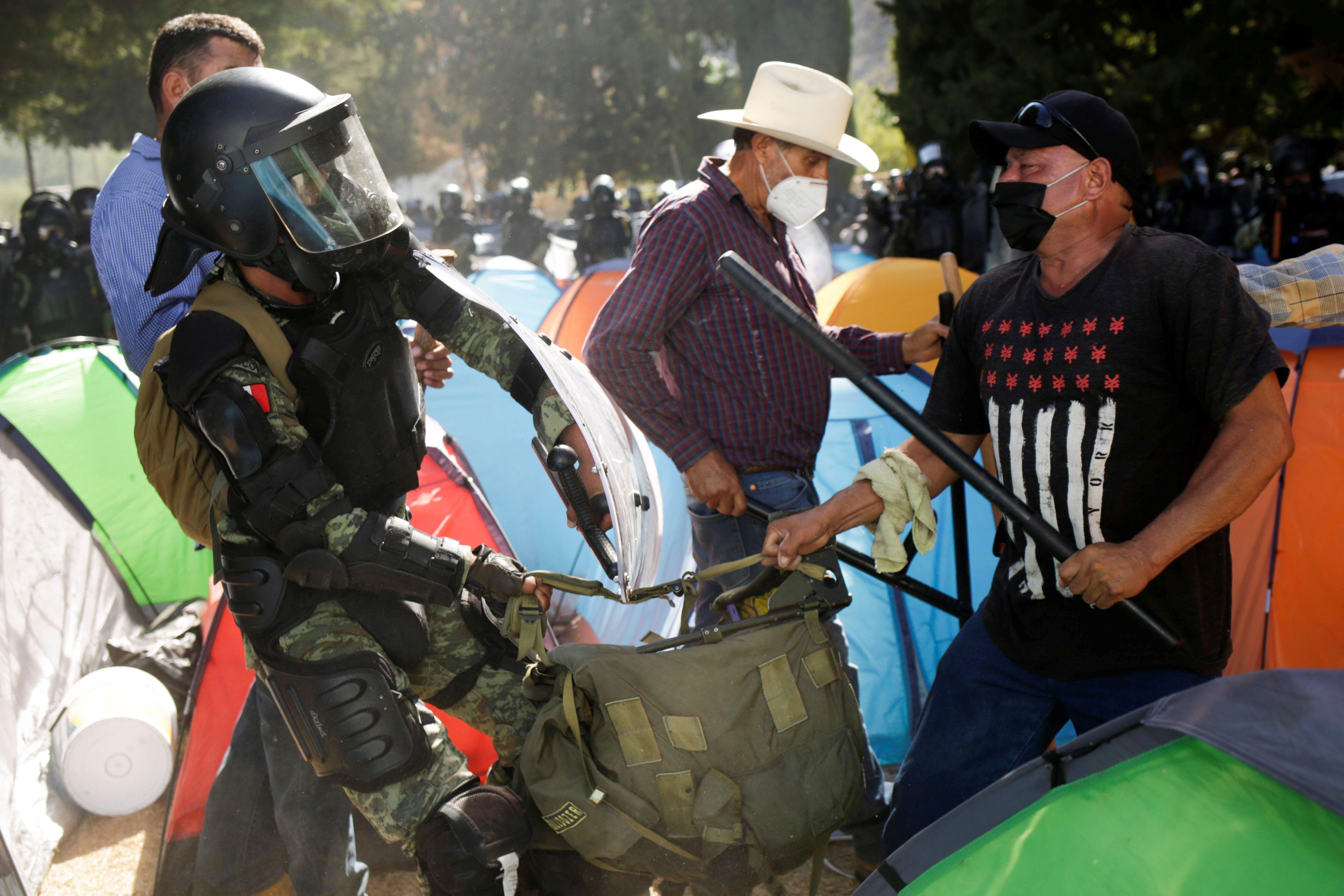
    In 2020, Chihuahuan farmers occupied a dam in protest of Mexico’s treaty-obliged water diversions to the United States while in a drought. In response, the Federal government deployed the National Guard, which killed at least two people. More recently, disgruntled citizens in the states Nuevo Leon and Coahuila burned PVC pipes transporting water from their regions to more influential areas like Monterrey. While it’s hard to know if any of the people involved in this civil unrest were disappeared, it would not surprise me. The water crisis is intensifying civil unrest in an already chaotic situation, and I fear the ranks of dead including the disappeared will swell as cartels expand their influence and state-sponsored violence continues.

    According to the World Bank, Mexico’s murder rate surged from eight per 100,000 people in 2006 to 28 per 100,000 in 2020. All this despite the fact that by 2016, the United States had given more than $1.5 billion in militarized aid for Mexico’s drug war. Quite simply, if the  goal of the U.S. in rendering aid was to reduce violence while strengthening the rule of law,  it’s made a bad investment. Indeed, the U.S. government has acknowledged a need to change its approach to combat violence and cartels in Mexico with the announcement of the Bicentennial Framework;  however, the new framework notably neglects water specific environmental factors. Additionally, in 2021 alone the United States increased by nearly $200 million its humanitarian assistance to Mexico and Central America to provide basic access to food, water and shelter. That is commendable, but if the water systems of these areas are left unchanged then we can only hope for a sort of stable poverty with millions always on the edge of water scarcity.

    Not only does the U.S. have the resources to aid Mexico’s water crisis, but it has the know-how.

    The Biden administration has given $1.7 billion to Southwestern Indigenous tribes near the U.S.-Mexico border to help them improve water infrastructure. These efforts could be repeated in the geographically similar areas of Mexico, as the Environmental Protection Agency, through the Border Water Infrastructure Grant Program, already does in a limited area. The EPA bankrolls Mexican water projects, but only if they occur within 62 miles of the U.S. border and directly affect human and environmental health in the United States.

    In other words, the United States is aware of the scope of Mexico’s water emergency. In the meantime, Mexico City has contracted several NGOs to install rain-capture infrastructure to bolster its water reserves, but has run into funding issues. In water-parched Tijuana, a desalination plant was shelved because of its nearly half a billion dollar price tag, and the local government opted for private assistance to build a smaller desalination plant for $32 million. That plant will provide over five million gallons of water daily for over 100,000 people. For context, the United States gave five times that amount every year between 2006 and 2016 in militarized aid to Mexico.

    Thousands of families in Mexico have no closure in the disappearance or death of someone they love. My experience has shown me the depths of the failure of our fight against Mexico’s violence epidemic. But it has also shown me that we can work to contain it. The water crisis is inseparable from the scourge of violence in Mexico. If the U.S., which has a vested economic, humanitarian, and environmental interest in a stable Mexico, devoted a portion of the money it gives to aid Mexico’s drug war to helping private and public Mexican efforts to improve water capture and management, I believe we would see remarkable progress in the struggle against murder and disappearance in Mexico.

    This is an opinion and analysis article, and the views expressed by the author or authors are not necessarily those of Scientific American.


    Original Source Link

    Share. Facebook Twitter Pinterest LinkedIn WhatsApp Email Reddit Telegram
    Previous Article‘Growing up, I never saw any Black queer heroes in movies’
    Next Article The on-demand delivery trilemma • TechCrunch

    RELATED POSTS

    China Opens World’s First Wind-Powered Underwater Data Center

    June 11, 2026

    How Canadian rock duo Angine de Poitrine play with neurobiology and physics to make viral music

    June 10, 2026

    Frozen squirrel scat preserves ancient DNA from hundreds of species

    June 10, 2026

    This Summer Travel Season Could Forever Alter the Future of Sustainable Aviation Fuel

    June 9, 2026

    ‘Odd’ Gulf of Mexico earthquake rattles Florida and Cuba

    June 9, 2026

    Cuts to US ocean programme will hinder monitoring of El Niño and AMOC

    June 8, 2026
    latest posts

    New York City Declares West 8th Street as “Jimi Hendrix Way”

    While most of New York City right now is adorned in blue and orange, a…

    Digital sovereignty isn’t the same thing as digital isolation. Asia’s governments should be careful

    June 11, 2026

    Democrats Have All The Info They Need To End Trump And Vance With A Real Epstein Investigation

    June 11, 2026

    Jim Jordan scrutinizes U.K. surveillance laws over Five Eyes trust concerns

    June 11, 2026

    CISA Tells US Agencies to Fix Security Bugs in as Little as 3 Days Thanks to AI Threats

    June 11, 2026

    China Opens World’s First Wind-Powered Underwater Data Center

    June 11, 2026

    Poppy Liu on I Love Boosters, Working With Boots Riley, Hacks Ending

    June 11, 2026
    Categories
    • Books (1,298)
    • Business (6,201)
    • Events (58)
    • Film (6,138)
    • Lifestyle (4,220)
    • Music (6,258)
    • Politics (6,194)
    • Science (5,555)
    • Technology (6,134)
    • Television (5,824)
    • Uncategorized (7)
    • US News (6,189)
    popular posts

    A 5-Day Escape to Antigua (and What I Packed)

    A 5-Day Escape to Antigua (and What I Packed)Written by: Brianna Peters | Published on:…

    Why Trump Guitars Was Hit With a Cease-and-Desist By Gibson

    November 25, 2024

    Ariana DeBose Boards Stephanie Laing’s ‘Tow’ (Exclusive)

    April 3, 2024

    Wolfgang Van Halen describes “closure” after tribute to father Eddie

    October 4, 2022
    Archives
    Browse By Category
    • Books (1,298)
    • Business (6,201)
    • Events (58)
    • Film (6,138)
    • Lifestyle (4,220)
    • Music (6,258)
    • Politics (6,194)
    • Science (5,555)
    • Technology (6,134)
    • Television (5,824)
    • Uncategorized (7)
    • US News (6,189)
    About Us

    We are a creativity led international team with a digital soul. Our work is a custom built by the storytellers and strategists with a flair for exploiting the latest advancements in media and technology.

    Most of all, we stand behind our ideas and believe in creativity as the most powerful force in business.

    What makes us Different

    We care. We collaborate. We do great work. And we do it with a smile, because we’re pretty damn excited to do what we do. If you would like details on what else we can do visit out Contact page.

    Our Picks

    China Opens World’s First Wind-Powered Underwater Data Center

    June 11, 2026

    Poppy Liu on I Love Boosters, Working With Boots Riley, Hacks Ending

    June 11, 2026

    ‘The Valley’ Jesse Lally Sticks Up For Danny Booko & His Drinking

    June 11, 2026
    © 2026 New York Examiner News. All rights reserved. All articles, images, product names, logos, and brands are property of their respective owners. All company, product and service names used in this website are for identification purposes only. Use of these names, logos, and brands does not imply endorsement unless specified. By using this site, you agree to the Terms & Conditions and Privacy Policy.

    Type above and press Enter to search. Press Esc to cancel.

    We use cookies on our website to give you the most relevant experience by remembering your preferences and repeat visits. By clicking “Accept All”, you consent to the use of ALL the cookies. However, you may visit "Cookie Settings" to provide a controlled consent.
    Cookie SettingsAccept All
    Manage consent

    Privacy Overview

    This website uses cookies to improve your experience while you navigate through the website. Out of these, the cookies that are categorized as necessary are stored on your browser as they are essential for the working of basic functionalities of the website. We also use third-party cookies that help us analyze and understand how you use this website. These cookies will be stored in your browser only with your consent. You also have the option to opt-out of these cookies. But opting out of some of these cookies may affect your browsing experience.
    Necessary
    Always Enabled
    Necessary cookies are absolutely essential for the website to function properly. These cookies ensure basic functionalities and security features of the website, anonymously.
    CookieDurationDescription
    cookielawinfo-checkbox-analytics11 monthsThis cookie is set by GDPR Cookie Consent plugin. The cookie is used to store the user consent for the cookies in the category "Analytics".
    cookielawinfo-checkbox-functional11 monthsThe cookie is set by GDPR cookie consent to record the user consent for the cookies in the category "Functional".
    cookielawinfo-checkbox-necessary11 monthsThis cookie is set by GDPR Cookie Consent plugin. The cookies is used to store the user consent for the cookies in the category "Necessary".
    cookielawinfo-checkbox-others11 monthsThis cookie is set by GDPR Cookie Consent plugin. The cookie is used to store the user consent for the cookies in the category "Other.
    cookielawinfo-checkbox-performance11 monthsThis cookie is set by GDPR Cookie Consent plugin. The cookie is used to store the user consent for the cookies in the category "Performance".
    viewed_cookie_policy11 monthsThe cookie is set by the GDPR Cookie Consent plugin and is used to store whether or not user has consented to the use of cookies. It does not store any personal data.
    Functional
    Functional cookies help to perform certain functionalities like sharing the content of the website on social media platforms, collect feedbacks, and other third-party features.
    Performance
    Performance cookies are used to understand and analyze the key performance indexes of the website which helps in delivering a better user experience for the visitors.
    Analytics
    Analytical cookies are used to understand how visitors interact with the website. These cookies help provide information on metrics the number of visitors, bounce rate, traffic source, etc.
    Advertisement
    Advertisement cookies are used to provide visitors with relevant ads and marketing campaigns. These cookies track visitors across websites and collect information to provide customized ads.
    Others
    Other uncategorized cookies are those that are being analyzed and have not been classified into a category as yet.
    SAVE & ACCEPT