
Close Menu
New York Examiner News

    Subscribe to Updates

    Get the latest creative news from FooBar about art, design and business.

    What's Hot

    Brent Smith Ranks Every Shinedown Album (Even the New One)

    April 17, 2026

    Trump says Iran war will end ‘pretty soon’ as uranium deal is in sight

    April 17, 2026

    Donald Trump Has Lost His Power To Gaslight America

    April 17, 2026
    Facebook X (Twitter) Instagram
    New York Examiner News
    • Home
    • US News
    • Politics
    • Business
    • Science
    • Technology
    • Lifestyle
    • Music
    • Television
    • Film
    • Books
    • Contact
      • About
      • Amazon Disclaimer
      • DMCA / Copyrights Disclaimer
      • Terms and Conditions
      • Privacy Policy
    New York Examiner News
    Home»Science»Why Do So Many Tiny Asteroids Have Moons?
    Science

    Why Do So Many Tiny Asteroids Have Moons?

    By AdminSeptember 22, 2024
    Facebook Twitter Pinterest LinkedIn WhatsApp Email Reddit Telegram
    Why Do So Many Tiny Asteroids Have Moons?


    You might think of asteroids as just rocks of various sizes floating around in space. But they’re vastly more complex than that: they show an incredible diversity in size, shape, composition and even the way they change over time.

    If you did previously dismiss them, don’t feel bad. It wasn’t until the past few decades that astronomers started to realize just how interesting they are. For a long time, asteroids were treated with contempt; they were even called “vermin of the sky” for their tendency to photobomb astronomers’ observations of “important” objects, such as stars and galaxies.

    As astronomical equipment and techniques improved over the years, asteroids came into their own. And now, with spacecraft, we can study more of them up close and better appreciate their complexity, especially when it comes to small ones orbited by tiny asteroid moons.


    On supporting science journalism

    If you’re enjoying this article, consider supporting our award-winning journalism by subscribing. By purchasing a subscription you are helping to ensure the future of impactful stories about the discoveries and ideas shaping our world today.


    Yes, just like larger planets, asteroids can have moons, too!

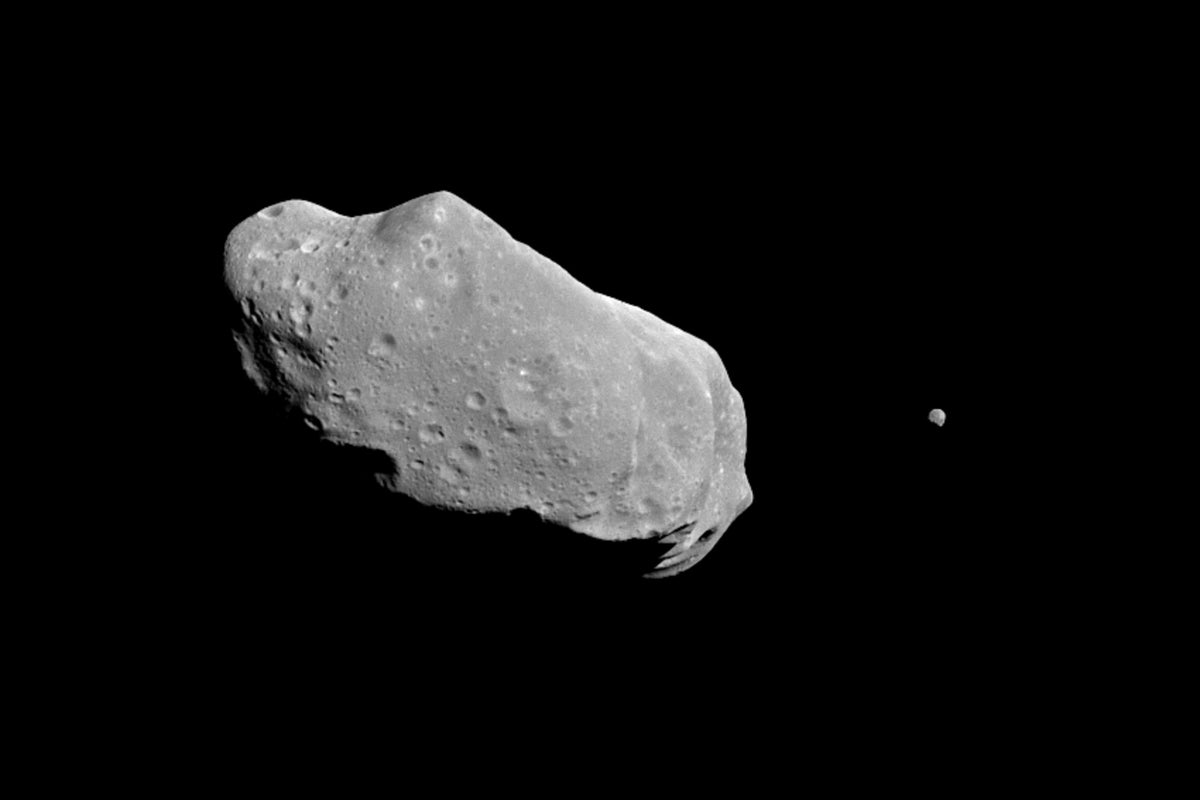
    The fact that asteroids can have satellites at all came as something of a surprise. The first such “binary asteroid” was discovered when NASA’s Jupiter-bound Galileo probe flew by the 60-kilometer-long asteroid Ida in 1993 and spotted Dactyl, a smaller 1.6-km wide orbiting companion. Since then scientists have found many hundreds more, but the origins of asteroid moons are still a bit mysterious. One idea is that they’re born at the same time as their parent object, possibly during an impact on a much larger asteroid. As debris from the big rock is ejected, some of it can collect together to form multiple objects. If two of those are moving at roughly the same speed, they can become bound gravitationally, forming an asteroid with a moon. It’s also possible that after an asteroid suffers a slow-speed collision, the debris directly coalesces to form a satellite.

    This could account for some of the pairs seen, but—and this is a common theme in astronomy—the situation is more nuanced than first thought. Many if not most smaller asteroids are “rubble piles” composed of small rocks tenuously held together by their own mutual gravity. They’re more like debris heaps in a construction pit than single, monolithic objects. Spacecraft have visited several small asteroids that pass near Earth, and they’ve all been rubble piles.

    For example, the near-Earth asteroid Didymos is about 850 meters wide and has a satellite, Dimorphos, that is approximately one fifth its width. Both are rubble piles. That basic similarity allows a potentially enlightening comparison to be made. Both objects are oblate, like a beach ball that someone has sat on; that’s what you’d expect of a fast-spinning rubble pile such as Didymos, which has a circa two-hour rotation. Such a rapid spin raises a significant centrifugal force at Didymos’s equator so that the asteroid, a loose conglomeration of smaller rocks, flattens out as the rocks roll toward its middle. Dimorphos’s oblate shape is more puzzling because this tiny moon spins too slowly (about once every 12 hours) to generate enough asteroid-flattening centrifugal force. So how did Dimorphos get squashed?

    Research published in the planetary science journal Icarus suggests an answer that could also explain the wider variety of shapes seen in binary asteroids.

    The leading hypothesis for an asteroid moon’s initial formation is what’s called mass shedding. In this scenario, a primary (larger) asteroid spins so fast that it ejects material from its surface, much like the old spinning playground equipment that would fling kids off at high speed as it rapidly rotated. (These are no longer en vogue, probably because they were designed to fling kids off at high speed.) Asteroids aren’t thought to start out spinning quickly enough to shoot away rocks, however. Instead they’re probably born spinning slowly but can gradually increase their rotation rate, thanks to an unlikely source: sunlight.

    A deeply weird but thoroughly verified quirk of physics is that while photons—particles of light—have no mass, they do have momentum. This means that photons can push on an asteroid to change its spin: the rock absorbs light from the sun, then reemits that energy as infrared light.

    If the asteroid were a perfectly smooth sphere, this process would be symmetric, and no changes would occur. Asteroids are not perfect spheres, however; they are more like lumpy, bumpy space potatoes. Because of this, absorbed sunlight isn’t reradiated in every direction equally but in some directions more than others. This acts like a very small rocket thrust, slightly changing the asteroid’s rotation, and can eventually accelerate the spin so much that the centrifugal force overpowers the asteroid’s weak gravity. The asteroid can then start shedding material into space from its equator. This spin-up, by the way, is called the YORP effect, short for the Yarkovsky-O’Keefe-Radzievskii-Paddack effect, after the scientists who first derived it. That’s a mouthful, so YORP is easier (and much more fun) to say.

    For a decently hefty asteroid, one that is a few hundred meters wide, that material isn’t flung away fast enough to escape entirely. Instead it forms an orbiting disk around the asteroid. If that material is too close to the surface, the tidal force from the asteroid can pull it apart, preventing the disk from aggregating into a moon. That tidal force weakens with distance, however, so a sufficiently far-out disk can give rise to an asteroid’s accompanying moon.

    Even then, the tidal force is enough to affect how the moon forms. The disk’s material will most likely fall onto the embryonic moon from the radial (in-out) direction, sculpting the satellite into an egg or football shape—what’s called a prolate spheroid—with the long axis pointing toward the parent body. Left alone, this is the shape most asteroid moons should be.

    But forming a moon is a messy business. Smaller chunks can emerge, only to then collide. What the scientists found in their Icarus study is that these collisions can change the shape of the overall moon as well, transforming it from prolate to oblate, just like we see with Dimorphos. The overall shape depends on the violence of the collisions as well as the geometry, but oblateness is a common end point.

    Interestingly, they also found that for denser primary asteroids, which exhibit stronger tides, collisions between two prolate moons during their individual formation can create what are called bilobate asteroids—two smaller masses that are touching, like the two snowballs that make the bottom two thirds of an archetypal snowman. Just such an asteroid moon was discovered late last year when NASA’s Lucy mission took close-up images of the small asteroid Dinkinesh and found that its moon, Selam, displayed this bizarre bilobate form.

    There are still other forms that small asteroids can take on, such as the mysterious diamond shapes of Bennu and Ryugu; each looks like a pair of eroded pyramids glued together base-to-base. The sculpting mechanism there isn’t well understood just yet; it could be caused by much of what’s described above plus the way jagged rocks move over each other in low gravity. There’s even a hypothesis that Ryugu started off as a comet and became an asteroid as it lost material.

    Clearly there’s a lot left to learn about space rocks. Given that they could still impact our planet and cause widespread havoc, finding out as much as we can about them doesn’t just satisfy our need to gain knowledge for the love of science—it could increase humanity’s ability to stick around, too.


    Original Source Link

    Share. Facebook Twitter Pinterest LinkedIn WhatsApp Email Reddit Telegram
    Previous ArticleWhen Fall Is Coming – first-look review
    Next Article This New Pac-Man Machine Brought Me Closer to My Teen Kids

    RELATED POSTS

    Former deputy surgeon general Erica Schwartz nominated as new CDC chief

    April 17, 2026

    Our dreams become more emotive and symbolic as we approach death

    April 16, 2026

    The US Government Will Ask Data Centers How Much Power They Use

    April 16, 2026

    The Trump administration is looking to experts to weigh in on peptides

    April 15, 2026

    Is a super El Niño imminent, and what could the impacts be?

    April 15, 2026

    Marine Animals in the Strait of Hormuz Don’t Get a Ceasefire

    April 14, 2026
    latest posts

    Brent Smith Ranks Every Shinedown Album (Even the New One)

    With a new album underway, Brent Smith ranked every Shinedown album — even the new…

    Trump says Iran war will end ‘pretty soon’ as uranium deal is in sight

    April 17, 2026

    Donald Trump Has Lost His Power To Gaslight America

    April 17, 2026

    Trump nominates former deputy surgeon general Erica Schwartz for CDC director

    April 17, 2026

    New leaders, new fund: Sequoia has raised $7B to expand its AI bets

    April 17, 2026

    Former deputy surgeon general Erica Schwartz nominated as new CDC chief

    April 17, 2026

    Paramount Skydance Confirming New Star Trek Movie After 10-Year Hiatus Is A Familiar Refrain

    April 17, 2026
    Categories
    • Books (1,188)
    • Business (6,091)
    • Events (44)
    • Film (6,028)
    • Lifestyle (4,130)
    • Music (6,140)
    • Politics (6,090)
    • Science (5,445)
    • Technology (6,022)
    • Television (5,710)
    • Uncategorized (6)
    • US News (6,080)
    popular posts

    Trump Rips ‘Bulls**t Artist’ Elon Musk As Tesla CEO Reportedly Defends Trump

    Donald Trump ripped Tesla CEO Elon Musk on Saturday, the same day Musk reportedly defended…

    Jensen Huang hails DeepSeek, touts ‘extraordinary’ Blackwell demand after Nvidia crushes earnings—again

    February 27, 2025

    Free Antivirus software. Should you use it?

    December 11, 2022

    18 Best Mattress and Sleep Deals for Prime Day (Day 2) (2022)

    July 13, 2022
    Archives
    Browse By Category
    • Books (1,188)
    • Business (6,091)
    • Events (44)
    • Film (6,028)
    • Lifestyle (4,130)
    • Music (6,140)
    • Politics (6,090)
    • Science (5,445)
    • Technology (6,022)
    • Television (5,710)
    • Uncategorized (6)
    • US News (6,080)
    About Us

    We are a creativity led international team with a digital soul. Our work is a custom built by the storytellers and strategists with a flair for exploiting the latest advancements in media and technology.

    Most of all, we stand behind our ideas and believe in creativity as the most powerful force in business.

    What makes us Different

    We care. We collaborate. We do great work. And we do it with a smile, because we’re pretty damn excited to do what we do. If you would like details on what else we can do visit out Contact page.

    Our Picks

    Former deputy surgeon general Erica Schwartz nominated as new CDC chief

    April 17, 2026

    Paramount Skydance Confirming New Star Trek Movie After 10-Year Hiatus Is A Familiar Refrain

    April 17, 2026

    Stars on Robby and Abbot’s Trauma Talk, Mohan’s Future, More (Exclusive)

    April 17, 2026
    © 2026 New York Examiner News. All rights reserved. All articles, images, product names, logos, and brands are property of their respective owners. All company, product and service names used in this website are for identification purposes only. Use of these names, logos, and brands does not imply endorsement unless specified. By using this site, you agree to the Terms & Conditions and Privacy Policy.

    Type above and press Enter to search. Press Esc to cancel.

    We use cookies on our website to give you the most relevant experience by remembering your preferences and repeat visits. By clicking “Accept All”, you consent to the use of ALL the cookies. However, you may visit "Cookie Settings" to provide a controlled consent.
    Cookie SettingsAccept All
    Manage consent

    Privacy Overview

    This website uses cookies to improve your experience while you navigate through the website. Out of these, the cookies that are categorized as necessary are stored on your browser as they are essential for the working of basic functionalities of the website. We also use third-party cookies that help us analyze and understand how you use this website. These cookies will be stored in your browser only with your consent. You also have the option to opt-out of these cookies. But opting out of some of these cookies may affect your browsing experience.
    Necessary
    Always Enabled
    Necessary cookies are absolutely essential for the website to function properly. These cookies ensure basic functionalities and security features of the website, anonymously.
    CookieDurationDescription
    cookielawinfo-checkbox-analytics11 monthsThis cookie is set by GDPR Cookie Consent plugin. The cookie is used to store the user consent for the cookies in the category "Analytics".
    cookielawinfo-checkbox-functional11 monthsThe cookie is set by GDPR cookie consent to record the user consent for the cookies in the category "Functional".
    cookielawinfo-checkbox-necessary11 monthsThis cookie is set by GDPR Cookie Consent plugin. The cookies is used to store the user consent for the cookies in the category "Necessary".
    cookielawinfo-checkbox-others11 monthsThis cookie is set by GDPR Cookie Consent plugin. The cookie is used to store the user consent for the cookies in the category "Other.
    cookielawinfo-checkbox-performance11 monthsThis cookie is set by GDPR Cookie Consent plugin. The cookie is used to store the user consent for the cookies in the category "Performance".
    viewed_cookie_policy11 monthsThe cookie is set by the GDPR Cookie Consent plugin and is used to store whether or not user has consented to the use of cookies. It does not store any personal data.
    Functional
    Functional cookies help to perform certain functionalities like sharing the content of the website on social media platforms, collect feedbacks, and other third-party features.
    Performance
    Performance cookies are used to understand and analyze the key performance indexes of the website which helps in delivering a better user experience for the visitors.
    Analytics
    Analytical cookies are used to understand how visitors interact with the website. These cookies help provide information on metrics the number of visitors, bounce rate, traffic source, etc.
    Advertisement
    Advertisement cookies are used to provide visitors with relevant ads and marketing campaigns. These cookies track visitors across websites and collect information to provide customized ads.
    Others
    Other uncategorized cookies are those that are being analyzed and have not been classified into a category as yet.
    SAVE & ACCEPT