
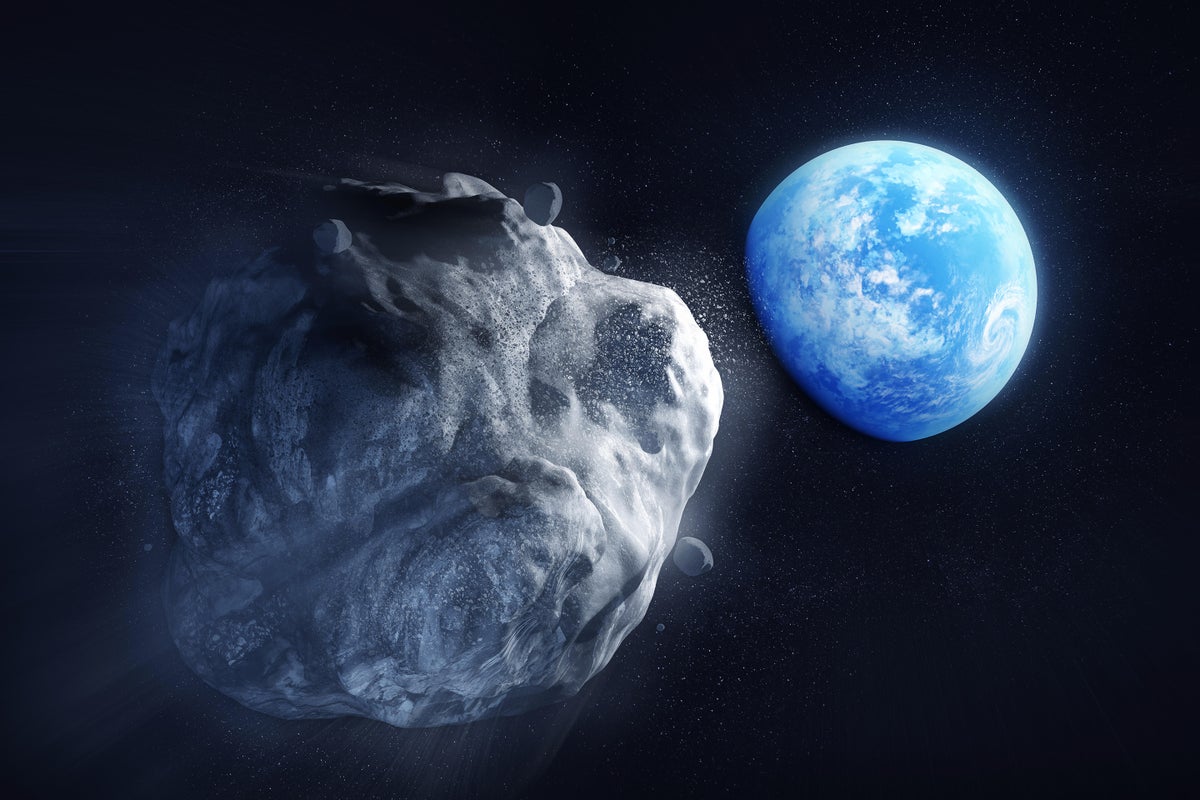
In late December astronomers using the Asteroid Terrestrial-Impact Last Alert System (ATLAS) telescope in Chile observed a new asteroid near our planet. Dubbed 2024 YR4, the object—somewhere between 40 and 100 meters in size—was spotted on December 27. The asteroid’s closest approach to Earth, it turned out, had been two days earlier, when YR4 was about 800,000 kilometers from our planet, roughly twice as far away as the moon. “It was zooming right by Earth,” says John Tonry, an astronomer at the University of Hawaii. Such objects are not uncommon; there are thousands of asteroids of this size or greater in our region of the solar system. But this one warranted further attention to make sure it wouldn’t pose a risk to our planet in future.
Rather than ruling out an impact, however, follow-up observations have done quite the opposite. On January 27 a NASA service called Sentry, which monitors potential asteroid impacts by pooling together observations from telescopes around the world, upgraded the risk of Y24 to our planet to an unprecedented degree. YR4, it seemed, had a 1.3 percent chance of hitting Earth on December 22, 2032. This assessment corresponds to a threat level of 3 on the Torino scale, a metric that ranks the danger an asteroid poses to Earth on an ascending scale from 1 to 10. Two days later the European Space Agency (ESA) announced that it had estimated a similar impact risk, and as this story went to press NASA’s Sentry service had upped the impact risk to 1.6 percent.
The chance of an impact is still low. “There is a 99 percent probability that this is going to miss, and that’s what we expect to happen,” says Davide Farnocchia, a scientist at the Center for Near Earth Object Studies at NASA’s Jet Propulsion Laboratory. This is a higher impact risk to our planet, however, than that of any asteroid since Apophis, which, for a brief while in December 2004, was estimated to have a 2.7 percent chance of hitting our planet in 2029. Better observations of Apophis eventually refined its orbit so that astronomers could confidently say it would miss. They are expecting that to happen with YR4, too—but so far, the ongoing analysis has been trending in the other direction. “The probability is increasing,” says Juan Luis Cano, planetary defense coordinator at ESA’s Near-Earth Object Coordination Center. And that might pose an interesting dilemma.
On supporting science journalism
If you’re enjoying this article, consider supporting our award-winning journalism by subscribing. By purchasing a subscription you are helping to ensure the future of impactful stories about the discoveries and ideas shaping our world today.
If an asteroid the size of YR4 were to hit our planet, it would not end life on Earth, but it would be devastating. At that size, the impact would be equivalent to a “10-megaton bomb,” Tonry says—more than enough to cause widespread regional decimation. “Everything within three or four kilometers would be incinerated,” Tonry says. “Everything out to maybe 10 kilometers is smashed. It’s not a nuclear explosion, but it’s an extremely hot explosion. There would be a huge fireball that would start fires out to 15 kilometers, something like that. It would kill a lot of people if they haven’t moved out of the way.”
Observations suggest YR4 is a stony asteroid rather than a metal-rich one, says Melissa Brucker, a planetary scientist at the University of Arizona. That means it would likely explode from the pressure in the upper atmosphere instead of reaching Earth’s surface. This could make its impact similar to the famous Tunguska event in 1908, when a suspected asteroid or comet burst over Russia and flattened 2,150 square kilometers of remote Siberian forest. “We think YR4 is about the same size as the Tunguska event [object],” Brucker says. A more recent example of such an impact occurred in 2013, when a meteor estimated at 20 meters wide exploded over the city of Chelyabinsk in Russia, shattering windows and injuring hundreds of people.

The near-Earth asteroid 2024 YR4, as seen by the European Southern Observatory’s Very Large Telescope in January 2025, shortly after the object was discovered in December 2024. As of January 29, 2025, the asteroid has an almost 99 percent chance of safely passing Earth on December 22, 2032, but a possible impact cannot yet be entirely ruled out.
While we can’t say for sure where YR4 would strike our planet, we can geographically constrain where Earth would possibly take the hit based on the projected impact date of December 22, 2032, says Daniel Bamberger, an amateur astronomer in Germany, who has calculated the asteroid’s possible impact corridor. The area under threat is a swath extending from the Pacific Ocean through northern South America, the Atlantic Ocean, sub-Saharan Africa, the Arabian Sea and parts of South Asia. “We knew we would one day find such an object with a reasonably high chance of impact,” he says.
Although apparently remote, the impact risk of YR4 remains worthy of notice, says Richard Binzel, a planetary scientist at the Massachusetts Institute of Technology, who created the Torino scale in 1997. A roughly 1 percent chance seems vanishingly small, and late 2032 may seem far-off, but the odds can rapidly worsen, and attempts to deflect or mitigate an impactor would require years to plan and execute. As astronomers get further views of the asteroid and better track its orbit, its Torino ranking may drop to level 1 and ultimately 0. But if instead such orbital refinements reveal YR4 on an ever tightening trajectory toward our planet, its assessed hazard could ascend to level 8 on the scale, the highest level possible for an asteroid of this size. “Level 8 means a certain collision,” Binzel says.
The risk of the asteroid hitting our planet could be promptly dismissed if astronomers find historical observations of YR4 from long-running surveys and gain knowledge of its trajectory over a long period of time. “It would immediately be clear if there was an impact or no impact,” Bamberger says. “That would be the end of the story.” Astronomers think such observations might have occurred during telescope surveys that were operational when the asteroid was calculated to have made a previous pass by Earth in 2016, but so far, archival searches have come up short. “We have been doing this for two weeks now, and unfortunately we haven’t succeeded,” Cano says.
And time is of the essence. The asteroid is currently moving away from Earth, and by April, it will no longer be visible to telescopes. Outside this slim window of opportunity, the next chance to observe the asteroid to assess its threat won’t arrive until YR4 next swoops near Earth in 2028—the only such pass before the unnerving deadline of December 22, 2032. If the asteroid still poses an impact risk by then, there would be perilously little time to stand up a robust response. Prudence may thus demand devising a mitigation strategy in the interim on the off chance—even if remote—that the asteroid could hit.
“When it comes whipping by in 2028, we could have a mission basically all ready to go when new observations come in,” Tonry says. Alternatively, he adds, “we could decide to leave it alone” if forecasts show the asteroid won’t strike Earth.
Preparations for such a precautionary response could begin as soon as next week, when, by chance, meetings of the United Nations’ Space Mission Planning Advisory Group and the International Asteroid Warning Network will take place between space agencies. “We’re going to be looking very carefully at this object,” Cano says. If the risk of impact cannot be ruled out before this April, the prospect of a deflection mission in 2028 might need to be seriously discussed. “Eight years until the [potential] impact is a very challenging scenario,” Cano says. “It takes between three to five years to design and build a mission. It would be really constrained.” Such a mission design could be similar to NASA’s Double Asteroid Redirection Test, which successfully changed the orbit of an asteroid by slamming into it in September 2022.
If deflection is not an option, the next one might be to explore “evacuation measures on the ground” in the predicted impact region, Farnocchia says. If the asteroid’s threat doesn’t dissipate as expected, such dire discussions would be years away, assuming they happen at all. The overwhelmingly likely scenario is that more observations of YR4 will prove that it will miss our planet and pose no risk. And there are plenty of available telescopes that can make those observations. Cano says he has applied for time on NASA’s James Webb Space Telescope to observe the asteroid, while Brucker says she could use the Keck Observatory in Hawaii to seek out YR4.
Amid so much unsettling uncertainty, the rapid progression of astronomers’ responses to YR4 offers reasons for optimism. As powerless as we may sometimes feel against natural disasters—especially ones as extreme as the universe hurling a space rock at Earth’s face—the global imperative to track and study potentially threatening asteroids is paying off. Decades ago it was a tall order to simply detect an object like YR4 in the first place, not to mention precisely tracking its path and possibility for destruction. Today space scientists are remarkably close to completing their census of sizable near-Earth objects to determine just how dangerous any really are. “All of the efforts that we have been doing in the last 20 years are fully devoted to finding asteroids and evaluating the chances that they will impact Earth,” Cano says. “That’s why we are here.”
Editor’s Note (1/31/24): This article was edited after posting to correct the name of the asteroid 2024 YR4.