
Close Menu
New York Examiner News

    Subscribe to Updates

    Get the latest creative news from FooBar about art, design and business.

    What's Hot

    Has Iran Won the War? It Thinks So Update By Howard Bloom

    May 29, 2026

    Bret Michaels Bails on Trump’s Great American State Fair

    May 29, 2026

    Girls Who Code CEO: 70% of teen girls want to work in cybersecurity. We’re losing them before they start

    May 29, 2026
    Facebook X (Twitter) Instagram
    New York Examiner News
    • Home
    • US News
    • Politics
    • Business
    • Science
    • Technology
    • Lifestyle
    • Music
    • Television
    • Film
    • Books
    • Contact
      • About
      • Amazon Disclaimer
      • DMCA / Copyrights Disclaimer
      • Terms and Conditions
      • Privacy Policy
    New York Examiner News
    Home»Science»We’re Thinking About Space All Wrong Humanity Must Stop Visiting Space, and Start Living There By Erinn van Wynsberghe Founder, VanWyn With Howard Bloom, Founder & Chair, Space Development Steering Committee
    Science

    We’re Thinking About Space All Wrong Humanity Must Stop Visiting Space, and Start Living There By Erinn van Wynsberghe Founder, VanWyn With Howard Bloom, Founder & Chair, Space Development Steering Committee

    By AdminMay 1, 2026
    Facebook Twitter Pinterest LinkedIn WhatsApp Email Reddit Telegram
    We’re Thinking About Space All Wrong Humanity Must Stop Visiting Space, and Start Living There  By Erinn van Wynsberghe  Founder, VanWyn With Howard Bloom, Founder & Chair, Space Development Steering Committee

    For more than half a century, we have told ourselves a story about space. It is a story of missions. We launch. We travel. We land. We plant a flag. And we come home. Apollo did it. Artemis is trying to do it again. Every headline, every press release, every televised launch reinforces the same narrative: Space is a place we visit.

    That story is not just outdated. It is dangerously wrong. Because what is happening right now is not a new era of exploration. It is a phase transition in the evolution of life itself.

    In his recent book, The Case of the Sexual Cosmos, Howard Bloom argues that the forces that drive life on Earth do not stop at the edge of our atmosphere. They are expansive, generative, and relentless. Life does not remain confined. It spreads, adapts, and invents. What we are beginning to see in space is not exploration.

    It is the emergence of a supply chain to space. Orbital transfer vehicles. Commercial space stations. Lunar landers. Surface payload systems. These are not isolated technologies. They are the early components of an interconnected architecture.  In other words, we are no longer merely exploring space.  We are preparing to take life from the surface of one planet to many.  We are preparing to give life a home in space.

    Which means it’s time to  stop calling our human launches  space missions.  Civilizations are not built on missions. They are built on systems.

    They are built on logistics chains that move materials continuously. On infrastructure that endures. On energy systems that operate without interruption. On maintenance cycles, redundancy, and operational planning.

    We already know how to do this. We have been doing it for decades. The International Space Station is not a mission. It is a system. It has remained continuously inhabited for more than twenty years because it is supported by a steady cadence of crew rotations, cargo deliveries, and maintenance operations.

    That is the model. Not missions. Campaigns.

    A campaign is fundamentally different from a mission. A campaign is ongoing. It integrates multiple launches, multiple systems, and multiple objectives into a sustained effort. It requires coordination between crewed and uncrewed operations. It depends on reliable logistics and repeatable processes.

    This is the shift we are only beginning to articulate. We must move from thinking about individual lunar landings to thinking about monthly cargo deliveries. From single rockets to launch cadence. From isolated missions to integrated systems of transport, energy, and habitation.

    The question is no longer, “Can we go?” The question is, “Can we sustain the flow?”

    This shift from missions to permanence is not just a technical evolution. It is a psychological and philosophical one. It requires us to stop thinking like explorers and start thinking like builders of infrastructure. Explorers pass through. Builders stay.

    Builders create transport networks between orbit and surface. They establish base camps, not just landing sites. They think about where to place habitats, how to move materials, how to generate and store energy, how to maintain systems over years and decades.

    Even the choice of location on the Moon reflects this shift. The question is no longer, “Where is the most interesting place to land?” It is, “Where can we build a sustainable operational base with access to multiple regions, resources, and routes?”
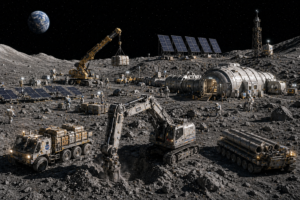
    This is the thinking that built Antarctica’s presence. Not at the most extreme point, but at a location that enabled continuous operation and expansion.

    Civilization is not built at the edge. It is built where systems can function.

    For decades, we have framed space as a place of scarcity. We ask whether there is water on the Moon, as if our future depends on finding a hidden reservoir. But this is the wrong question. If you have sufficient energy, water is not something you find. It is something you produce. The Moon is rich in oxygen bound in oxides. Hydrogen exists in trace amounts. With enough power, chemistry does the rest.

    This is the deeper shift we are only beginning to grasp. Space is not barren. It is raw potential. And the key to unlocking that potential is not discovery. It is infrastructure powered by energy.

    From the moment life first emerged on Earth, it has expanded. It has pushed into every available niche, reshaping environments along the way. Now, for the first time, life has developed the tools to expand beyond its home planet.

    But this expansion will not happen through isolated heroic missions. It will happen through systems that operate continuously. Through cargo flights that arrive on schedule. Through machines that build and maintain. Through energy systems that run without interruption. Through human crews supported by a constant logistical backbone.

    That is how life spreads. Not in leaps. But in sustained, coordinated processes.

    This expansion will not be carried out by humans alone. Robotics and artificial intelligence are becoming integral to this system. Machines can operate continuously in harsh environments. They can build, extract, process, and maintain infrastructure long before humans arrive and long after.

    But this is not a replacement. It is a partnership. Human beings provide vision, direction, and meaning. Machines provide scale, precision, and persistence. Together, they create a system capable of sustaining life beyond Earth.
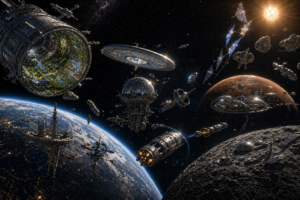
    The greatest obstacle to this future is not engineering. It is imagination. We are still designing programs as if we are visiting a distant outpost, not building a new domain of civilization. We debate constraints that are already beginning to dissolve. We cling to frameworks that no longer match our capabilities. We are thinking too small.

    We stand at a hinge point in history. The technologies required for permanence are emerging. Launch cadence is increasing. Costs are falling. Infrastructure is taking shape.

    The pieces are coming together. What is missing is the shift in mindset. We must stop asking how to execute the next mission. We must start asking how to build systems that endure.

    Because the truth is this: We are no longer a species that merely explores. We are becoming a species that builds beyond Earth. A species that plants life in space. A species that begins, however tentatively, to garden the solar system and green the galaxy.

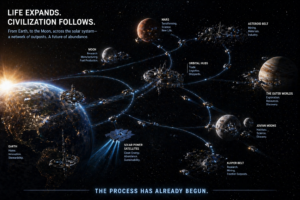
    And the process has already begun.
    ___________

    Howard Bloom of the Howard Bloom Institute has been called the Einstein, Newton, Darwin, and Freud of the 21st century by Britain’s Channel 4 TV. One of his eight books — Global Brain — was the subject of a symposium thrown by the Office of the Secretary of Defense including representatives from the State Department, the Energy Department, DARPA, IBM, and MIT. His work has been published in The Washington Post, The Wall Street Journal, Wired, Psychology Today, and Scientific American. He is the founder of the Space Development Steering Committee and the co-founder of the Asia Space Technology Summit. Bloom does news commentary at 1:06 am Eastern Time every Wednesday night on 545 radio stations on Coast-to-Coast AM. For more, see http://howardbloom.institute.

    Share. Facebook Twitter Pinterest LinkedIn WhatsApp Email Reddit Telegram
    Previous ArticleIsaiah Rashad Links Up With SZA for New Song “Boy in Red”
    Next Article Mystery & Thriller Where Every Answer Costs Something

    RELATED POSTS

    This chip startup just raised $135M on a bet that AI’s biggest bottleneck isn’t compute — it’s memory

    May 29, 2026

    White House proposes new rules giving political appointees final approval on research grants

    May 29, 2026

    The GOP’s Attacks on James Talarico Are Straight Out of the Incel Handbook

    May 29, 2026

    Mathematical AI helps researchers crack 50-year-old problem

    May 29, 2026

    Oura unveils its Ring 5 with a thinner, lighter design starting at $399

    May 28, 2026

    These Ebola Researchers Are Stuck in US Due to Trump’s Funding Cuts

    May 28, 2026
    latest posts

    Has Iran Won the War? It Thinks So Update By Howard Bloom

    Our president believes we’ve won the Iran war. He might be surprised to discover that…

    Bret Michaels Bails on Trump’s Great American State Fair

    May 29, 2026

    Girls Who Code CEO: 70% of teen girls want to work in cybersecurity. We’re losing them before they start

    May 29, 2026

    Power To The People Protest Festival Will Be The Final Pre-Midterm Nail In Trump’s Coffin

    May 29, 2026

    Archaeologists discover 2,500-year-old Bronze Age neck rings in Swedish grave

    May 29, 2026

    This chip startup just raised $135M on a bet that AI’s biggest bottleneck isn’t compute — it’s memory

    May 29, 2026

    White House proposes new rules giving political appointees final approval on research grants

    May 29, 2026
    Categories
    • Books (1,272)
    • Business (6,176)
    • Events (55)
    • Film (6,113)
    • Lifestyle (4,210)
    • Music (6,231)
    • Politics (6,171)
    • Science (5,530)
    • Technology (6,109)
    • Television (5,796)
    • Uncategorized (7)
    • US News (6,164)
    popular posts

    Zepbound: Highly effective weight-loss drug approved for use in the US

    Tirzepatide is sold under the name Mounjaro to treat type 2 diabetesShutterstock / Mohammed_Al_Ali A…

    Plus, The Best Teas For Bloating

    October 17, 2023

    Star of The Leopard, Le Samourai, Purple Noon Was 88

    August 18, 2024

    Don’t Let The Media Blame Democrats For Republican Dysfunction

    October 5, 2023
    Archives
    Browse By Category
    • Books (1,272)
    • Business (6,176)
    • Events (55)
    • Film (6,113)
    • Lifestyle (4,210)
    • Music (6,231)
    • Politics (6,171)
    • Science (5,530)
    • Technology (6,109)
    • Television (5,796)
    • Uncategorized (7)
    • US News (6,164)
    About Us

    We are a creativity led international team with a digital soul. Our work is a custom built by the storytellers and strategists with a flair for exploiting the latest advancements in media and technology.

    Most of all, we stand behind our ideas and believe in creativity as the most powerful force in business.

    What makes us Different

    We care. We collaborate. We do great work. And we do it with a smile, because we’re pretty damn excited to do what we do. If you would like details on what else we can do visit out Contact page.

    Our Picks

    This chip startup just raised $135M on a bet that AI’s biggest bottleneck isn’t compute — it’s memory

    May 29, 2026

    White House proposes new rules giving political appointees final approval on research grants

    May 29, 2026

    GTA 6 Unreal Loading Times Shown In Leaked Gameplay

    May 29, 2026
    © 2026 New York Examiner News. All rights reserved. All articles, images, product names, logos, and brands are property of their respective owners. All company, product and service names used in this website are for identification purposes only. Use of these names, logos, and brands does not imply endorsement unless specified. By using this site, you agree to the Terms & Conditions and Privacy Policy.

    Type above and press Enter to search. Press Esc to cancel.

    We use cookies on our website to give you the most relevant experience by remembering your preferences and repeat visits. By clicking “Accept All”, you consent to the use of ALL the cookies. However, you may visit "Cookie Settings" to provide a controlled consent.
    Cookie SettingsAccept All
    Manage consent

    Privacy Overview

    This website uses cookies to improve your experience while you navigate through the website. Out of these, the cookies that are categorized as necessary are stored on your browser as they are essential for the working of basic functionalities of the website. We also use third-party cookies that help us analyze and understand how you use this website. These cookies will be stored in your browser only with your consent. You also have the option to opt-out of these cookies. But opting out of some of these cookies may affect your browsing experience.
    Necessary
    Always Enabled
    Necessary cookies are absolutely essential for the website to function properly. These cookies ensure basic functionalities and security features of the website, anonymously.
    CookieDurationDescription
    cookielawinfo-checkbox-analytics11 monthsThis cookie is set by GDPR Cookie Consent plugin. The cookie is used to store the user consent for the cookies in the category "Analytics".
    cookielawinfo-checkbox-functional11 monthsThe cookie is set by GDPR cookie consent to record the user consent for the cookies in the category "Functional".
    cookielawinfo-checkbox-necessary11 monthsThis cookie is set by GDPR Cookie Consent plugin. The cookies is used to store the user consent for the cookies in the category "Necessary".
    cookielawinfo-checkbox-others11 monthsThis cookie is set by GDPR Cookie Consent plugin. The cookie is used to store the user consent for the cookies in the category "Other.
    cookielawinfo-checkbox-performance11 monthsThis cookie is set by GDPR Cookie Consent plugin. The cookie is used to store the user consent for the cookies in the category "Performance".
    viewed_cookie_policy11 monthsThe cookie is set by the GDPR Cookie Consent plugin and is used to store whether or not user has consented to the use of cookies. It does not store any personal data.
    Functional
    Functional cookies help to perform certain functionalities like sharing the content of the website on social media platforms, collect feedbacks, and other third-party features.
    Performance
    Performance cookies are used to understand and analyze the key performance indexes of the website which helps in delivering a better user experience for the visitors.
    Analytics
    Analytical cookies are used to understand how visitors interact with the website. These cookies help provide information on metrics the number of visitors, bounce rate, traffic source, etc.
    Advertisement
    Advertisement cookies are used to provide visitors with relevant ads and marketing campaigns. These cookies track visitors across websites and collect information to provide customized ads.
    Others
    Other uncategorized cookies are those that are being analyzed and have not been classified into a category as yet.
    SAVE & ACCEPT