
The legacy that accompanies most anime is often viewed through the lens of its era, with distinct tropes, animation styles, and elements acting as defining markers for each decade. Notwithstanding, true artistry occasionally transcends these temporal boundaries, resulting in works that feel current years after their initial release.
These visionary works and films introduced complex themes, experimental visuals, and narrative structures that the industry would only fully embrace over the following generations. Be it predicting the isolating nature of the internet, deconstructing the hero archetype, or exploring the geopolitical nuances of war, these titles were writing the future when their contemporaries were stuck in the past.
Hence, this list honours ten classic anime that were not just great for their time, but arguably too advanced for it. They are pioneering works that set the groundwork for modern anime to thrive.
Revolutionary Girl Utena (1997)

Revolutionary Girl Utena is a surrealist masterpiece that deconstructed the “magical girl” and “shoujo” genres long before Madoka Magica popularised it. Directed by the visionary Kunihiko Ikuhara, the series utilises heavy symbolism and allegorical storytelling to explore its experimental themes surrounding gender roles and sexuality.
Centred on the life of Utena Tenjou, the series offered a psychological labyrinth of metaphors, combined with a stark, theatrical visual language. Nonetheless, what made the series so revolutionary was the confidence of its experimentation. Its heavy queer themes, abstract structure, and reliance on metaphor predated the wave of postmodern anime by years.
Many titles now praised for bold psychological storytelling follow pathways this series carved when audiences still expected clear answers and familiar tropes. Essentially, Utena challenged the medium with the elegance of sociological and emotional experimentation, and it continues to stand as one of the most forward-thinking anime ever produced.
The Big O (1999)

Created by Kazuyoshi Katayama for Studio Sunrise, The Big O is a stylistic anomaly that feels less like a Japanese anime and more like a fusion of Batman: The Animated Series and a film noir detective thriller. Set in the partially domed Paradigm City, better known as ‘The City of Amnesia’, the series revolves around the negotiator Roger Smith.
Backed by the giant mech robot Big O, he uncovers the city’s mysterious nature and memories that keep disappearing. Ironically, though the show’s ambition went unnoticed at the time of release, today it reads like a blueprint for high-concept psychological sci-fi.
The series not only embraced narrative ambiguity and metafictional elements but also a slow-burn structure, long before these became fashionable in anime. In sum, its blend of classic noir sensibilities and thematic density placed it far ahead of the late-1990s landscape, creating a legacy that feels more at home with contemporary anime storytelling than in its own era.
Future Boy Conan (1978)

Decades before the current obsession with post-apocalyptic survival stories, Hayao Miyazaki’s Future Boy Conan laid the groundwork for the environmental storytelling that later engulfed the rest of his Ghibli films. Premiering in the late 70s, it depicted a world flooded by rising sea levels caused by ultra-magnetic weapons.
Instead of the bleak, nihilistic wastelands typical of the genre at the time, Conan presented a vibrant, regrown world where nature had reclaimed the ruins of civilisation. Most impressively, the show’s balance of the horror of societal collapse and an unshakeable sense of optimism and adventure created a tonal mix that modern “solarpunk” fiction can only try to recapture now.
However, the true brilliance of its pioneering nature lies in the thematic and technical maturity Miyazaki employs. The series introduced ideas that later became staples of his work, and, by extension, of others’, including environmental responsibility and the resilience of human compassion. In an era dominated by simpler adventure shows, Future Boy Conan carried the sensibility of a modern auteur production.
Ashita no Joe (1970)

The brainchild of Asao Takamori, Tetsuya Chiba and Osamu Dezaki, Ashita no Joe (Tomorrow’s Joe) is often categorised as a sports anime, but to view it solely as that is to miss its profound sociological impact. Released in 1970, it presents a brutal and uncompromising look at the Japanese working class, at poverty, and the self-destructive nature of ambition.
Focusing intently on the physical and psychological toll of competitive sports, it conveys its message through the protagonist, Joe Yabuki, who is anything but a clean-cut hero; a delinquent and outcast, who burns his life away for the sake of the ring. It is precisely this emotional depth that marked the series as decades ahead of its peers.
Rather than relying on triumphant arcs, through Joe, the show portrayed ‘burnout culture’ and societal imbalance with an intensity most modern anime still struggle to match. Treating its message as everything, its iconic final scene of Joe smiling after giving it literally his all serves as the final allusion to the reality of today’s high-pressure society.
Legend of the Galactic Heroes (1988)

Written by Yoshiki Tanaka, Legend of the Galactic Heroes tells an immense story of political power, ideological conflict, and the shifting tides of cosmic warfare. Set in AD 2081, the series tracks the lives and strategies of countless characters confined within two major factions, the Empire and the Free Planets Alliance, as both struggle for supremacy.
Through the central characters, Reinhard von Lohengramm and Yang Wen-li, the narrative examines governance, military ethics, propaganda, and the inevitable decay of idealism. Interestingly, before the series, no anime had attempted anything so grand or intellectually rigorous. Like a prophecy, the writing predicted the modern audience’s appetite for long-form, complex political dramas like Game of Thrones.
With dialogue heavily infused with philosophy and historical references, the show explores how democracies rot from within through corruption, examining critical aspects of nationalism. In the current era, when anime is often criticised for its reliance on tropes and fan service, Legend of the Galactic Heroes stands as a monument to intellectual storytelling.
Mobile Suit Gundam (1979)

It is almost impossible to overstate the revolutionary impact of the Mobile Suit Gundam series when it premiered in 1979, even after its cancellation. Before Gundam, giant robots were superheroes that shouted attack names and saved the day. However, Director Yoshiyuki Tomino’s portrayal of the robot as just another weapon of war, rather than a character, changed everything.
Still, though, the show’s true innovation was not its treatment of the machine, but the pilot and the heaviness of everything he represented. Rather than a hot-blooded hero eager to fight, Amuro Ray was a socially awkward, terrified teenager suffering from PTSD, exhaustion, and the crushing weight of having to kill other human beings.
At the time, its message of warfare and ‘grey morality’ only showed how unprepared audiences were for a war story that stripped away heroic simplicity. The show’s shift toward realism and systemic critique created the foundation for the “real robot” genre, which later became a cultural phenomenon that reshaped the entire medium.
Space Adventure Cobra (1982)

Osamu Dezaki’s Space Adventure Cobra brought a level of pulp sci-fi swagger and cinematic direction that was practically nonexistent in the early ’80s anime landscape. Based on Buichi Terasawa’s titular manga, the series felt less like something of Japanese origin and more like a high-budget Hollywood blockbuster crossed with a spaghetti western.
The protagonist, modelled after French actor Jean-Paul Belmondo, Cobra, is a rugged, wisecracking pirate who broke the mould of the typical teenage anime hero. Critically, Cobra’s visual and narrative ambition set it apart and ahead of its time. The series’ embrace of the “wide-screen” aesthetic essentially predicted the shift toward stylistic experimentation in sci-fi anime.
Seamlessly blending sci-fi, fantasy, and noir coolness, many modern productions echo the freedom and flair Cobra embraced decades earlier. In the end, Cobra was the first real proof that anime could be stylish, offering a Western-influenced flavour that only became popular a decade later.
Akira (1988)

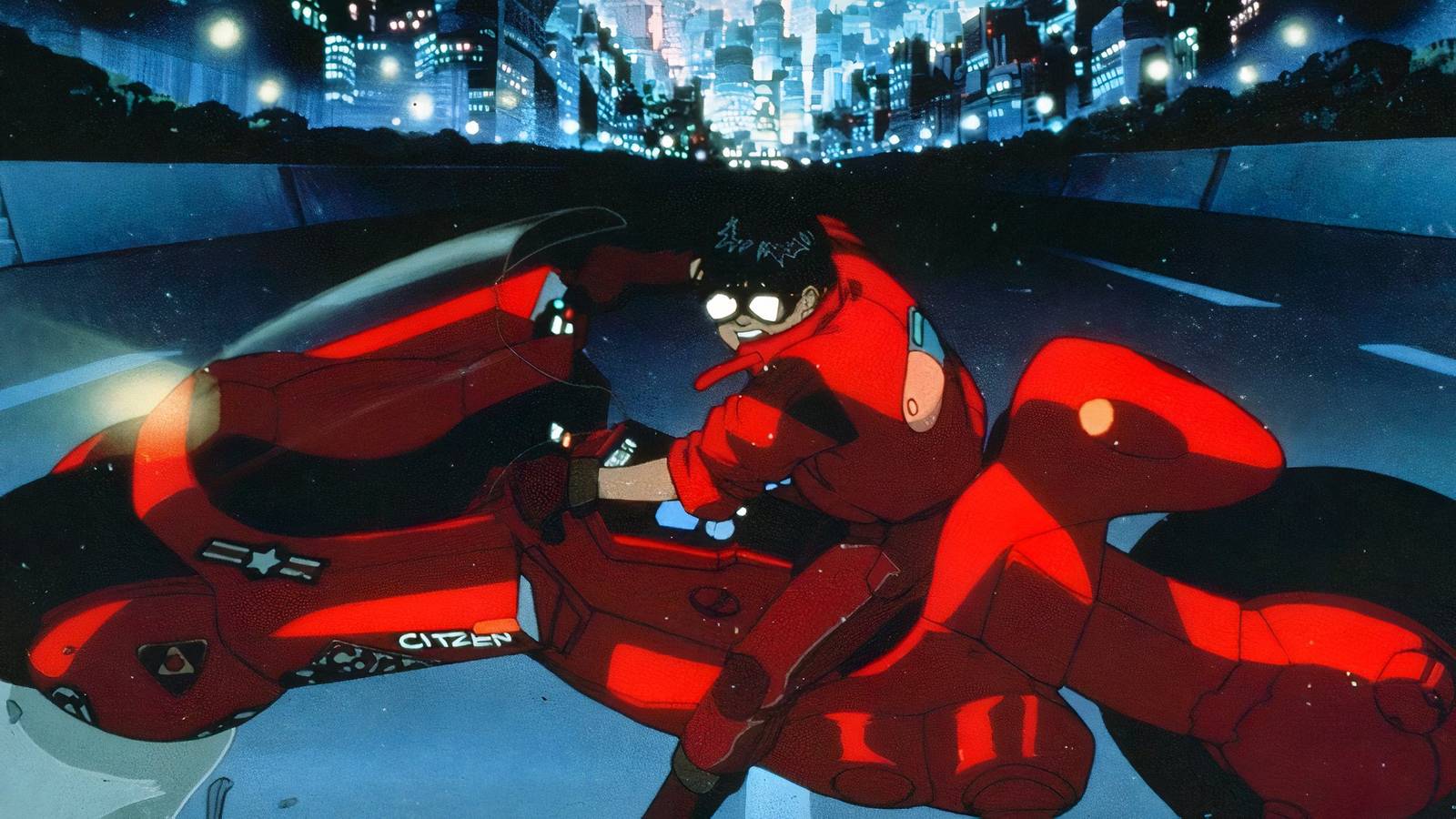
Perfectly described as a ‘once in a lifetime movie,’ Akira is the film that arguably introduced the concept of “adult anime” to the rest of the world. Still, the film’s foresight goes far beyond its role as a cultural ambassador.
Visually, Katsuhiro Otomo’s magnum opus remains unsurpassed, given that it was produced with 24 frames per second animation and pre-scored dialogue, resulting in a level of fluidity and accuracy that is almost impossible to replicate today. However, among everything it does, the film’s thematic content feels prophetic.
Set in “Neo-Tokyo” in 2019, Akira depicts a society crumbling under the weight of political corruption, youth disenfranchisement, and the spectre of nuclear annihilation. All traits that are common to the reality of many nations today.
Notwithstanding, its legacy is the result of how far it pushed every boundary: technical, thematic, and cultural. Not only did it introduce an entire generation to adult-oriented animation, but it also influenced Western sci-fi for decades and established a visual language still mirrored in cyberpunk media today.

Released in 1994, Key the Metal Idol classifies as a forgotten gem that explored the intersection of technology, celebrity culture, and the human soul long before AI became reality. The story follows the life of Key, a robot girl who believes she can become human if she gains 30,000 friends, a task she attempts by becoming a pop idol.
What follows is the slow unravelling of her identity and the conspiracy surrounding her being. In terms of being forward-thinking, the series’ thematic ambition placed it far ahead of its time. While mid-1990s sci-fi often favoured spectacle, Key embraced introspective tension and philosophical reflection, asking difficult questions around the constitution of a soul and the basis for connection.
Furthermore, the series anticipated the parasocial relationships of the digital age, that is, now, presenting a chilling vision of how technology and entertainment would eventually merge to consume human identity. After more than three decades, the series remains one of the most quietly influential experiments of its era.
Serial Experiments Lain (1998)

Released when the internet was still in its infancy for most people, Ryutaro Nakamura’s Serial Experiments Lain understood the web’s psychological impact better than most modern sociologists to a startling degree. The story details the life of Lain Iwakura, a quiet girl who becomes increasingly immersed in “The Wired,” a virtual reality network that begins to bleed into the real world.
Exploring themes of dissociation, digital identity, and the loss of privacy, the series posited that the internet would eventually become a layer of reality just as fundamental as the physical world. A concept, now, an undeniable fact of today’s reality. Truthfully, Lain wasn’t just ahead of its time; it prophesied the digital shape of the modern world.
Discussions about digital selves, social detachment, and collective consciousness were far from mainstream in 1998, yet the series approached each with a clarity and conviction that can’t be attributed to luck. Though it might be a complicated watch for some, Serial Experiments Lain remains the most prescient work of its generation.