
Close Menu
New York Examiner News

    Subscribe to Updates

    Get the latest creative news from FooBar about art, design and business.

    What's Hot

    Sully Erna’s Heartfelt Message After Godsmack’s Pol’and’Rock Show

    August 3, 2026

    Trump says negotiations will resume Monday afternoon while Tehran continues Hormuz talks with Oman

    August 3, 2026

    Parents Who Starved Their 75-Day-Old Baby to Death Will Get No Jail Time After Guilty Plea – Guess Who the Judge Is

    August 3, 2026
    Facebook X (Twitter) Instagram
    New York Examiner News
    • Home
    • US News
    • Politics
    • Business
    • Science
    • Technology
    • Lifestyle
    • Music
    • Television
    • Film
    • Books
    • Contact
      • About
      • Amazon Disclaimer
      • DMCA / Copyrights Disclaimer
      • Terms and Conditions
      • Privacy Policy
    New York Examiner News
    Home»Science»A Recently Discovered Gas Cloud Near Andromeda Stumps Astronomers
    Science

    A Recently Discovered Gas Cloud Near Andromeda Stumps Astronomers

    By AdminJanuary 21, 2023
    Facebook Twitter Pinterest LinkedIn WhatsApp Email Reddit Telegram
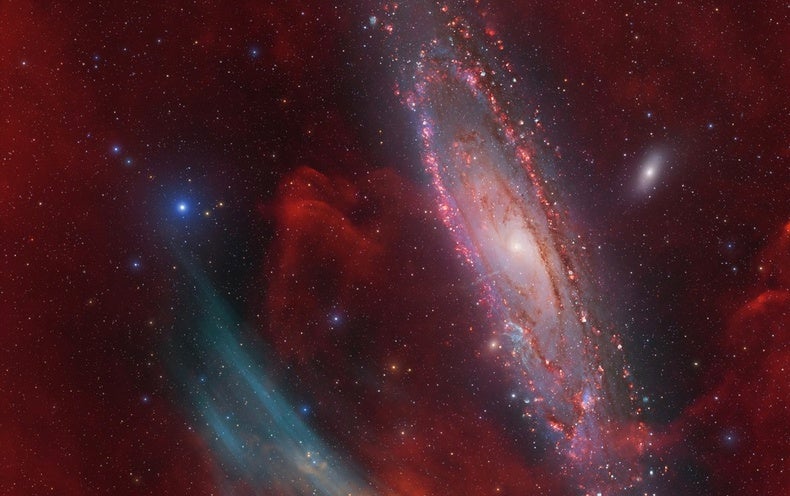
    A Recently Discovered Gas Cloud Near Andromeda Stumps Astronomers


    With dozens of large telescopes scattered across Earth and some well above it, you might think we’ve pretty much discovered all there is to find in the sky. But this is, literally, too narrow a view.

    The recent discovery of a huge cloud of gas floating near the Andromeda galaxy—one of the most extensively studied objects in the heavens—is the latest proof that the sky still offers a vast amount of celestial real estate to sift through. This cloud has been hiding in plain sight for decades. And the best part is that its origin is a mystery.

    The advent of inexpensive but very high-quality digital detectors has made astronomical photography easier than ever before. This has sparked a new trend among astronomy enthusiasts to focus on one select area of the sky and take what are effectively very long exposures in the hopes of finding whatever faint fuzzies might lie there.

    Amateur astronomers and researchers Marcel Drechsler and Xavier Strottner decided to take advantage of these recent technological improvements. They wanted to scan parts of the sky looking for faint nebulae—gas clouds—so they brought in Yann Sainty, a French amateur astronomer and astrophotographer. Sainty decided to target Andromeda, a large spiral galaxy much like our own Milky Way that’s just 2.5 million light-years away. Its proximity, cosmically speaking, has made Andromeda a juicy target for astronomers for more than a century. With its most obvious riches mapped, astronomers had generally assumed anything left to discover there would be small, individual objects such as nebulae inside the galaxy itself.

    Sainty sent his observations to Drechsler and Strottner for processing and analysis. And while poring over the images, they found something that defied expectations: a huge extended structure appearing almost as big as Andromeda itself and right next to it. The nebula only materialized when Sainty obtained images with a filter that blocks all light except for the blue-green glow emitted by doubly ionized oxygen—that is, oxygen atoms that have lost two of their outer electrons, a common occurrence in giant gas clouds. It was essentially human curiosity that drove the use of this filter; no very deep large-scale maps of the sky around Andromeda had ever been made before.

    During this same observing run, Sainty also took deep images using another filter tuned to the light from hydrogen atoms. And while he saw plenty of such gas clouds surrounding Andromeda (most likely nebulae in our own Milky Way superposed in the sky near Andromeda), none matched the size and shape of the peculiar oxygen-rich nebula.

    The team wondered, however, if the cloud might be some sort of artifact in Sainty’s images—reflected light in his telescope, for example. To find out, the researchers asked another accomplished amateur astronomer, Bray Falls, to make more observations with his own telescope. He saw the same nebula in his data, independently confirming the cloud’s existence.

    In the end, observations from five telescopes in France, California and New Mexico convinced the team that this object was real. It’s now dubbed Strottner-Drechsler-Sainty Object 1, or SDSO-1.

    But the question still remains: What is it?

    To find out, the team reached out to professional astronomers Robert Fesen, Michael Shull and Stefan Kimeswenger for a deeper analysis. Published in the American Astronomical Society’s (AAA’s) journal Research Notes of the AAAS, the results of this professional-amateur collaboration are fascinating, even as clues to the nebula’s origins remain maddeningly vague.
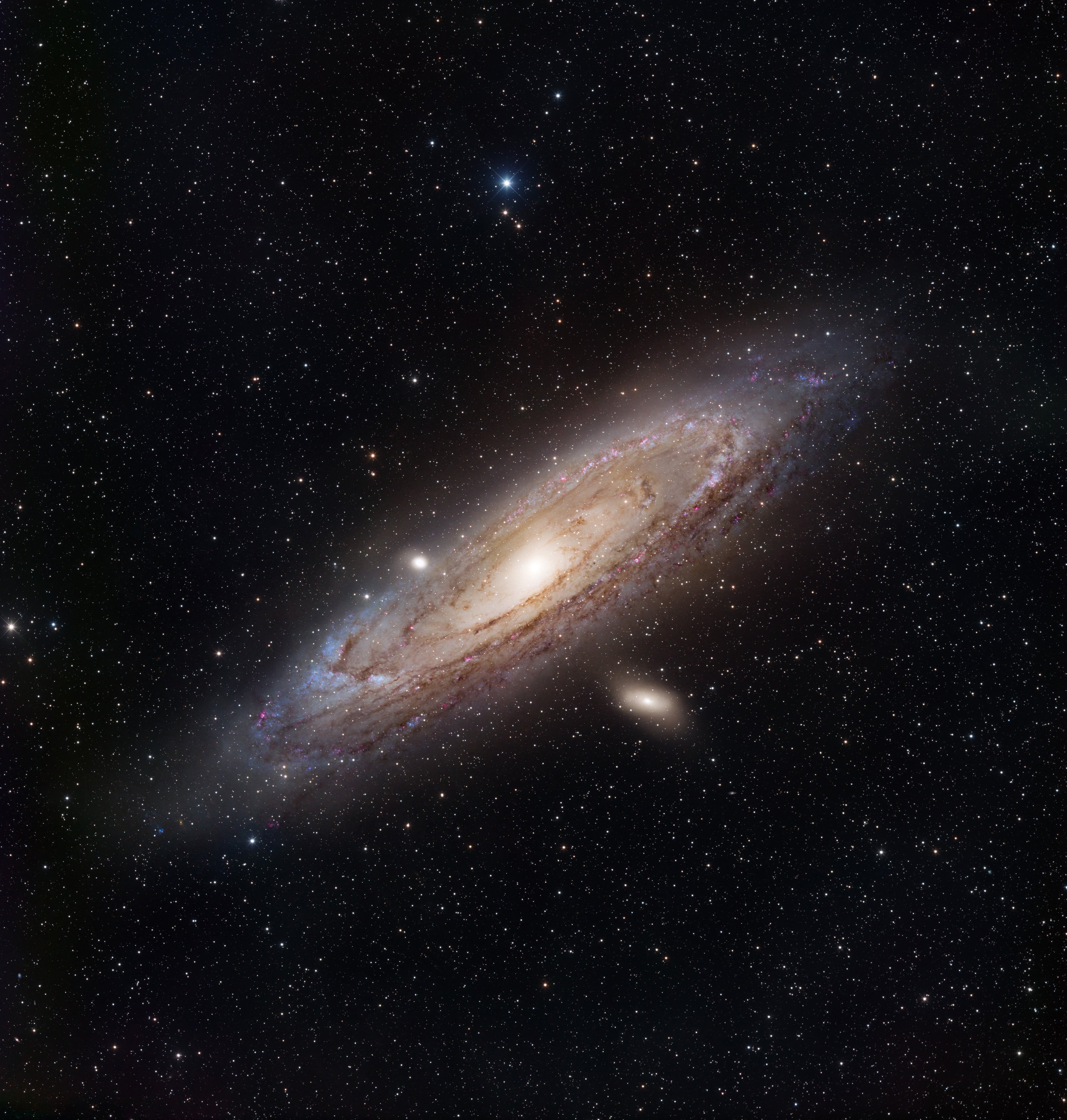
    Andromeda galaxy.
    Most images of Andromeda are spectacular—such as this one, taken in visible light using red, green and blue filters—but show no signs of the giant cloud, called Strottner-Drechsler-Sainty Object 1 (SDSO-1). Credit: Adam Block/Steward Observatory/University of Arizona

    Astronomers have looked at many possibilities, but at this point, the gas cloud resists explanation. Its proximity to Andromeda in the sky would strongly suggest some relation to the galaxy, and the cloud is gently curved, as if bulging away from the galaxy. Neither of these properties conclusively ties the cloud physically to the galaxy, but both are certainly provocative. If SDSO-1 is truly part of Andromeda but outside of the galaxy’s main body, that would mean the cloud is tens of thousands of light-years long, making it one of the Andromeda’s largest coherent structures.

    If it resides in Andromeda’s enormous halo—a roughly spherical collection of stars surrounding the galaxy—it could be gas flung off by streams of stars there. But if so, there should be copious hydrogen seen as well because that’s the major component of stars. Yet, as Sainty showed with his hydrogen-detecting filter, the cloud has none—or at least too little to detect.

    Andromeda is moving toward our Milky Way, with SDSO-1 lying roughly between them, offering another potential clue. Andromeda is so close to the Milky Way that their individual haloes may be interacting, bumping into each other as the two galaxies pass in space. Diffuse gas in the two galactic haloes would compress on collision, forming a curved structure like the bow wave from a ship moving through water. If that were the case, however, the cloud should not appear so close to Andromeda. Instead it would appear in the sky roughly halfway between Andromeda and the center of the Milky Way. And this scenario still wouldn’t explain the lack of hydrogen.

    Another possibility is that the cloud is physically far smaller but much closer to us, meaning it’s a nebula in the Milky Way that is only coincidentally appearing near Andromeda. Planetary nebulae are shells of gas cast off by dying sunlike stars, and they are usually rich in hydrogen and oxygen. With the central star energizing the gas, these nebulae tend to appear bright in light emitted by both elements. So again, the lack of hydrogen in SDSO-1 is baffling.

    It’s possible SDSO-1 could be the remnant of a Milky Way star that exploded as a supernova, but then it should also be glowing in ultraviolet light and radio waves. Searching older observations of Andromeda, however, astronomers see nothing coming from the cloud at any other wavelengths, including x-rays and visible and infrared light.

    So at the moment, no known mechanism fits all the data. While baffling, this is also the sort of thing scientists love. Solving puzzles is why we wanted to be scientists in the first place.

    The fact that something so enormous in our sky has escaped detection until now is amazing, if not entirely surprising to astronomers. Big telescopes tend to have a narrow field of view, so observing objects that have a large apparent size is difficult—especially one as sprawling as SDSO-1, which is as wide as three full moons in the sky. Bigger instruments simply missed it, unable to see the forest for the trees.

    Also, the cloud is extremely faint, requiring very long exposures to spot at all. The total observation time in the discovery and confirmation images that used just the doubly ionized oxygen filter was a staggering 160 hours. Even the filters and detectors used in professional observatories are designed to observe in a different way than amateur telescopes. This also amplifies the difficulty of finding objects like SDSO-1. Even the 3.8-meter Canada-France-Hawaii Telescope, which is equipped with an incredible 378-megapixel camera and an oxygen filter, looked right at the spot in the sky where SDSO-1 sits and saw nothing. It’s an impressive piece of equipment, but it just wasn’t designed to see something so big and faint in the sky.

    Solving this mystery will require spectra—breaking the cloud’s light up into small wavelength divisions similar to how raindrops break up sunlight into a rainbow. By carefully examining the spectrum of SDSO-1, the velocity of its gas can be determined via the Doppler effect—the slight blueshift of its color if the gas is moving toward us or the redshift if it’s moving away. If the cloud is moving at a similar speed as Andromeda, then it’s likely to be a part of that galaxy. If instead it’s moving more slowly, then it’s likely to be inside our own. The study’s authors report that such spectral observations are already underway, but until those are finished, the origin and behavior of this cloud will remain an enigma.

    While SDSO-1 presents a conundrum, it’s also something of a beacon of hope: it’s showing us there are still many treasures in the sky left to find. We just need to use the right tools to uncover them.

    This is an opinion and analysis article, and the views expressed by the author or authors are not necessarily those of Scientific American.

    Editor’s Note (1/12/23): This article was edited after posting to correct the descriptions of Marcel Drechsler’s, Xavier Strottner’s and Yann Sainty’s respective roles in the discovery.


    Original Source Link

    Share. Facebook Twitter Pinterest LinkedIn WhatsApp Email Reddit Telegram
    Previous ArticleDoug Liman Doc Digs Into Brett Kavanaugh Hearings – The Hollywood Reporter
    Next Article Area 120, Google’s in-house incubator, severely impacted by Alphabet mass layoffs • TechCrunch

    RELATED POSTS

    Eating less protein could help you live longer

    August 3, 2026

    The James Webb Telescope Is Changing Astronomers’ Understanding of the Ancient Cosmos

    August 2, 2026

    AI helped produce two proofs for the same cryptography problem

    August 2, 2026

    Astronomers Have Detected an Exomoon for the First Time

    August 1, 2026

    Postpartum psychosis is at the center of the Lindsay Clancy trial. What is it?

    August 1, 2026

    The World Is Too Hot. El Niño Is Partly to Blame

    July 31, 2026
    latest posts

    Sully Erna’s Heartfelt Message After Godsmack’s Pol’and’Rock Show

    Last Thursday (July 30), Godsmack headlined the 32nd annual Pol’and’Rock Festival in Czaplinek, Poland. According…

    Trump says negotiations will resume Monday afternoon while Tehran continues Hormuz talks with Oman

    August 3, 2026

    Parents Who Starved Their 75-Day-Old Baby to Death Will Get No Jail Time After Guilty Plea – Guess Who the Judge Is

    August 3, 2026

    SummerSlam results: Roman Reigns retains the World Heavyweight Championship

    August 3, 2026

    Best Car Vacuums (2026): Handheld, Cordless, Shopping Tips

    August 3, 2026

    Eating less protein could help you live longer

    August 3, 2026

    Brand New Day’ Box Office Opening at $355M Is Second-Best

    August 3, 2026
    Categories
    • Books (1,404)
    • Business (6,308)
    • Events (64)
    • Film (6,244)
    • Lifestyle (4,319)
    • Music (6,367)
    • Politics (6,290)
    • Science (5,661)
    • Technology (6,240)
    • Television (5,934)
    • Uncategorized (9)
    • US News (6,296)
    popular posts

    Mass Layoffs or Hiring Boom? What’s Actually Happening in the Jobs Market

    By Sarah Chaney Cambon and Ray A. SmithFeb. 9, 2023 8:01 am ETListen to article(2…

    Alibaba names Joseph Tsai chairman, Eddie Wu CEO

    June 20, 2023

    Feral Hogs Are the Worst Invasive Species You’ve Never Thought About

    March 25, 2023

    Innovative Tools Used In Vehicle-Centric Investigations

    January 14, 2024
    Archives
    Browse By Category
    • Books (1,404)
    • Business (6,308)
    • Events (64)
    • Film (6,244)
    • Lifestyle (4,319)
    • Music (6,367)
    • Politics (6,290)
    • Science (5,661)
    • Technology (6,240)
    • Television (5,934)
    • Uncategorized (9)
    • US News (6,296)
    About Us

    We are a creativity led international team with a digital soul. Our work is a custom built by the storytellers and strategists with a flair for exploiting the latest advancements in media and technology.

    Most of all, we stand behind our ideas and believe in creativity as the most powerful force in business.

    What makes us Different

    We care. We collaborate. We do great work. And we do it with a smile, because we’re pretty damn excited to do what we do. If you would like details on what else we can do visit out Contact page.

    Our Picks

    Eating less protein could help you live longer

    August 3, 2026

    Brand New Day’ Box Office Opening at $355M Is Second-Best

    August 3, 2026

    Gayle Rankin Loves That Alys Pisses People Off (Exclusive)

    August 3, 2026
    © 2026 New York Examiner News. All rights reserved. All articles, images, product names, logos, and brands are property of their respective owners. All company, product and service names used in this website are for identification purposes only. Use of these names, logos, and brands does not imply endorsement unless specified. By using this site, you agree to the Terms & Conditions and Privacy Policy.

    Type above and press Enter to search. Press Esc to cancel.

    We use cookies on our website to give you the most relevant experience by remembering your preferences and repeat visits. By clicking “Accept All”, you consent to the use of ALL the cookies. However, you may visit "Cookie Settings" to provide a controlled consent.
    Cookie SettingsAccept All
    Manage consent

    Privacy Overview

    This website uses cookies to improve your experience while you navigate through the website. Out of these, the cookies that are categorized as necessary are stored on your browser as they are essential for the working of basic functionalities of the website. We also use third-party cookies that help us analyze and understand how you use this website. These cookies will be stored in your browser only with your consent. You also have the option to opt-out of these cookies. But opting out of some of these cookies may affect your browsing experience.
    Necessary
    Always Enabled
    Necessary cookies are absolutely essential for the website to function properly. These cookies ensure basic functionalities and security features of the website, anonymously.
    CookieDurationDescription
    cookielawinfo-checkbox-analytics11 monthsThis cookie is set by GDPR Cookie Consent plugin. The cookie is used to store the user consent for the cookies in the category "Analytics".
    cookielawinfo-checkbox-functional11 monthsThe cookie is set by GDPR cookie consent to record the user consent for the cookies in the category "Functional".
    cookielawinfo-checkbox-necessary11 monthsThis cookie is set by GDPR Cookie Consent plugin. The cookies is used to store the user consent for the cookies in the category "Necessary".
    cookielawinfo-checkbox-others11 monthsThis cookie is set by GDPR Cookie Consent plugin. The cookie is used to store the user consent for the cookies in the category "Other.
    cookielawinfo-checkbox-performance11 monthsThis cookie is set by GDPR Cookie Consent plugin. The cookie is used to store the user consent for the cookies in the category "Performance".
    viewed_cookie_policy11 monthsThe cookie is set by the GDPR Cookie Consent plugin and is used to store whether or not user has consented to the use of cookies. It does not store any personal data.
    Functional
    Functional cookies help to perform certain functionalities like sharing the content of the website on social media platforms, collect feedbacks, and other third-party features.
    Performance
    Performance cookies are used to understand and analyze the key performance indexes of the website which helps in delivering a better user experience for the visitors.
    Analytics
    Analytical cookies are used to understand how visitors interact with the website. These cookies help provide information on metrics the number of visitors, bounce rate, traffic source, etc.
    Advertisement
    Advertisement cookies are used to provide visitors with relevant ads and marketing campaigns. These cookies track visitors across websites and collect information to provide customized ads.
    Others
    Other uncategorized cookies are those that are being analyzed and have not been classified into a category as yet.
    SAVE & ACCEPT