
November 17, 2025
5 min read
How Influential People Map Their Social World
The same brain areas that help us map physical space help us chart social connections, and the best relationship cartographers have most clout
What do social climbers and gossipmongers have in common? My mother would tell me that both are morally suspect. This moral umbrage is etched into lessons from fairy tales and scripture that we readily pass on to our children: Avoid the schemer and the whisperer.
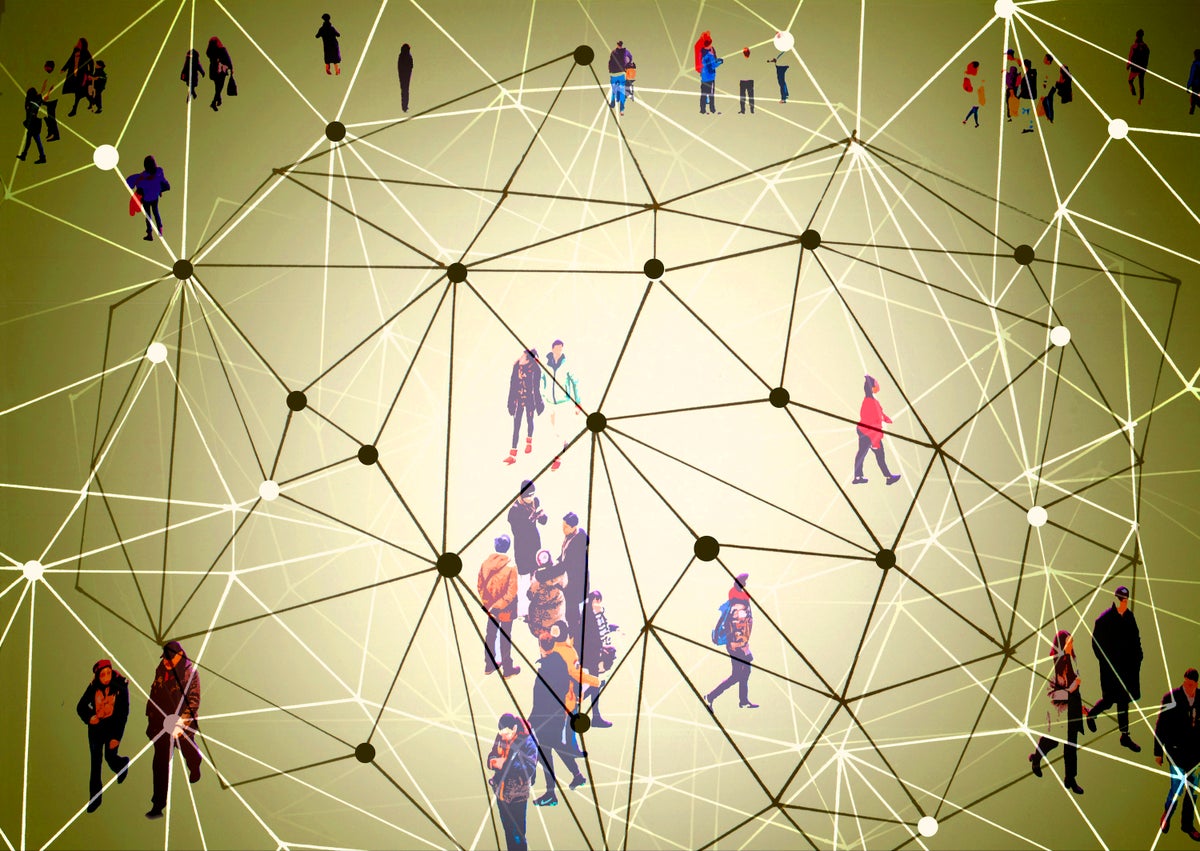
But stories are known to simplify reality. The truth is that that the most effective gossipers and social climbers possess a remarkable grasp of social structure, knowledge they use to cleverly navigate their social worlds. This skill isn’t a moral failing; it’s a cognitive feat. Our minds are sophisticated engines that mentally map our social landscapes. Who’s close to whom? Who belongs to which group? Who’s popular, and who’s just one step away from power?
Recent work from my laboratory has shown that our mind’s representations of the social world—what are known as “cognitive maps”—shape many of our critical social skills. These maps are used to rise in influence, figure out when we choose to talk about others and build tighter bonds between those in our inner circle. Social success depends not just on who you know but also on how well you understand the invisible architecture of your social world.
On supporting science journalism
If you’re enjoying this article, consider supporting our award-winning journalism by subscribing. By purchasing a subscription you are helping to ensure the future of impactful stories about the discoveries and ideas shaping our world today.
Mapping this social architecture is no small feat. Consider the magnitude of the challenge. Real-world social networks are large, with hundreds of people and tens of thousands of possible connections. Knowing who is connected to whom is no trivial task. Every time a relationship is forged or destroyed, you need to mentally update that map. My colleagues and I wanted to understand what type of cognitive map would enable you to constantly keep stock of the changing social landscape. And perhaps more importantly, we wanted to know why someone would take the time and effort to mentally track the web of connections that surrounds them. It turns out that building a cognitive map of your social network affords quite a lot; in fact, it gives you superpowers.
To better understand the powers of social navigation, my collaborator Apoorva Bhandari, cognitive neuroscientist at Brown University, and I developed a series of studies to probe how people build cognitive maps. But first we needed a population to follow. We wanted to test these mapmaking skills in a large group of people who have never met and yet one day find themselves living in close proximity. What better option than college freshmen? Across a year we logged friendships as they formed and faded, building a live network of roughly 200 people. We also asked each student to tell us about their personality: “Do you like to socialize, or are you more of a wallflower?” Finally, we asked each student to tell us how they thought others were connected, yielding a second map of their beliefs about the network.
In one study, for example, we find that those who rise to the top of the social hierarchy aren’t the most charismatic or extroverted—they’re the best social mapmakers. By repeatedly asking our participants who their friends are, we can quantify who is most well-connected to other well-connected people—that is, who is most influential in their social network. The most influential people, this work shows, are the ones that quickly build mental maps of how their peers are connected. Armed with such a map, it’s relatively easy to identify who is part of which clique or group or whether there might be holes in the network where you can strategically position yourself. In contrast, people who were initially quite influential—connected to many other well-connected people—but who did not have accurate mental maps of the network did not stay influential for long.
In a second paper, we examined whether mapmaking aids in another type of socially adaptive behavior: gossiping. While spilling the tea often gets a bad rap, the humdrums of life get spiced up through the stories we hear or tell others, and it can be an efficient way to quickly learn about the ins and outs of the community. Gossip has even shaped history from the shadows (for example, it’s been a tool used in civil rights movements and royal coups), which means paying attention to the currents of gossip is likely a worthwhile endeavor. People seem to be quite sensitive to tracing gossip. We rarely get caught talking about others, for instance, even though more than 65 percent of our conversations are about other people.
To understand how humans pull off this remarkable feat, we wondered whether mapmaking helps predict where information will spread. Calculating which of many paths gossip might travel requires quite a bit of mental math. You can’t just know the ties among your friends; you also need to grasp the connections between your friends’ friends and beyond. Mental maps become quite useful in this case, we found, especially because they capture two key features of the network: how popular someone is and how far they are from the target of gossip. Maps that gauge popularity and distance can be used to quickly compute a good confidant—someone who is just far enough from the target so that gossip won’t reach them yet well-connected enough to spread information effectively.
How does the brain build these maps? Two recent studies from my lab explain the map-building machinery that enables social wayfinding. In one study, still unpublished, we find that the hippocampus and entorhinal cortex—a neural hub known for navigating physical space—also carries a map of connections between people. The stronger these maps are encoded in the brain, the better people are at brokering ties that knit their communities together.
In another study, we also found evidence that the brain refines these maps during rest, when it has the time to think about all the possible network connections. This process of revisiting recent experiences is known as replay, akin to rewinding a movie on high speed. In this case, people at rest seem to be unconsciously thinking about all the ties in the network at extraordinarily high speeds. If the rest period includes sleep, the map becomes fuzzier (rather than more precise). This might sound problematic, but this fuzziness actually helps reveal the overall shape of the network by making it more abstract. Abstraction, by design, naturally highlights the most important structures in the network—just as impressionist Claude Monet used broad, choppy brushstrokes to reveal the important elements in his paintings, letting his lily pads come into focus when viewed at a distance. For social networks, abstraction works by bringing into relief the most important routes, the highways and major arteries of the system. If the brain needs to quickly figure out where gossip might spread, knowing where the popular people are positioned, or the key relationships that bridge otherwise disconnected communities, allows us to chart the sequence of ties that can efficiently cross the network.
Surrounded by my three children, I often catch myself belting out lyrics from the movie Moana, “We set a course to find a brand-new island everywhere we roam…. We know the way.” But strategic wayfinding isn’t only for physical space. It is just as necessary to be able to effectively navigate through our social landscapes. Armed with a deliberately fuzzy atlas of our social community, skilled social navigators can do what no GPS can. They see the bridges before they’re built, steer around the storms of rumor, and chart a course to common ground.
Are you a scientist who specializes in neuroscience, cognitive science or psychology? And have you read a recent peer-reviewed paper that you would like to write about for Mind Matters? Please send suggestions to Scientific American’s Mind Matters editor Daisy Yuhas at dyuhas@sciam.com.
It’s Time to Stand Up for Science
If you enjoyed this article, I’d like to ask for your support. Scientific American has served as an advocate for science and industry for 180 years, and right now may be the most critical moment in that two-century history.
I’ve been a Scientific American subscriber since I was 12 years old, and it helped shape the way I look at the world. SciAm always educates and delights me, and inspires a sense of awe for our vast, beautiful universe. I hope it does that for you, too.
If you subscribe to Scientific American, you help ensure that our coverage is centered on meaningful research and discovery; that we have the resources to report on the decisions that threaten labs across the U.S.; and that we support both budding and working scientists at a time when the value of science itself too often goes unrecognized.
In return, you get essential news, captivating podcasts, brilliant infographics, can’t-miss newsletters, must-watch videos, challenging games, and the science world’s best writing and reporting. You can even gift someone a subscription.
There has never been a more important time for us to stand up and show why science matters. I hope you’ll support us in that mission.