
The Montreal Protocol didn’t just preserve the ozone layer, it helped save Earth from a climate change time bomb.
The landmark ozone treaty was agreed 35 years ago this month, at a time when both climate and ozone science was far less developed than it is today. Yet every nation signed on, accepting binding commitments to reduce the production, consumption and emissions of chemicals responsible for thinning the ozone layer that guards the planet from the sun’s most damaging radiation. The same set of chemicals happened also to be immensely powerful greenhouse gases, and cutting them bought the world valuable time to deal with the climate crisis.
“If we let the [chlorofluorocarbons (CFCs)] keep growing, we would have had the impacts of climate change that we’re feeling now … a decade ago,” said David Doniger, a lawyer with the Natural Resources Defense Council who has worked on the issue since the 1980s. “And things would be that much worse now.”
The protocol’s status as a climate treaty was enhanced by the 2016 Kigali Amendment—named for the Rwandan capital where the deal was drafted—which targeted a class of coolants that weren’t ozone-depleting but were climate-forcing. Scientists say the global hydrofluorocarbon (HFCs) phasedown, which the U.S. is now poised to join after a key Senate vote Wednesday, has the potential to avoid half a degree Celsius of warming by 2100.
Scientists, lawyers and others who have worked on the issue for decades say that long before international negotiators struck the deal on HFCs, the ozone treaty had prevented a particularly harmful set of climate superpollutants from being baked into the air conditioning and refrigerators that developing countries were at last acquiring.
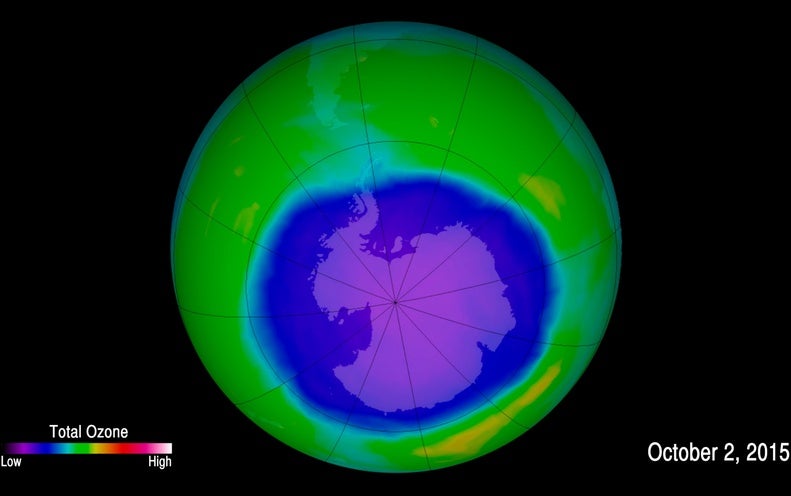
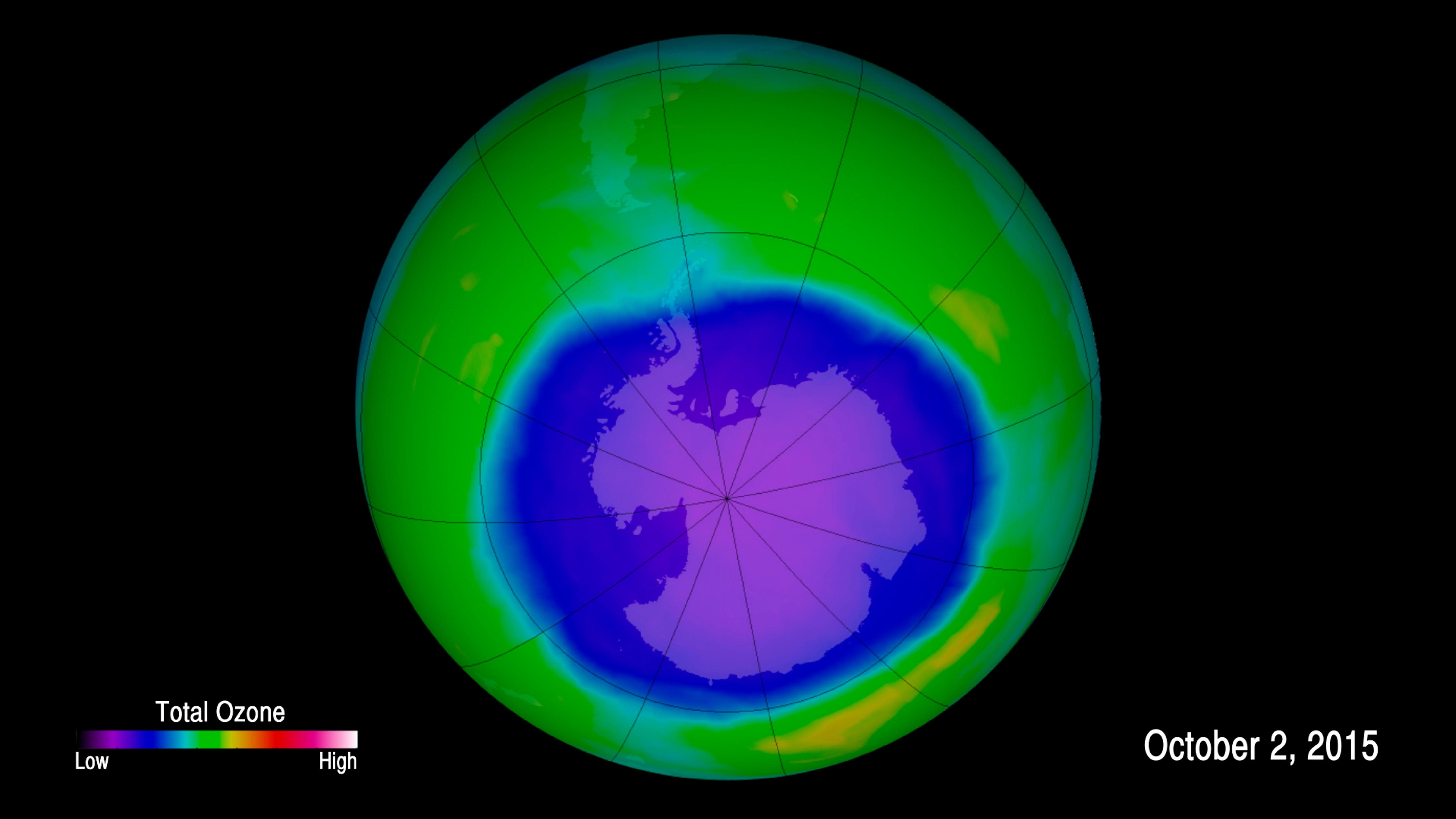
David Fahey, director of NOAA’s Chemical Sciences Laboratory and co-chair of the Montreal Protocol’s scientific assessment panel, was among the scientists who in 1987 flew a NASA research aircraft into the ozone hole that had appeared over Antarctica. There were at the time several competing theories for why the hole was appearing, he said.
But the NASA journey, he said, “created a smoking gun plot, as we call it, that was really the pivotal evidence that chlorine was destroying ozone on the scale of what would cause the Antarctic ozone hole.”
The world responded quickly.
“The same month we were in southern Chile flying into Antarctica, in Montreal the Montreal Protocol was being signed,” he said. “And it was basically signed without knowing for sure what was causing the Antarctic ozone hole.”
The new agreement was not only a leap of faith as far as the science was concerned, but it had attributes that have never been replicated in any subsequent climate treaty despite far higher levels of scientific certainty.
The treaty is universal with 197 member countries. It is legally binding with penalties for countries that flout its provisions. And it is fully funded, meaning that poorer countries that might not have been able to meet its targets to phase down chemicals received assistance from richer ones.
“There’s no other forum that has those three dimensions,” Fahey said, noting the 2015 Paris Agreement on climate change relies on voluntary commitments with no penalties for breaking them.
“Probably the underlying problem with the climate change situation is we don’t have such a forum,” he said.
DuPont scientist’s key role
Fahey said there was some understanding among scientists from the start that CFCs played a role in driving climate change as well as depleting the ozone layer. But that role was clarified by a scientific study that he and four other scientists published in 2007, which looked at the “worlds avoided” by stemming the growth of the chemicals.
The report showed that without the Montreal Protocol, CFC use would have ballooned. Under a conservative scenario by 2010, the chemicals would have had a greenhouse gas content nearly equal to half the carbon dioxide emissions from all other sources. The effect on the climate would have been catastrophic.
“I think the estimates are something on the order of an extra 2 degrees by the middle of the century,” said Susan Solomon, a professor of environmental studies at the Massachusetts Institute of Technology.
She noted that had the world continued on its trajectory of increasing CFC use through 2050, the consequences for the ozone layer would have threatened the health and survival of every living thing on the planet, including humans. That might have forced action, she said.
“The great news is that we avoided all of that, and we not only saved the ozone layer, we actually had a tremendous win for the climate as well,” she said.
While CFCs packed the biggest punch on climate change, the hydrochlorofluorocarbons (HCFCs) that temporarily replaced them still had significant consequences for the climate. After the 2007 paper was published, parties to the Montreal Protocol quickly moved to shorten the treaty’s timeline for phasing down HCFCs, an adjustment that Fahey said was the first decision made under the Montreal Protocol to reduce global warming.
HCFCs were replaced by HFCs. And HFCs, which have no effect on the ozone, were intended to be the Montreal Protocol’s final destination. But they’re climate superpollutants that can be thousands of times as potent as carbon dioxide.
Industry was initially resistant to the idea that HFC use would have a significant impact on climate change. But Fahey credits an industry scientist, Mack McFarland of DuPont, with changing the discussion.
“The thing that Mack understood was the growth in the developing world,” he said. “That the developing world was catching up with the developed world.”
McFarland started talking to delegates at the annual Montreal Protocol meetings about the role HFCs could eventually play in driving climate change, Fahey said.
“This became one of his main messages to not only the delegates, but to the scientists and to the technologists,” he said. “And it wasn’t extremely well-received or immediately received. And even the scientists—I being one of them—didn’t really get it, so to speak.”
But in 2009, McFarland, Fahey and the other scientists who had collaborated on the 2007 paper on the climate implications of the protocol published a paper on the effects of running the world’s air condition and refrigeration units on HFCs. And its conclusions sparked the negotiations that finally led to the Kigali Amendment’s creation eight years later.
Solomon said she was shocked when the Senate voted this week by a 69-27 margin to join the Kigali treaty. The accord took effect Jan. 1, 2019, after reaching a ratification threshold. The U.S. is the 138th country to sign on.
But Solomon said that in the 1970s and ‘80s, the U.S. led the charge on global ozone protection.
“I think the primary credit needs to go to the American people,” she said.
Help for poor countries
When ozone science was in its infancy, not long after scientists Sherwood Rowland and Mario Molina demonstrated in 1974 that CFC damaged the ozone, but before the extent of the damage was known, U.S. consumers stopped buying aerosol deodorant and hair spray.
The consequences were transformational. U.S. personal care products made up 75 percent of global CFC use in 1974. Plunging demand forced industry to seek alternatives and made the Montreal Protocol possible.
And countries that now project leadership on climate change and other issues clung to their aerosol products.
“The Europeans were actually on the other side of the negotiating table,” Solomon said. “It was us saying, ‘We should get rid of these compounds, we have substitutes, let’s move on. Let’s save the planet.’ And it was Europe saying, ‘Well, you know, we don’t really see that need the way you do.’”
Solomon also credited former President Barack Obama and former Secretary of State John Kerry with creating the geopolitical momentum that carried Kigali across the finish line.
Nor are the direct climate benefits of the protocol’s cuts in CFCs, HCFCs and now HFCs the full story.
Solomon pointed out that the protocol’s multilateral fund helped poor countries gain access to refrigeration, reducing emissions from food waste and spoilage.
NRDC’s Doniger referenced a study published in Nature last year that found that without the ozone preservation benefits of the Montreal Protocol, much less CO2 would have been absorbed over the past 35 years as the world’s biosphere disintegrated.
“The damage done to trees and other vegetation would have meant that they would have soaked up a lot less CO2 from the atmosphere,” he said.
The Nature study argues that the protocol helped avoid 2.5 degrees Celsius of warming. For context, scientists have warned that the world—and especially vulnerable countries—will face catastrophic damages if warming exceeds 1.5 C.
Reprinted from E&E News with permission from POLITICO, LLC. Copyright 2022. E&E News provides essential news for energy and environment professionals.