
Close Menu
New York Examiner News

    Subscribe to Updates

    Get the latest creative news from FooBar about art, design and business.

    What's Hot

    Slam Dunk director to step down from festival operations amid allegations

    April 25, 2026

    North Korean IT workers are stealing remote jobs—and Americans are helping them do it

    April 25, 2026

    Disaster For Trump As He Even Fox News’s Poll Finds He’s Mentally Unfit

    April 25, 2026
    Facebook X (Twitter) Instagram
    New York Examiner News
    • Home
    • US News
    • Politics
    • Business
    • Science
    • Technology
    • Lifestyle
    • Music
    • Television
    • Film
    • Books
    • Contact
      • About
      • Amazon Disclaimer
      • DMCA / Copyrights Disclaimer
      • Terms and Conditions
      • Privacy Policy
    New York Examiner News
    Home»Science»Math’s Block-Stacking Problem Has a Preposterous Solution
    Science

    Math’s Block-Stacking Problem Has a Preposterous Solution

    By AdminJuly 6, 2025
    Facebook Twitter Pinterest LinkedIn WhatsApp Email Reddit Telegram
    Math’s Block-Stacking Problem Has a Preposterous Solution


    This Block-Stacking Math Problem Has a Preposterous Solution You Need to See to Believe

    In principle, this impossible math allows for a glue-free bridge of stacked blocks that can stretch across the Grand Canyon—and into infinity
    By Jack Murtagh edited by Jeanna Bryner

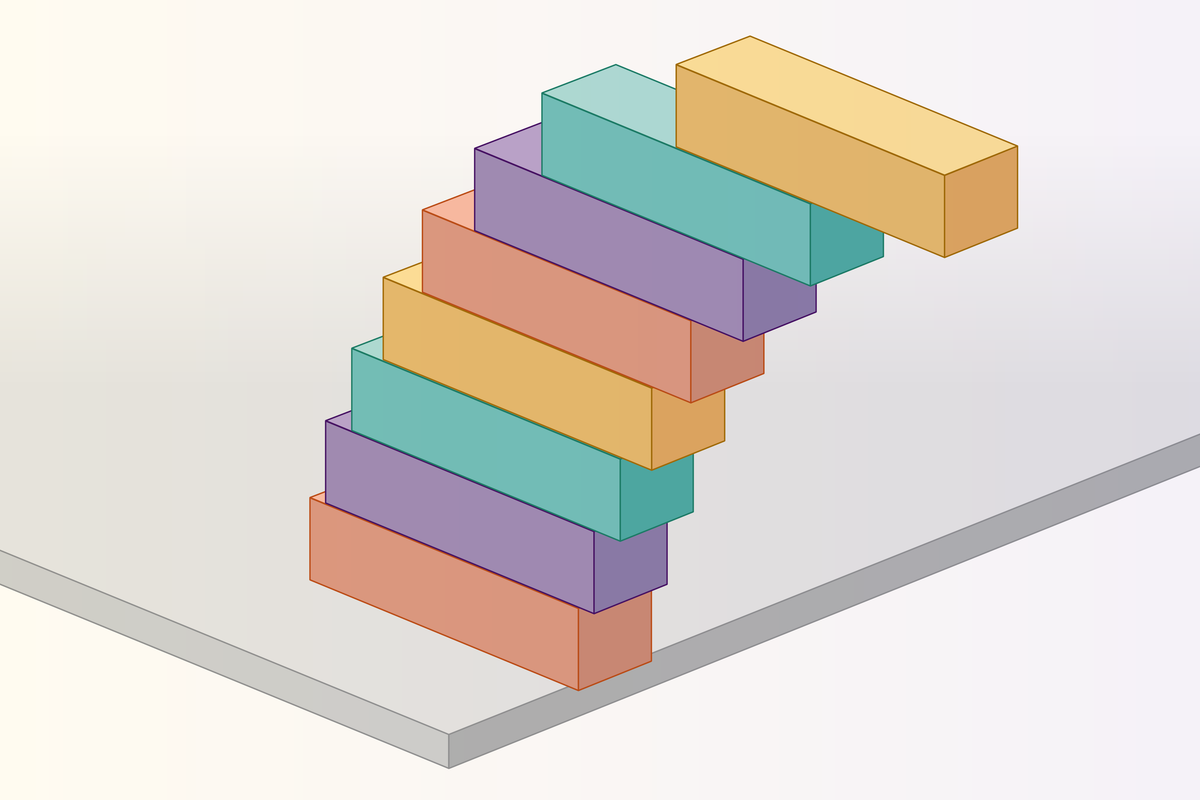
    Graphic shows eight multicolored Jenga blocks stacked on a table and oriented perpendicular to the edge. From top to bottom, the blocks extend into space by decreasing proportions of their length.

    Here’s a mind-blowing experiment that you can try at home: Gather some children’s blocks and place them on a table. Take one block and slowly push it over the table’s edge, inch by inch, until it’s on the brink of falling. If you possess patience and a steady hand, you should be able to balance it so that exactly half of it hangs off the edge. Nudge it any farther, and gravity wins. Now take two blocks and start over. Stacking one on top of the other, how far can you get the end of the top block to poke over the table’s edge?
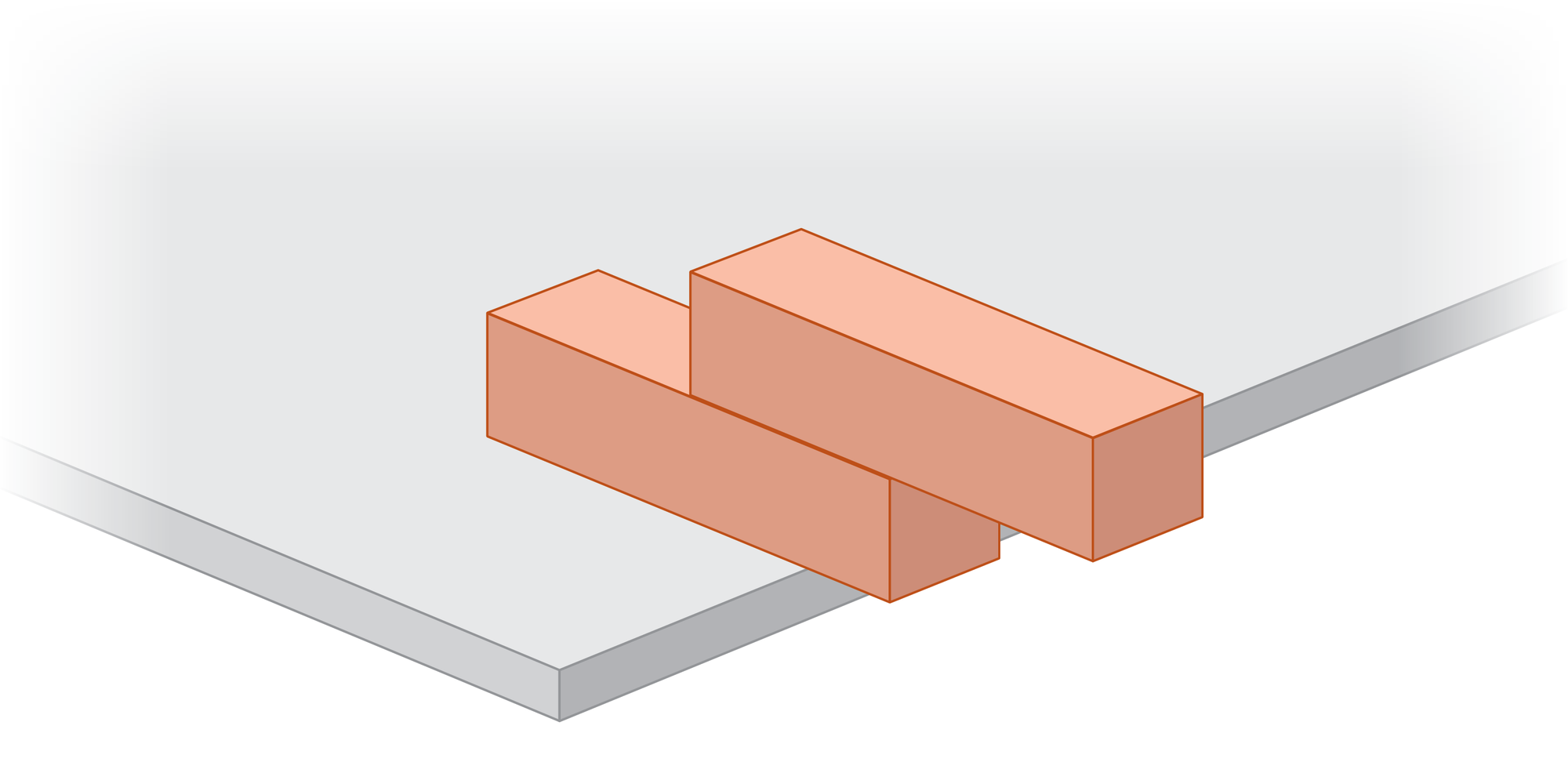
    Graphic shows two identical Jenga blocks stacked on a table and oriented perpendicular to the edge. The bottom block extends a little beyond the edge of the table, and the top block extends beyond the bottom one by about half its length.

    Keep going. Stacking as many blocks as you can, what is the farthest overhang you can achieve before the whole structure topples? Is it possible for the tower to extend a full block length beyond the lip of the table? Does physics permit two block lengths? The stunning answer is that the stacked bridge can stretch forever. In principle, a freestanding stack of blocks can span the Grand Canyon, no glue required.


    On supporting science journalism

    If you’re enjoying this article, consider supporting our award-winning journalism by subscribing. By purchasing a subscription you are helping to ensure the future of impactful stories about the discoveries and ideas shaping our world today.


    Don’t click “checkout” on an infinite pack of Jenga blocks just yet. Real-world practicalities such as irregular block shapes, air currents and the crushing weight of an endless edifice may hamper your engineering aspirations. Still, understanding why the overhang has no limit in an ideal mathematical world is enlightening. The explanation hinges on math’s harmonic series and the physics concept of center of mass, two seemingly simple ideas with outsize power. [For more fun, check out: How Tall Can You Build a Tower without It Toppling?]

    Your intuition might tell you that a single block can hang half of its mass beyond the table’s edge before tipping. But why is that so? Every object has a center of mass—a single point at which we can imagine the entire object’s weight to be concentrated when we’re thinking about balance. As long as the center of mass sits above the table, the object stays put. The moment that center of mass passes over an edge, however, gravity will pull the whole thing over. In the case of a spoon, an item with irregular weight distribution, we can hang more than half of the utensil’s handle over an edge before it tips because the center of mass lies closer to its head, where more of the weight resides. For our stacked bridge, we assume that our blocks are all identical, with a uniform density (that is, they’re not denser in some parts than others), so each one’s center of mass sits at the middle point.

    When we add more blocks, we must account for the center of mass of the entire tower. Consider the case of two blocks. We know the top block can extend half of its mass beyond the one below it. But after doing that, how far can we push out the bottom block?
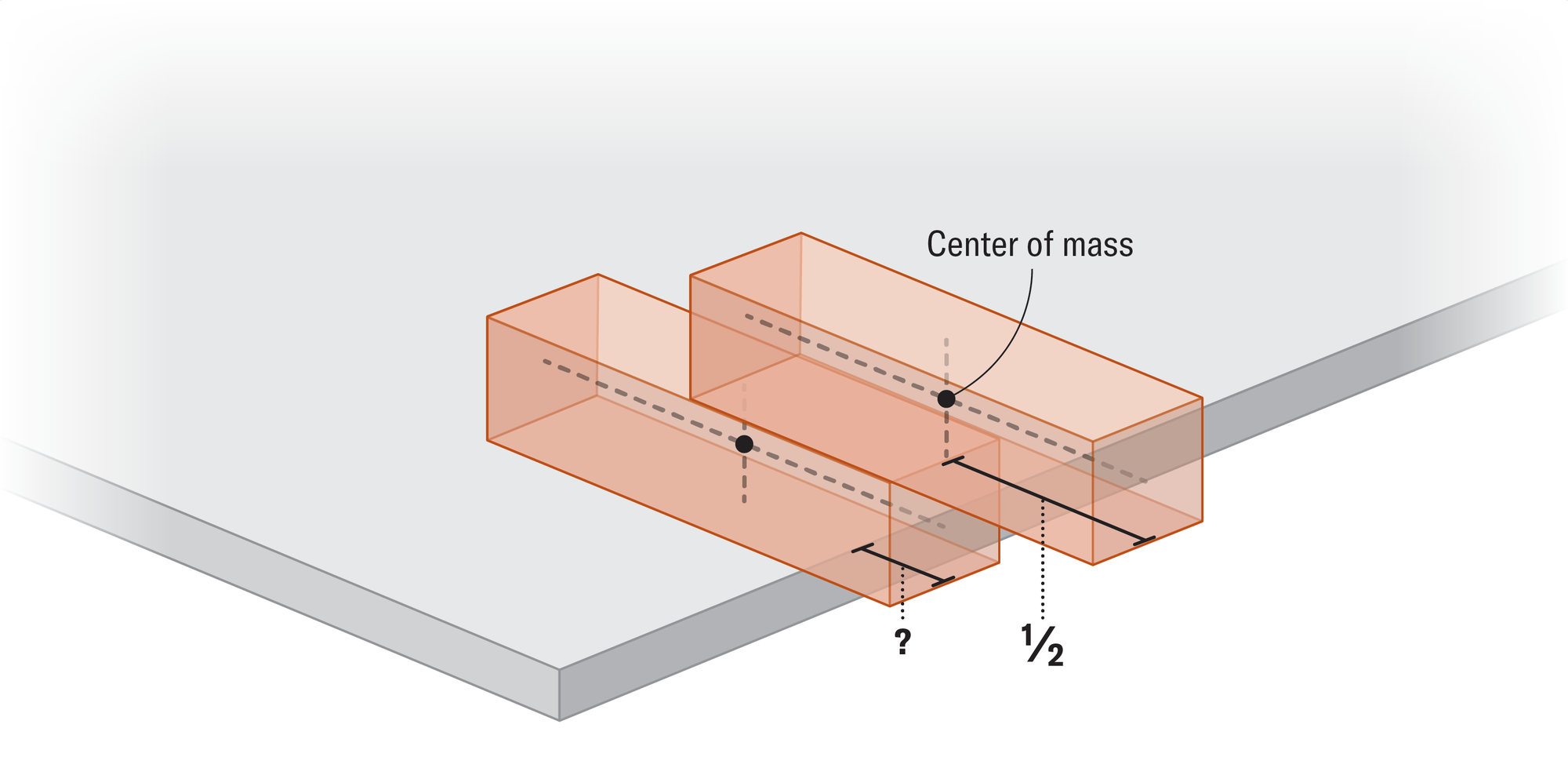
    Graphic shows transparent versions of the two Jenga blocks in the same positions as above with a dot marking the center of mass of each block. Labels indicate that the top block extends beyond the bottom one by half its length and that the bottom one extends beyond the edge of the table by an unknown length.

    For simplicity, let’s say each block has a length of 1 and a mass of 1. You’ll find the bottom block can poke out only a quarter of the way (compared with having half its length over the edge when it was alone). At that point, the center of mass of the top block and the center of mass of the bottom block are equidistant from the edge of the table (the top block’s center of mass sits one quarter to the right of the edge, and the bottom block’s center of mass sits one quarter to the left of the edge). So the combined center of mass of the two-block system rests perfectly balanced above the edge of the table.

    A pattern emerges as we continue to add blocks to the structure. The top block extends 1⁄2 beyond the one below it, the second block extends 1⁄4 beyond the block below it, the third extends 1⁄6, the fourth extends 1⁄8, then subsequent blocks extend 1⁄10, 1⁄12, and so on. To see why, let’s look at another example. Suppose we have a stable tower that contains five blocks, and we want to add a sixth block below it and then slide the whole structure out as far as we can. It’s helpful to conceptualize this picture as only two blocks: one with a mass of 5 atop a single block with a mass of 1. We’ll first scoot the heavy block as far as it will go so that its center of mass sits right above the bottom block’s edge. We can then push the bottom block exactly 1⁄12 of a unit beyond the table’s edge. How do we know that?
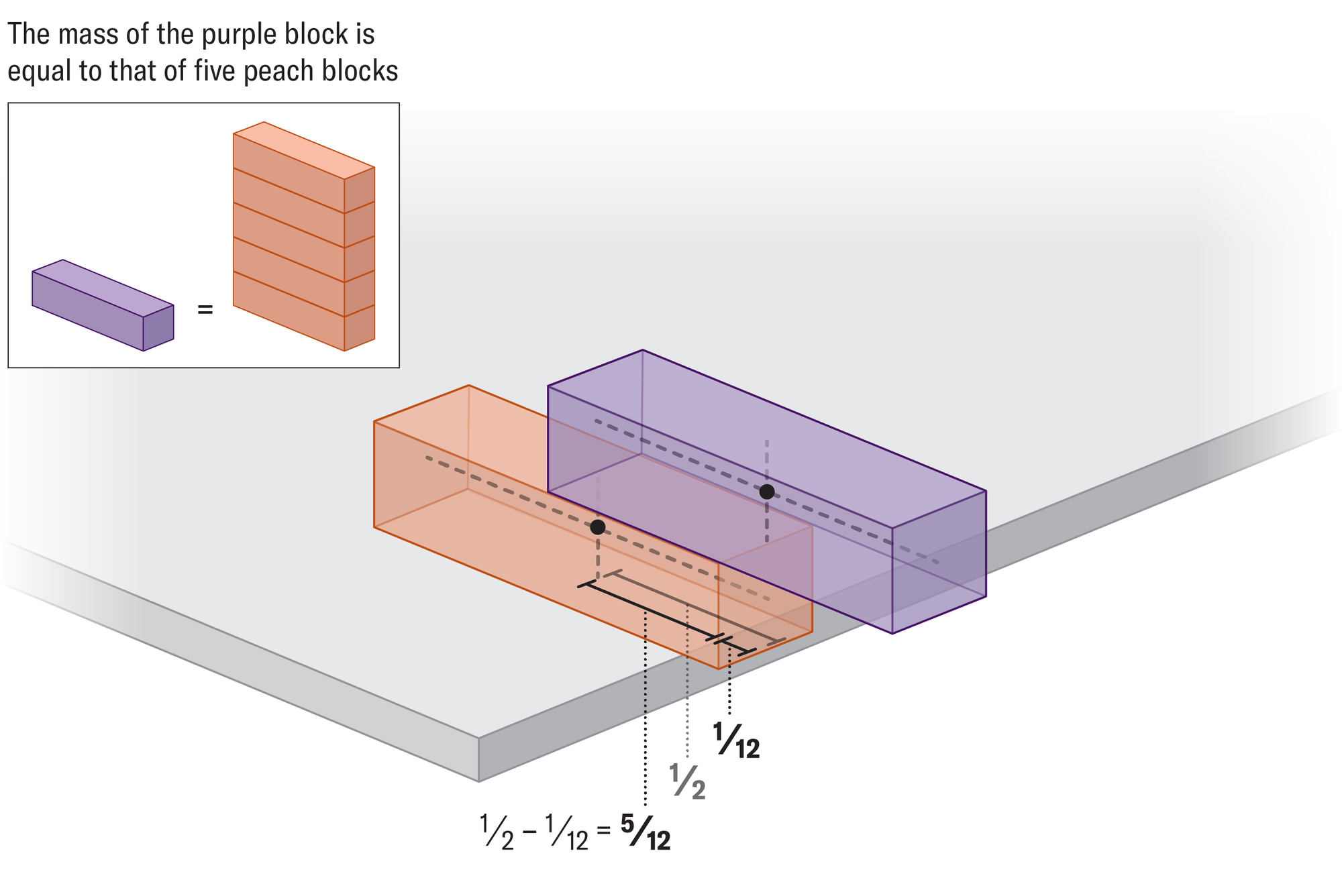
    Graphic shows two Jenga blocks stacked on a table and oriented perpendicular to the edge. The top block is a different color, and an inset indicates that its mass is five times that of the bottom block. The top block extends beyond the bottom one by half its length, and a label indicates that the bottom block extends beyond the edge of the table by one twelfth of its length.

    Again, the answer comes down to balancing out the centers of mass of the two blocks, only this time, because the bottom block is five times lighter, its center of mass must end up five times farther on the tabletop to counteract the weight of the heavier block. This is known as the law of the lever—think about how a book feels heavier in your palm the farther you move it away from your body, so a paperback in a fully extended arm might feel equivalent to a textbook held close to your torso. The distance between the center of mass of the top block and the table’s edge is 1⁄12, and the distance for the bottom block is 1⁄2 – 1⁄12 = 5⁄12, or five times more. A similar calculation reveals the correct overhang at every level of the tower.
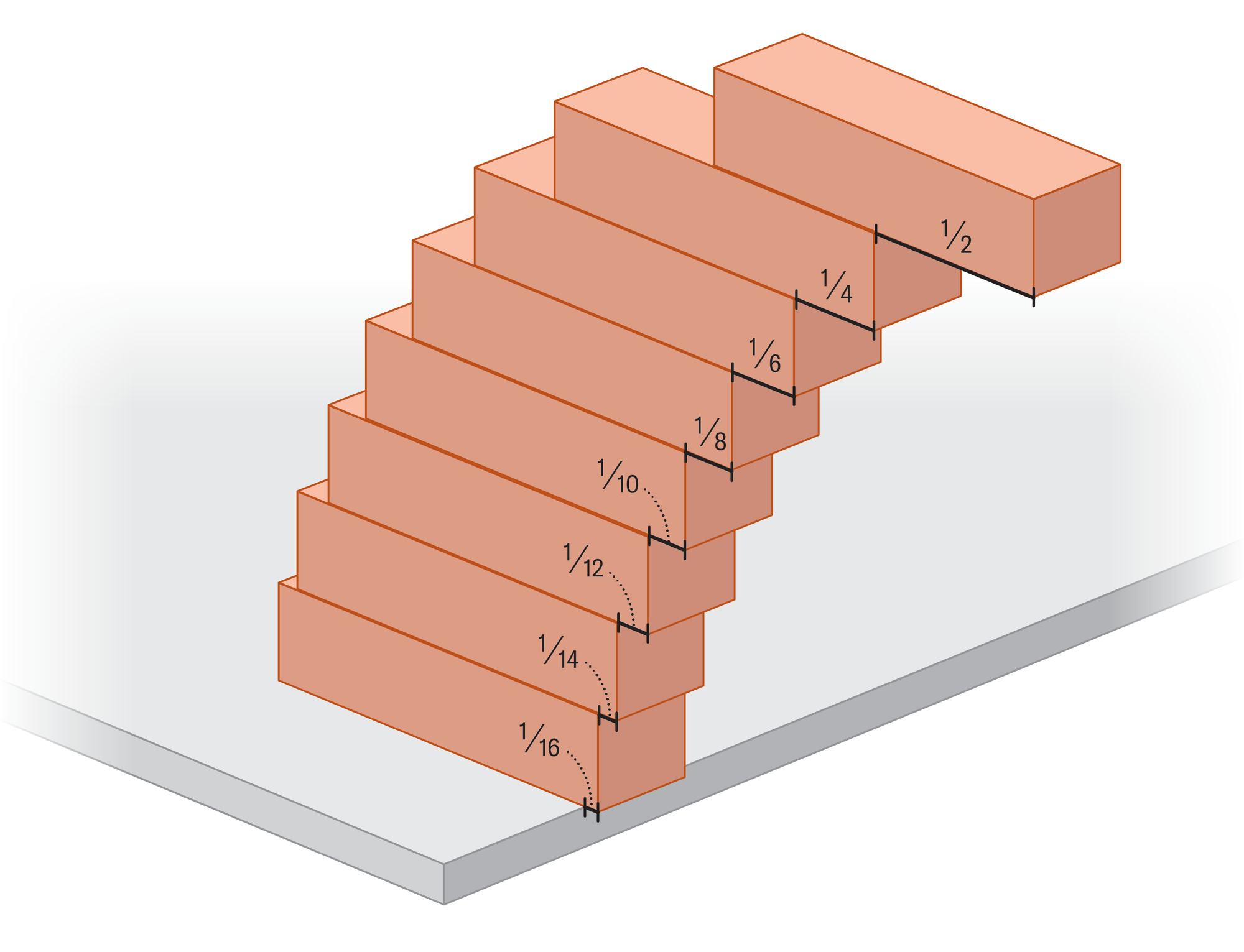
    Graphic shows eight identical Jenga blocks stacked on a table and oriented perpendicular to the edge. Labels indicate that, from top to bottom, the blocks extend into space by the following fractions of their length: one half, one fourth, one sixth, one eighth, one tenth, one twelfth, one fourteenth and one sixteenth.

    Answering our opening question (how far out can the tower extend?) amounts to adding up all of these successive overhangs. If you have 10 blocks, they can extend to 1⁄2 + 1⁄4 + 1⁄6 + 1⁄8 + 1⁄10 + 1⁄12 + 1⁄14 + 1⁄16 + 1⁄18 + 1⁄20, which adds up to about 1.464 block lengths beyond the edge. But what is the limit to how far we can stack blocks? For that, we must add infinitely many of these shrinking terms. The resulting pattern bears a striking resemblance to one of the most famous infinite sums in math, the harmonic series, which takes the reciprocal of every counting number (that is, 1 divided by every positive integer) and sums them all:

    1 + 1⁄2 + 1⁄3 + 1⁄4 + 1⁄5 + …, and so on forever.

    If you look closely, you might notice that the overhangs from the block-stacking problem are exactly half of each of these terms: 1⁄2 + 1⁄4 + 1⁄6 + 1⁄8 + 1⁄10 + …

    Calculus, the branch of math that digs into how things change, teaches us that even when adding up infinitely many shrinking terms, sometimes the sum converges on a finite value and sometimes it diverges to infinity. The total of the harmonic series grows incredibly slowly. The first 100,000 terms add up to about 12.1 while the first million terms only equal around 14.4. Still, at a relentless snail’s pace, the harmonic series grows forever.

    Each individual overhang in the block-stacking problem equals half of a term in the harmonic series. Because half of infinity is still infinity, the tower’s potential overhang also has no bound.

    Of course, translating pure math into practice always comes with hurdles, but the block-stacking problem offers an amusing dexterity challenge. With only four blocks, you should be able to extend the top one a full block length past the edge (1⁄2 + 1⁄4 + 1⁄6 + 1⁄8 = ~1.042). To fulfill my journalistic due diligence, I tried this at home with playing cards on my coffee table. After a few minutes of patient tinkering, I managed to balance the top card just beyond the edge, with it hanging entirely off the table, and I felt like a magician.

    Two full block lengths beyond any surface would require 31 pieces. Meanwhile100 million pieces wouldn’t even get you a full 10 block lengths of overhang because the sum of the first 100 million terms in the harmonic series all divided by 2 equals about 9.5. So it will take some grit to span the Grand Canyon. At huge scales, physics kicks in to topple mathematicians’ fun. But in idealized conditions where center of mass and the harmonic series alone rule the roost, the possibilities are literally endless.


    Original Source Link

    Share. Facebook Twitter Pinterest LinkedIn WhatsApp Email Reddit Telegram
    Previous ArticleDavid Cronenberg: ‘You don’t want to bore peo­ple…
    Next Article ‘Improved’ Grok criticizes Democrats and Hollywood’s ‘Jewish executives’

    RELATED POSTS

    AI-Designed Drugs by a DeepMind Spinoff Are Headed to Human Trials

    April 25, 2026

    One scientist’s 10-year quest to calculate the strength of gravity

    April 24, 2026

    Is stem cell therapy about to transform medicine and reverse ageing?

    April 24, 2026

    A Startup Says It Grew Human Sperm in a Lab—and Used It to Make Embryos

    April 23, 2026

    Passage from Homer’s Iliad discovered in the abdomen of a Roman-era Egyptian mummy

    April 23, 2026

    98 per cent of meat and dairy sustainability pledges are greenwashing

    April 22, 2026
    latest posts

    Slam Dunk director to step down from festival operations amid allegations

    Slam Dunk have announced that one of their festival directors will remove themselves from operations…

    North Korean IT workers are stealing remote jobs—and Americans are helping them do it

    April 25, 2026

    Disaster For Trump As He Even Fox News’s Poll Finds He’s Mentally Unfit

    April 25, 2026

    JOHN YOO: Supreme Court leak shows the left in full meltdown over lost liberal power

    April 25, 2026

    Lachy Groom to back India startup Pronto at a $200M valuation, sources say

    April 25, 2026

    AI-Designed Drugs by a DeepMind Spinoff Are Headed to Human Trials

    April 25, 2026

    What I Learned From Dean Tavoularis, Legendary Production Designer

    April 25, 2026
    Categories
    • Books (1,204)
    • Business (6,107)
    • Events (48)
    • Film (6,044)
    • Lifestyle (4,146)
    • Music (6,158)
    • Politics (6,106)
    • Science (5,461)
    • Technology (6,038)
    • Television (5,726)
    • Uncategorized (7)
    • US News (6,096)
    popular posts

    Proud Boys Aim To Subpoena Trump As Witness At Their Jan. 6 Trial: Reporter

    Five Proud Boys plan to subpoena former President Donald Trump as they face seditious conspiracy…

    Telehealth Is Proving to be a Boon to Cancer and Diabetes Care

    April 23, 2023

    Missing Sub Passengers Believed Dead After Debris Found From Likely Implosion

    June 23, 2023

    Reality TV Legend Dr. Will Kirby Talks How He Pulled Off Secret Strategy & Formed Alliances

    December 9, 2025
    Archives
    Browse By Category
    • Books (1,204)
    • Business (6,107)
    • Events (48)
    • Film (6,044)
    • Lifestyle (4,146)
    • Music (6,158)
    • Politics (6,106)
    • Science (5,461)
    • Technology (6,038)
    • Television (5,726)
    • Uncategorized (7)
    • US News (6,096)
    About Us

    We are a creativity led international team with a digital soul. Our work is a custom built by the storytellers and strategists with a flair for exploiting the latest advancements in media and technology.

    Most of all, we stand behind our ideas and believe in creativity as the most powerful force in business.

    What makes us Different

    We care. We collaborate. We do great work. And we do it with a smile, because we’re pretty damn excited to do what we do. If you would like details on what else we can do visit out Contact page.

    Our Picks

    AI-Designed Drugs by a DeepMind Spinoff Are Headed to Human Trials

    April 25, 2026

    What I Learned From Dean Tavoularis, Legendary Production Designer

    April 25, 2026

    Tony Beets Achieves Season First After More Than 40 Years Mining

    April 25, 2026
    © 2026 New York Examiner News. All rights reserved. All articles, images, product names, logos, and brands are property of their respective owners. All company, product and service names used in this website are for identification purposes only. Use of these names, logos, and brands does not imply endorsement unless specified. By using this site, you agree to the Terms & Conditions and Privacy Policy.

    Type above and press Enter to search. Press Esc to cancel.

    We use cookies on our website to give you the most relevant experience by remembering your preferences and repeat visits. By clicking “Accept All”, you consent to the use of ALL the cookies. However, you may visit "Cookie Settings" to provide a controlled consent.
    Cookie SettingsAccept All
    Manage consent

    Privacy Overview

    This website uses cookies to improve your experience while you navigate through the website. Out of these, the cookies that are categorized as necessary are stored on your browser as they are essential for the working of basic functionalities of the website. We also use third-party cookies that help us analyze and understand how you use this website. These cookies will be stored in your browser only with your consent. You also have the option to opt-out of these cookies. But opting out of some of these cookies may affect your browsing experience.
    Necessary
    Always Enabled
    Necessary cookies are absolutely essential for the website to function properly. These cookies ensure basic functionalities and security features of the website, anonymously.
    CookieDurationDescription
    cookielawinfo-checkbox-analytics11 monthsThis cookie is set by GDPR Cookie Consent plugin. The cookie is used to store the user consent for the cookies in the category "Analytics".
    cookielawinfo-checkbox-functional11 monthsThe cookie is set by GDPR cookie consent to record the user consent for the cookies in the category "Functional".
    cookielawinfo-checkbox-necessary11 monthsThis cookie is set by GDPR Cookie Consent plugin. The cookies is used to store the user consent for the cookies in the category "Necessary".
    cookielawinfo-checkbox-others11 monthsThis cookie is set by GDPR Cookie Consent plugin. The cookie is used to store the user consent for the cookies in the category "Other.
    cookielawinfo-checkbox-performance11 monthsThis cookie is set by GDPR Cookie Consent plugin. The cookie is used to store the user consent for the cookies in the category "Performance".
    viewed_cookie_policy11 monthsThe cookie is set by the GDPR Cookie Consent plugin and is used to store whether or not user has consented to the use of cookies. It does not store any personal data.
    Functional
    Functional cookies help to perform certain functionalities like sharing the content of the website on social media platforms, collect feedbacks, and other third-party features.
    Performance
    Performance cookies are used to understand and analyze the key performance indexes of the website which helps in delivering a better user experience for the visitors.
    Analytics
    Analytical cookies are used to understand how visitors interact with the website. These cookies help provide information on metrics the number of visitors, bounce rate, traffic source, etc.
    Advertisement
    Advertisement cookies are used to provide visitors with relevant ads and marketing campaigns. These cookies track visitors across websites and collect information to provide customized ads.
    Others
    Other uncategorized cookies are those that are being analyzed and have not been classified into a category as yet.
    SAVE & ACCEPT