
Close Menu
New York Examiner News

    Subscribe to Updates

    Get the latest creative news from FooBar about art, design and business.

    What's Hot

    Marilyn Manson Halts Concert For ‘Confession’ About Sobriety

    April 24, 2026

    Businesses spending $4 million to cross the Panama Canal as ‘it’s safer’ than the Strait of Hormuz

    April 24, 2026

    Trump’s Nightmare Week Worsens As Democrats Prepare Day One Impeachment Plan

    April 24, 2026
    Facebook X (Twitter) Instagram
    New York Examiner News
    • Home
    • US News
    • Politics
    • Business
    • Science
    • Technology
    • Lifestyle
    • Music
    • Television
    • Film
    • Books
    • Contact
      • About
      • Amazon Disclaimer
      • DMCA / Copyrights Disclaimer
      • Terms and Conditions
      • Privacy Policy
    New York Examiner News
    Home»Science»One scientist’s 10-year quest to calculate the strength of gravity
    Science

    One scientist’s 10-year quest to calculate the strength of gravity

    By AdminApril 24, 2026
    Facebook Twitter Pinterest LinkedIn WhatsApp Email Reddit Telegram
    One scientist’s 10-year quest to calculate the strength of gravity


    April 24, 2026

    4 min read

    Google Logo Add Us On GoogleAdd SciAm

    One scientist’s 10-year quest to calculate the strength of gravity

    Earth’s gravitational force, g, has been known for centuries. But the exact value of G, the universal gravitational constant, is elusive
    By Emma Gometz edited by Clara Moskowitz

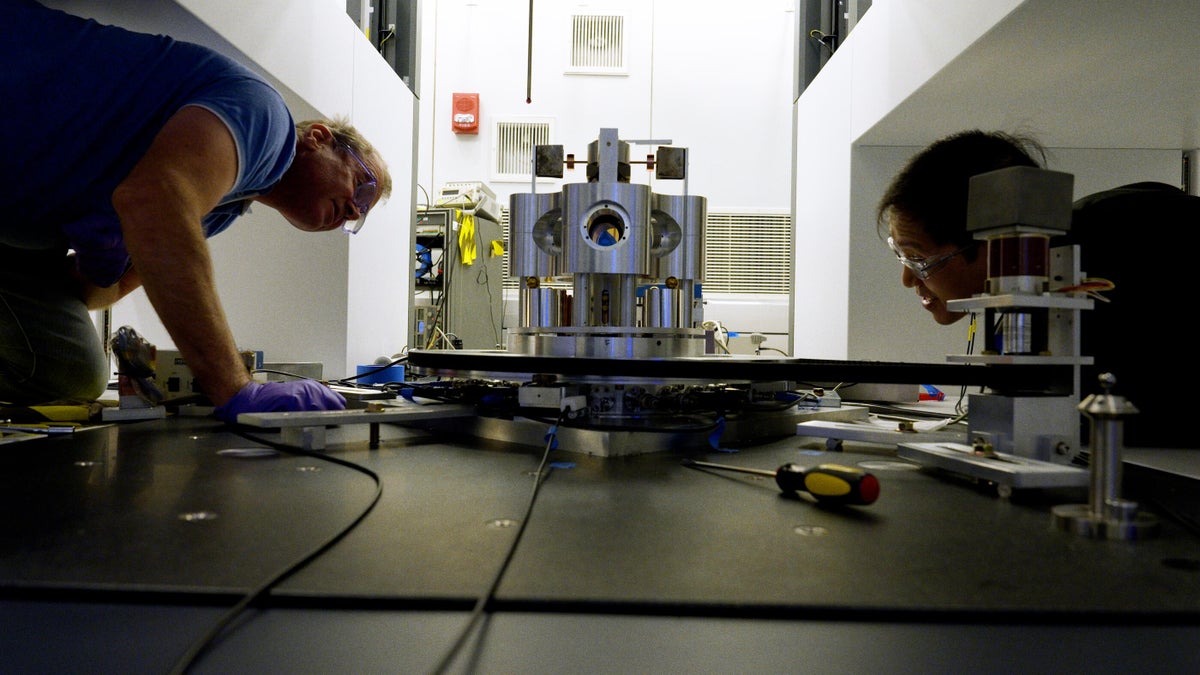
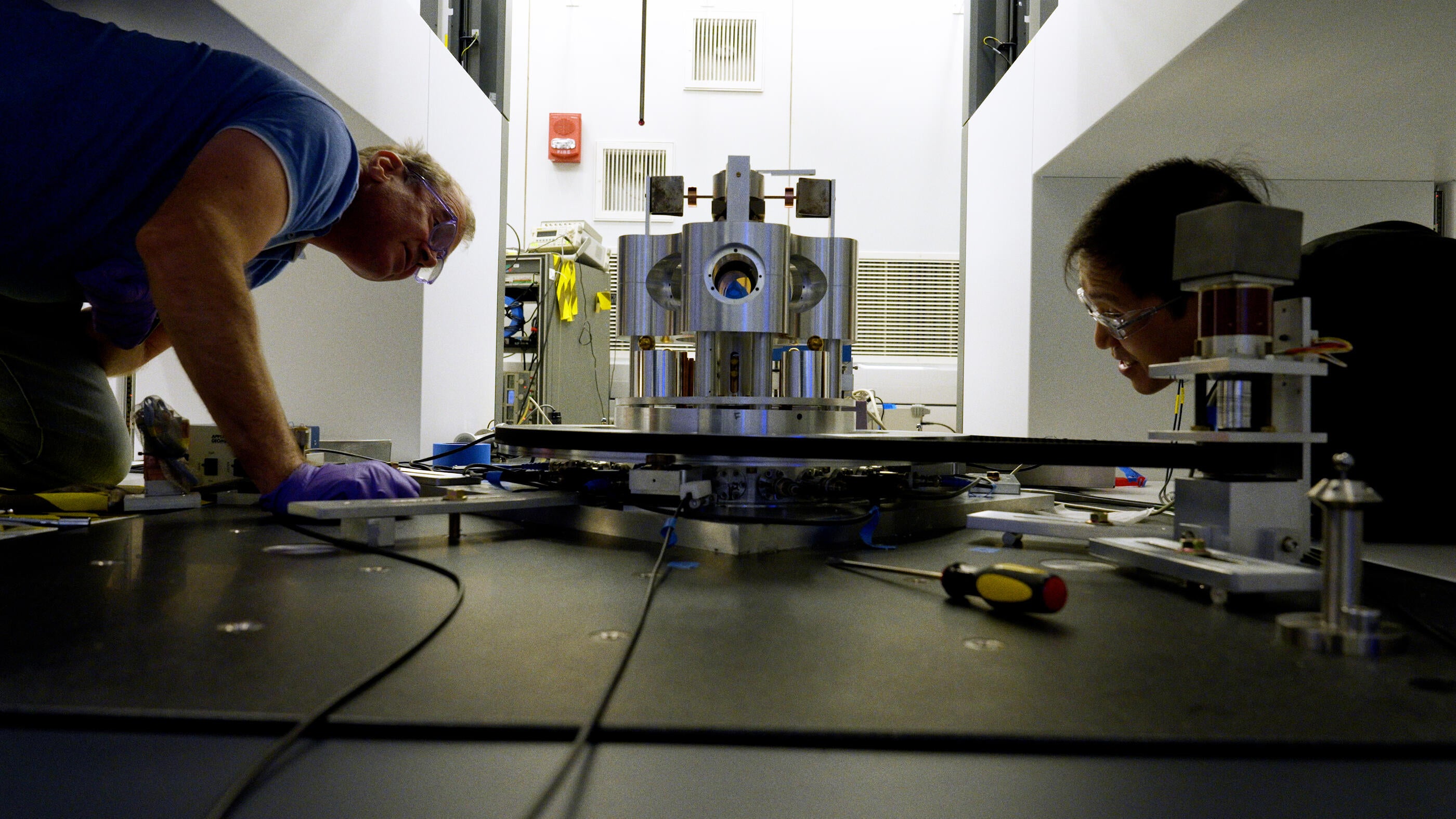
    Two men wearing goggles leaning over a table looking at a torsion balance machine

    NIST scientists Stephan Schlamminger (left) and Vincent Lee examine the torsion balance they used to measure the gravitational constant, big G, a decade-long undertaking.

    After 10 years of painstaking measurements, physicist Stephan Schlamminger stood in a hotel water park, waiting for a career-defining moment. His new measurement of the gravitational constant, or G, one of the most fundamental values in physics, was going to be revealed to his peers that afternoon. Hours before his talk, he took refuge amid the chlorine.

    “I was so stressed out,” he says. “I almost wanted to cancel it.”

    Just as Earth’s gravity pulls baseballs to the ground after they are thrown, all masses exert a gravitational force on other masses. But measuring the constant that determines the strength of that force is tricky, even for experienced scientists. On April 16 Schlamminger published a new measurement of G, adding another data point in the quest to determine its exact value.


    On supporting science journalism

    If you’re enjoying this article, consider supporting our award-winning journalism by subscribing. By purchasing a subscription you are helping to ensure the future of impactful stories about the discoveries and ideas shaping our world today.


    According to Isaac Newton’s law of universal gravitation, the gravitational force between two objects is the gravitational constant, G, multiplied by the product of the two masses divided by the square of the distance between them. In an equation, that looks like F = G(m1m2)/ r2.

    The force of Earth’s gravitational pull, which can be found using this equation, is known as “little g.” Scientists have measured this constant to a high degree of precision with little disagreement: g = 9.80665 meters per second squared, or 9.80665 m/s2 at Earth’s surface. But “big G” is different. It’s the gravitational constant that is the same for all objects, no matter how massive. Previous measurements of G look like a scatter plot when they’re put together on a chart—the value still has a pretty large degree of uncertainty, Schlamminger says. That’s because it’s a very weak force, and isolating it is very difficult, even for our most cutting-edge instruments.

    “G is kind of special,” Schlamminger says. “It’s like the lady clad in red velvet, it’s always wrapped in scandal.”

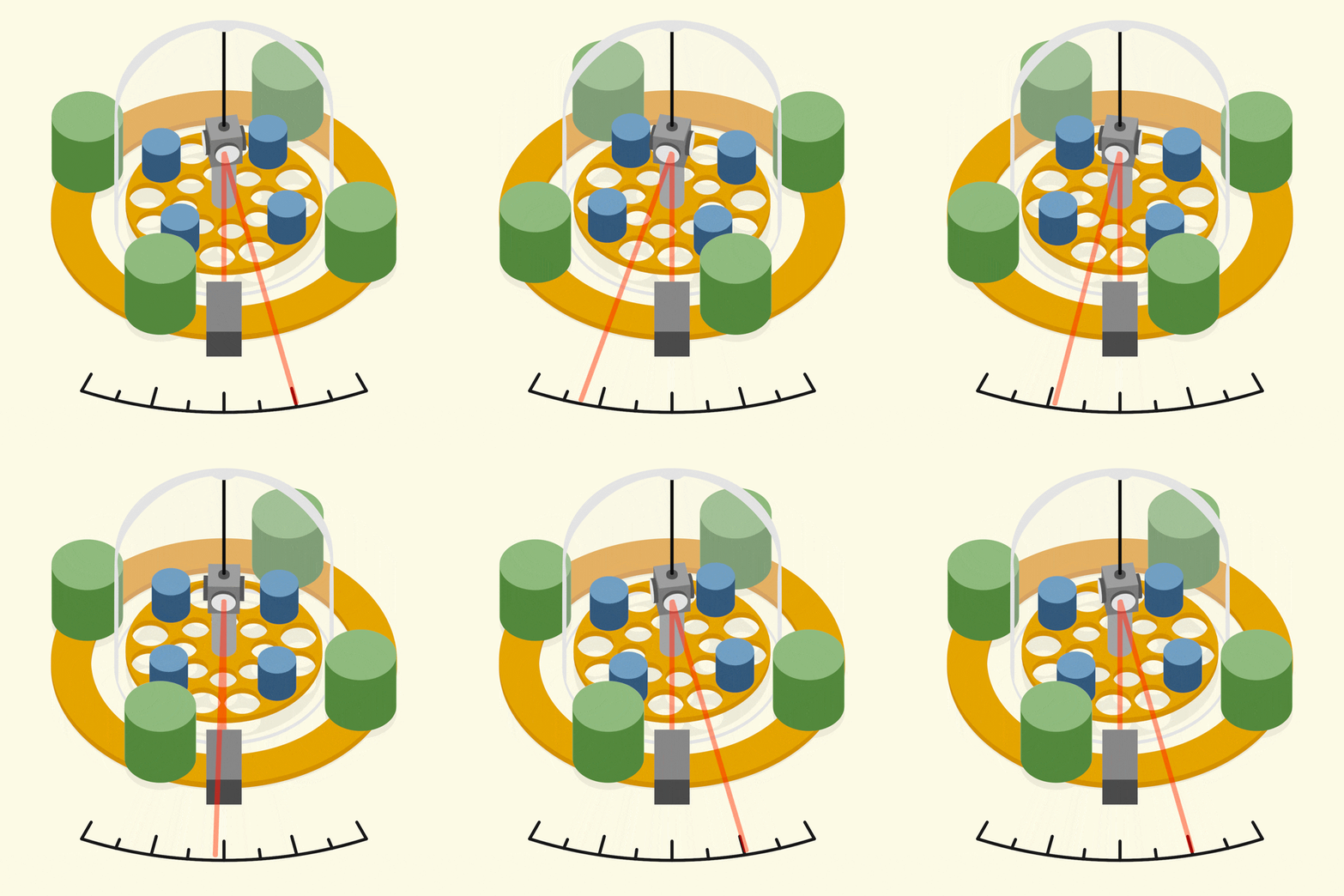
    Schlamminger’s team repeated methods from a 2014 study from the International Bureau of Weights and Measurements (BIPM) and hoped for the same result. The measuring tool the researchers used in the new study is called a torsion balance, which is a modern update on a centuries-old method pioneered in the so-called Cavendish experiment. That experiment was originally designed to determine the density of the Earth. In it, a thin wooden beam with two lead balls on its ends was suspended from a wire at its center and then a structure that had heavier lead balls and was otherwise identical was stacked on top of the first beam. The result looked something like a weathervane. Instead of wind pushing the lead balls around, however, their mutual gravitational attraction caused them to twist toward one another. When they twisted, the angle of the beam balancing the small weights could be used to calculate the value of G.

    Schlamminger’s version, which took place at the National Institute of Standards and Technology’s facilities in Gaithersburg, Md., used the exact same instrument and procedure as the 2014 BIPM setup. (BIPM sent it to NIST in 2016.) Researchers placed the masses on flat platelike objects called torsion disks, with the lighter masses on the inside suspended by a thin copper beryllium strip and the heavier masses located on a separate disk on the outside. Then they placed the whole apparatus inside a vacuum chamber. The arrangement was also a replication of the 2014 BIPM methods, but the team made some updates to it. For example, the scientists repeated the experiment with both copper and sapphire masses to eliminate effects from the type of material being used; replaced the apparatus’s torsion disk so the top and bottom were perfectly parallel; and rewrote the software suite for the device to improve instrument control.
    A GIF of a torsion balance moving

    Setup at NIST for measuring the strength of gravity.

    The final number they calculated for G, 6.67387 × 10⁻¹¹m3kg–1s–2, was lower than both the BIPM measurement and the internationally agreed-upon standard from the Committee on Data of the International Science Council (CODATA), which had been determined from a group of the best measurements taken so far. The result suggests that we still don’t know G as precisely as we’d like. “I think it’s always worth having one more measurement,” says Terry Quinn, former director of the BIPM and first author of the 2014 measurement study. But for most purposes, the CODATA consensus for G “is as good as we need at the moment,” he adds.

    Measuring G is useful because it tests the quality of precision measurement instruments. The minor discrepancies among measurements may even point toward a yet-unknown mystery of physics, Schlamminger says. But the value itself, he admits, doesn’t have much practical use. Trying to determine the exact value of G is exciting for its own sake.

    “I love taking measurements. Measurement science is my passion,” Schlamminger says. “I know it’s difficult to understand for many people, but it is. It can be exciting and very fulfilling.”

    It’s Time to Stand Up for Science

    If you enjoyed this article, I’d like to ask for your support. Scientific American has served as an advocate for science and industry for 180 years, and right now may be the most critical moment in that two-century history.

    I’ve been a Scientific American subscriber since I was 12 years old, and it helped shape the way I look at the world. SciAm always educates and delights me, and inspires a sense of awe for our vast, beautiful universe. I hope it does that for you, too.

    If you subscribe to Scientific American, you help ensure that our coverage is centered on meaningful research and discovery; that we have the resources to report on the decisions that threaten labs across the U.S.; and that we support both budding and working scientists at a time when the value of science itself too often goes unrecognized.

    In return, you get essential news, captivating podcasts, brilliant infographics, can’t-miss newsletters, must-watch videos, challenging games, and the science world’s best writing and reporting. You can even gift someone a subscription.

    There has never been a more important time for us to stand up and show why science matters. I hope you’ll support us in that mission.


    Original Source Link

    Share. Facebook Twitter Pinterest LinkedIn WhatsApp Email Reddit Telegram
    Previous Article5 Best Horror Movies Turning 50 In 2026, Ranked
    Next Article Give Mom Warm Coffee All Year Long With This Ember Smart Mug Deal

    RELATED POSTS

    Is stem cell therapy about to transform medicine and reverse ageing?

    April 24, 2026

    A Startup Says It Grew Human Sperm in a Lab—and Used It to Make Embryos

    April 23, 2026

    Passage from Homer’s Iliad discovered in the abdomen of a Roman-era Egyptian mummy

    April 23, 2026

    98 per cent of meat and dairy sustainability pledges are greenwashing

    April 22, 2026

    New Gas-Powered Data Centers Could Emit More Greenhouse Gases Than Entire Nations

    April 22, 2026

    Hegseth says U.S. military no longer requires flu vaccination, drawing criticism from health experts

    April 21, 2026
    latest posts

    Marilyn Manson Halts Concert For ‘Confession’ About Sobriety

    Marilyn Manson needed to stop down during the first show of his current tour to…

    Businesses spending $4 million to cross the Panama Canal as ‘it’s safer’ than the Strait of Hormuz

    April 24, 2026

    Trump’s Nightmare Week Worsens As Democrats Prepare Day One Impeachment Plan

    April 24, 2026

    Federal judge sanctions law firm in Epstein-linked case against Leon Black

    April 24, 2026

    Give Mom Warm Coffee All Year Long With This Ember Smart Mug Deal

    April 24, 2026

    One scientist’s 10-year quest to calculate the strength of gravity

    April 24, 2026

    5 Best Horror Movies Turning 50 In 2026, Ranked

    April 24, 2026
    Categories
    • Books (1,203)
    • Business (6,106)
    • Events (48)
    • Film (6,043)
    • Lifestyle (4,145)
    • Music (6,157)
    • Politics (6,105)
    • Science (5,460)
    • Technology (6,037)
    • Television (5,725)
    • Uncategorized (7)
    • US News (6,095)
    popular posts

    Trump Speaks With Putin, Zelenskyy – Says Ceasefire Negotiations to Start ‘Immediately’

    Credit: (Screenshot), Times of India and Fox 5 Washington DC and LiveNOW from FOX, via…

    Nvidia’s H20 AI chips may be spared from export controls — for now

    April 9, 2025

    SG Fleet Receives $780 Million Private-Equity Takeover Proposal

    November 25, 2024

    Watch Death Cab For Cutie play an unreleased song called ‘Here To Forever’

    July 10, 2022
    Archives
    Browse By Category
    • Books (1,203)
    • Business (6,106)
    • Events (48)
    • Film (6,043)
    • Lifestyle (4,145)
    • Music (6,157)
    • Politics (6,105)
    • Science (5,460)
    • Technology (6,037)
    • Television (5,725)
    • Uncategorized (7)
    • US News (6,095)
    About Us

    We are a creativity led international team with a digital soul. Our work is a custom built by the storytellers and strategists with a flair for exploiting the latest advancements in media and technology.

    Most of all, we stand behind our ideas and believe in creativity as the most powerful force in business.

    What makes us Different

    We care. We collaborate. We do great work. And we do it with a smile, because we’re pretty damn excited to do what we do. If you would like details on what else we can do visit out Contact page.

    Our Picks

    One scientist’s 10-year quest to calculate the strength of gravity

    April 24, 2026

    5 Best Horror Movies Turning 50 In 2026, Ranked

    April 24, 2026

    ‘Unexpected’ Hunter’s Dad Granted Custody, Texts With Falen

    April 24, 2026
    © 2026 New York Examiner News. All rights reserved. All articles, images, product names, logos, and brands are property of their respective owners. All company, product and service names used in this website are for identification purposes only. Use of these names, logos, and brands does not imply endorsement unless specified. By using this site, you agree to the Terms & Conditions and Privacy Policy.

    Type above and press Enter to search. Press Esc to cancel.

    We use cookies on our website to give you the most relevant experience by remembering your preferences and repeat visits. By clicking “Accept All”, you consent to the use of ALL the cookies. However, you may visit "Cookie Settings" to provide a controlled consent.
    Cookie SettingsAccept All
    Manage consent

    Privacy Overview

    This website uses cookies to improve your experience while you navigate through the website. Out of these, the cookies that are categorized as necessary are stored on your browser as they are essential for the working of basic functionalities of the website. We also use third-party cookies that help us analyze and understand how you use this website. These cookies will be stored in your browser only with your consent. You also have the option to opt-out of these cookies. But opting out of some of these cookies may affect your browsing experience.
    Necessary
    Always Enabled
    Necessary cookies are absolutely essential for the website to function properly. These cookies ensure basic functionalities and security features of the website, anonymously.
    CookieDurationDescription
    cookielawinfo-checkbox-analytics11 monthsThis cookie is set by GDPR Cookie Consent plugin. The cookie is used to store the user consent for the cookies in the category "Analytics".
    cookielawinfo-checkbox-functional11 monthsThe cookie is set by GDPR cookie consent to record the user consent for the cookies in the category "Functional".
    cookielawinfo-checkbox-necessary11 monthsThis cookie is set by GDPR Cookie Consent plugin. The cookies is used to store the user consent for the cookies in the category "Necessary".
    cookielawinfo-checkbox-others11 monthsThis cookie is set by GDPR Cookie Consent plugin. The cookie is used to store the user consent for the cookies in the category "Other.
    cookielawinfo-checkbox-performance11 monthsThis cookie is set by GDPR Cookie Consent plugin. The cookie is used to store the user consent for the cookies in the category "Performance".
    viewed_cookie_policy11 monthsThe cookie is set by the GDPR Cookie Consent plugin and is used to store whether or not user has consented to the use of cookies. It does not store any personal data.
    Functional
    Functional cookies help to perform certain functionalities like sharing the content of the website on social media platforms, collect feedbacks, and other third-party features.
    Performance
    Performance cookies are used to understand and analyze the key performance indexes of the website which helps in delivering a better user experience for the visitors.
    Analytics
    Analytical cookies are used to understand how visitors interact with the website. These cookies help provide information on metrics the number of visitors, bounce rate, traffic source, etc.
    Advertisement
    Advertisement cookies are used to provide visitors with relevant ads and marketing campaigns. These cookies track visitors across websites and collect information to provide customized ads.
    Others
    Other uncategorized cookies are those that are being analyzed and have not been classified into a category as yet.
    SAVE & ACCEPT